It’s supposed to be announced this morning whether we will go into another lockdown, Austria wide, on Monday. And our numbers are terrible. (Our 7-day average of new cases per 100k population is three times that of Germany. Three times!)
Has the vaccination made a difference? You bet it has. Last year on 18 November there were 4,525 COVID cases in hospital in Austria, including the 658 in intensive care. 113 people had died of COVID in the 24-hour period before that. And that after two weeks in a partial lockdown. This year on the same date there are 2,744 in hospital, 486 in the ICU, and 39 have died. Still too many. Still shocking in a population of about 8.9 million, but quite a different picture, especially given that most people have been out and about with only an FFP2 mask as a sign that the pandemic is still raging.
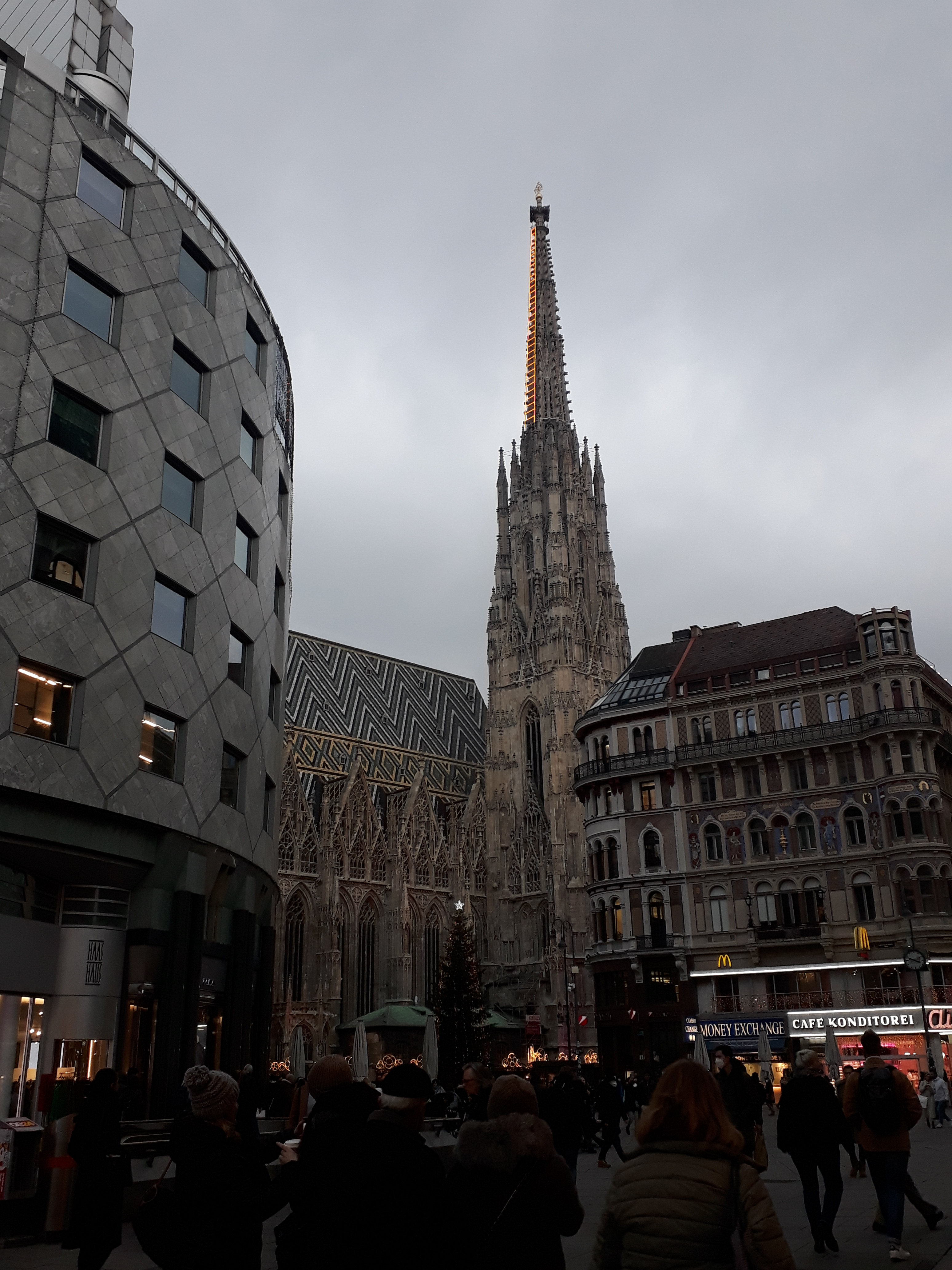
Today is almost like the November days I remember from 30 years ago — gray, damp, chilly. It isn’t raining, but the pavements are damp with condensation; it isn’t that cold in temperature (about 4°C), but it is a penetrating chill. The air, as always on these days, is a bit acrid because the cloud cover holds in all the exhaust. And it may be a bit warmer than back then. Certainly it is somewhat brighter as the buildings are for the most part cleaner and this year’s spectacular foliage, in yellow and gold, is not yet completely gone.
I’m on my way to the university and heard this announcement for the first time: “Dear Passengers, Please keep your luggage with you at all times. Unattended bags will be removed.” Feels almost as if I’m finally living in London.
Once again Austrian contestants have done a stellar job at the European championships — the trade / apprenticeship championships, that is, where they demonstrated their skills, for example, in wall painting and hotel reception. Austria, with its 8.8 million inhabitants got 33 medals, top of all EU countries and behind only Russia. There’s an article in the Kurier today about why Austria always does so well. Unfortunately, I don’t have time to read it right now as I am off to teach the next generation in logistics.
I just saw the mayor of Vienna, Michael Ludwig, on my street. He looked very happy and was, of course, walking around without any security detail. Ah, Vienna!
The Vienna City Marathon (VCM) is back, in its 38th iteration, and like many things that had to take a break at the height of the pandemic, it felt really special. The ORF (Austrian Broadcasting) wrote that it brought victories for unexpected contenders—and it did.
My ritual on VCM days hasn’t changed. I watch the beginning on TV, then walk down to a stretch near me to see the first runners go by (first man, first woman, first Austrian man, first Austrian woman), and then I walk home to watch the rest on TV. My dog, Maylo, really gets into the spirit, as you can see. 😉
And so it was that I saw Derera Hurisa, the frontrunner for almost all of the marathon, running with the total focus top marathoners seem to have. (Do they even notice us cheer and clap?) He was surrounded by the three or so people who were left in the lead after several had dropped out or dropped back. Then came Vibian Chebkirui, the first woman, alone except for her pacemaker.
First Austrian man, even at that point, was Martin Mistelbauer in something of an upset, clearly having a good day and running with great panache. Finally, gamely, came Victoria Schenk, a school teacher and track and field athlete, who was expected to—and did—win the Austrian title in the women’s race. I say “gamely” because there were times when she was clearly struggling and it almost hurt to watch.
Some firsts (I think):
The date (usually the VCM is run in April)
Couples in ball dress (right down to long white gloves on the women) waltzing at the Rathaus to provide some entertainment and applauding the top ten runners as they came in
A group playing Japanese drums spurring on the (Japanese?) runners
Cheerleaders in front of the State Opera
Descriptions of the clothes people were wearing (e.g., “neon orange top, black shorts and white shoes”)
One of the hobby runners in the half marathon collapsing right near the finish line of the full marathon and needing the ambulance so that Vibian Chebkirui, the leading woman, had to swerve to avoid them and to complete the race (she did this with great goodwill and grace)
Four Japanese runners (men) in the top contenders, one of whom, Kento Kikutani, came in (in the final reckoning) fourth (three of these four placed in the top ten)
I write “in the final reckoning” above because Derera Hurisa, who crossed the finish line first, was, heartbreakingly, disqualified for wearing shoes that didn’t meet the relatively new regulations, which moved all the other men up one slot
Not quite as sad but nonetheless something of an upset: the favorite among the women, Gelete Burka, took a tumble about an hour into the race and lost her lead, coming in third
The Kenyans on the podium (Vibian Chebkirui, Edwin Kosgei, and Leonard Langat) didn’t look very happy although the Ethiopians (Gelete Burka, Meseret Dinke, and Betesfa Getahun) did—even though it was their countryman who was disqualified
Some fixtures:
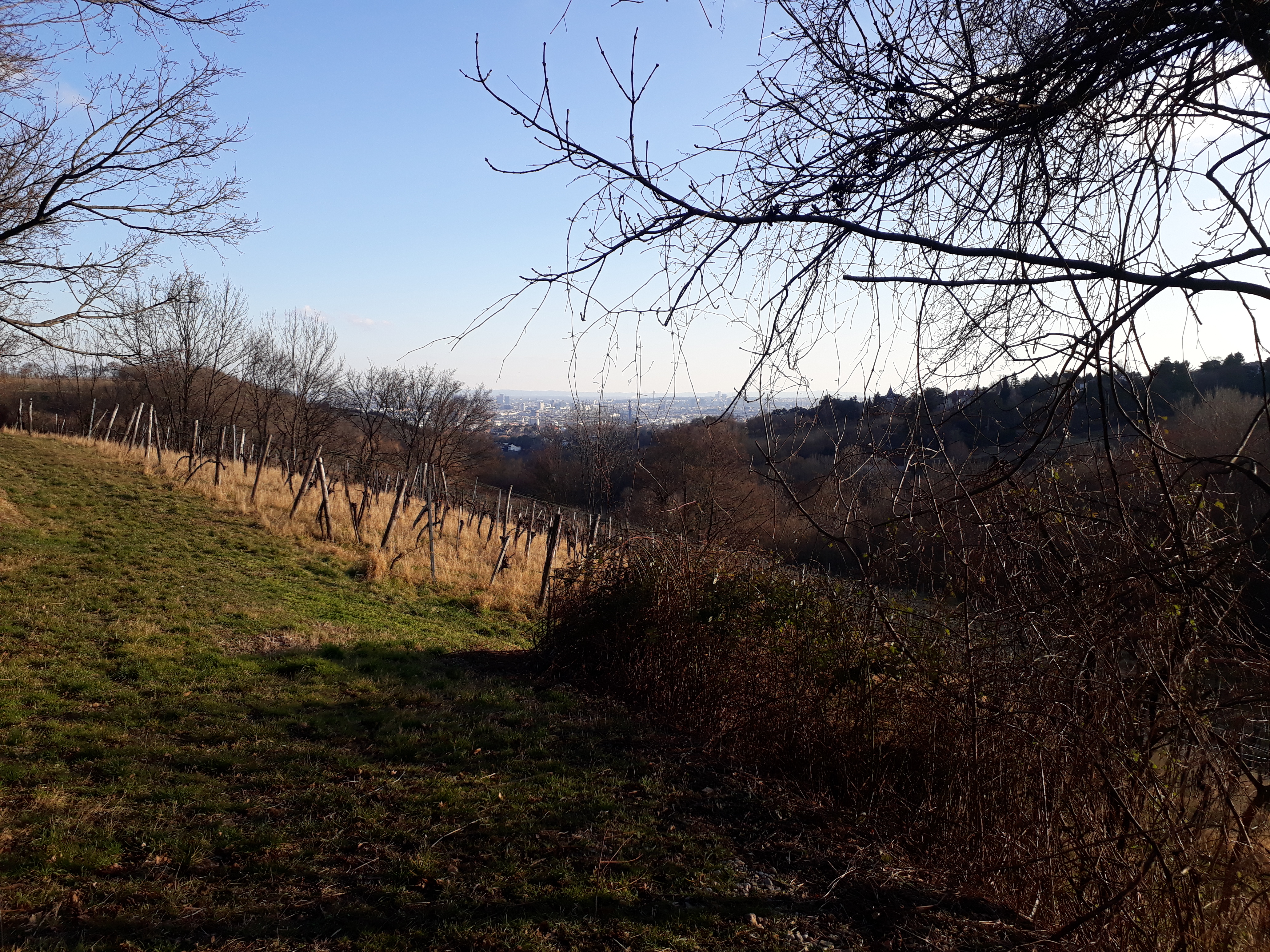
The route with shots, some aerial, of this gorgeous city (see photos)
The enthusiastic ORF (Austrian Broadcasting) commentary
I’m not sure at which point I became a convert to watching (but never running!) the marathon. I used to wonder at anyone who wanted to participate in such a race when the first person to run that distance dropped dead after delivering his message. Now I find it fascinating and am always surprised that two and a half hours have gone by so quickly. I also greatly enjoy the interviews afterwards with the athletes.
I’m glad it’s back, next year in April again—Sunday, 24 April 2022.
Today we carried on with the second half of Trail 18 and more than all of Trail 19 (we missed a sign and probably went about 2 kms out of our way). And today I have photos! 🙂
It was a beautiful sunny day (although with such a wind that a friend sent a message: “Hopefully you will not get blown away!”) with beautiful flowers (see above), including lots of elderflowers (visible on the left of the photo below), which my hiking partner collected to make syrup, and some interesting wildlife. We saw a bird that neither of us had ever seen before and I couldn’t find in my field guide and which I think may, in fact, be a pet that escaped and is now living it up in the fields of the 22nd district. In shape it had some similarities to a dove but was much larger, had bright blue markings on its head, and interesting black and white striping on its tail. If anyone has any ideas, please let me know.
We were still in a very flat part of Vienna with scattered small bodies of water. It is still quite rural (see below) and had horses! As with other parts of the Rundumadum trail, I was amazed to see food being grown on a relatively large scale (the 10th district also has proper fields with grain and vegetables). From the underground train you can see extensive greenhouses and the paths we took today were almost all through open fields. Really extraordinary for a city of almost two million people. Long may it last.
This was such a nice stretch that I would like to come back and perhaps even swim in the Süßenbrunner Teiche (ponds).
You can see I’m getting sloppier in the execution of (as well as the writing about) the Rundumadum hiking trail. Half of 18? Really? I don’t think it’s entirely my new hiking partner’s fault, but I must say he’s more ambitious than I am (trying to do two or three at a time) and in this case we didn’t manage to do the whole two stretches on 2 May 2021. (You can see I’m trying to catch up in my reporting of progress, even though I in this case didn’t take any photos.)
It may have been the discouragement of arriving at the U2 Seestadt station and then not being able to find the bus we were supposed to take (and this on a Sunday when nothing runs as often as on other days) so having to wait almost half an hour or it might have been the considerable and rather unpleasant wind blowing across that very flat part of Vienna (Transdanubia) on a steely gray day or it could have been the frustration of the detour along the road instead of through the fields ostensibly because of construction, where the U-Bahn line they were supposed to be working on was completed several years ago. (It turns out the City of Vienna is not perfect! ;-))
In any case, we did get discouraged and stopped halfway through the second stretch. We enjoyed the walk through neighborhoods neither of us knew before, though, as well as through fields that may not much longer be fields (this part of Vienna is being developed very rapidly) and past Himmelteich (~ Heaven’s Pond), one of the small bodies of water that is so common in the east of Vienna. We also enjoyed a picnic before we got the underground back to the city center, eating cheddar and spinach muffins and bananas in an out-of-the-wind spot in what will one day be a park across the street from Nelson-Mandela-Platz.