Different actors. Different Rex, of course. Same beautiful cityscapes and Wiener Schmäh.
Here is what I wrote on the 30th anniversary of the original series: ttps://ecbinvienna.com/2024/02/17/kommissar-rex/
Different actors. Different Rex, of course. Same beautiful cityscapes and Wiener Schmäh.
Here is what I wrote on the 30th anniversary of the original series: ttps://ecbinvienna.com/2024/02/17/kommissar-rex/
The info screen on the tram is telling me that the Wiener Staatsoper reopened on this day in 1955. It was bombed in the final days of World War II. The auditorium and backstage area were completely destroyed. The Viennese are said to have wept openly in the streets as they watched it burn.
The opera chosen for the opening of the rebuilt house was “Fidelio” by Ludwig van Beerhoven, a story about unlawful imprisonment, courage, and justice.
Otto Schenk, Opera Director and Bulwark of Tradition, Dies at 94 https://www.nytimes.com/2025/01/09/arts/music/otto-schenk-dead.html?unlocked_article_code=1.ok4.Zuvw.Ivh1Lunq0RCP
I’m glad he made it into the NYT. He was an extraordinary artist. I had the great pleasure of experiencing him as Frosch, the prison guard, in Johann Strauss’s “Die Fledermaus” on New Year’s Eve 1988 at the Staatsoper.
The Votivkirche was officially re-opened today with a celebratory mass. The extensive renovations, inside and out, have been going on for a quarter of a century.
The ORF story (in German): https://wien.orf.at/stories/3234020/
An earlier story from me: https://ecbinvienna.com/2023/04/19/votivkirche/
And a Wikipedia entry in English on the history of the Votive Church: https://en.wikipedia.org/wiki/Votivkirche,_Vienna
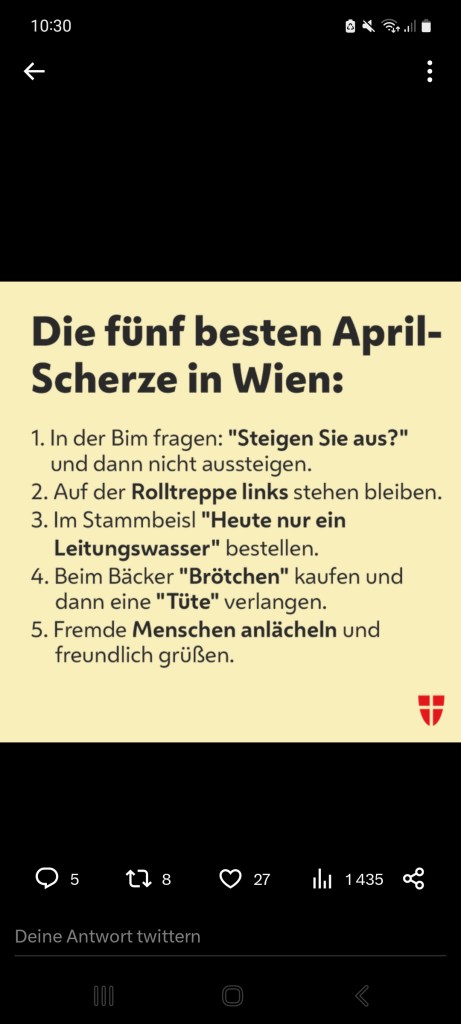
Seen on Twitter. The City of Vienna has a few ideas on how to discombobulate the Viennese this April Fool’s Day. 1: On the tram say “I’m getting off” [so that people make room for you to get out the door] and then stay on. 2: Stand on the left on the escalators. 3: In your regular neighborhood restaurant order “Just a glass of tap water today”. 4: (my favorite) At the bakery buy “Brötchen” (rolls) and then ask for a “Tüte” (bag) to put them in. Both those words are High German and sound really weird in this context. Viennese would probably say “Gebäck” and “Sackerl”. 5: (also good for anyone familiar with the grumpy side of the Viennese) Smile at complete strangers on the street and greet them in a friendly way.
Sorry, in some ways you had to be there, I think, but they made me laugh.
This morning, as on every Saturday I’m not teaching, Maylo and I went to the Trafik on our way home from our morning walk. He got his treats and I got mine (newspaper and instant lottery ticket). Then because it wasn’t busy we got into a chat, quite a heavy chat as it turned out.
The Trafikant, nearing 80, was born in Vienna during the Second World War and told how his mother would wrap him in a blanket and carry him down to the air raid shelter in the cellar.
One of his employees then started talking about her experiences during the war in Bosnia before her family fled to Vienna, how she, too, spent time in bomb cellars. From her accent, I could tell that she wasn’t Austrian born, but we had never talked before about where she came from. (I personally am so allergic to the question “Where are you from?” when I have lived here over half my life that I very rarely ask it of others.)
We had gotten onto the topic of how each time we thought it was the last war in Europe and how the whole misery is being repeated now in Ukraine when another customer came in and Maylo and I left.
I think Trafiks are often microcosms of the world around us.
I always check the ORF headlines on my phone at breakfast. This morning I saw that today is the 100th anniversary of the death of Karl I of Austria — the Habsburg who had the thankless task of assuming the throne after the almost 68-year reign of Franz Josef I. He was ill-prepared, not really having expected to ascend to the throne (Crown Prince Rudolf shot himself, Franz Ferdinand made a morganatic marriage and was, of course, later assassinated in Sarajevo, and Karl’s father died young) and took on the role in the middle of a war he had mixed feelings about. One could say that at least he only had to do the job for two years, from 1916 to 1918 when Austria became a republic, but I suspect he didn’t see it that way.
Reading this reminded me that I was a part of the crowd at Stephansplatz that gathered to see Empress Zita’s funeral procession. What I had forgotten was that this was on 1 April 1989. What I still remember is that I got a very good place to stand because there was an incredible downpour just as I was walking to Stephansplatz, which, I suspect, sent the people who were already gathered there scurrying for cover. I sheltered in the doorway of a shop until the worst was over and then made my way to the square and took up a spot near the doors to St. Stephen’s Cathedral in the front row.
What particularly overwhelmed me as the procession went by was the weight of history summed up in this last imperial funeral in Austria. The funeral coach had already become a museum piece and I had seen it in the Wagenburg (Imperial Carriage Museum) at Schönbrunn. The enormous black horses with their stiff black plumes were like something out of Victorian England, as were the uniforms worn by the staff members of the City of Vienna undertakers. The crowd stretched away from Stephansplatz up Kärntner Straße and off along the Graben, where people hoped to catch a glimpse of the procession as Zita was conveyed from the Cathedral to the Kapuzinergruft, where the Habsburgs are interred in their family vault. The Habsburgs are laid out chronologically and so it happens that Zita’s coffin stands on a pedestal next to that of Franz Josef I. Because of history and human frailty, her husband’s grave is still (and probably now will remain) at Funchal in Madeira, although in the manner of the Habsburgs his heart lies elsewhere (in Switzerland).
What a privilege it was to be able to see that bit of history. Something I will never forget.
If you would like more information, here are two pages from the ORF website, with videos.
About Karl I: https://orf.at/stories/3256669/
On Zita’s funeral: https://tvthek.orf.at/history/Persoenlichkeiten/9501729/Begraebnis-von-Kaiserin-Zita/9573009
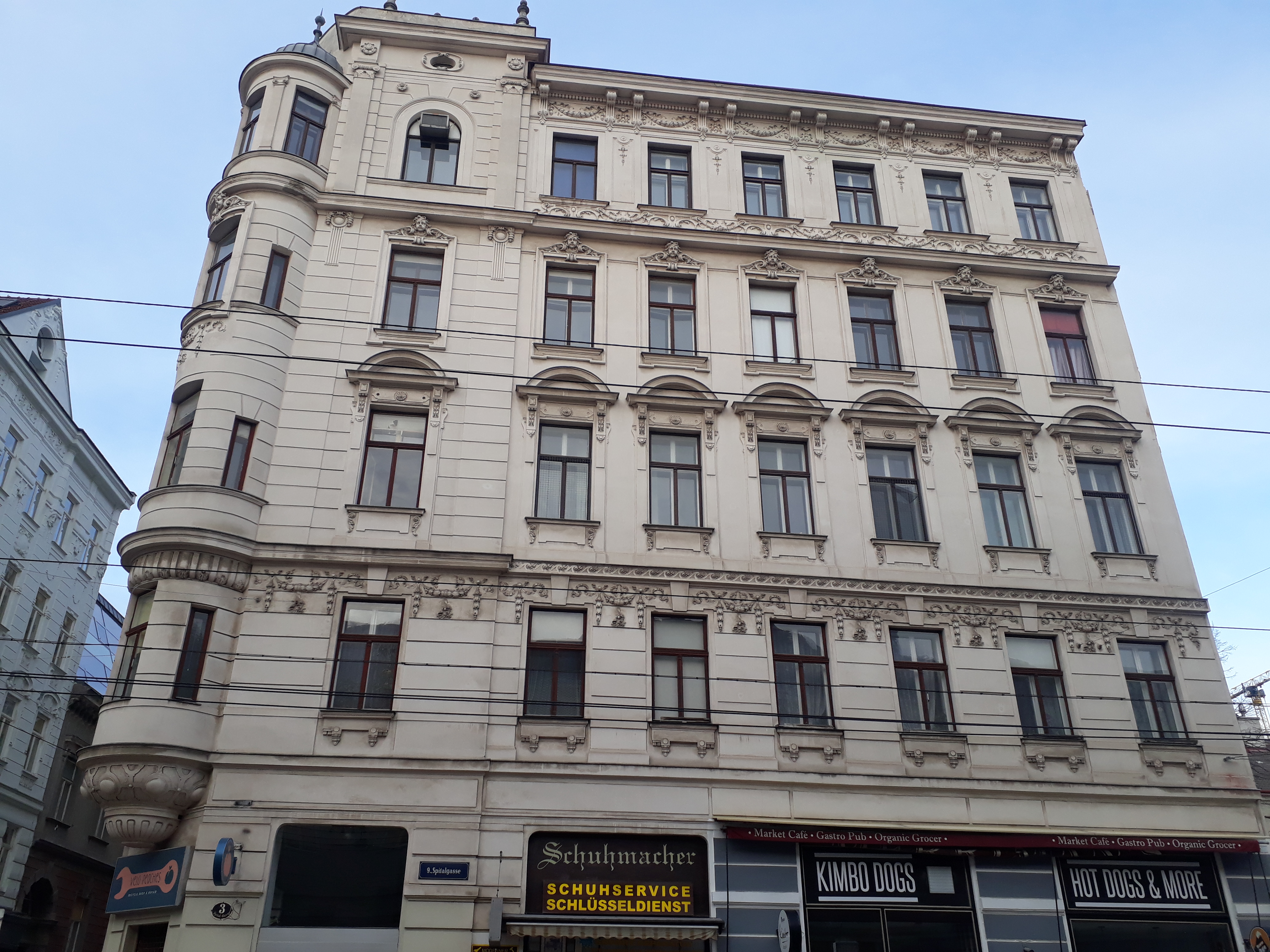
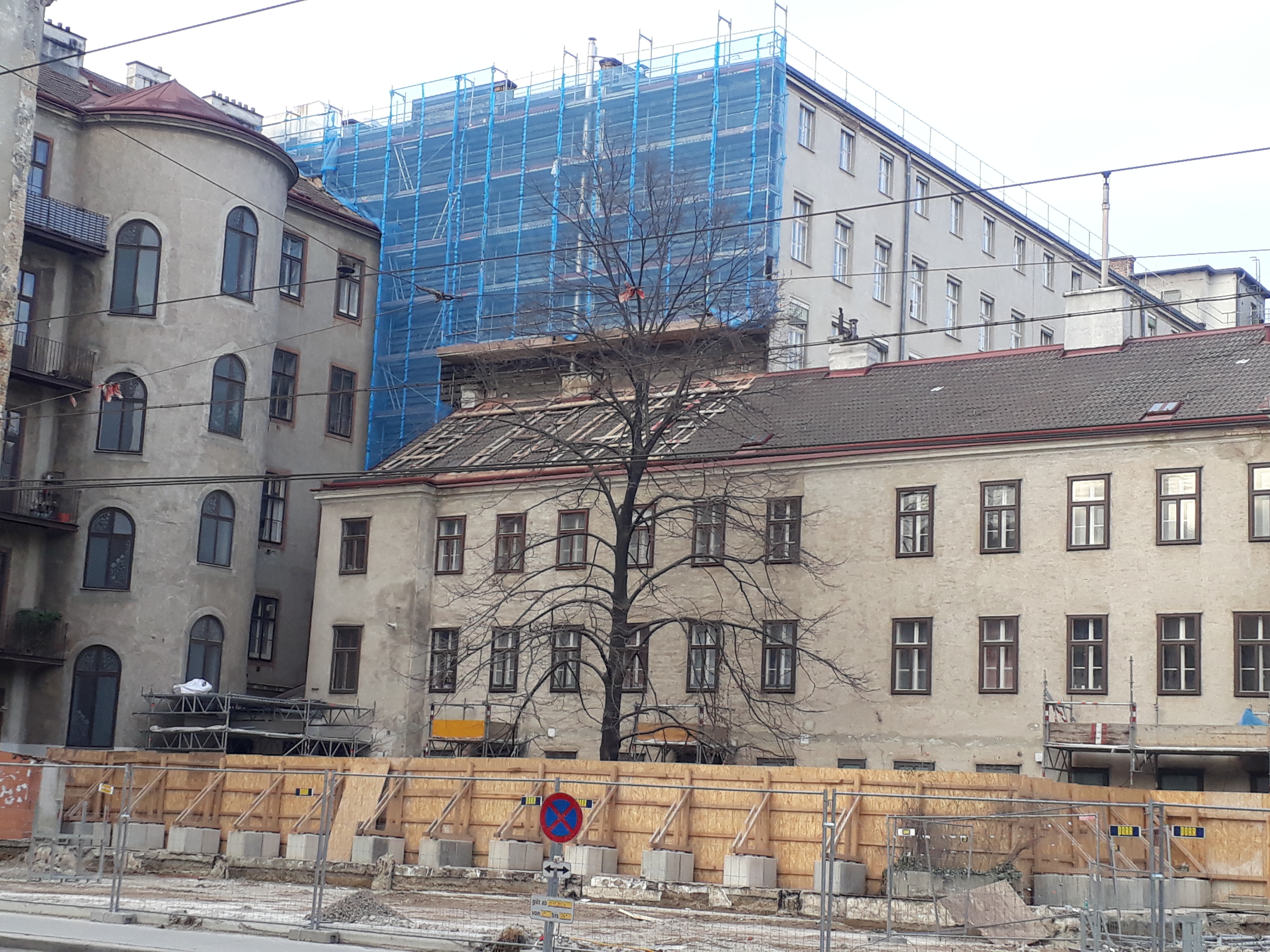
The old (1970s) WienEnergie building on Spitalgasse has been torn down to make room for a new “campus” for the medical school of the University of Vienna. This makes perfect sense–the general hospital is nearby, the old general hospital was turned into a proper campus for the University of Vienna a little over 20 years ago, and one semi-public building (the utilities provider was municipally owned at one time and then hived off) will remain in public hands. (The University of Vienna is a public university.) In addition, not even this defender of older buildings is sorry to see the olive green and orange structure go. I’ll be curious to see what comes.
In the meantime, the clearing of the site has laid the neighboring house open to scrutiny and shows some interesting things about Viennese buildings and, in fact, culture. Appearances are quite important in Vienna. (A friend of mine who has lived in Boston, London, Paris, Amsterdam, and Washington D.C. as well as in Vienna said that Vienna is the only city she has lived in where you got better service at the deli counter in the supermarket if you had put your make-up on.) For me, this focus on appearances is reflected in the relatively ornate facade of the house (the photo on the left) compared to the plainness of back of the house, with wing (the photo on the right). At the same time, it is often said that the imposing facades of the turn-of-the-century houses in Vienna hide some of the nicest aspects. These are for house residents only. This I see in what appears to be a small garden with a tree. That is probably quite a nice place to sit out–or will be again once the building project is complete!
An example of what is called a cultural artifact in the intercultural world …
Yes, you read that correctly. As of yesterday our restaurants are open and people are allowed to eat out. There are, of course, certain restrictions, but they don’t seem that tough.
What is really interesting and, I feel, particularly Viennese is that the city of Vienna is issuing gift certificates to each household for use in a restaurant. EUR 25 for single households and EUR 50 for families. Gives new meaning to the expression “Put your money where your mouth is,” doesn’t it?
 ecbinvienna