Tag Archives: changes in vienna

The use of “du”

16 May

Many of my readers know that German, like many languages, has two forms of you. “Du” can signify an equal relationship (students for example automatically use “du” with each other because they are peers) or a close relationship. “Sie” is for people we don’t know or to whom we need to show formal respect.

As in many languages, this is changing. I still remember many years ago my Italian teacher telling us about “tu” and “lei” and saying with visible dismay that she had gone into a travel agency in Italy (see how old this story is ;-)) and booked something. When the agent needed her name, the agent said “Come ti chiama?” using the informal you. That hits hard if you’re used to being per “Sie” as a customer in a service situation.

Why bring this up now? This question of when to use which form of “you” has fascinated me for decades, and I have collected many stories. I’m writing about it today because the Kurier just had an article on something they called “das aufgezwungene Du”. This is when the person at the receiving end is not given a real choice about which “you” to use. I had a boss, for example, who had done his MBA in the USA and thought he was being modern (this was in the 1990s) in offering all of us the “du” form. Having already heard pretty negative things and also on my own having formed an unfavorable impression of him, I felt like saying “I don’t want to call you ‘du’!” In that case, it was because “du” implies a closeness I did not want to express in any way. I wanted to keep my distance. However, it was forced on me. (Very tricky thing to tell your boss “Don’t use ‘du’ with me.”)

The Kurier article opened with something I had never heard of, a new hashtag. Apparently, many people now sign off on their e-mails with the hashtag: #gerneperdu or “happy to be per du”. Such an article is not complete without citing Thomas Schäfer-Elmayer, owner of the most proper dancing school in Vienna and widely regarded as the expert on etiquette in Austria. (I went to Elmayer for dancing lessons and always said afterwards that I learned how to behave but not how dance, something I learned later at a dancing school in the 18th district.) For a gentleman older than I am and not known for his flexibility, he is remarkably relaxed about the move towards more “du” and less “Sie”. He did say, however, that putting such a hashtag in an e-mail is not good manners. The offer should be made personally, he feels. (At the least, I would say.)

Just a couple of the stories I have gathered over the years.

I was shocked to hear a journalist interviewing diva, Edita Gruberova, using the “du” form. A friend of mine, from Argentina, suggested that perhaps they had known each other for a long time, that is, before Gruberova became so very famous, and had been per “du” in those days. Once you are per “du” it would be very insulting (and most likely perceived as very arrogant) to go back to “Sie”.

There was an article in the Lufthansa magazine a number of years ago answering the question whether crews were per “du” or per “Sie”. They are per “du” to facilitate quick collaboration. There should be no hierarchy. People should feel free to speak up, if necessary. And the crews should come together quickly, mesh, so to speak, so that they can serve customers better. (This is the main reason given for having a “du” culture in any company.”) That said, I’m quite sure they are all still per “Sie” with the Board.

Twenty years ago or so, I was co-teaching with a colleague at a university of applied sciences in Krems. (Great wine after class. :-)) We taught in English, but the students would often come up with concerns in the break and speak German. My colleague, Viennese born and bred, was explicit that, while first names were acceptable when speaking English, “Frau Mag.” and “Sie” would be proper in German. That illustrates the usefulness of the difference, if you ask me. We were not their peers. We had to give them grades, for example. It’s not really fair for them to be mis-led by informality into forgetting that.

Finally, it used to be an honor for someone older and respected to offer the “du” form. It showed, again, greater equality, respect, and emotional closeness. Ah, well. One more thing biting the dust. What is the world coming to? 😉

That Glass of Water at a Coffeehouse

1 Mar

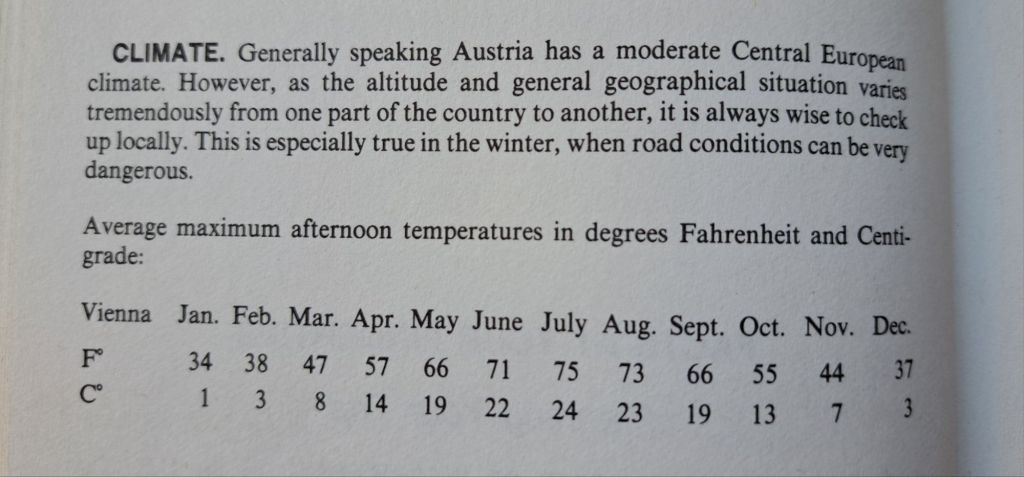
That glass of water in Viennese coffeehouses has been under fire for a number of years. True, you still get one small glass of the fabulous Viennese tap water with your coffee, but you can no longer count on it being considered “perfectly normal to ask for another glass, or even several extra glasses” as my Baedeker’s Vienna assured its readers in 1988.

In fact, a year or two ago, I was breakfasting at Landtmann. Knowing that they had started charging for tap water, I pointed, to be explicit, to the small glass that had come with my coffee and said, “Noch ein Glas Wasser, bitte.” They brought a mini carafe and charged EUR 1.50 for it. A reason not to go back, if you ask me.

In the Kurier, picked up at the supermarket yesterday as the Trafik is still closed, there was a story about precisely this — but Café Landtmann came off better this time. A family had been celebrating the birthday of a great aunt at Landtmann. Once all the others were gone, one family member asked if he might stay for a bit and read the newspapers. The waiter’s answer? “We close at 11 p.m.” (Quite an open invitation these days when, even in Vienna, you are sometimes informed that you have the table for two hours only.)

The author of that piece, Wolfgang Kralicek, is himself the owner of a café and added a story from his own experience. The record for number of glasses of water to one coffee is seven(!). He then writes that the guest in question left such a large tip that he could easily have ordered a second Melange. Just goes to show it’s not always about the money.

Some Wiener Grant of my own

25 Oct

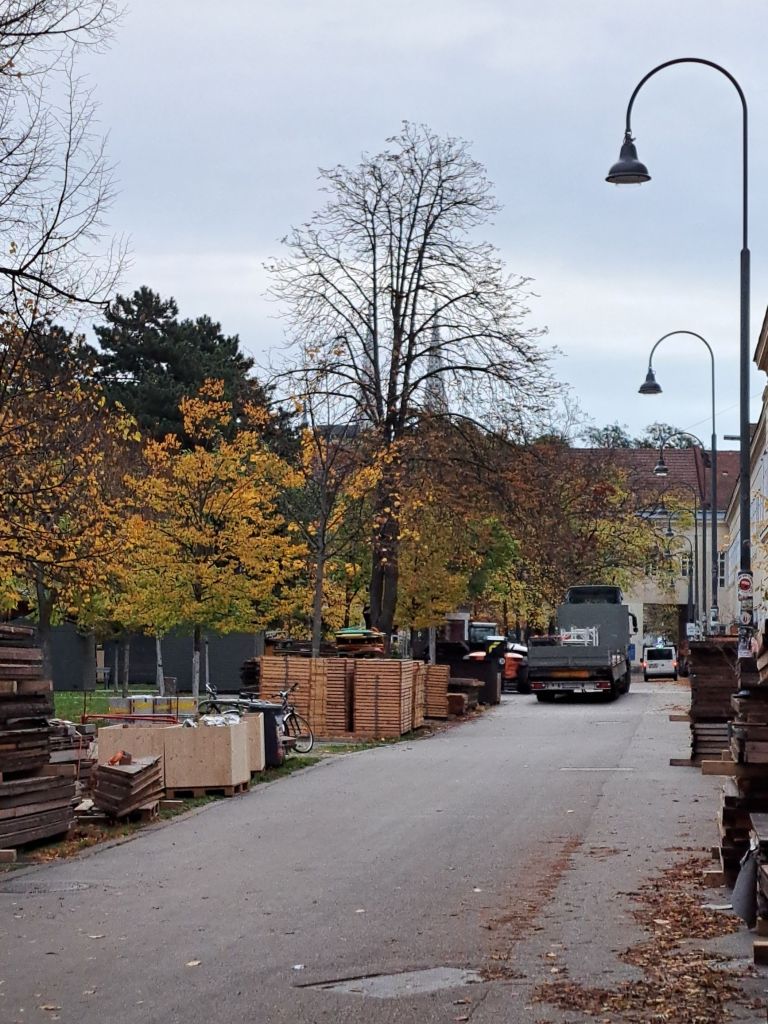
Why am I grumpy? Because that, ladies and gentlemen, is a photo of a Christmas market to be. When I arrived in Vienna, many years ago, granted, there wasn’t a Christmas market in every corner of the city and, if I remember correctly, they didn’t open until the First Sunday in Advent. At last, I thought, I’ve found a land unmoved by the consumerism of free-market capitalism.

Well, it was too good to be true. For a number of years, the Christmas markets have opened the middle of November. This year they seem almost to be striving for a pre-Halloween date.

Grant (a.k.a. grumpiness).

Some good news on the preservation front

21 Sep

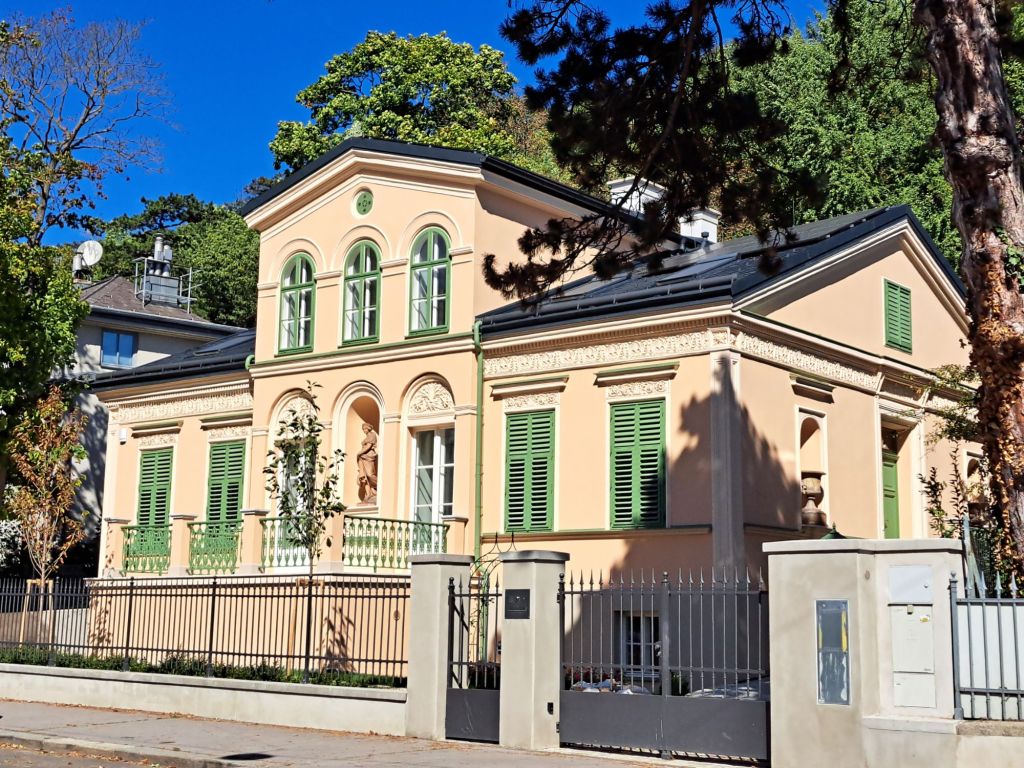
A friend and I have been keeping an eye on this villa in Neuwaldegg. We’ve seen too many treasures over the years been allowed to decay to a point when they could legally be torn down. Invariably, they were replaced with faceless, cement structures that were, possibly, quite nice to live in but brought no joy to the folks out front.

This one sat on a construction site for about two years, and for a while it wasn’t clear which way the project was going to go. Then it started to look promising. This time when I walked by I was treated to the fully renovated version.

If the person who invested the time, money, and care into restoring this property ever reads this — thank you! Not only did you save a beautiful piece of Viennese history. You restored a tiny bit of my hope in people.

Vienna in the 80s

2 Aug

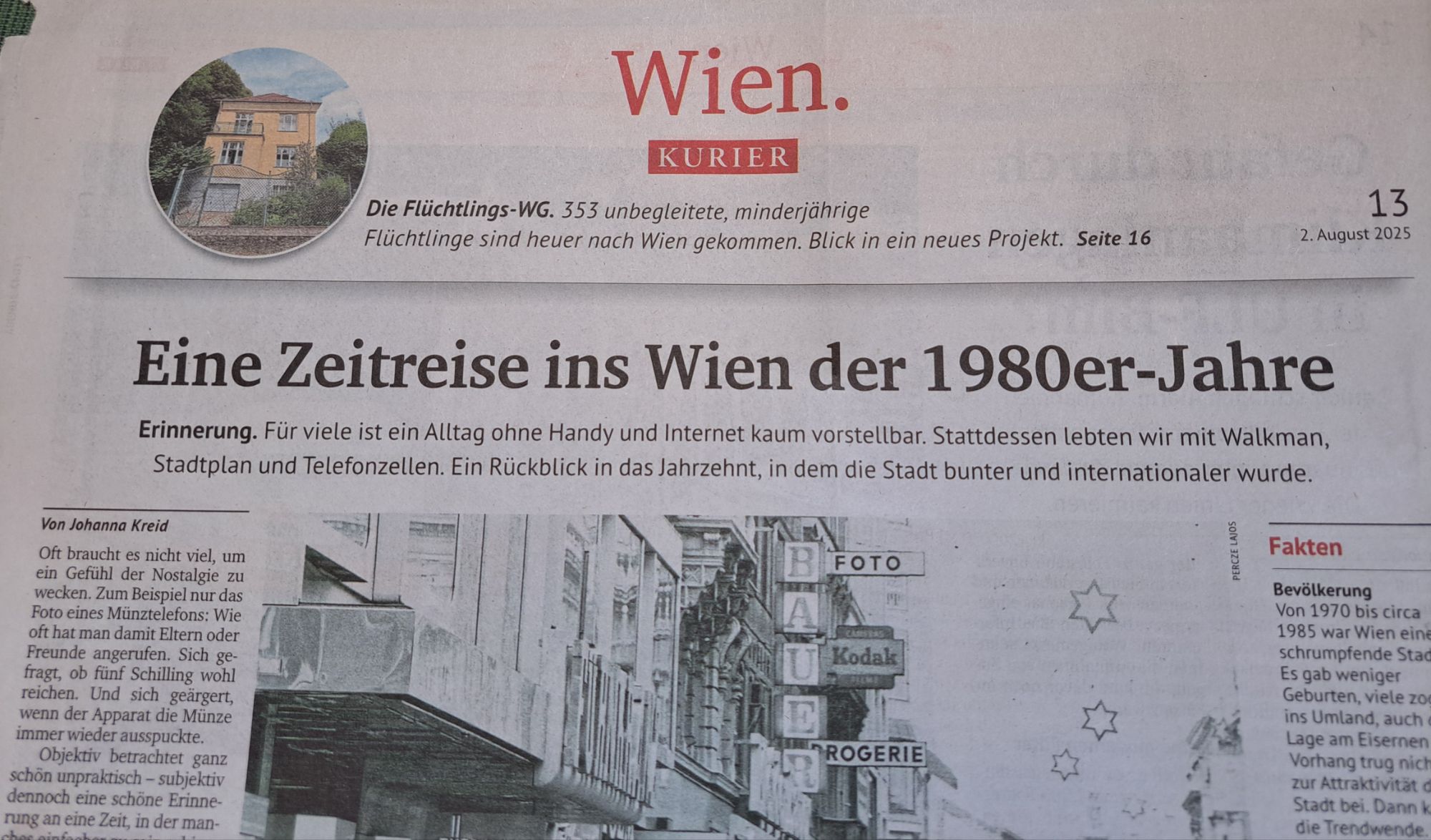
The Kurier today had an article about Vienna in the 1980s — a trip back in time. (Thanks, Kurier. That is very good way to make someone who was already an adult at that time feel rather old.) I arrived in Vienna in 1988 (had my 37th anniversary yesterday, celebrated, appropriately, at a Heuriger) and have seen significant changes, I thought it would be fun to write about some of the points mentioned.

For one thing, they write about pay phones, which reminded me of two things.

One of my first mornings in Vienna, after my German course at the Goethe Institut, I was out with my mother, who had accompanied me to help settle me in. We needed to phone the couple who became my Viennese parents to make arrangements, so we found a pay phone (they were plentiful then ;-)), put our money in, and dialed. When my Viennese father answered, he probably realized it was us calling because he couldn’t hear anything and said “Den roten Knopf drücken.” (“Press the red button.”) My mother did this, we heard the coin drop and were connected. That red button was called the “Zahlknopf” (zahlen = to pay) and released the money so that the connection could be made. Even in the late 80s, not all phones had a Zahlknopf anymore, but that one did and the Viennese had learned to give the necessary instructions.

The other phone story is much shorter. I saw a sign on a phone booth that said something about “retten”. I was familiar with the word (probably from the opening scene of “The Magic Flute” when Tamino rushes onstage pursued by the monster and sings “Save me! Save me!”) but couldn’t figure out what that had to do with a telephone. My mother translated the sign for me: This telephone can save lives. Do not destroy it. (“Dieses Telefon kann Leben retten. Zerstör es nicht.” Oddly enough, I don’t think they used the “Sie” form there.)

The article also reminded me of the men (I think it was always men) who used to sell newspapers on the street after the Trafiken had closed, which they do to this day. Vienna — thank goodness in my opinion — still has clear opening hours and very little at all is open on Sundays. You could get your news there truly hot off the press, and people often bought the next day’s paper on their way home from a ball, late opera night, or late shift. People who were looking for apartments or jobs would wait for these men and the newspapers to show up so that they could get a headstart on the search. And a tip for these men who worked long hours, in all sorts of weather, and for very little pay was obligatory.

The author also writes about Mariahilfer Straße — a very important shopping street in Vienna — and how even the part farther out, past the Gürtel, was a useful and relatively pleasant area 40 years ago. Currently, it is full of stores with really cheap goods and kebab take-out places although, apparently, there are plans to renew it. I remember, and still miss, the trams, the 52 and 58, that used to run along Mariahilfer Straße from the Ring to the Gürtel and beyond. Now we have the U3 line. Not so useful for a shopping street, I would argue. I do enjoy the kind-of pedestrian zone, though. “Kind-of” because it is what is called a “Fairness Zone,” which means you have pedestrians, bicyclists, e- and other scooter riders, and delivery trucks all in the same space without clear delineation of lanes. (What could possibly go wrong? ;-))

In addition, the author mentioned something I didn’t know. In 1988, when the Hungarians were already free enough to come to Vienna en masse, even though the Iron Curtain had not officially fallen, Mariahilfer Straße became their destination to buy things they couldn’t get at home and for a time was called “Magyarhilfer Straße” by the Viennese. My memory of this time was the truly old and stinking busses that they arrived in. We were very spoiled in Vienna with catalytic converters. These busses had no such thing and ran, I suspect, for the most part on diesel, making an ungodly noise and leaving huge black clouds behind them.

Ah, the 1980s. It wasn’t such a bad time.

Here a link to the article, which, sadly for me, appears to be available to Kurier subscribers only: https://kurier.at/chronik/wien/wien-achtzigerjahre-1980er-zeitreise-ein-alltag-ohne-handy-und-internet/403063709

International Women’s Day

8 Mar

One of the biggest demonstrations I’ve ever seen in Vienna. And one of the loudest. I was teaching and had to interrupt the class!

Pension office

22 Nov

I went to the pension office this morning to clarify a few points and saw that some things have really changed in Austria and some things haven’t.

One thing that has changed: the woman in front of me in line at the reception desk was talking about her “Partnerins” (female partner’s) appointment. When there was some confusion about her name, she explained that when they had married she had taken on her partner’s family name and officially changed it on all her documents. Then I overheard that she herself isn’t self-employed but rather her partner, and she would like to be covered under her partner’s insurance.

This would have been unimaginable even five years ago (Austria enacted “Ehe für Alle” or “Marriage for All” on 1 January 2019, building on the civil union that became possible in 2010). For anyone who would like more information, here is a website (in German) giving an overview of the history of same-sex marriage as well as legal details: https://www.familienrechtsinfo.at/eherecht/ehe-fuer-alle/

Something that hasn’t yet changed? When I came out of my appointment, there was a man waiting, with his large, well-behaved, non-service dog. Wish I’d known I could have taken Maylo!

The backstage view of a Viennese house

2 Feb

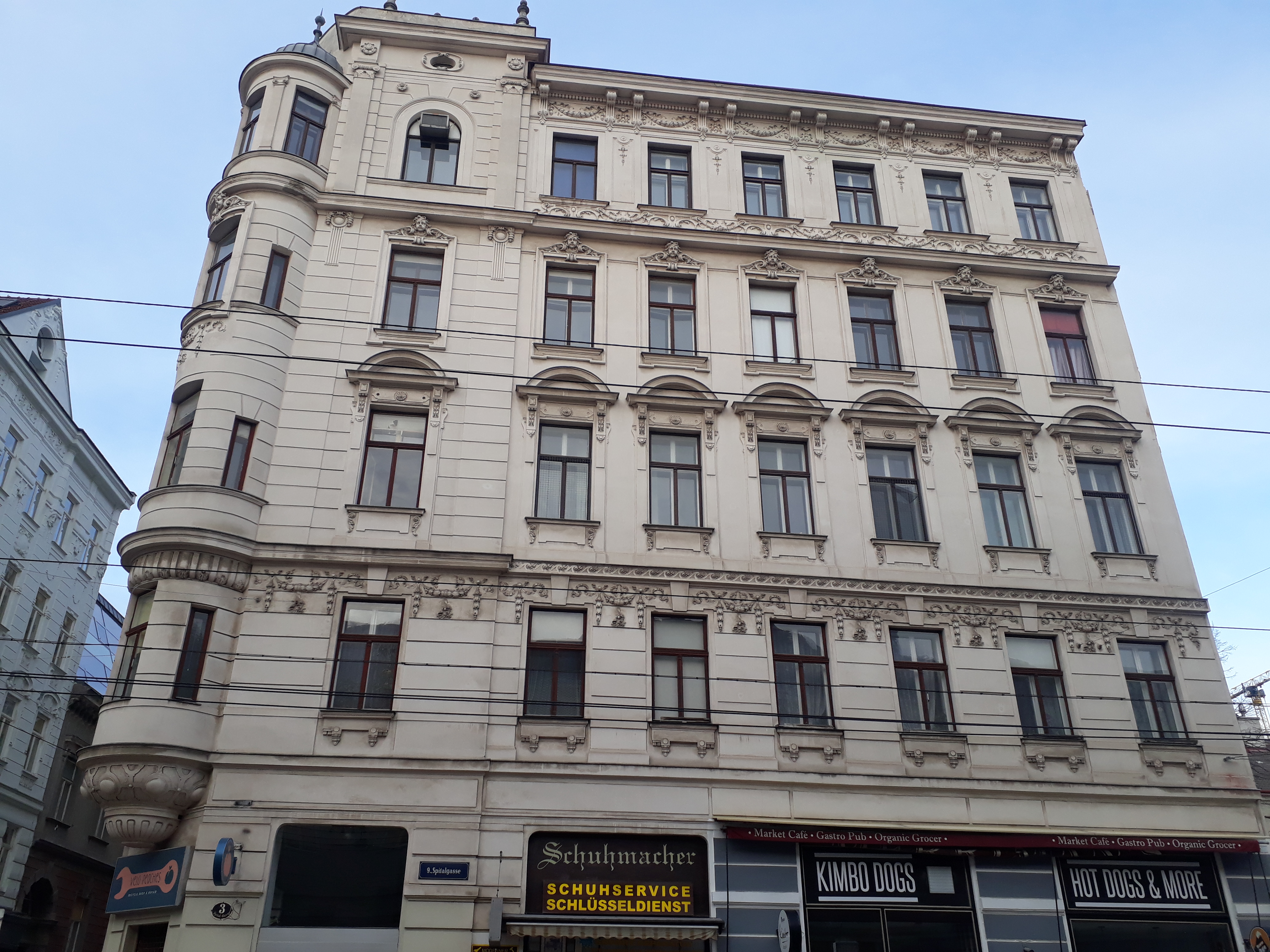
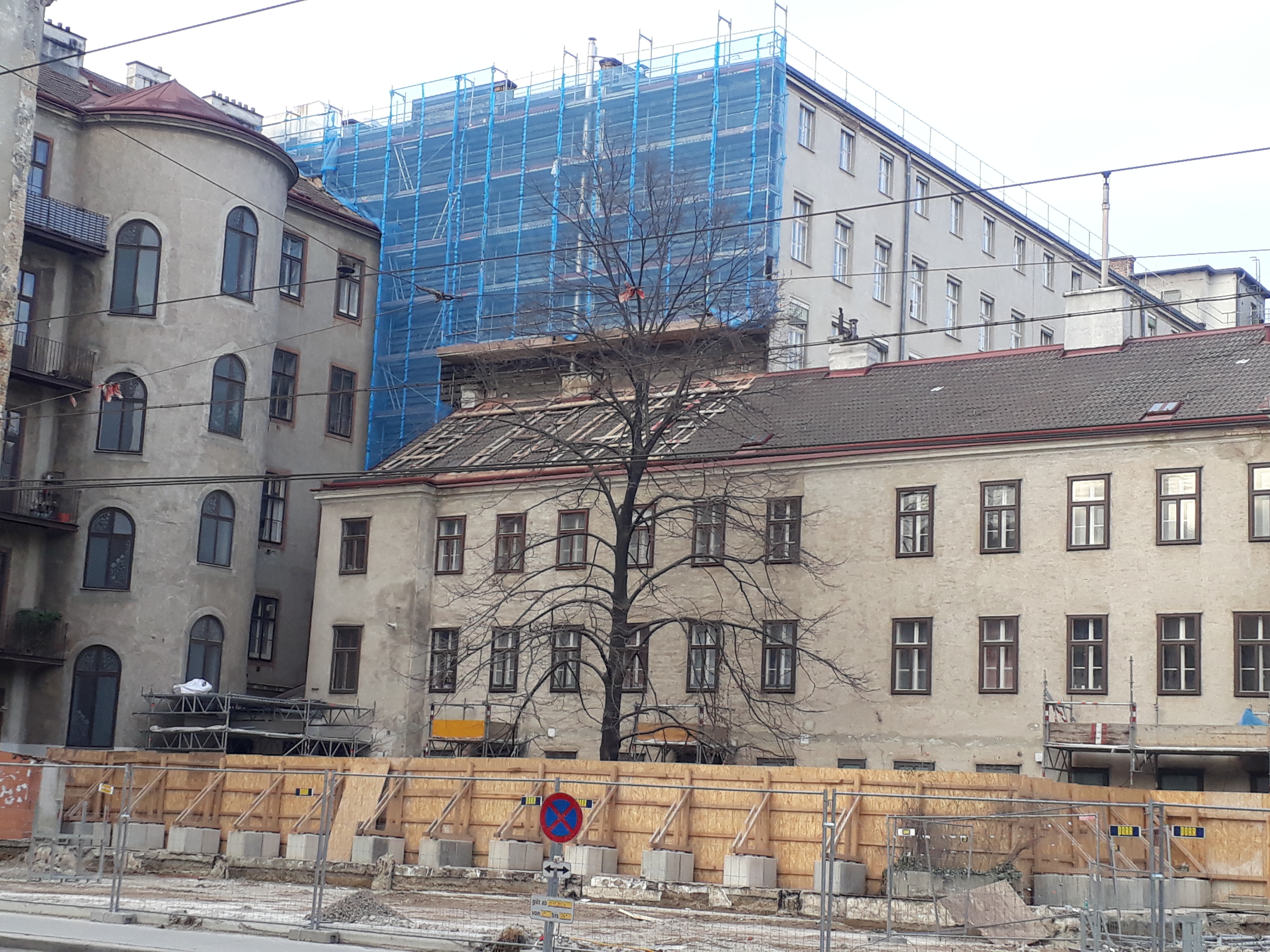
The old (1970s) WienEnergie building on Spitalgasse has been torn down to make room for a new “campus” for the medical school of the University of Vienna. This makes perfect sense–the general hospital is nearby, the old general hospital was turned into a proper campus for the University of Vienna a little over 20 years ago, and one semi-public building (the utilities provider was municipally owned at one time and then hived off) will remain in public hands. (The University of Vienna is a public university.) In addition, not even this defender of older buildings is sorry to see the olive green and orange structure go. I’ll be curious to see what comes.

In the meantime, the clearing of the site has laid the neighboring house open to scrutiny and shows some interesting things about Viennese buildings and, in fact, culture. Appearances are quite important in Vienna. (A friend of mine who has lived in Boston, London, Paris, Amsterdam, and Washington D.C. as well as in Vienna said that Vienna is the only city she has lived in where you got better service at the deli counter in the supermarket if you had put your make-up on.) For me, this focus on appearances is reflected in the relatively ornate facade of the house (the photo on the left) compared to the plainness of back of the house, with wing (the photo on the right). At the same time, it is often said that the imposing facades of the turn-of-the-century houses in Vienna hide some of the nicest aspects. These are for house residents only. This I see in what appears to be a small garden with a tree. That is probably quite a nice place to sit out–or will be again once the building project is complete!

An example of what is called a cultural artifact in the intercultural world …

A November Day

12 Nov

Today is almost like the November days I remember from 30 years ago — gray, damp, chilly. It isn’t raining, but the pavements are damp with condensation; it isn’t that cold in temperature (about 4°C), but it is a penetrating chill. The air, as always on these days, is a bit acrid because the cloud cover holds in all the exhaust. And it may be a bit warmer than back then. Certainly it is somewhat brighter as the buildings are for the most part cleaner and this year’s spectacular foliage, in yellow and gold, is not yet completely gone.

A new announcement in the U-Bahn

16 Oct

I’m on my way to the university and heard this announcement for the first time: “Dear Passengers, Please keep your luggage with you at all times. Unattended bags will be removed.” Feels almost as if I’m finally living in London.