In need of a bit of fresh air, I went off to walk along the Donaukanal this evening. My first summer in Vienna, when I was preparing for my audition at the conservatory, I went every evening. I was living in a student residence (katholische Hochschülerinnenheim) on Servitengasse in the 9th and would walk over as a part of my fitness regime.
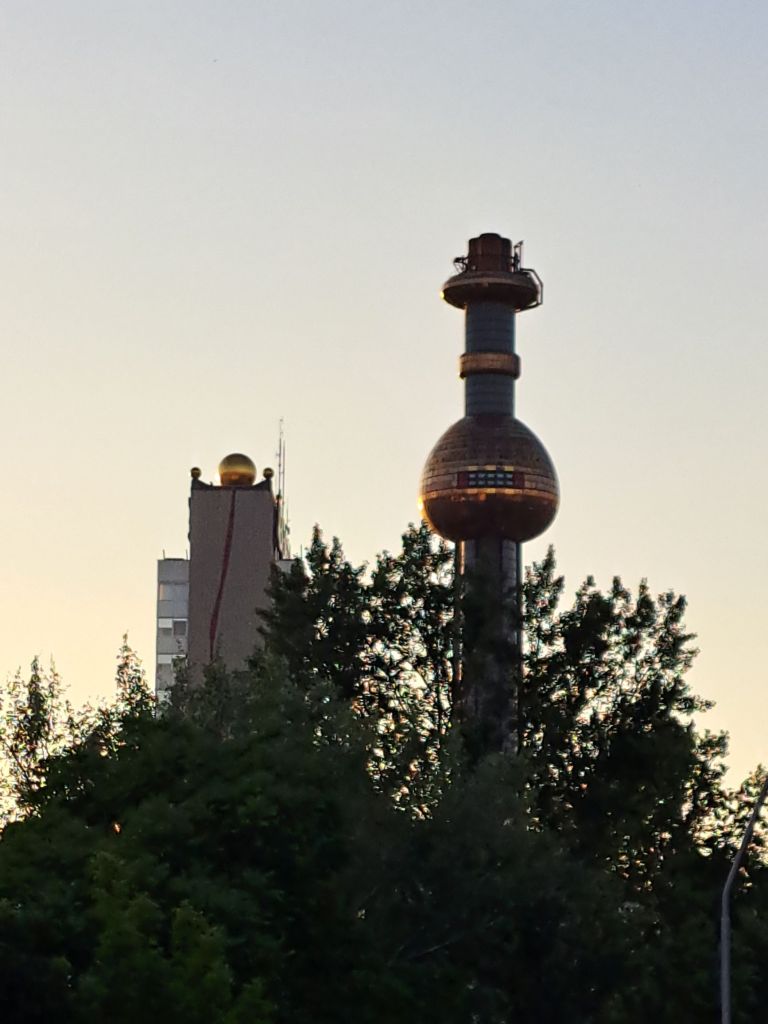
High time I came again. It is beautiful with the trees and green, swiftly flowing water. I didn’t used to come up to Spittelau, where the famous Hundertwasser trash incinerator is, but I’m glad I did this evening.
And the linden trees are getting started. There was promise in the air yesterday evening. After a temperature of 31°C (high 80s Fahrenheit) today, they are flooding the air with their perfume.
All in all, a nice evening constitutional on this “Pfingstmontag” (Whitmonday) holiday.
Many of my readers know that German, like many languages, has two forms of you. “Du” can signify an equal relationship (students for example automatically use “du” with each other because they are peers) or a close relationship. “Sie” is for people we don’t know or to whom we need to show formal respect.
As in many languages, this is changing. I still remember many years ago my Italian teacher telling us about “tu” and “lei” and saying with visible dismay that she had gone into a travel agency in Italy (see how old this story is ;-)) and booked something. When the agent needed her name, the agent said “Come ti chiama?” using the informal you. That hits hard if you’re used to being per “Sie” as a customer in a service situation.
Why bring this up now? This question of when to use which form of “you” has fascinated me for decades, and I have collected many stories. I’m writing about it today because the Kurier just had an article on something they called “das aufgezwungene Du”. This is when the person at the receiving end is not given a real choice about which “you” to use. I had a boss, for example, who had done his MBA in the USA and thought he was being modern (this was in the 1990s) in offering all of us the “du” form. Having already heard pretty negative things and also on my own having formed an unfavorable impression of him, I felt like saying “I don’t want to call you ‘du’!” In that case, it was because “du” implies a closeness I did not want to express in any way. I wanted to keep my distance. However, it was forced on me. (Very tricky thing to tell your boss “Don’t use ‘du’ with me.”)
The Kurier article opened with something I had never heard of, a new hashtag. Apparently, many people now sign off on their e-mails with the hashtag: #gerneperdu or “happy to be per du”. Such an article is not complete without citing Thomas Schäfer-Elmayer, owner of the most proper dancing school in Vienna and widely regarded as the expert on etiquette in Austria. (I went to Elmayer for dancing lessons and always said afterwards that I learned how to behave but not how dance, something I learned later at a dancing school in the 18th district.) For a gentleman older than I am and not known for his flexibility, he is remarkably relaxed about the move towards more “du” and less “Sie”. He did say, however, that putting such a hashtag in an e-mail is not good manners. The offer should be made personally, he feels. (At the least, I would say.)
Just a couple of the stories I have gathered over the years.
I was shocked to hear a journalist interviewing diva, Edita Gruberova, using the “du” form. A friend of mine, from Argentina, suggested that perhaps they had known each other for a long time, that is, before Gruberova became so very famous, and had been per “du” in those days. Once you are per “du” it would be very insulting (and most likely perceived as very arrogant) to go back to “Sie”.
There was an article in the Lufthansa magazine a number of years ago answering the question whether crews were per “du” or per “Sie”. They are per “du” to facilitate quick collaboration. There should be no hierarchy. People should feel free to speak up, if necessary. And the crews should come together quickly, mesh, so to speak, so that they can serve customers better. (This is the main reason given for having a “du” culture in any company.”) That said, I’m quite sure they are all still per “Sie” with the Board.
Twenty years ago or so, I was co-teaching with a colleague at a university of applied sciences in Krems. (Great wine after class. :-)) We taught in English, but the students would often come up with concerns in the break and speak German. My colleague, Viennese born and bred, was explicit that, while first names were acceptable when speaking English, “Frau Mag.” and “Sie” would be proper in German. That illustrates the usefulness of the difference, if you ask me. We were not their peers. We had to give them grades, for example. It’s not really fair for them to be mis-led by informality into forgetting that.
Finally, it used to be an honor for someone older and respected to offer the “du” form. It showed, again, greater equality, respect, and emotional closeness. Ah, well. One more thing biting the dust. What is the world coming to? 😉
This year — as, in fact, in many years — the Eisheiligen (“Ice Saints”) arrived pretty much on schedule, bringing a real drop in temperatures and, this year, some rain.. They haven’t quite left us yet so are a bit tardy in that respect, but the rain is desperately needed so I, for one, am not complaining.
Who are the Eisheiligen? This year I decided to look into the matter a little bit and turned to the German-language Wikipedia (see link below).
The first thing I noticed was that Wikipedia listed Mamertus on May 11th as the first “ice saint”. I had never heard of Mamertus, even though he was Archbishop of Vienna in the 5th century. Then I noticed that Mamertus apparently only counts in northern Germany. Bavaria and Austria consider the first “ice saint” to be Pankratius on May 12th. Here I am on familiar territory.
The other “ice saint” I always remember is the last one, die Kalte Sophie, on May 15th. From Wikipedia I learned that she was tacked on later, perhaps to accommodate the fact that Bavaria and Austria usually get the weather from northern Germany a day later. This explains why “our” ice saints start a day later and end a day later.
Anyway here they are with their dates: Mamertus (May 11), Pankratius (May 12), Servatius (May 13), Bonifatius (May 14), and, as stated above, Sophia (May 15).
Why are these saints special? It’s complicated, partly because the dates that have been handed down come from the Julian calendar and don’t align with the Gregorian calendar. In any case, it’s a little bit like the weather forecasts in the Farmers’ Almanac in the USA — there to help farmers plan their planting times but predicted on the basis of recognizable patterns far before any forecast can hope to be accurate. And, yet, the forecasts are right quite a bit of the time.
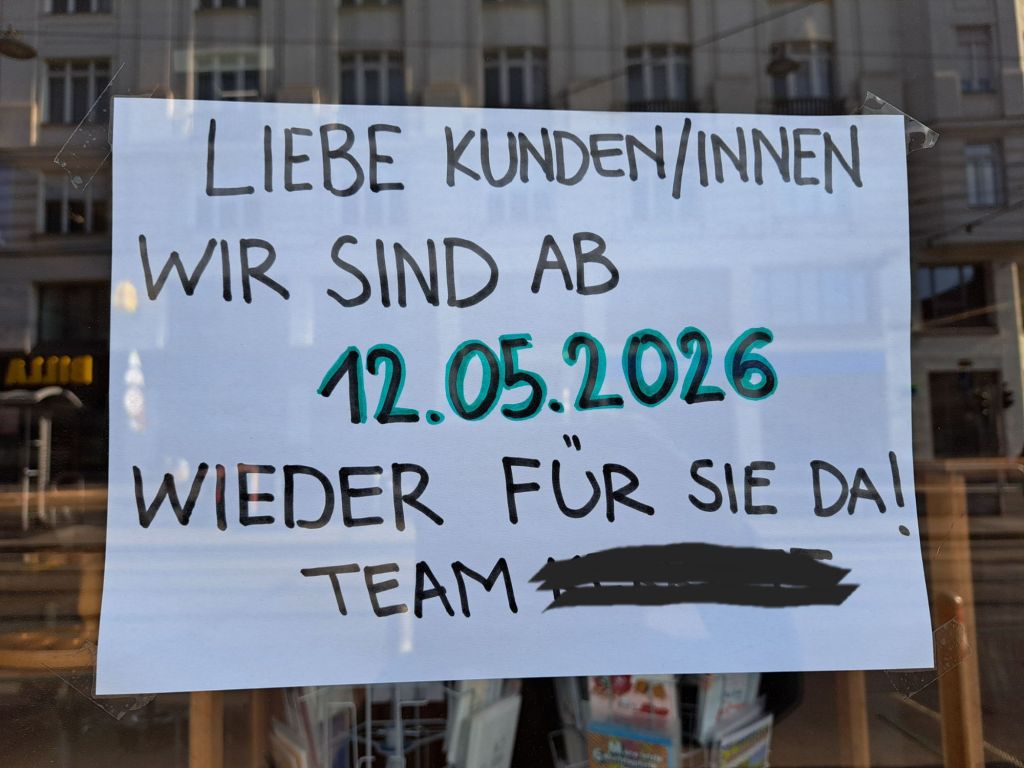
It is re-opening! Sadly, it doesn’t look as if the two women who used to work there are taking it over. A few days ago, I saw three men trying to figure out the vending machine out front. In any case, as of Tuesday I should know more.
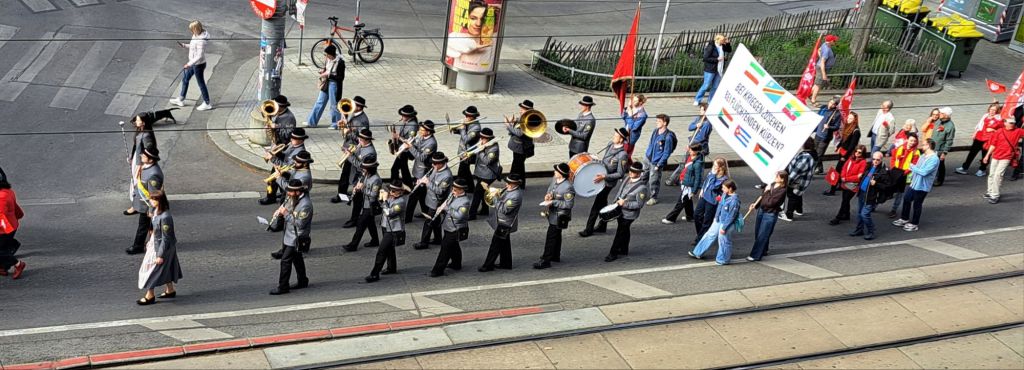
And the band sounded especially tuneful and jaunty this morning.
Main themes were peace and freedom, two “F”s in German: Frieden and Freiheit. The banner in the photo says “Watch wars [without doing anything] and cut the budget for those fleeing them?” Interesting, but typical for the Social Democrats, that the sign uses the less negatively connoted “Flüchtende” (fleeing people) rather than the older, more loaded “Flüchtlinge” (refugees).