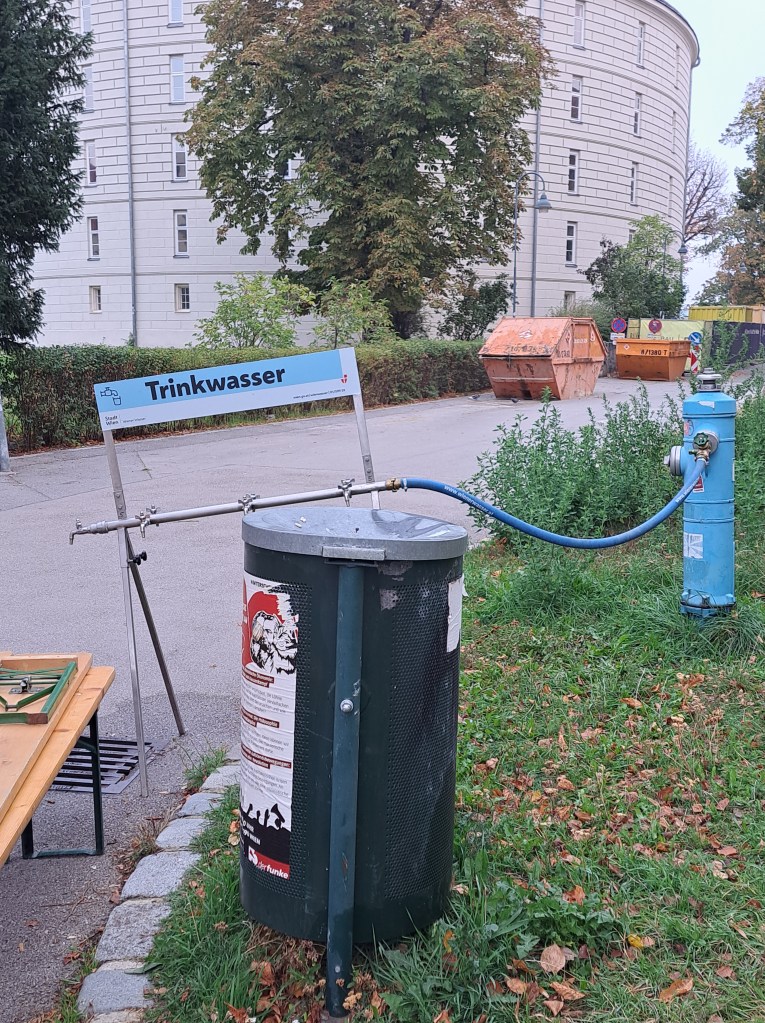
Drinking water from a fire hydrant? Yes, in Vienna, where a Viennese friend once proudly said that here we flush our toilets with water others buy in supermarkets. (It comes from the mountains, thanks to Kaiser Franz Josef. Mentioned here: https://ecbinvienna.com/2022/01/04/08-breitenfurter-strase-to-alterlaa/)
In this case, there is a sponsored run to support cancer research today and the runners apparently will be able to get water at this station near the Narrenturm. (More about the Narrenturm here: https://www.nhm-wien.ac.at/en/narrenturm)
It’s late and hot. Maylo and I were on our way home from a Heuriger. (Where else would we go on a hot Friday evening? ;-))
It was quite a long trip home with several changes and long waits. We were waiting the tram that would more or less drop us off at our door and Maylo was lying on the sidewalk looking tired. Next thing I knew a man, dirty and poorly dressed but with gentle eyes and a smile, was sharing his bottled water with Maylo, pouring it onto the pavement and watching while Maylo lapped it up.
I couldn’t tell whether he was deaf and that’s why he didn’t speak or simply didn’t speak German. He tried to communicate with gestures and I sadly couldn’t tell what he wanted to say. Then our tram arrived and I thanked him for the water and said good night. Just as the tram doors started to close, he slid the bottle in to Maylo and went his way.
I was sure he needed the wonderfully cold, almost full bottle of water more than Maylo did, but I also thought he perhaps wanted to give it to a hot little dog more than he wanted to drink it himself.
In any case, it was a very special exchange for me, especially in a world where ever more people push themselves ahead, never mind the others, and I wanted to share it with you.
Here is a nice, light story in a world full of heavy news. A 10-meter whale sculpture that stood in front of a Gasthaus (kind of restaurant), zum Walfisch, in the Prater is being moved to the Wien Museum now that the restaurant it represented is no longer there. It is so big that it is being moved in now while the renovations are still ongoing. Eventually it will be hung from the ceiling.
More about this later, I hope, but now I have to go to work. The curse of the drinking classes, as my father loved to quip, possibly quoting George Bernard Shaw. Curse of the writing classes is more like it! 😉
Thursday was a holiday in Austria (Corpus Christi). What does that have to do today in the Trafik? More than one would think. When a holiday in Austria falls on a Thursday then many people in Vienna take a “Fenstertag” or “window day” and leave town for a four-day weekend. This leaves behind in the city people like me, who have no family to visit in, say, Salzburg, and those who have to work.
This was clearly visible in the Trafik this morning. Usually, there are a lot of people in and out on a Saturday morning. Many, like me, are picking up their newspaper to be read during a leisurely breakfast. Today only a few came in and all of them bought cigarettes but no newspapers, apparently on their way to work. Maylo and I stayed for a while and chatted with the Trafikantin, which we otherwise never get the chance to do, before wending our way home for breakfast.
I love Vienna when half the population is out of town. 🙂
Two days ago I caught a whiff of a sweet fragrance as we set out on our morning dog walk. Yesterday it was clear it was the linden blossoms of one particular tree that gets a lot of sun. Today it reminded to let you know — it must be June, the linden trees are out.
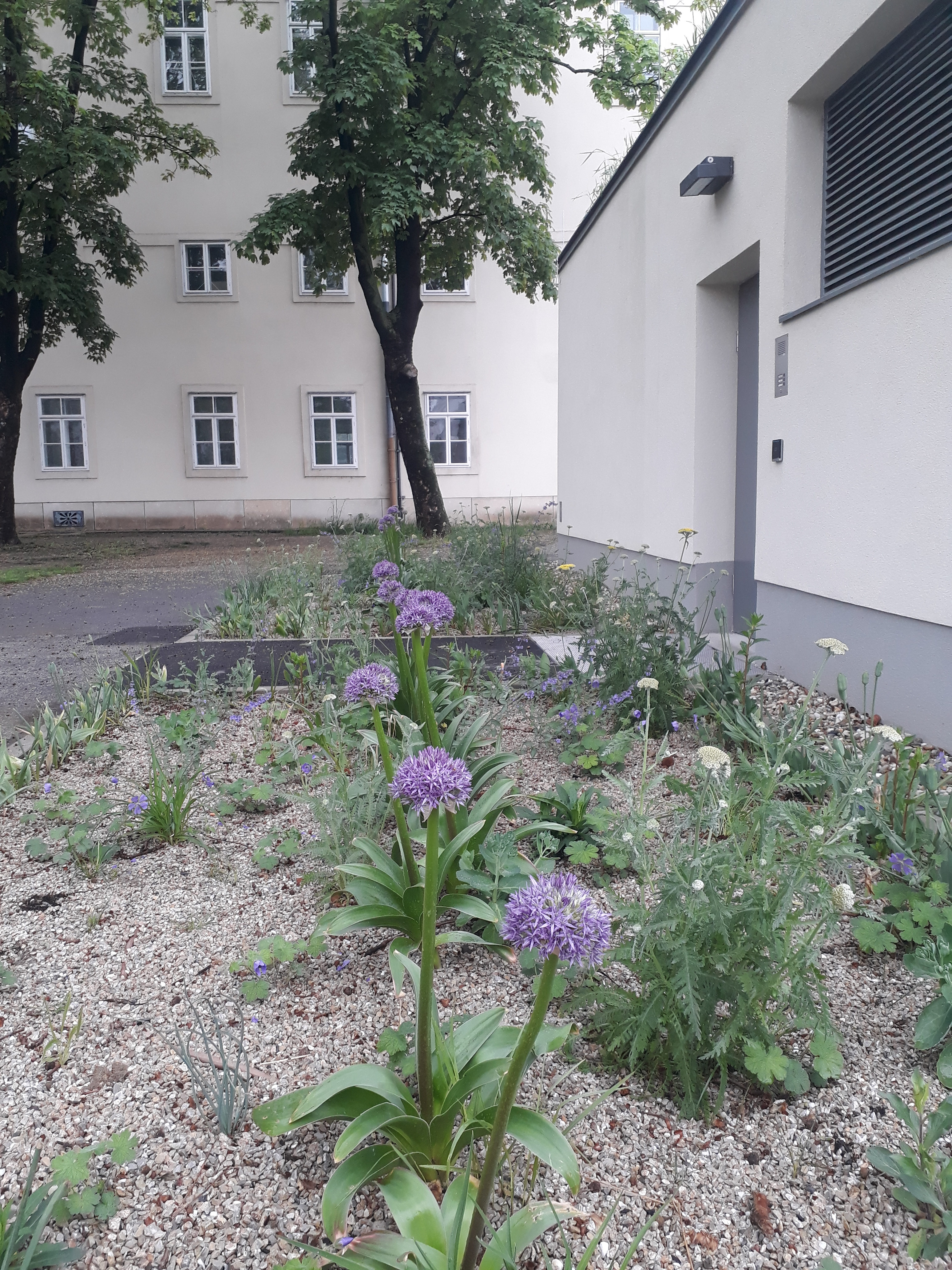
Every year the MA 42 (the “Magistratsabteiling” of the City of Vienna responsible for public parks and gardens) choose certain mixtures of flowers that they plant everywhere. The daffodils and red tulips are gone, but these have come out. I have no idea what they are (I am the kind person who is happy to work in a garden as long as someone else tells me what to do), but they are tall (about a foot and a half) and look like something out of Dr. Seuss, if you ask me. Fun.
We are nearing the end of the Rundumadum. In fact, because I started with the last leg of the trail, I have now come full circle. I do still need to get the stamp from the Roter Hiasl restaurant in the Lobau as they were not open when we passed that way. Then I will be eligible for my City of Vienna hiking pin. 🙂
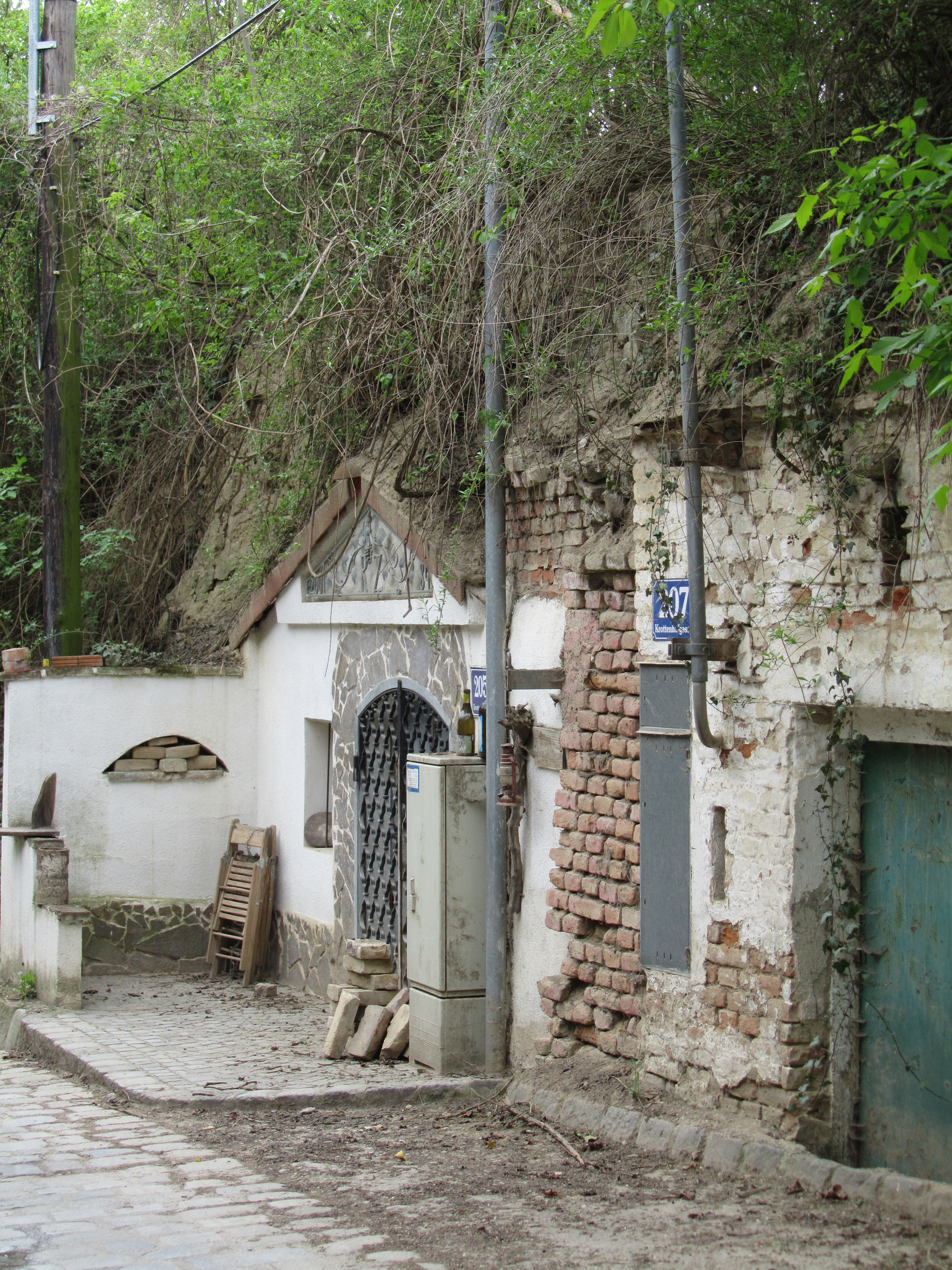
But I am getting ahead of myself, which is a pity because the start of this stretch was so enticing (not just because the bus took us uphill and we only walked downhill ;-)). Here it is, an old “Kellergasse” within the city limits.
An old “Kellergasse” in Vienna’s 21st district
What is a “Kellergasse”? Many will already know that a “Keller” is a “cellar” and, in this case, a wine cellar, and a “Gasse” is a narrow street or alley. They are (or were) common in wine-growing regions and were used to store wine before it was sold. Now, many people are buying them up and converting them into weekend retreats. As they are typically in rather green and agricultural areas, they make good retreats.
We followed Krottenhofgasse all the way down into Strebersdorf (one of the many villages that were incorporated into Vienna), oohing and aahing over the many flowering shrubs, which were at least two weeks behind what they are in town.
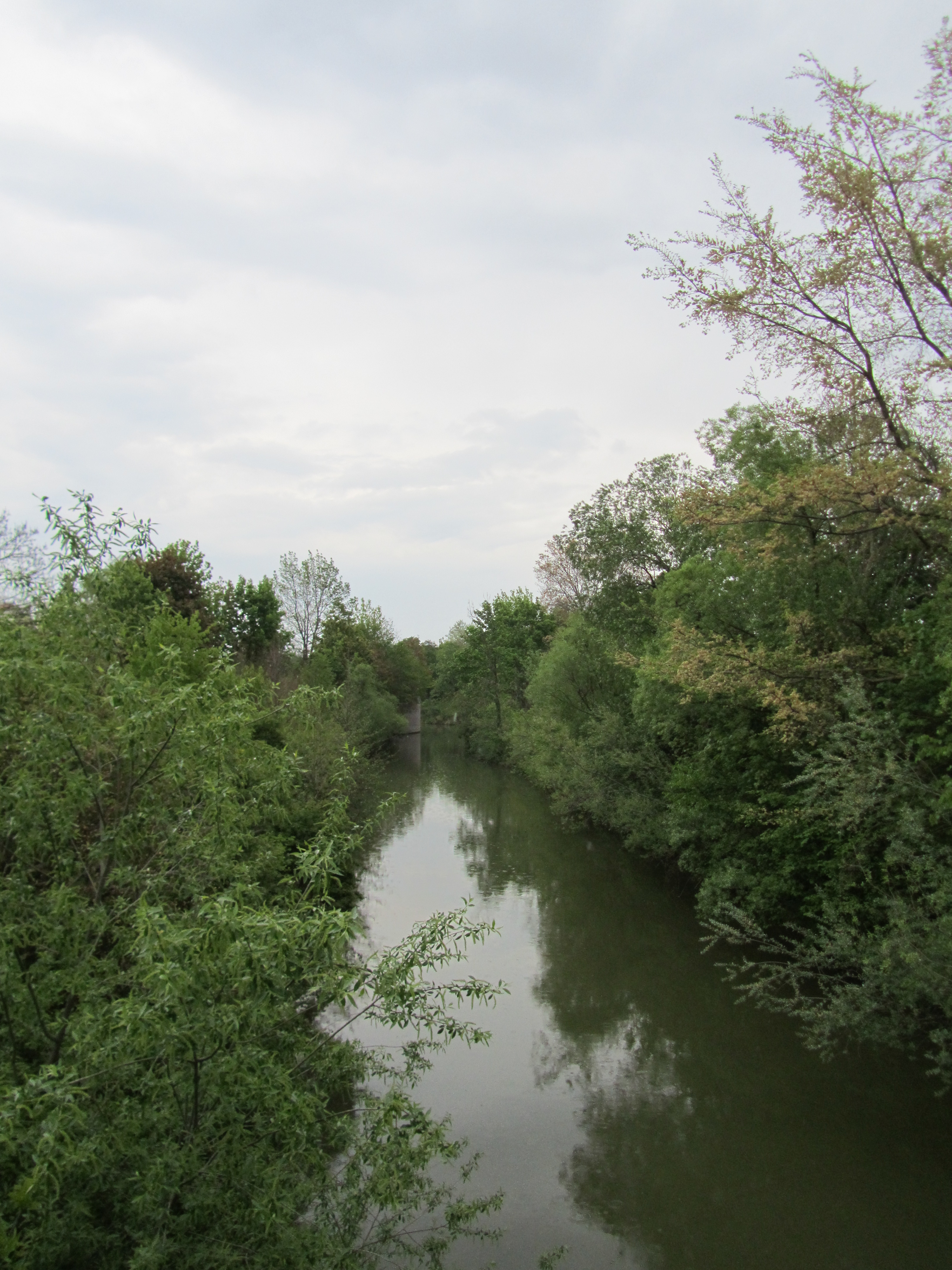
In Strebersdorf, we linked up with the Marchfeld Canal again, part of which we had seen on one of the earlier stretches, and carried on in even as it started to rain, noting the many places you could go down to the water and presumably swim. I couldn’t say I’d be very tempted as the water was pretty murky, but it might be nice to have the option nearby on a hot day.
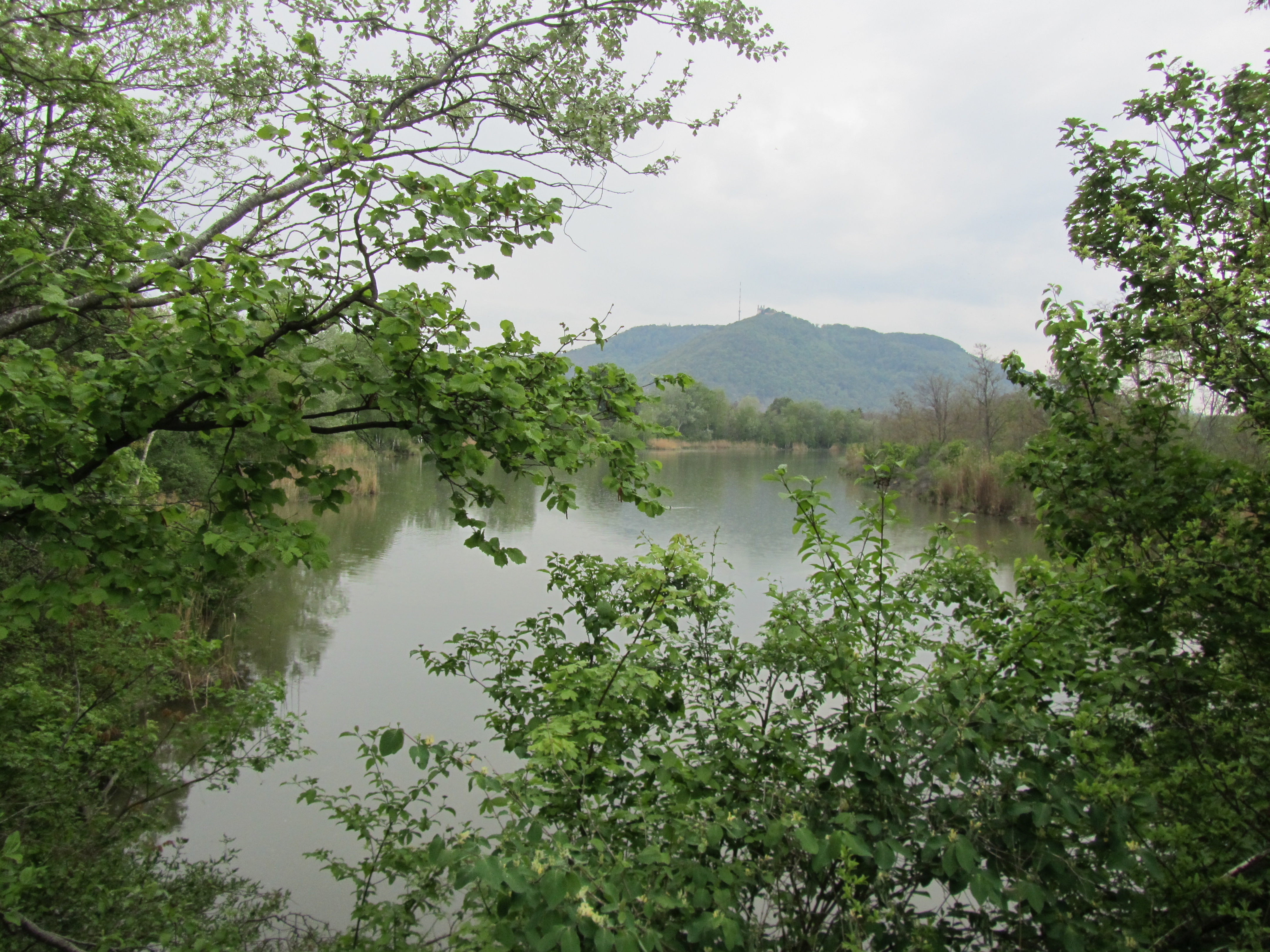
On the left is a stretch of the canal that had an unidentified round structure on the shore (barely visible on the lefthand side) and on the right is a view still of the canal, although it looks like a lake or pond, with a glimpse of the church at the top of Leopoldsberg on the other side of the Danube (not visible). You can see from the photos that the weather was not bright, to employ a bit of understatement.
As has happened before, we at some point lost track of the Rundumadum signs and had to find our own way. We navigated, rather unusually, by checking out the bus route and managed to find our way to the 34A, which took us back to Floridsdorf. And just in time. By the time the bus pulled into Franz-Jonas-Platz in front of the U6 station at Floridsdorf it was coming down pretty heavily.
As I look over my notes, scribbled while watching the marathon on TV, I’m not quite sure to begin. Perhaps at the beginning. 😉 I missed it, sadly, but the event was opened with speech from Austrian President Alexander van der Bellen, who emphasized the themes of this year’s marathon: joy, togetherness, and peace. (He was also reponsible for the starting signal, which worked, thank goodness, even though the bell fell off the can. [Sorry if that is not the correct terminology. I hope you can picture it nonetheless.]) The themes were highlighted by some of ORF footage, including an enormous “Stop War” banner on Stephansdom and a “Stand with Ukraine” banner on the Burgtheater, where the race ends.
As always, the commentary focused mainly on the first man, the first woman, the first Austrian man or, in this case, men, and the first Austrian woman. And as usual there was a lot to say what with giving running histories and personal interest stories — that the winner of the men’s race, Cosmas Matolo Muteti, placed 5th in Berlin in September 2021, that Vibian Chepkirui, winner of the women’s race, was defending her title, that one of the top Austrian men, Timon Theuer, has had a run of bad luck, which continued in this race as he fell and injured his hip at eight-kilometer mark and gave up finally because of the pain at about the 32-kilometer mark, that his pacemaker had planned to bow out at about the 30-kilometer mark but felt great so just kept going and crossed the finish line in 19th place. In fact, Muteti also commented that he could feel it was a really good day for him and so sped up to pass the leader, Oqbe Kibrom of Eritrea, who ended up coming in third, and so managed to cross the finish line first and with great panache.
As usual, I went down to watch the top runners go by at the stretch near me and was sad to realize I had missed the top men runners. (Boy, they must have been fast this year!) I made it just in time to see the leading Austrian man, Lemawork Ketema, go by and then Chepkirui, who was at that point still clearly in the lead of the women’s race. I waited about 15 minutes to see if the first Austrian woman would go by, but there was no sign of anyone. It turned out there was no top runner and, in fact, there was some question at the end as to who the fastest Austrian woman was. It turned out to be Anna Holzmann with a net time of 3:03:59, about a minute and a half faster than Carola Bendl-Tschiedl, the first Austrian woman to actually cross the finish line. (The start, as you can imagine with over 30,000 runners, is staggered.)
The men’s race was close at the end and exciting. The women’s race had me shouting at the TV it was so thrilling. Chepkirui was in the lead but Ruth Chebitok was catching up so fast and running so well that it really wasn’t clear if Chepkirui would find enough left inside herself to stay in the lead. She did, however, and, perhaps because of the pressure from Chebitok, broke the course record (Nancy Kiprop’s record) with a time of 2:20:59. Chebitok came in four seconds behind her. It galled me that although there were interviews with three of the men (the winner, the first Austrian, and the pacemaker who completed the race) there were none with the women, in spite of that spectacular run. Of course, there could be other reasons than unconscious bias for that omission — Chepkirui was clearly exhausted at the end or perhaps she doesn’t speak English and they didn’t want to spring for an interpreter — and then again it could be unconscious bias. ORF take note!
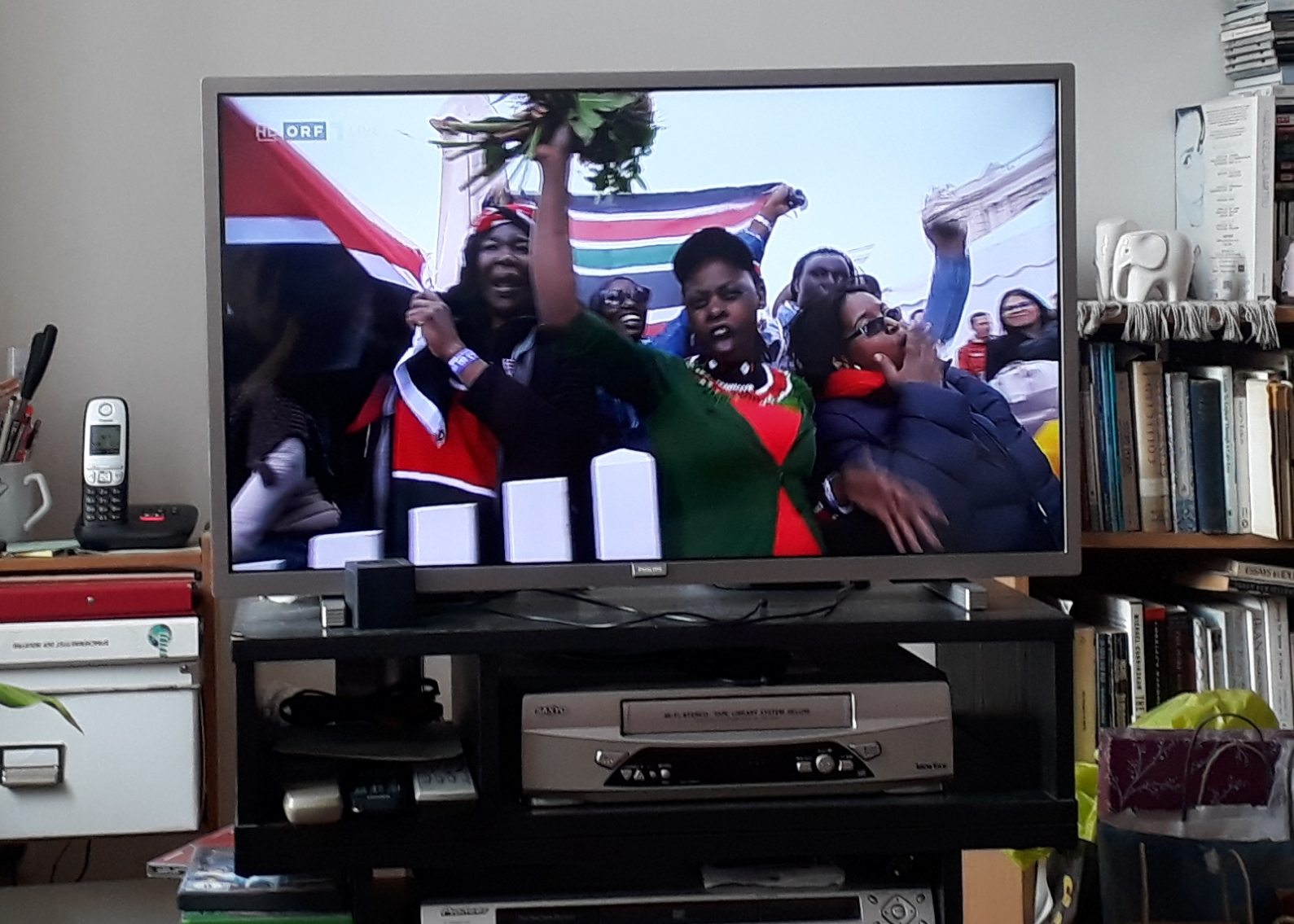
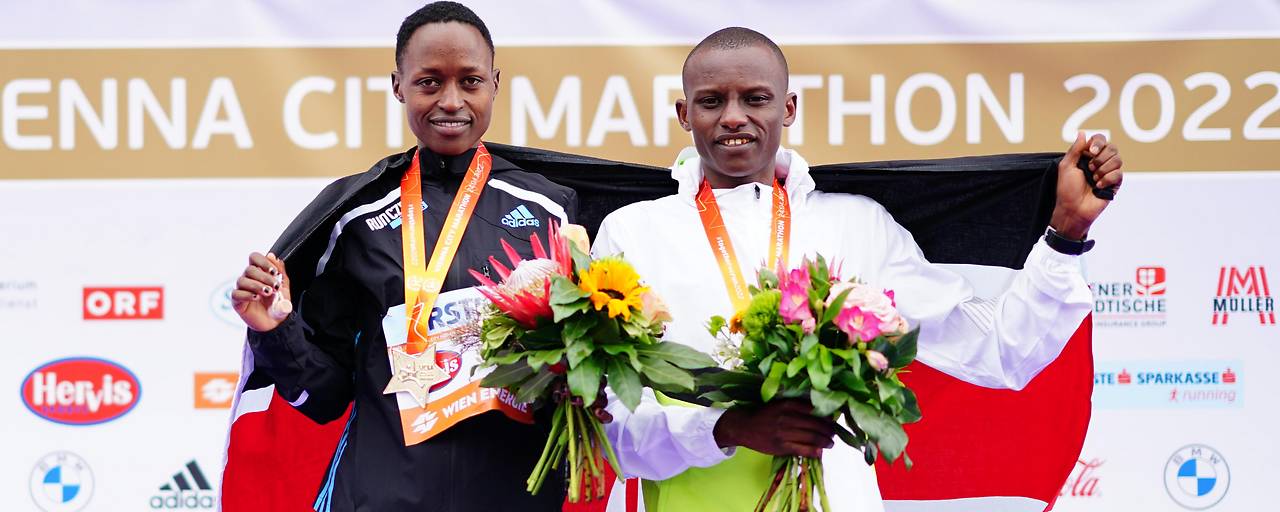
In any case, it was a Kenyan day. Out of the six top runners, the three men and the three women, five were Kenyan. And the Kenyan fan base went wild (see photo of my TV). I also thought it was lovely that in the photo session after the award ceremony Muteti, who had done his victory lap wrapped in a Kenyan flag, shared that flag with Chepkirui (other photo, from the ORF website).
Where I went today to see if I can test my way out of quarantine. (Yes, the evil C-Virus did finally catch up with me.)
Just made me think of a line from an old Jennifer Aniston – Paul Rudd movie. Their ballroom dancing teacher kept admonishing them “Head up, young person!”
A week ago, my walking partner and I (and Maylo, of course) walked the 22nd stretch of the Rundumadum trail. It’s amazing to me how the landscape changes. After all, we are circumnavigating only one city.
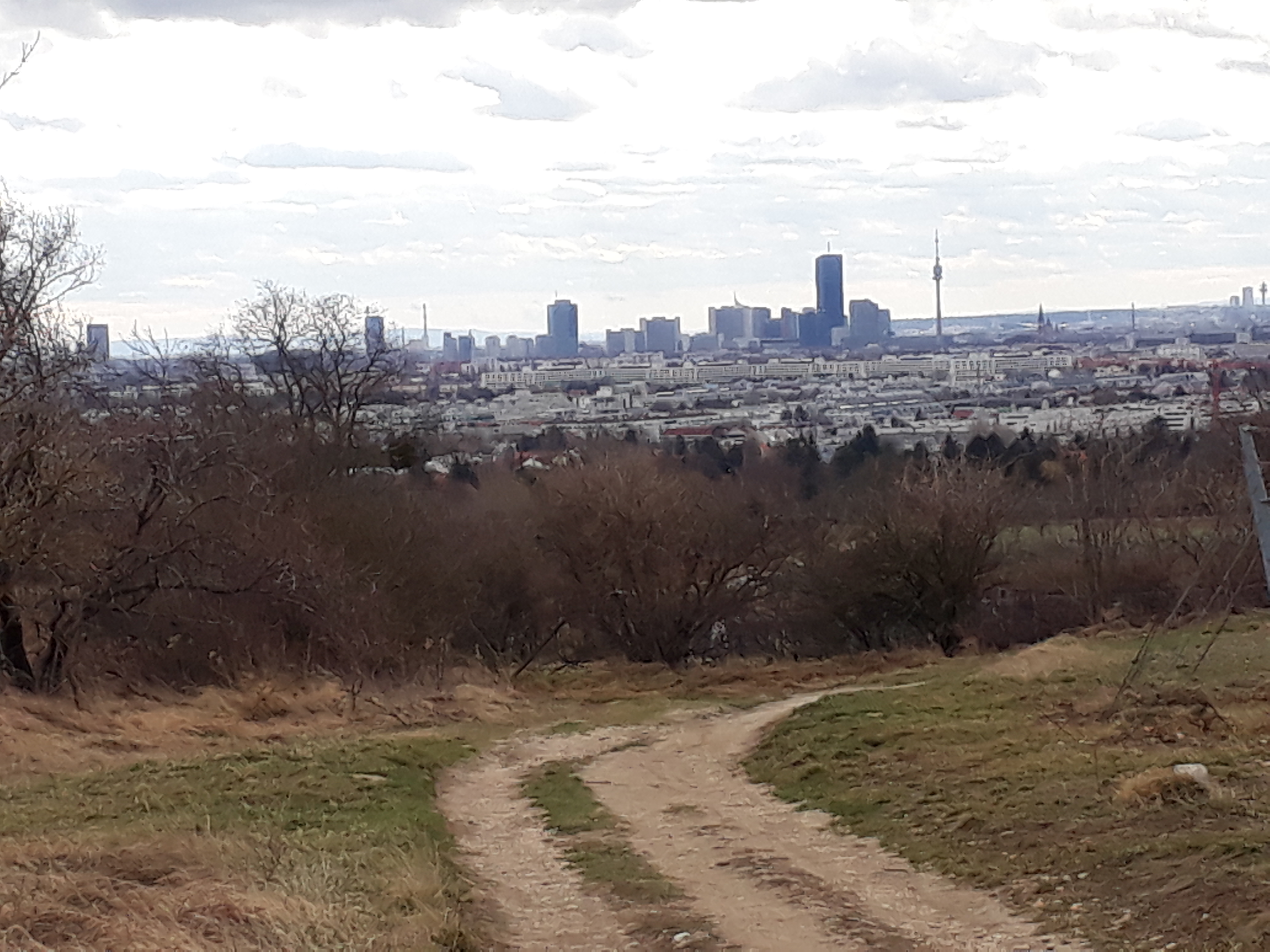
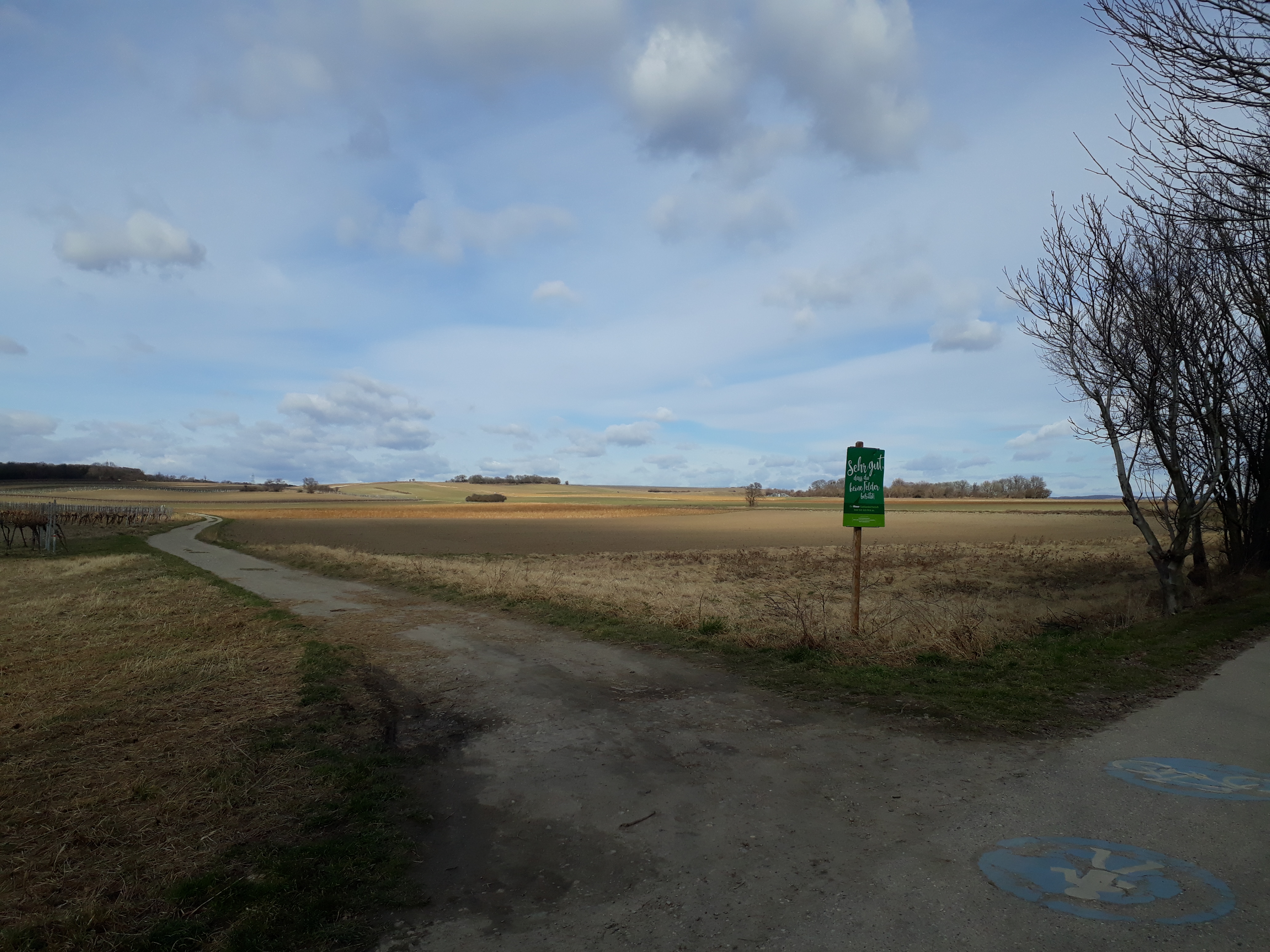
This time we walked through rather bleak vineyards (well, it is still February) and then open fields on the flat, with a view of Vienna on one side and of Lower Austria (not shown) on the other, before climbing up a stretch of Bisamberg and heading back to Hagenbrunn.
I’ve walked this route before but in the other direction when doing the Stadtwanderweg (city hiking trail) number 5 with a friend. In addition, I have pleasant memories of snacks on Bisamberg before Bergheuriger Langer closed its doors forever, a stop once at the Magdalenenhof, and enchanting coppices (or copses).
It was a pleasant, uneventful hike — even the buses ran when they were supposed to. 😉 We only did one stretch, which turned out to be just right. Anyway, I’ll be going back to re-visit the Heurigen (wine taverns) out that way when the weather gets warmer.
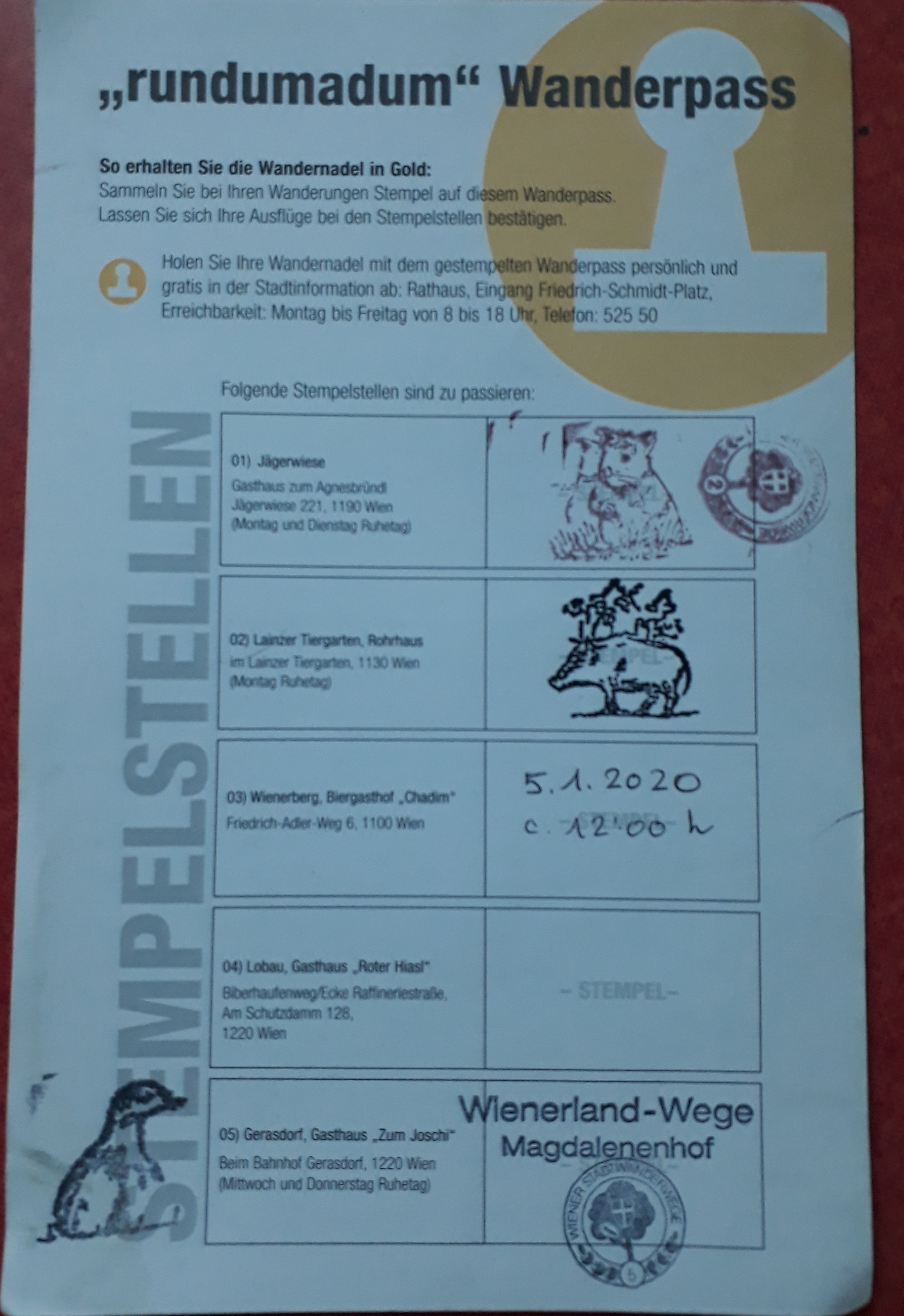
The Magdalenenhof, as you can see at the bottom, is a Stempelstelle or place to stamp one’s Rundumadum card, necessary for getting the hiking pin of the City of Vienna.