A new corner of Vienna, and a new idea

2 Nov

It is (still) autumn and for me, after so many years of living according to the academic calendar, it is (still) the time to start new endeavors.

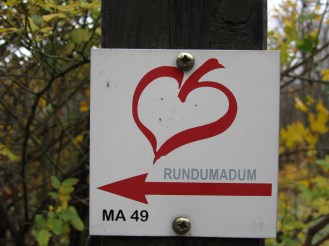
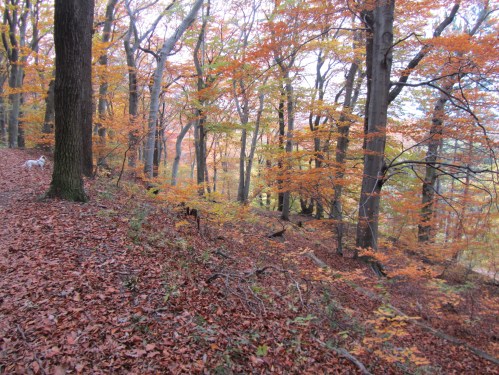
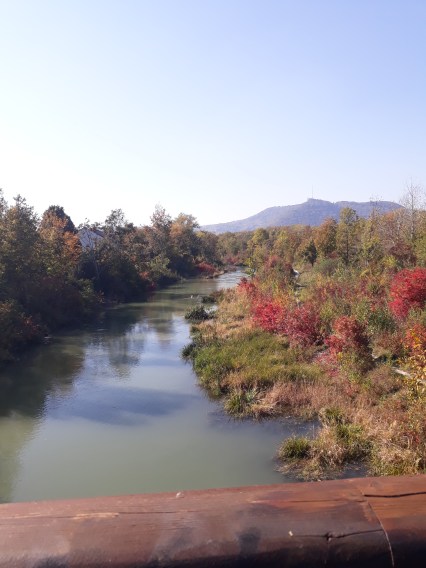
In my last post, I said I’d like to start exploring the neighborhoods around underground (subway / metro) stations I don’t know. Rather without meaning to, I seem to have started a second project along the same lines. I have done two sections of the Rundumadum hiking trail, the trail that takes you through Vienna’s “Grüngürtel” or “green belt”, and am thinking I’d like to walk the whole thing.

Stay tuned and keep an eye out for the dedicated tag “Rundumadum”.

A new corner of Vienna

26 Oct

Somehow I find myself avoiding my usual corners of Vienna, like Neuwaldegg or Nussberg. They’ve been so crowded recently that I’ve hardly enjoyed my walks there with Maylo. I think it’s great that so many people are out in our beautiful fall weather getting some exercise and fresh air. I just don’t want to share the space with all of them. It isn’t very restful.

Today, on the Nationalfeiertag (celebration of Austria’s neutrality clause after the Second World War), Maylo and I followed up a tip from another dog person and took the U1 out to its new (to me) terminus, Oberlaa, where there’s a clinic / spa with thermal waters.


My ancient (1988) Baedeker’s Austria tells me that the Kurzentrum Wien-Oberlaa is a “spa treatment establishment” opened in 1974, a date that doesn’t surprise me as it showed up constantly on the various signs in the Kurpark. The site was the scene of the Vienna International Garden Show in 1974, and a number of attractions in this 860,000-square-meter green space, like the sculpture on the Rosenhügel or the Japanese garden, date back from that year.


Unlike many of Germany and Austria’s spa towns, Oberlaa does not seem to have a long history of people taking the waters there in spite of the fact that they, according to my Baedeker’s, have one of the strongest and hottest sulfur springs in Austria. (I figured out about the sulfur without Baedeker’s help. You smell it the moment you get out of the underground station.) So it’s not very traditional but they wasted no time in establishing two things essential to any Kurort: the park and a famous patisserie.

The park, true to Kurparks everywhere, is a carefully controlled environment suitable to people being treated for various maladies. There are paved paths, railings, lots of benches to rest on, carefully tended flowerbeds and lawns, and completely tamed bodies of water. It’s also suitable for people staying for several weeks at a time, providing different attractions like a petting zoo, restaurants, different kinds of gardens including an allergy garden(!), and, no doubt, somewhere a gazebo for concerts on fine days. We wouldn’t want people to get bored while they’re being treated!


Maylo and I didn’t make it to the patisserie, Kurkonditorei Oberlaa, but we wandered about the park and enjoyed ourselves, catching the impressively clean and quick U1 back into town when we had had enough.

Our excursion has inspired me to start a new practice. I’m going to try to get around to all the underground stations in Vienna to see what is there, focusing especially on those stations I don’t go to regularly. Look for more under the tag “U-Bahn stations”.

A note for my readers not familiar with the Austrian concept of Kur. A Kur is a stay, usually about three weeks, at a nice, although sometimes somewhat clinical, hotel at a place with special springs where various medical conditions are treated. Several of my friends have been on Kur for intensive physiotherapy. It’s almost de rigeur after major surgery. And sometimes it is prescribed simply because people are feeling run down. It sounds like something for rich people and did use to be. The aristocracy of Europe used to run into each other at Kurorte all over Germany and Austria and similar places of healing in Switzerland (those sanatoriums!). These days, though, it is prescribed through the national health system here and patients pay only a tiny daily rate based on their income. There’s something (else) to be said for social democracy.

This means that a Kurort is a town with such an establishment, a Kurpark is a park attached to such an establishment, and a Kurkonditorei is a Konditorei or patisserie especially associated with such an establishment, essential because the Austrians, on the whole, have never been all that good at denying themselves the pleasures of life if they could help it.

At it again

7 Oct

Austria cleaned up at the EuroSkills competition (for people learning trades and crafts) for the fourth time in a row with a total of 21 medals. Russia (a rather larger country than Austria, if I may point that out) came in second with a total of 19. The Russians did have more gold medals (nine to Austria’s four), but still. I’m so glad there are still countries that promote and reward the trades!

The vineyards in Vienna

29 Jul

Vienna is officially the city worldwide with the largest area within city limits devoted to vineyards. Just one of the many reasons I live here! 🙂

https://m.facebook.com/story.php?story_fbid=10156858863584665&id=347303004664

Heatwave

28 Jul

It’s going to be hot the next few days. Here are a few tips from today’s Kurier on how how to stay cool in a city that until recently has largely eschewed air-conditioning.

1 Follow the heat-crazed tourists to the bars and restaurants of luxury hotels. Guaranteed temperature 19°C.

2 Go to a fishmonger’s. Hopefully, everything there is on ice.

3 Churches, basilica, and cathedrals. Now is the perfect time for appreciating art history and quiet reflection.

4 Cinema. Go to one matinee after the other.

Finally, you could get into your car, turn the air-conditioning on full blast, and drive for hours around the block.

I hope some of these tips help you enjoy the weekend.

Wien ist ein Dorf (Vienna is a village)

25 Jul

This evening I decided to try out a pizzeria, highly recommended by friends, near Maylo’s vet. The head waiter came to take my order and opened with “Hallo, Nachbarin!” (“Hello, neighbor!”) I looked up and saw the man who was my neighbor for a number of years before moving out a few years ago without a word to me. Vienna is, as people keep telling me, a village.

A scene from the World Cup

16 Jun

Since neither Austria nor Italy are in the World Cup (which in the case of Austria is not so surprising) this is the only flag I’ve seen so far. (The Pride flag wasn’t there yesterday. I assume that is because of the Pride Parade today.)

More or less unheard of in Vienna

28 May

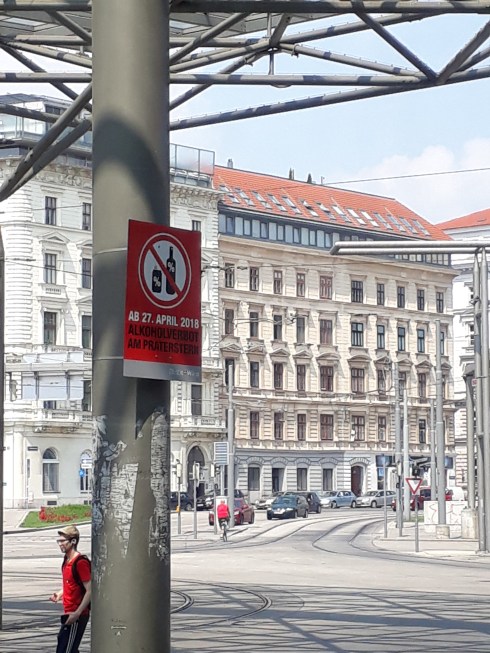
Generally speaking, you can drink alcohol where and when you like in Vienna (and you don’t need a brown paper bag). However, there has been so much violence at Praterstern recently, much of it alcohol-inflamed, that alcohol is now forbidden there. Drastic times, drastic measures.

New Mayor

26 May

I just feel I should report that after 23(?) years Vienna has a new mayor. Dr. Michael Häupl departed on Thursday and the new mayor, Dr. Michael Ludwig, has taken up the reins. Just FYI: It’s not a pre-requisite that you be called Michael to be mayor of Vienna. The one before Häupl was named Helmut … However, it does seem to help if you have a PhD.

Pentecost Monday (holiday)

21 May

I found myself early-ish this morning, about 20 minutes on foot from Stephansplatz, the heart of the city, walking along in peace and quiet with a thrush singing from a rooftop on my right and a dove cooing in the park on my left. My heart sang along.