Maylo and I are still in bed as I write this. We would get up (it has stopped raining), but then we would get to the Trafik before they opened and not be able to get treats (Maylo) and Saturday newspaper and instant lottery ticket (me). They’re opening an hour later than usual for the time being. Special coronavirus opening hours.
Will the ante be upped?
19 MarThere was some question today whether the parks would be closed to prevent the spread of the coronavirus. A friend of mine was quite worked up about it because–as so often happens–the people who were behaving carelessly were ruining things for the rest of us. (She said people had been partying in the park near her.)
Given that this was hanging over our heads, I checked the news especially before going out with Maylo this afternoon and saw that the Minister of Health had specifically said that parks were not (yet) going to be closed. Nonetheless, it was hard to miss the police present in one of the parks we often walk in. Three police officers just keeping an eye on the distance between people and occasionally speaking to pairs or trios, asking them to move farther away from each other.
Because I was alone with Maylo they didn’t say anything to me. We even were able to sit in the sun a bit. Then there came the announcement over the bullhorn, “Hier ist die Polizei. Bitte gehen Sie nach Hause.” (“This is the police. Please go home.”) Slowly, reluctantly, people got up and started to shuffle, more or less, home. It was only when Maylo and I were about halfway home that I realized they were almost certainly talking to a specific group of people, no doubt behaving carelessly. They only said it once and did not do a tour of the park.
We shall see where we go from here.
Gratitude
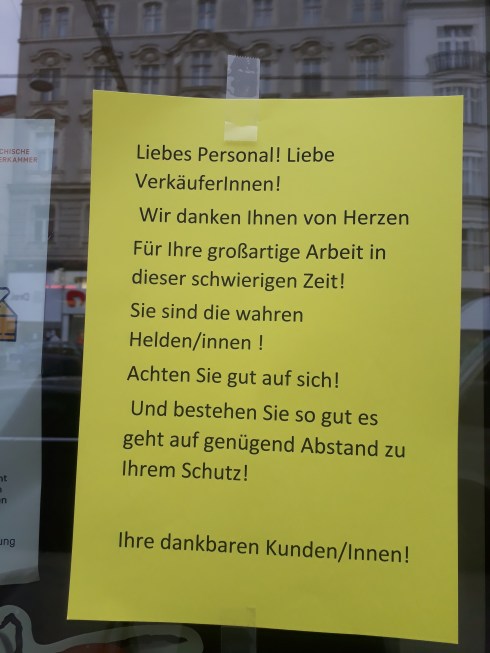
17 MarI saw these yellow signs this morning on all the shops on my street that are still open – the pharmacy, the drugstore, the supermarket. It is a thank you to the people keeping the shops going and calls them true heroes. Yes, the commitment, often the humor, and the sheer hard work they have been putting in for the last five days or so are indeed heroic.
A crisis with an odd sense of comfort
16 MarJust a quick post today to say that two aspects of this coronavirus crisis are particularly disorienting here in Vienna.
One is that we are going through this in considerable comfort. As the child of two Europeans, both of whom grew up in war zones during the Second World War, I have always assumed that a crisis would be accompanied by severe rationing (=hunger, for years), cold, long stretches without water or electricity, not to mention the fear of having a bomb dropped on your head or the head of someone you loved. It is almost disturbing to have everything, including, so far, excellent internet, phone service, and so on. It seems it should be more painful!
Come to think of it, that is not only the impression I got from my parents. When you grow up in New England, as I did, you know there can be snowstorms that take out the power and telephone for days on end and therefore make sure you have food, wood, and water on hand. You know that you will have lots of time to read (provided you have alternative sources of light), but you don’t expect it to be really comfortable.
The second factor contributing to this sense of disorientation is the exquisite early spring weather we’re experiencing. How can something bad be happening when the sun is shining the way it is and blossoms and flowers are coming out?
It doesn’t seem possible–and yet it is.
NYTimes: My Lockdown Diary, From a Small, Old Town in Italy
15 MarMy Lockdown Diary, From a Small, Old Town in Italy https://nyti.ms/2IJA34u
I read this an hour or two ago and now the ORF (Austrian broadcasting) has just announced that Tyrol is being locked down along these lines.
Mobility in the time of the corona virus
15 MarYesterday I picked up A4 paper at Libro, as announced in yesterday’s post, and, I must confess, I picked up something else–a bicycle helmet.
I’ve been meaning for a couple of years to replace mine, which is over 25 years old, but the truth is that for various reasons I haven’t been riding my bike. Now, though, even with the relatively empty trams, I’ve been thinking I might want an alternative form of transportation.
I had already gone to the sports store near me a month or so ago to look and get some information, and yesterday I decided the time had come to act.
At the cash register the woman in front of me in line was buying a city scooter. The process was taking some time–the salesperson was making some adjustments for her–so I started a conversation. (This is something I ordinarily wouldn’t do in Vienna as it is frowned upon but seems more acceptable under these exceptional circumstances.)
I pointed to the helmet I was buying and said,”Are you thinking in terms of alternatives to public transporation, too?” She opened up, telling me that she wants to make sure she can check in on her elderly parents without taking the tram and would prefer to get to work that way, too. (She is in a job where her presence is required.) Then she pointed to the bike helmet and said, “I don’t like riding on the street so I’m getting something I can use on the sidewalk.”
By then her scooter was ready to go. She rolled away, and I finally purchased my helmet.
Somehow I have the feeling that, before this virus is under control, I’ll be getting done a number of things that have been on the back burner for quite some time.
On today’s to-list: Get bike out of cellar, pump up tires, and take bike for a spin.
A city in corona mode (and I don’t mean beer)
14 MarGreetings from Vienna in an “Ausnahmesituation”. (I’ve just realized I am not sure of the English for that. “Ausnahme” is not as strong as “emergency” but it does tell us that it is certainly not business as usual. LEO tells me it means “exceptional circumstances”.)
So how has the coronavirus so far changed how we live and do business?
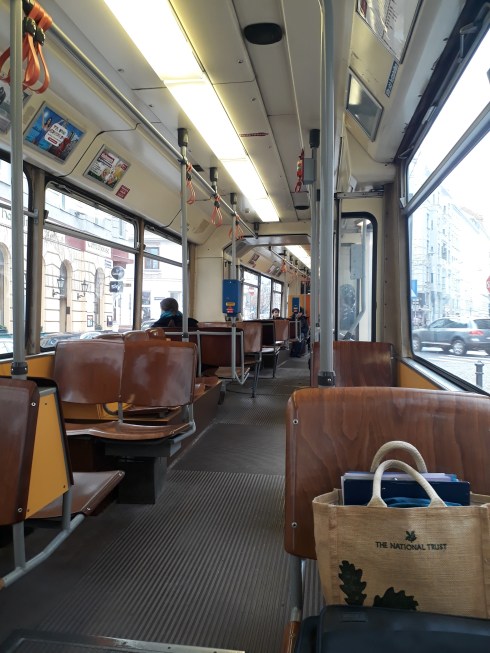
One of the biggest changes I see at the moment (other than the fairly empty trams ;-)) is that, as the ORF website put it this morning, “Nichts mehr ist selbstverstaendlich” or “We can’t take anything for granted anymore.” The ORF has been sending out updates every hour or so instead of every few days. From hour to hour the situation changes.
Yesterday St. Anton and Panzauntal were put under quarantine. This morning a ski resort in Carinthia, Heiligenblut, was added to the list.
The universities switched to online learning last Wednesday. As of Monday, schools will be closed.
A few days ago, indoor public gatherings of more than 100 people (and outdoor gatherings of more than 500) were banned. (Vienna without concerts–otherwise unimaginable!) Yesterday we heard that as of next week restaurants and so on will only be open until 3 p.m. and night spots will be closed until further notice. Most stores will be closed as of Monday, although (luckily) for the time-being supermarkets, pharmacies, and banks, among other exceptions, will stay open as usual. (More about the supermarkets in another post.)
Many employees have already started working from home. As of next week it will be more. (I’m wondering how well that will work with the schools closing and am glad that I “only” have a dog.)
Of course, all of these measures are being imposed by the government. I will say openly that I am not a fan of the current chancellor in general, but I feel the Austrian government under his guidance (as well as the City of Vienna government) is responding well–clearly, calmly, unequivocally, and willing to make what could be unpopular decisions.
There have been calls for solidarity, a very special word in European politics, not just because of the Solidarity movement in Poland, and apparently people are responding. In a city where, in many cases, people are only on nodding terms with their neighbors, we are being encouraged to look out for older people and others who are especially at risk, and offer to run errands for them. Exceptional circumstances, indeed!
This will not be my only post on the subject, I’m sure. In fact, I’m creating a special coronavirus tag. But I need to go now. I got my groceries at 8:00 this morning but have realized that I need more paper for the printer if I’m going to be working from home, and Libro (office supply store) is presumably one of the ones that will be closed after today.
May my readers be of good health and cheer through these exceptional circumstances!
A glossary
4 MarFor a long time I’ve been meaning to write up a glossary for the Viennese concepts I find hard to translate. This seems like a good time to get started. (I’ll add to this as I go along.)
Magistratsabteilung or MA – a city office responsible for a specific task, e.g., the MA 48 is the city sanitation office.
Melange – a kind of coffee typically made from espresso, hot milk, and milk foam. Anyone who has ordered a melange knows, however, that this is not carved in stone. (In fact, it’s somewhat disputed.)
Schmäh – a special kind of Viennese humor that should come with a winky emoji.
Trafik – a small store with a special license to sell cigarettes, tickets for the public transportation, and lottery tickets, for example. The practice started after the First World War, if I remember correctly, to create jobs for wounded veterans.
What some Viennese choose when they have three wishes
4 MarThis, too, is a side of life in Vienna. The good fairy offers the Viennese man three wishes. First he asks for a soft liver. And then for two more beers.
A good start to the day
20 FebJust one of those fun exchanges with the men of the MA 48 (city sanitation) to start the day off well, including a good example of Wiener Schmäh:
Maylo and I walked out of our door and down the street this morning. There was a worker from the MA 48 in his distinctive orange uniform at the entrance to the apartment building next door. As we approached, he held up his hand to someone in the building. Maylo and I stopped, and then he encouraged us to carry on and made sure his colleague who was bringing out the trash bins waited until we had passed. I thanked him. A few seconds went by and he said, “Auf den Hund passma [passen wir] auf.” That is, “We’re looking out for the dog” emphasis on “dog”. What could I do but laugh, thank him again, and carry on.
That kind of humor is part of what is called “Wiener Schmäh”–a kind of humor that requires a winky emoticon.
“Magistratsabteilungen” or MAs are city offices. They all have numbers and you start to realize the central points of your life by which numbers you know by heart–MA 6 for pets, MA 35 for immigration, MA 42 for parks and gardens, and MA 48 for sanitation.

