Mylo and I saw a fox in the park yesterday evening on our last walk of the day, practically downtown. This city never fails to amaze me.
Archive | Vienna, City of My Dreams RSS feed for this section
Christmas greetings
24 DecSome things, thank goodness, never change–or at least they haven’t changed yet.
I am in the process of sending out my Christmas and New Year’s greetings by e-mail and am getting a slew of auto-replies back. Almost all of them say that the recipient is out of the office until January 7. Apparently, people are still honoring the twelve days of Christmas here. What a wise folk! 😉
The Wiener Linien
1 NovThe Wiener Linien is the public transport authority in Vienna and true to form they are running extra trams on this All Saints holiday to accommodate those people who can’t afford a car or simply choose not to drive to the cemetery for their traditional visits to the graves of late loved ones. Classic Vienna.
State holiday
26 OctAbsolutely perfect fall weather (see below) for the Nationalfeiertag today and a record number of people in the Vienna Woods to make the most of it. What does Austria celebrate on its state holiday? Many Austrians themselves are not sure. A quick look at the German-language Wikipedia shows that it is Austria’s return to sovereign state status when the last occupying troops (Brits in the province of Carinthia) left. The Austrian parliament then immediately enacted a law ensuring Austria’s eternal neutrality, a point that is now viewed with some skepticism given Austria’s EU membership. So today Austria celebrates its sovereignty and its neutrality. True to Austrian custom there is no extra day to make up for the holiday even though it falls on the weekend. On Monday we all have to go back to work. In the meantime we get to enjoy this:
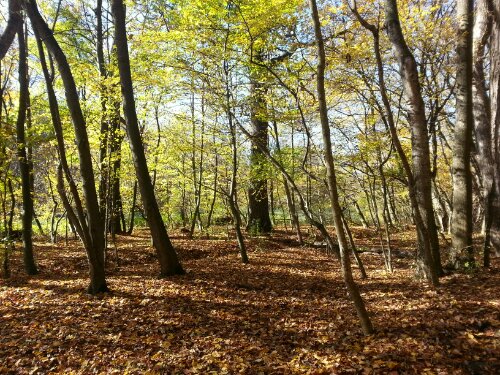
Fall weather
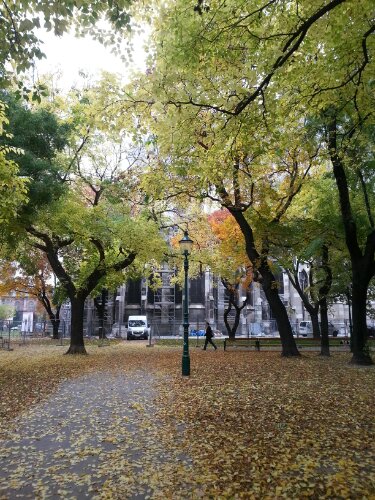
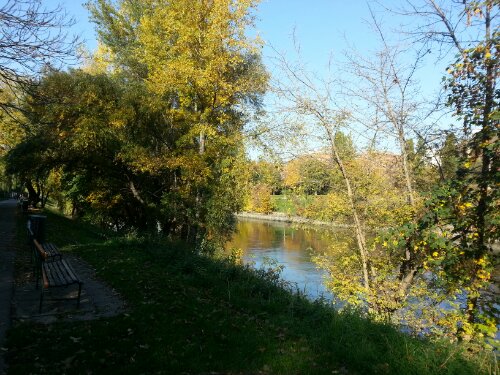
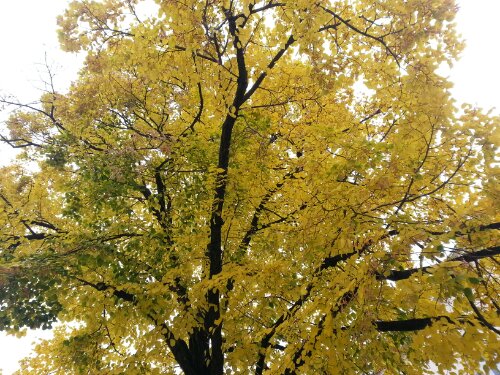
23 OctWe are finally experiencing some perfect fall weather and I get to enjoy it in spite of an unusually heavy work load at the moment because Mylo, of course, still needs to be walked. The photo of the canopy of golden trees with the golden carpet under foot was taken yesterday at the Votivkirche. The other photo was taken today at the Donaukanal. Long live the autumn!
More on Kaiserstrasse
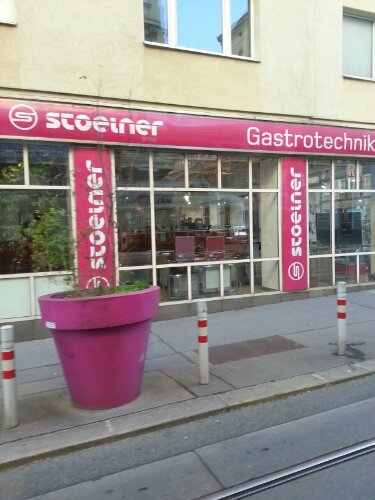
17 OctI’m spending a lot of time on the number 5 tram riding along Kaiserstrasse at the moment (long story) and occasionally still see new things, like several of these large, hot pink flower pots. Now I wonder whose idea they were.
Living without a car in Vienna
12 OctOnce again something from today’s Kurier.
In the city section the Kurier reported on an apartment complex built 13 years ago in Vienna’s 21st district where the rental contracts require residents to commit to neither owning a car nor using one regularly over a longer period of time. Over 700 people have chosen to live this way, filling the complex to capacity.
This is possible, in part, because of Vienna’s exceptional public transportation. But the Viennese mentality, with its deeply-rooted ambivalence about cars, also supports the creation of such a space. The Viennese, for the most part, accept the taxes and so on that make owning and driving a car in Vienna (and Austria) very expensive. For years they have resisted the various campaigns to get car drivers to rebel (although the system of parking permits recently introduced by the red-green coalition currently governing Vienna have finally managed to anger them).
One of the greatest advantages of signing away one’s right to a car should be rather obvious. The money that otherwise would have gone into building a large garage for residents has instead gone into landscaping, which includes large green spaces and even a goldfish pond, and nicer communal rooms for events with even a shared bike repair workshop in the basement. (Well, you would need that, wouldn’t you. ;-))
The assumption was that such an apartment complex would attract a certain kind of person–someone who might choose to have greater control of how the work around the complex is done–and that has been borne out. This means that the work of the Hausverwaltung (the property management, usually outsourced to a specialized company) has been taken on by a group of residents, saving all of them about 1/3 of the usual costs–and the incredible frustration that most Viennese experience when dealing with such a body.
There are, of course, tensions. About 10% of the people do own cars having, as one resident expressed it, “… all the advantages of the facilities without sticking to the rules, and thereby taking away the chance for someone else who would be interested in living in the complex.” In addition, as a kind of co-op housing arrangement residents have the option to buy their apartment after a specified number of years. The no-car rule doesn’t seem to apply after purchase, which another resident said “waters down the concept of freedom from cars.” And there are some political tensions. The initial plan has Green Party written all over it. There’s some feeling that the “Reds” (the Social Democrats, for decades the indisputedly dominant party in Vienna) don’t stand behind the concept and will not be building more in the area–too afraid of losing power to the Greens in the district, according to some of the residents.
That said, in a side bar the Kurier reported on seven new housing projects, scattered around Vienna and supported by the Social Democrats, which will marginalize the cars. For example, the garages will be built on the edges of the developments, leaving the central green spaces free from cars, and residents will have all kinds of other options like car-sharing and free yearly passes for public transporation in their first year of residence.
Out of interest I checked some car ownership statistics because I have the impression that the number of cars in Austria has jumped dramatically since I arrived 25 years ago. The data I could find doesn’t bear this out, but then the earliest year I could find numbers for was 2003, 15 years after I arrived. Since I went to the trouble of getting it, here it is:
In 2003 there were about 4m cars on the roads in Austria (with a population of 8.1m that makes not quite half a car per person ;-)). In August 2013 there were 4.6 m cars and a population of 8.4m making it a little more than half a car per person.
Clearly this would be more interesting if I could make some comparison to the USA, for example, but when I tried to get the data I received the following message: “Due to the lapse in government funding, census.gov sites, services, and all online survey collection requests will be unavailable until further notice.”
Thanks to Statistik Austria for the information on car ownership and population (http://www.statistik.at/web_de/statistiken/verkehr/strasse/kraftfahrzeuge_-_bestand/index.html ).
The information about the apartment complex in the 21st district comes from the article “Ein Leben (fast) ohne Auto” by Josef Gebhard and appeared in the “Chronik” section of the Kurier on 12 October 2013.
Kaiserstrasse
23 SepIt is a sobering experience to take the number 5 tram along Kaiserstrasse these days. Many shops have closed and others are in terrible shape. Not very fitting for a route named Emperor Street.
The Trafik
14 SepTrafik is what English (EFL) teachers call a “false friend”. It may make the English speakers reading my blog think of “traffic” as in cars, yet it means something completely different in Austrian German, is something I think of as very European, and it, too, is changing.
First of all, a Trafik is a small, neighborhood store that has government concessions to sell tobacco products, some postage stamps, lottery tickets, pay-and-display parking stubs, and tickets for public transportation. (They also used to sell the dreaded Stempelmarken–those stamps you had to buy for any official transaction, for example, making a visa application. This particular system has since been modernized.) From my time in France–granted, over thirty years ago now–I seem to remember that there was an equivalent, the Tabac.
In addition to cigarettes and so on the Trafiks sell newspapers and magazines, smoking paraphernalia, greeting cards, wrapping paper, and such and are very much a part of everyday life in Vienna. I have the impression that most Viennese have one Trafik they always go to. I have four within a five-minute walk from my apartment and still almost always go to the same one, even though they weren’t all that friendly to me until I walked in the first time with Mylo. 😉
Trafiks traditionally have played a significant role in Grätzl* life. As one Trafikant (proprietor of a Trafik), interviewed in today’s Kurier, said, “Our customers and we were like family. People exchanged news about the Grätzl, sport, and politics. We knew who had died and when a new baby had been born. It was really nice in the Trafik.” In fact, to visit another European country briefly, in a few of her crime novels set in Venice Donna Leon has her police detective, Brunetti, get invaluable information from the Italian equivalent. The people in the Trafik simply know what is going on in the ‘hood.
But apparently, what with changes in the Trafikgesetz (Trafik laws) and in the concessions they have, ever more Trafiks are having trouble making a real living and, as is possible in a highly centralized administrative system, the government office responsible for regulating them can simply decide to close some down. According to today’s Kurier that government office is planning to close down about 10% of the existing 2600 Trafiks in Austria in the next four years.
Now I hear the free-market capitalists out there saying, “So what? That makes sense.” At this point I need to bring in some additional information. It has always been my understanding that many of the Trafikanten have disabilities that make it hard for them to get other work. One of the points of the Trafik system is to provide them with a moderately pleasant way of making a living and knowing that they are a part of and contributing to society. The Kurier article makes the same point. Some Trafikanten will retire, some will (have to) find other jobs, and the ones with disabilities will simply be out of a job.
For me, old-fashioned person that I am in some ways, it is simply a further sign of the deterioration of organic, local community. And I find myself paraphrasing Winston in 1984: Don’t close down my Trafik. Do it to someone else!
* See here for a brief definition of Grätzl.
All references in this post to the Kurier are to the article “Abschied von der Trafik-Kultur” by Michael Berger.
 ecbinvienna