Tag Archives: shopping

Shopping

21 Jan

I love shopping at Mastnak on Neubaugasse. It’s the epitome of the kind of specialty store Vienna used to have hundreds of (or perhaps thousands–I’m not very good with numbers).

In this case, their specialty is paper and office supplies, although they also have a very good arts and crafts department. A fews days ago when I was there, I was looking for refills for a four-color Lamy pen I’ve had since I was a teenager and erasers for a Faber-Castell propelling lead pencil. (You can keep your Mont Blancs and your Graf von Faber-Castels. I’m a middle-of-the-road kind of woman who appreciates quality and ease of writing but doesn’t want to take out a mortgage for a writing implement.)

I knew that I could get the Lamy refills because I have bought them there many times. I was less sure about the erasers, but having struck out at Libro (the Austrian equivalent of Staples, where I bought the pencil itself) I thought Mastnak was my best bet. I never should have doubted them. Even though I neglected to take the pencil to show them (Faber-Castell makes a lot of different models) they promptly took me to the right drawer and provided me with a pack of three erasers (the original eraser lasted at least five years so we’re talking fifteen years of use here) for a little over EUR 2. While I was there, I was reminded of the year I decided to use up old candle ends and make my own candles. I remembered how to do that from summer camp, but I had no idea where to get wicks. Well, that arts and crafts department I mentioned, which shares the floor with the pencil erasers–they sell wicks, among many other things.

For the record, I am someone who hates to throw out a toaster, for example, because I can’t repair it myself and the repair shop tells me it isn’t worth doing because the repair would cost twice what a new appliance would. I hate being made an accomplice to this wasteful, throwaway society we live in. For that reason, I deeply appreciate how the Mastnak product range and service make it possible to live an old-fashioned economical life, at least in my paper and office supplies. It makes possible a life where things (even old candle ends) aren’t just thrown away but are re-used.

As our grandparents could tell us, living economically in that way is also environmentally friendly. You don’t have to throw away the very nice propelling lead pencil because it doesn’t have an eraser anymore. You replace the eraser and get a couple more decades of use and pleasure out of it.  And beyond helping people recycle old candles and restore their mechanical pencils, Mastnak helps its customers live an environmentally friendly life by having a whole section of office products made, for example, from recycled paper. They even sell the inks you need to top up those refillable flipchart markers that most people don’t bother to refill, probably partly because it’s not easy to find the necessary ink.

Those aren’t the only points that make it a specialty store, though. Their staff know what they’re doing. They know where things are, even though the store is on several floors and has things squeezed into every corner. They understand what you need even from your rather flawed descriptions. And they are helpful. None of the quite common “Das gibt’s nicht” (“There’s no such thing”, which means “I’ve never heard of it” or “We don’t stock it” or maybe even “I’d have to get a ladder to get it down from the top shelf and that is just too much trouble”), which you might hear at other stores in Vienna. At Mastnak, they smile at you and lead you to the thing you’re looking for.

How can Mastnak survive, I hear you asking, when they take up time and space with erasers that only cost EUR 2 for a pack of three? For one thing, they sell Mont Blancs, too, and one Mont Blanc probably pays the rent for at least a week. For another thing, the store was crowded when I was there, with short lines at each of the several cash registers. They probably also have a thriving online business. Being lucky enough to live in this city, though, I’ve never used it.
The Third Day of Christmas

27 Dec

What a surprise it was to step onto the street today shortly after 8 a.m. for the first walk of the day and find people and cars and open shops and simply activity in general!

For many, my surprise will be incomprehensible. Was it really so quiet the last few days? Yup. Shops usually close in Vienna at midday on Christmas Eve and remain closed for Christmas Day and the Feast of Saint Stephen (known in the UK as Boxing Day). This year, however, Christmas Eve fell on a Sunday, when most shops are closed all day anyway, which meant that we have had three days of wonderful peace and quiet (and a most unusual abundance of free parking spaces) with the Viennese enjoying one of their favorite things–Ruhe (also known as peace and quiet).

Vienna time

14 Nov

Some of my readers know that I have been in the U.S.A. for a few months now. Shortly, I will be heading back to my life in Vienna. It’s been a wonderful time here and I am also looking forward to going back.

I’m looking forward to going back partly because of a photo a friend sent of the vineyards in Neustift magnificent in their autumnal splendor, but it was also helped by a drive to visit friends outside of Boston yesterday. I realize that along with Hall’s concept of monochronic and polychronic time and Levine’s studies of the pace of life there is another aspect of time not yet researched (that I know of)–when the periods of high activity are vs. the periods of low activity. I assumed (having now internalized Viennese time in a way I wasn’t aware of) that my hour and a half drive on Sunday morning at least would be restful. (I was mentally prepared for a Sunday afternoon rush hour.) I thought people would be enjoying a quiet Sunday morning at home with family, the newspaper, and a nice breakfast. Imagine my shock when by 10 a.m. the traffic was only slightly less heavy and fast than on a weekday. (The drive back late Sunday afternoon was completely overwhelming to someone who avails herself of public transportation wherever possible.)

The other side of this is that I’ll be going to the supermarket today and expect to have an easy time of it. This is something I try to avoid in Vienna as a lot of people go on Monday because the stores are closed (thank God) on Sundays. My experience here over the last few months tells me I’ll probably have an easy drive and short lines at the cash registers. Many people did their shopping yesterday instead.

Different periods of high activity and low activity …

Customer service

4 May

I’m doing a bit of clearing out this morning and found a file with the beginnings, in some ways, of this blog. I’ve been jotting down bits and pieces from life in Vienna since long before there was even something called the internet. This one is about quite a controversial topic in the U.S. American / Viennese dialogue, customer service.

One topic that comes up again and again among U.S. American expatriates in Vienna is the quality of customer service. The general opinion is that it isn’t very good. My feeling is that it is different from what you get in the U.S.A. but not always worse. Yes, there can be grumpy and / or rude waiters especially in the traditional coffeehouses, who sometimes—but not always—become less grumpy when addressed in good German. On the other end of the spectrum I have stories of customer service I’ve received in Vienna that is so good it is off the scale.

First of all, there is the kind of customer service that the Viennese miss when they go abroad. In the words of a Viennese who has been a professor at a major U.S. university for over 25 years, “I miss sales clerks who know what they are talking about.” He was referring to the system of training people to be specialists that is still common in Vienna.

Shortly after he said this I experienced vividly what he was talking about. I have the kind of engagement calendar which is like a ring binder and for which I need to buy new inserts every year. I bought it because I liked the look of it, never realizing that it is not a common brand and therefore very hard to get inserts for. For a number of years I went to one store on Kärntnerstraße in the First District. Then they fell victim to the general trend of replacing Viennese stores that had been there for generations with the usual chain stores you find in every European capital.

After asking around, I found out that there was another stationery store, Mayr & Fessler, on Kärntnerstraße that might have what I need. I went off to see if they could help me. The young saleswoman I talked to knew exactly what I was referring to but said she feared they were out but that they usually got their weekly deliveries from that distributor on that very day of the week. She would call down to the stock room to see if the inserts I needed had come in that day’s shipment. In under a minute she was able to confirm that they had. In less than three minutes one of her colleagues had brought them up for me. Having worked in retail myself, I was much impressed that she knew that a shipment should have arrived and that she went to the trouble of checking for me. When I thanked her she said it was “selbstverständlich” (approximately in this context “her job”).

This was the same store that, on another occasion, after selling me the leads for my mechanical pencil offered to refill the pencil for me. When I saw that they put the leads in from the top, not shoved up from the bottom as I am wont to do, I asked the saleswoman to show me how she had done it and got a quick lesson in the manufacturer-approved method.

Then there is the customer service in Vienna that allows the customer as much time as he or she wants. (Granted this can backfire—sometimes you are allowed far more time than you want!). The Viennese are used to being allowed to sit for an entire evening in a restaurant and would be shocked to be rushed or even kicked out. You must ask for the check in a Viennese eatery or you will sit there forever. The waiter will never bring the check without being asked.

I know the system in the U.S. is different. Having worked a short stint as a waitress I am perfectly aware that restaurants live from turnover on tables and the wait staff live from their tips. I still had no comfort or explanation to offer one of my Austrian friends who was in Washington, D.C., on business. After a hard day’s work he went out with some other European colleagues (all high-level employees of an EU government body) to a restaurant recommended to them as one of the best in Washington. They enjoyed the meal and were lingering over their coffee. The waitress brought the check. They were in no rush to pay. The waitress made a few subtle attempts to get them to pay. They resisted. She finally asked them outright to pay and leave as she needed the table. At this point they complied, naturally, in their opinion, leaving no tip. As the waitress confronted them about this they explained their position. At this point the manager got involved—on the side of the waitress! Whatever else you may have to put up with in restaurants in Vienna (grumpy waiters, slower service than you are used to, problems paying at the end) I doubt you will find that you are first asked to leave and then expected to tip for the pleasure!

And then there is the extraordinary customer service, the customer service clearly based on the Golden Rule.

For example, there was the time someone called me from the main post office. She had a postcard for me on which there was no family name and no address but my telephone number. It’s a long story how that happened. The short version is that I had met a student from Korea on a coach between Oxford and London. She thought she might be coming to Vienna so I gave her my telephone number and asked her to call me if she came. She sent the postcard to let me know that she wouldn’t be coming after all and, as all she had was my first name and my phone number, she used that. The lady from the post office asked for my address, I gave it to her, and she sent along the card.

There was also the time when I was so impressed by the customer service that I interrupted a busy day to painstakingly write, in German, a letter to the head of the company about the incident. I had paid for a purchase at my local perfume store with my debit card. Then I made a change to my purchases which entitled me to a credit. I was told that only the amount of my final purchases would be charged. Yet when I did my bookkeeping for the month I saw that the credit hadn’t been taken into account. The store owed me a little over EUR 12. With very little hope I went back to the shop, wondering how on earth I would be able to explain what had happened and back up my claim. I had barely launched into my story when the saleswoman said, “We owe you EUR 12.05.” She reached into a drawer, took out an envelope with the money in it, gave it to me, and gave me a small present to make up for the trouble of having to come back. I shall be their loyal customer until they are taken over by the international chains taking over all the small shops in Vienna.

The Trafik

14 Sep

Trafik is what English (EFL) teachers call a “false friend”. It may make the English speakers reading my blog think of “traffic” as in cars, yet it means something completely different in Austrian German, is something I think of as very European, and it, too, is changing.

First of all, a Trafik is a small, neighborhood store that has government concessions to sell tobacco products, some postage stamps, lottery tickets, pay-and-display parking stubs, and tickets for public transportation. (They also used to sell the dreaded Stempelmarken–those stamps you had to buy for any official transaction, for example, making a visa application. This particular system has since been modernized.) From my time in France–granted, over thirty years ago now–I seem to remember that there was an equivalent, the Tabac.

In addition to cigarettes and so on the Trafiks sell newspapers and magazines, smoking paraphernalia, greeting cards, wrapping paper, and such and are very much a part of everyday life in Vienna. I have the impression that most Viennese have one Trafik they always go to. I have four within a five-minute walk from my apartment and still almost always go to the same one, even though they weren’t all that friendly to me until I walked in the first time with Mylo. 😉

Trafiks traditionally have played a significant role in Grätzl* life. As one Trafikant (proprietor of a Trafik), interviewed in today’s Kurier, said, “Our customers and we were like family. People exchanged news about the Grätzl, sport, and politics. We knew who had died and when a new baby had been born. It was really nice in the Trafik.” In fact, to visit another European country briefly, in a few of her crime novels set in Venice Donna Leon has her police detective, Brunetti, get invaluable information from the Italian equivalent. The people in the Trafik simply know what is going on in the ‘hood.

But apparently, what with changes in the Trafikgesetz (Trafik laws) and in the concessions they have, ever more Trafiks are having trouble making a real living and, as is possible in a highly centralized administrative system, the government office responsible for regulating them can simply decide to close some down. According to today’s Kurier that government office is planning to close down about 10% of the existing 2600 Trafiks in Austria in the next four years.

Now I hear the free-market capitalists out there saying, “So what? That makes sense.” At this point I need to bring in some additional information. It has always been my understanding that many of the Trafikanten have disabilities that make it hard for them to get other work. One of the points of the Trafik system is to provide them with a moderately pleasant way of making a living and knowing that they are a part of and contributing to society. The Kurier article makes the same point. Some Trafikanten will retire, some will (have to) find other jobs, and the ones with disabilities will simply be out of a job.

For me, old-fashioned person that I am in some ways, it is simply a further sign of the deterioration of organic, local community. And I find myself paraphrasing Winston in 1984: Don’t close down my Trafik. Do it to someone else!

* See here for a brief definition of Grätzl.

All references in this post to the Kurier are to the article “Abschied von der Trafik-Kultur” by Michael Berger.

Christmas shopping

6 Dec

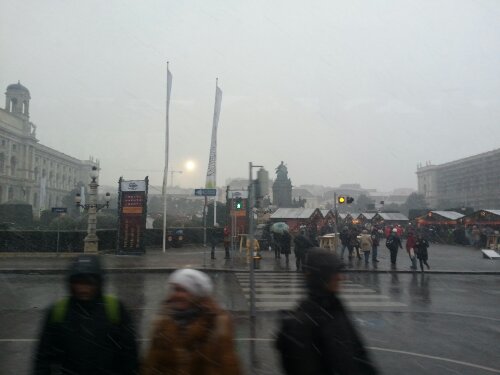
I was out doing some Christmas shopping this afternoon in what was supposed to be sunny weather.

image

🙂

Specialty shops – 1

6 Oct

The search for bobbins for my sewing machine has reminded me of the confusion and fun of the first year or so of living in Vienna.

In different countries you can find that things you need or want are not sold where you would expect them to be sold. What I most clearly remember was the search for contact lens solutions. Used to the all-service supermarkets in the U.S. I tried there first. People looked at me as if I were crazy. I fled. Then I thought, “I bet they have them at the pharmacy” (a much more restricted concept in Austria than in the U.S.), but when I asked there they thought I was crazy, too. But at least they told me where to go. In Austria, still, the one and only place to buy contact lens solutions is at the optician’s.

The Austrian culture is higher on uncertainty avoidance–that’s a technical term and part of Geert Hofstede’s model of cultural dimensions–than the U.S. American culture. One way this expresses itself is through the credence given to experts. What might happen if we were allowed to buy aspirin or contact lens solutions all by ourselves at the supermarket? (Other than the disintegration of the pharmacies and the opticians’?) Heaven alone knows! Better to be safe than sorry.

So back to my sewing machine. I thought I had figured the system out by this time. I went to a specialty sewing shop to buy, among other things, bobbins for my perfectly normal, nothing out of the ordinary Singer sewing machine. And was told I could only get them from Singer direct!

A Friday morning in Vienna in the summer (an e-mail to my mother)

24 Aug

Good morning, dear!

It’s promising (threatening? ;-)) to be very hot today. Mylo and I went for our usual walk and I took my usual break on my usual tree stump in the meadow at the Narrenturm. We were having such a nice time outdoors I thought “I don’t want to go home” and decided on the spot to go to Café Weimar, dogwalking shorts and naked face notwithstanding. So Mylo and I traipsed off to Café Weimar where we sat under the awning and I had a croissant and caffè latte. As Maylo’s vet is very near there and I needed to pick up the food I had ordered for him I considered hanging around until they opened at 9:00 to save myself an extra trip. However it was only 8:15, and I thought that might be a bit too much hanging around.

Then I found myself staring at the big sign announcing the weekly open-air market of organic and (relatively) local produce at the WUK on the other side of Währinger Straße. I’ve thought about checking that out for years and never gotten around to it. They didn’t open until 9:00 either, but I decided that those two things together were worth waiting for so  I pulled out a little notebook from my bag and started making notes for work on Monday and my interview on Tuesday. I was able to pull my thoughts together really well (amazing what a cup of strong coffee and nice surroundings will do for one’s concentration) and then went off and bought grapes to take to M’s party tomorrow and picked up Mylo’s food.

Just to top it all off—I texted P from Café Weimar and arranged to have dinner together this evening in Pötzleinsdorf.

I have now closed up all windows and lowered all possible blinds to stem the onslaught of the heat and am sitting here with the fan blowing on my legs.

Wishing you just such a nice day!!!