This past week I was at two exhibition openings, in each case at a Bezirksmusem.
Bezirk means “district” and is similar to what the Parisians mean with arrondissement. Therefore the exhibitions were at the small museums that serve each district in Vienna by maintaining and displaying things that are unique to that district. Sometimes these museums are located in the same building as the administrative offices for the district, as in the 18th district where I was on Thursday evening, and sometimes not, as in the 8th district where I was last Sunday. Usually they also house an auditorium that can be rented for different kinds of performances and occasions.
The exhibitions were completely different from each other and yet both fit perfectly the idea of what a Bezirksmuseum is for.
Last Sunday was the Day of District Museums in Vienna. Each district museum (there are 23) was open for most of the day and had its own exhibition on a common topic. In this case, the theme was—not surprisingly—“Vienna 1914: The End of an Era”. (People in other parts of the world may also be aware that this year marks the 100th commemoration of the start of the First World War.)
Each district in Vienna also has a name. For the 8th district this is “Josefstadt,” which explains why the exhibition was entitled “Josefstadt from 1900 to 1914”. If anyone doubts that there was enough going on in those 14 years to warrant an exhibition, allow me to put their minds at rest. It was a time in Viennese history when tremendous expansion was going on. When it seemed clear that the threat of the Turks overrunning Vienna was truly over (around 1858) the city walls were torn down, the famous Ringstraße with its stunning buildings was created, and the satellite towns were incorporated into the city proper. Josefstadt was such a town.
This meant that there was suddenly much demand for housing outside the first district and many of the Baroque houses—too small and too uncomfortable to accommodate the growing and ever more demanding population—were torn down to make room for much larger and, above all, taller buildings. (Sound familiar?)
New streets were created. Several existing streets, like Lange Gasse, were lengthened to open up contact to the—are you ready for this?—9th district. All of this expansion required new transportation and so new streetcar lines and then the Stadtbahn (literally “city railway”, now the U6, running along the old outer line of defense against the Turks) were constructed.
All of this meant that many open spaces, where old maps suggest gardens and orchards that provided food for the district, were built over. The improved transportation no doubt made it possible to bring in what was needed from areas farther out.
The 8th district is considered a very desirable neighborhood, and it was no different back then. The famous painter, Gustav Klimt, had his studio in the courtyard of a house on Josefstädter Straße. He, too, was a victim of the expansion. That house was torn down to make room for a bigger house with no room for artists’ studios, and Klimt had to move to the 13th district (also very desirable so my sympathy is somewhat limited). Apparently, though, he was so attached to his studio in the 8th district that he continued to use the address professionally.
Some of the obvious parallels from that era to this were highlighted by the talk given by the elected administrative head of the district. She mentioned a planned building that will cut off a historic view from the 8th to St. Stephen’s Cathedral. She didn’t mention the building of what has been referred to as the “phantom underground line U5”, but that, too, apparently is on the way. Plus ça change, plus c’est le meme chose.
On Thursday in the 18th district the exhibition was of ceramic pieces with modest price tags done by two residents of the district. The artists, married to each other, were both self-taught and had earned their livings doing something else. The guests were mainly friends, family, and neighbors, one had the sense. Music was provided by two ladies, one on the violin and the other on the cello and both well over 60 at a guess, playing Haydn(?) with an encouraging blend of skill, musicality, and love—true amateurs, then, who probably also live in the 18th. When one had sufficiently explored the artwork one could wander through the 18th district’s version of “Vienna 1914: The End of an Era,” more rural than in the 8th and as such fitting to the character of the district, which lies farther out. To round off the evening, the artists’ son and his partner danced the Tango Argentino.
So you see that, too, was simply a typical gathering at a Bezirksmuseum …
Two exhibition openings in one week
30 MarViolence in the city
3 FebSomething terrible is happening in this city I love. We are not used to violent crime, or really much violence (or crime for that matter), in Vienna, but in the last few weeks there have been reports of a tram driver being knifed in the back, violent demonstrations against a ball organized and attended by the extreme right wing, a dog (a Pekingese so it was clearly not self-defense) being kicked and throttled on the platform of an underground station, my neighbors were broken into and robbed when they were away for four hours only, and this evening coming home from work I saw two men attacking another man at a major underground station.
At first I thought it was just shouting. Then I saw they were pushing, kicking, and hitting him. It looked as if no one was going to intervene when suddenly four women emerged from the crowd and started to run interference to protect the victim, who was not only one against two but was also so drunk he was completely unable to defend himself. These women kept this up long enough and effectively enough, one on the phone to the police, that the attackers gave up and disappeared, at which point someone from the underground oversight appeared and took on responsibility for the drunken, battered man.
The women went their own ways, obviously previously unknown to each other, having simply stepped in spontaneously together in the interest of protecting the weak.
There is a campaign on in Vienna encouraging people to show more “Zivilcourage” (“moral courage” according to leo.org). These women, and not really anyone else in the crowded concourse, seem to have taken that message to heart.
If things go on as they are, we are all going to need a lot more “Zivilcourage”.
Kaiserstrasse
23 SepIt is a sobering experience to take the number 5 tram along Kaiserstrasse these days. Many shops have closed and others are in terrible shape. Not very fitting for a route named Emperor Street.
The Trafik
14 SepTrafik is what English (EFL) teachers call a “false friend”. It may make the English speakers reading my blog think of “traffic” as in cars, yet it means something completely different in Austrian German, is something I think of as very European, and it, too, is changing.
First of all, a Trafik is a small, neighborhood store that has government concessions to sell tobacco products, some postage stamps, lottery tickets, pay-and-display parking stubs, and tickets for public transportation. (They also used to sell the dreaded Stempelmarken–those stamps you had to buy for any official transaction, for example, making a visa application. This particular system has since been modernized.) From my time in France–granted, over thirty years ago now–I seem to remember that there was an equivalent, the Tabac.
In addition to cigarettes and so on the Trafiks sell newspapers and magazines, smoking paraphernalia, greeting cards, wrapping paper, and such and are very much a part of everyday life in Vienna. I have the impression that most Viennese have one Trafik they always go to. I have four within a five-minute walk from my apartment and still almost always go to the same one, even though they weren’t all that friendly to me until I walked in the first time with Mylo. 😉
Trafiks traditionally have played a significant role in Grätzl* life. As one Trafikant (proprietor of a Trafik), interviewed in today’s Kurier, said, “Our customers and we were like family. People exchanged news about the Grätzl, sport, and politics. We knew who had died and when a new baby had been born. It was really nice in the Trafik.” In fact, to visit another European country briefly, in a few of her crime novels set in Venice Donna Leon has her police detective, Brunetti, get invaluable information from the Italian equivalent. The people in the Trafik simply know what is going on in the ‘hood.
But apparently, what with changes in the Trafikgesetz (Trafik laws) and in the concessions they have, ever more Trafiks are having trouble making a real living and, as is possible in a highly centralized administrative system, the government office responsible for regulating them can simply decide to close some down. According to today’s Kurier that government office is planning to close down about 10% of the existing 2600 Trafiks in Austria in the next four years.
Now I hear the free-market capitalists out there saying, “So what? That makes sense.” At this point I need to bring in some additional information. It has always been my understanding that many of the Trafikanten have disabilities that make it hard for them to get other work. One of the points of the Trafik system is to provide them with a moderately pleasant way of making a living and knowing that they are a part of and contributing to society. The Kurier article makes the same point. Some Trafikanten will retire, some will (have to) find other jobs, and the ones with disabilities will simply be out of a job.
For me, old-fashioned person that I am in some ways, it is simply a further sign of the deterioration of organic, local community. And I find myself paraphrasing Winston in 1984: Don’t close down my Trafik. Do it to someone else!
* See here for a brief definition of Grätzl.
All references in this post to the Kurier are to the article “Abschied von der Trafik-Kultur” by Michael Berger.
Regeneration of a district – Neu Marx
20 Jun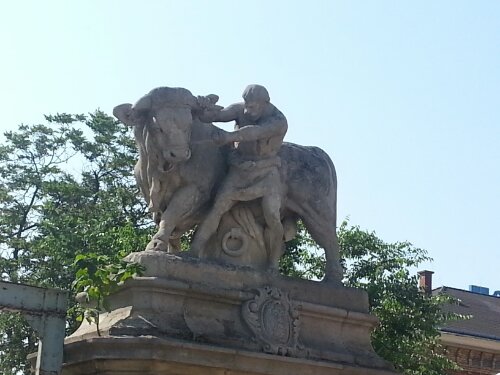
This morning Mylo and I took a trip out to a part of the 3rd district I haven’t been to in ages, if ever. We needed at health certificate for him for reasons that belong in another blogpost and had to go out to the MA (Magistratsabteilung) 60 to get it.
They are based in an area that used to house the stockyards and the slaughterhouses, as the photo above suggests, and are located on a street that did not appear on my 25-year-old map. (It didn’t matter. I asked a construction worker who at first said he was sorry they came in from Mödling and didn’t know the area. It was clear from his accent that he originally came from somewhere outside Austria, possibly Hungary, and, indeed, he then lit up and said, “The street named for the Hungarian comedian, Karl Farkas?” and pointed me in the right direction.)
In addition to the monumental statues of steers on the gates to the stockyards, there is other evidence of the past uses of the space–for example, an enormous building still called the “Rinderhalle” or “beef hall” and the Municipal Vocational School for Butchers (photo below). In true Vienna fashion there is also much for the 21st century. The Campus Vienna Biocenter, one of the leading international biomedical research centers, is out there, too. And there are a number of cheerful eateries that lend life and gaiety to the neighborhood.
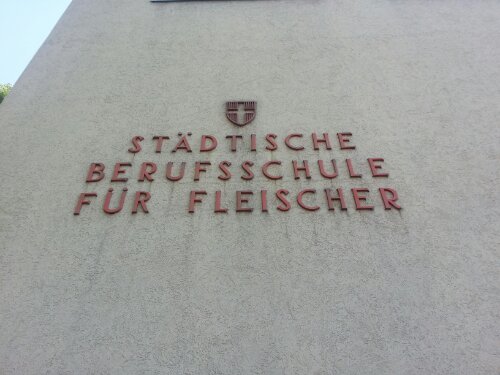
I’ll be going back–not just because we couldn’t get everything accomplished today (also in true Vienna fashion)!
Destruction of the old
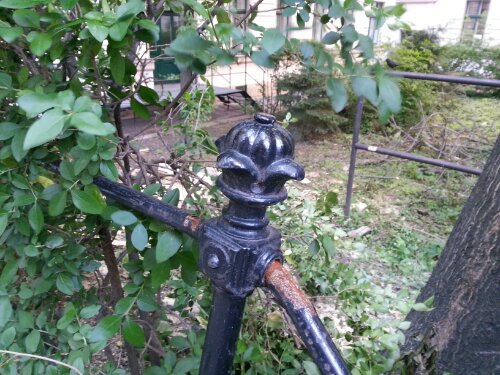
16 JunOne of my usual walks with Mylo is through the courtyard of a turn-of-the-last-century house. Many of the old houses have closed the access because the people walking through have abused the privilege by being especially loud, stealing bikes chained to the railings, or using the space as an open-air toilet. I have always been grateful that we are allowed to walk through this courtyard and experience this very private part of Vienna, right down to the abandoned concierge’s quarters–tiny and without any windows directly to the outside but with a protruding, glassed-in front entrance where the Portier could sit and keep an eye on what was going on. Seeing that always makes me think of Hans Moser films and Eva Ibbotson novels set in Vienna.
My distress was all the greater then to see the destruction of the railing on one side by what seemed to be some incompetent tree work.
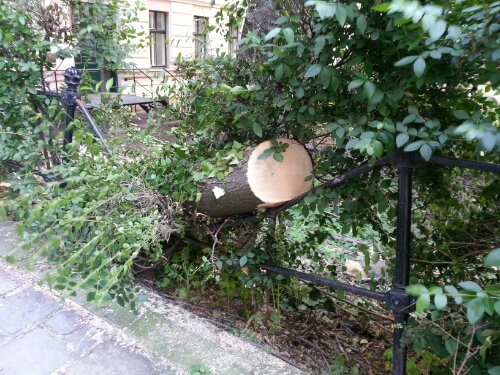
Then, being the suspicious person I am, I started to wonder if the damage wasn’t intentional. In Vienna it has been known to happen that historical houses protected by law from being razed are mysteriously damaged beyond repair by bulldozers incompetently driven into them at odd hours of the night. This frees up the land for a modern block of apartments, which is often quicker and cheaper to build than the restoration of an old house.
Along the same principle, I wonder if the massive tree branches weren’t allowed to fall accidentally on purpose on the railings so that the owners of the house could put in simple, cheaper railings as they have already done on the other side.
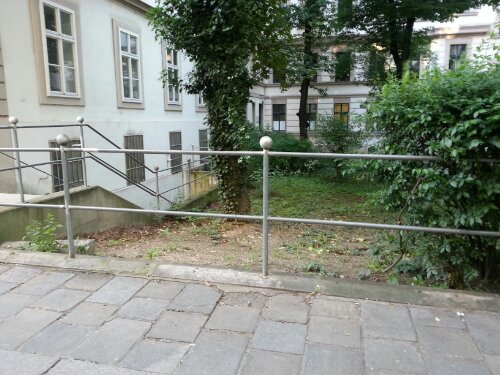
Of course, it’s easy for me to criticize. I don’t have to pay for the restoration of the railings. It still makes me sad, though, to see the replacement of the beautifully wrought old railings with the completely generic new ones.
May Day or The Band Played in Tune
1 MayToday is May Day, International Workers’ Day, and a public holiday in Austria among other places. One of the many parades has just passed under my window on its way to City Hall, where there are various celebrations. Because this is Vienna the marching was relaxed and not entirely tidy and the band played musically and in tune.
May Day has a lot to do with Vienna, the city government here being predominantly socialist. There is a lot of red around–flags and flowers and so on–and, true to the apparent Viennese belief that even those who earn less well should be able to enjoy the good things in life, the wine served at the City Hall festivities is decent.
Some things are changing, though. The Social Democrats no longer have an absolute majority in Vienna, as they did for decades. They now govern in a coalition with the Green Party. That may help explain why public transport runs on the usual holiday schedule on May Day rather than not starting until about 2 p.m. as used to be the case, something I found out the hard way my first year in Vienna when I was trying to get to lunch at friends’. (I ended up walking. Luckily, it wasn’t far but I felt I had earned my Schnitzel!)
The People’s Party (Volkspartei (VP), essentially the Conservatives) has its own Fest this coming weekend. Like many things in Austria, the system of providing a “red” option and a “black” option (the color of the VP is black) is alive and well, even if the idea of Proporz–divvying up positions on boards in state-owned industries and other bodies according to who came out on top in the last national elections–is dying out with those same state-owned entities.
Café Konditorei Klement
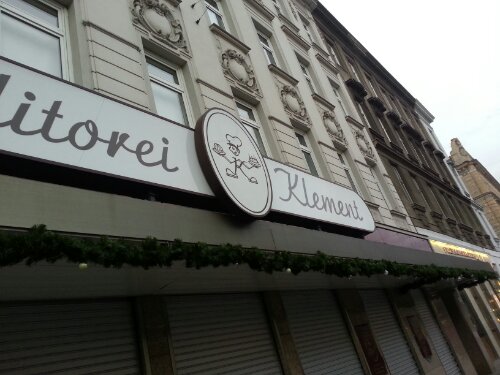
4 JanI went to have breakfast with a friend at Café Konditorei Klement in the 17th district and found that they closed their doors on December 31st. The friend actually has been a customer there much longer than I have and was able to give me a bit of background, although she, too, hadn’t known they were closing.
It is a fairly typical story not only for Vienna. The children–in this case a daughter–didn’t want to take on the business so that when the parents reached an age where they could no longer keep the café going (and, let’s face it, it is very long hours and hard work with no great financial return) the café closed. The photo below of the notice outside Café Konditorei Klement explains the circumstances to some extent. Another factor may very well have been that the terms on the lease changed with the new proprietor. This makes it even harder for children to take over the business and make a good living.
Klement was, in fact, one of the few hold-outs left. A number of other Konditoreien (fine pastry shops) have become chains–centralized their production and standardized their look, taking over family businesses with sound customer bases as they close. In fact, L. Heiner, who is taking over the Klement premises, is one such company. Originally a very select pastry shop in the First District it has grown to simply a very good mass producer and distributor of creamy cakes. (Can you tell where my preferences lie? ;-))
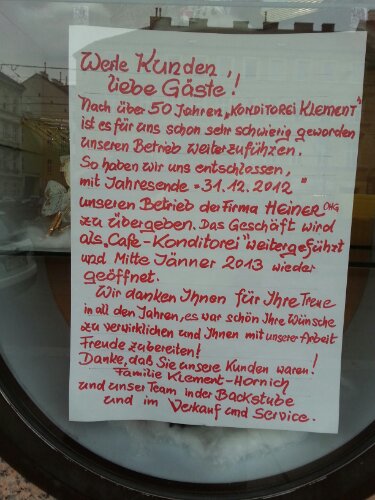
It reminds me a little of the sign Kathleen Kelly hangs on her children’s bookstore in “You’ve Got Mail” when she accepts the inevitable. One paragraph above says: We thank you for your loyalty over all those years. It was a pleasure to fulfill your wishes and delight you with our work. Thank you for having been our customers!
Old Vienna
22 DecWith the exception of the cars and the height of the trees this view of Vienna probably hasn’t changed much since the houses were built over 100 years ago. It seems to have been largely spared the destruction in the war and has been protected since then.

Thank you for your attention
14 DecAn announcement over the PA system at the tram stop this morning reminded me of another change in Vienna. At some point the Wiener Linien (public transport authority) realized that they were really irritating their passengers by finishing their announcements about delays, for example, with the phrase “Wir danken für Ihr Verständnis” (word for word: “We thank you for your understanding”), to which some more vocal Viennese would respond, “You don’t have my understanding.” These announcements occur ever more frequently now as traffic and mechanical problems interfere with the smooth running of busses and trams. No one is very happy about that, but at least we no longer have to consider whether the Wiener Linien have our “understanding” or not. They have changed the last phrase to “Wir danken für Ihre Aufmerksamkeit“–“Thank you for your attention.”
 ecbinvienna