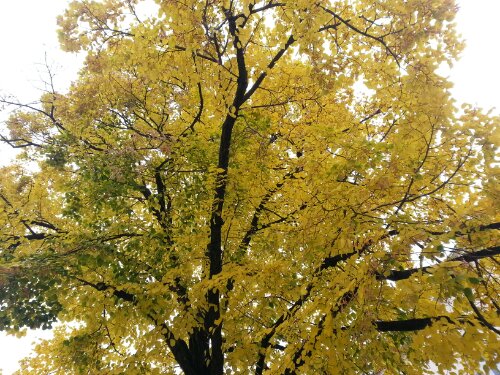
At some point while my back was turned fall came to Vienna.
I have to confess I had a bit of a headache this morning after tasting at least 10 wines yesterday evening. I know you’re supposed to spit instead of swallow, but when I get a really good wine in my mouth I want to hang onto it. It’s like Oda Mae Brown in “Ghost” after Sam tells her she has to give the check to the nun–and I had no Patrick Swayze to get me to let go.
There was a time I think, although I’m no expert, when luxury hotels advertised with products from foreign places. The trend seems to have reversed itself, at least in Austria. Suddenly there is Strassertaler honey and jam made by a local farmer (or more likely the farmer’s wife) out of their own “house plums” at the breakfast buffet.
I am on my way out of Vienna for the weekend to do one of the things the Viennese like to do on sunny fall weekends. I am going to the Kamptal to enjoy the fresh air and good wine. One thing that has already struck me is how full – and yet quiet – the train is. Lots of people, businesspeople and students alike, commute to Vienna by train and it seems that by midday on Friday they are willing to call it a week and go home. Not such a bad idea, if you ask me.
It is a sobering experience to take the number 5 tram along Kaiserstrasse these days. Many shops have closed and others are in terrible shape. Not very fitting for a route named Emperor Street.
Trafik is what English (EFL) teachers call a “false friend”. It may make the English speakers reading my blog think of “traffic” as in cars, yet it means something completely different in Austrian German, is something I think of as very European, and it, too, is changing.
First of all, a Trafik is a small, neighborhood store that has government concessions to sell tobacco products, some postage stamps, lottery tickets, pay-and-display parking stubs, and tickets for public transportation. (They also used to sell the dreaded Stempelmarken–those stamps you had to buy for any official transaction, for example, making a visa application. This particular system has since been modernized.) From my time in France–granted, over thirty years ago now–I seem to remember that there was an equivalent, the Tabac.
In addition to cigarettes and so on the Trafiks sell newspapers and magazines, smoking paraphernalia, greeting cards, wrapping paper, and such and are very much a part of everyday life in Vienna. I have the impression that most Viennese have one Trafik they always go to. I have four within a five-minute walk from my apartment and still almost always go to the same one, even though they weren’t all that friendly to me until I walked in the first time with Mylo. 😉
Trafiks traditionally have played a significant role in Grätzl* life. As one Trafikant (proprietor of a Trafik), interviewed in today’s Kurier, said, “Our customers and we were like family. People exchanged news about the Grätzl, sport, and politics. We knew who had died and when a new baby had been born. It was really nice in the Trafik.” In fact, to visit another European country briefly, in a few of her crime novels set in Venice Donna Leon has her police detective, Brunetti, get invaluable information from the Italian equivalent. The people in the Trafik simply know what is going on in the ‘hood.
But apparently, what with changes in the Trafikgesetz (Trafik laws) and in the concessions they have, ever more Trafiks are having trouble making a real living and, as is possible in a highly centralized administrative system, the government office responsible for regulating them can simply decide to close some down. According to today’s Kurier that government office is planning to close down about 10% of the existing 2600 Trafiks in Austria in the next four years.
Now I hear the free-market capitalists out there saying, “So what? That makes sense.” At this point I need to bring in some additional information. It has always been my understanding that many of the Trafikanten have disabilities that make it hard for them to get other work. One of the points of the Trafik system is to provide them with a moderately pleasant way of making a living and knowing that they are a part of and contributing to society. The Kurier article makes the same point. Some Trafikanten will retire, some will (have to) find other jobs, and the ones with disabilities will simply be out of a job.
For me, old-fashioned person that I am in some ways, it is simply a further sign of the deterioration of organic, local community. And I find myself paraphrasing Winston in 1984: Don’t close down my Trafik. Do it to someone else!
* See here for a brief definition of Grätzl.
All references in this post to the Kurier are to the article “Abschied von der Trafik-Kultur” by Michael Berger.
The word “Grätzl” deserves its own post, it has so many associations for the Viennese. Short version: It is Viennese dialect and refers to one’s neighborhood.
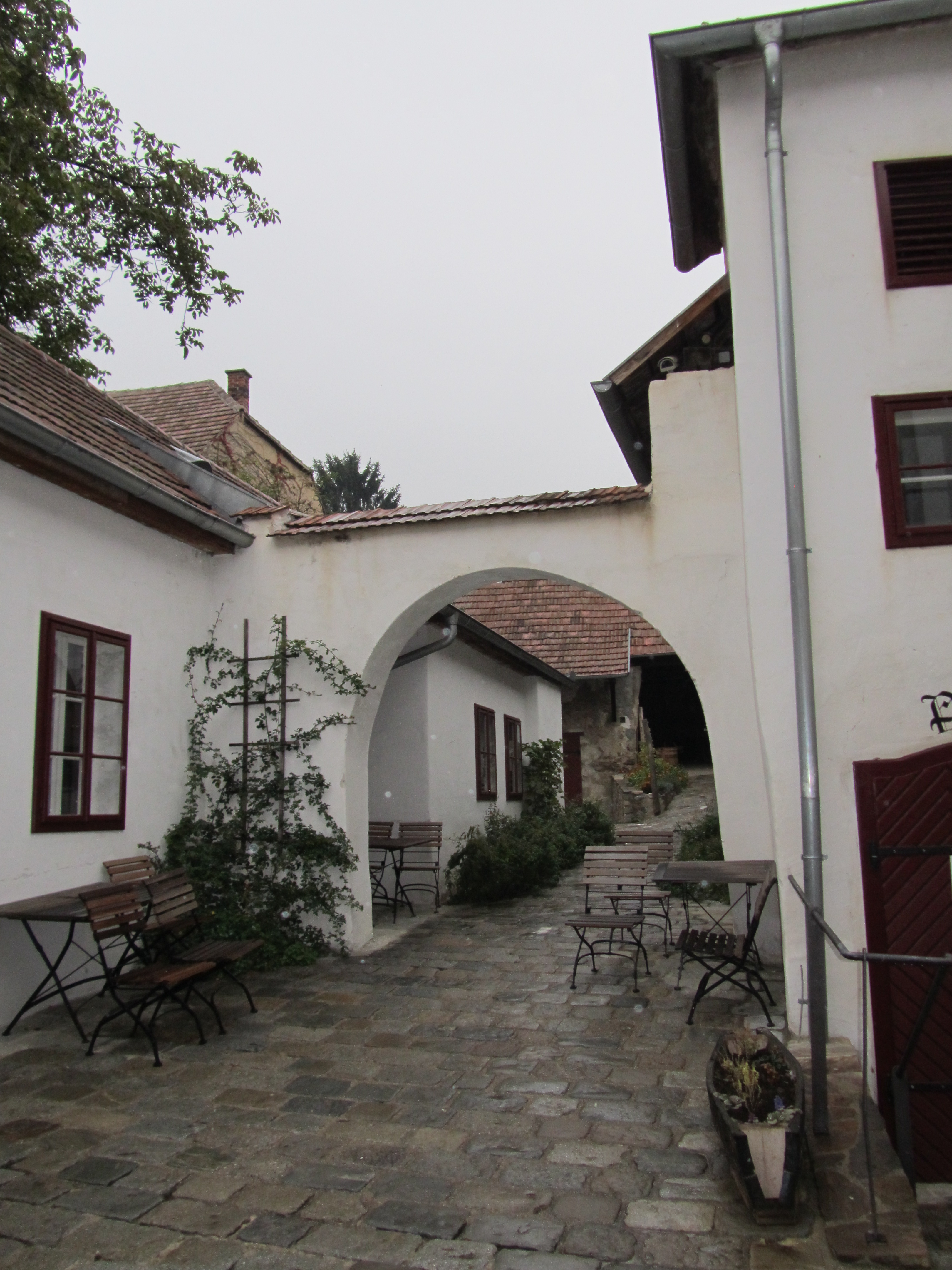
Where does one go in Vienna when the sun is still shining and the temperature is still warm? To the Heurigen (wine tavern), of course. Mylo and I are meeting friends in the beautiful garden at the Dorfschenke in Neustift – and this is what we saw on the way:

🙂
This morning Mylo and I took a trip out to a part of the 3rd district I haven’t been to in ages, if ever. We needed at health certificate for him for reasons that belong in another blogpost and had to go out to the MA (Magistratsabteilung) 60 to get it.
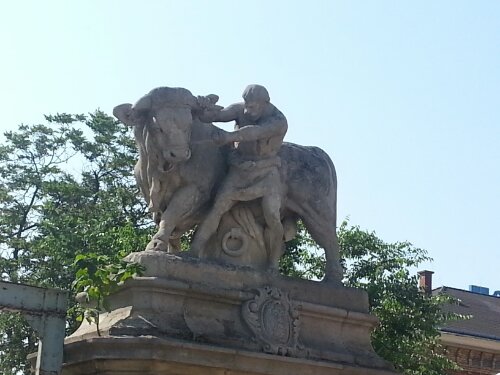
They are based in an area that used to house the stockyards and the slaughterhouses, as the photo above suggests, and are located on a street that did not appear on my 25-year-old map. (It didn’t matter. I asked a construction worker who at first said he was sorry they came in from Mödling and didn’t know the area. It was clear from his accent that he originally came from somewhere outside Austria, possibly Hungary, and, indeed, he then lit up and said, “The street named for the Hungarian comedian, Karl Farkas?” and pointed me in the right direction.)
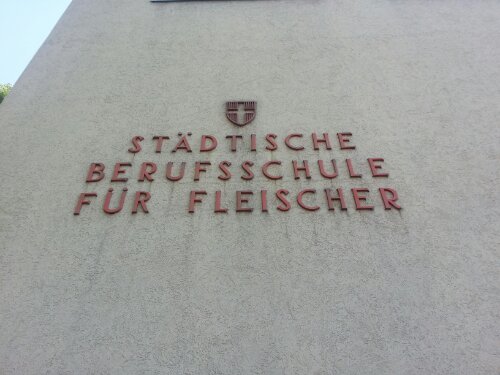
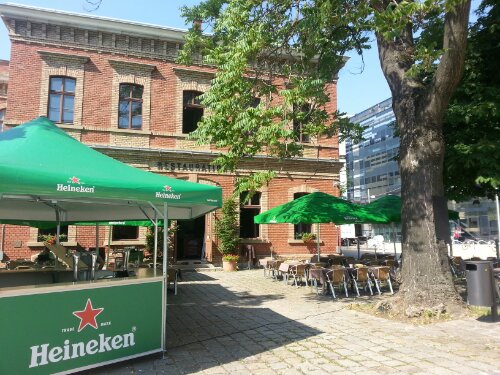
In addition to the monumental statues of steers on the gates to the stockyards, there is other evidence of the past uses of the space–for example, an enormous building still called the “Rinderhalle” or “beef hall” and the Municipal Vocational School for Butchers (photo below). In true Vienna fashion there is also much for the 21st century. The Campus Vienna Biocenter, one of the leading international biomedical research centers, is out there, too. And there are a number of cheerful eateries that lend life and gaiety to the neighborhood.
I’ll be going back–not just because we couldn’t get everything accomplished today (also in true Vienna fashion)!

 ecbinvienna