Tag Archives: public transportation

Vienna in the 80s

2 Aug

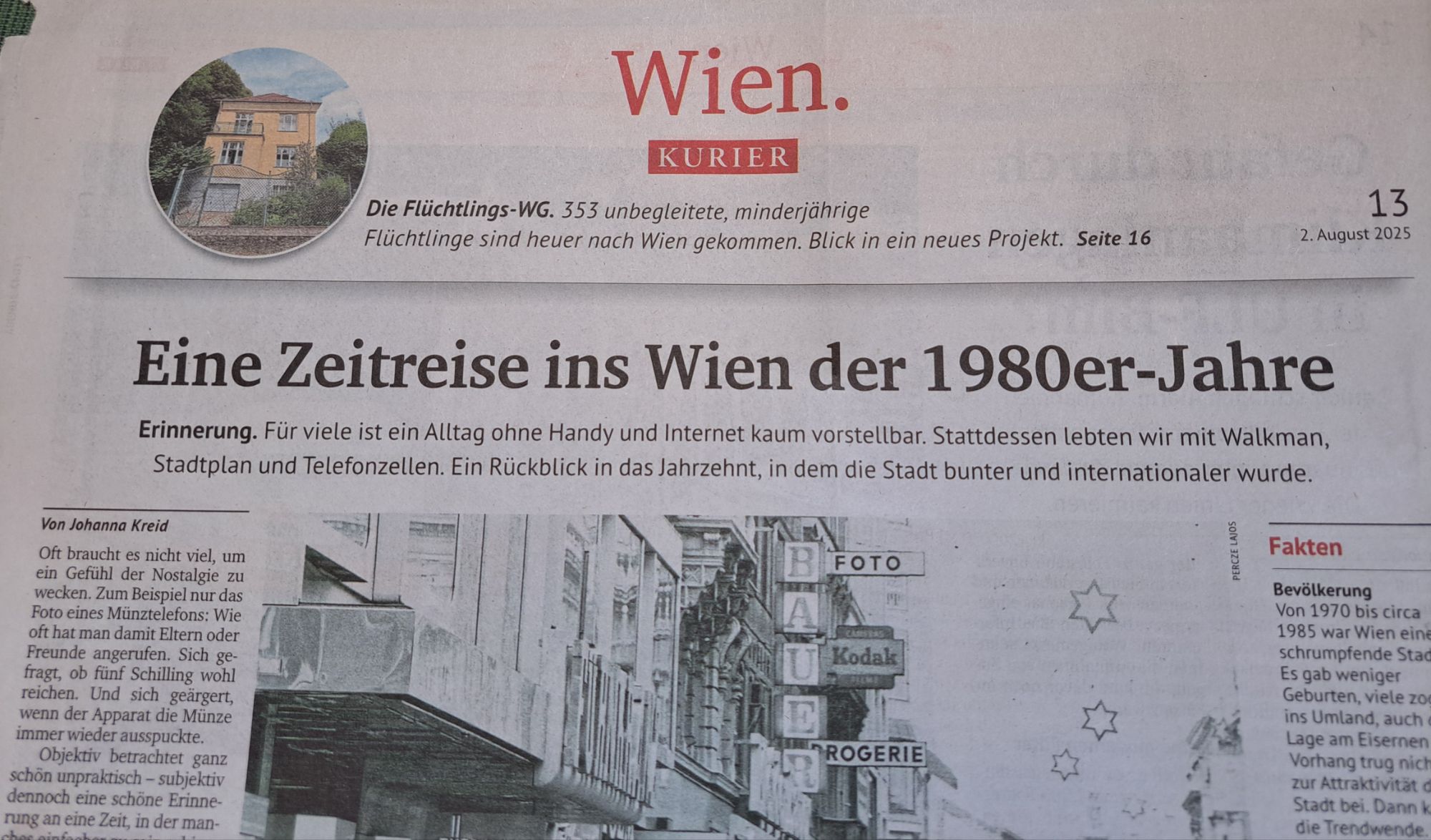
The Kurier today had an article about Vienna in the 1980s — a trip back in time. (Thanks, Kurier. That is very good way to make someone who was already an adult at that time feel rather old.) I arrived in Vienna in 1988 (had my 37th anniversary yesterday, celebrated, appropriately, at a Heuriger) and have seen significant changes, I thought it would be fun to write about some of the points mentioned.

For one thing, they write about pay phones, which reminded me of two things.

One of my first mornings in Vienna, after my German course at the Goethe Institut, I was out with my mother, who had accompanied me to help settle me in. We needed to phone the couple who became my Viennese parents to make arrangements, so we found a pay phone (they were plentiful then ;-)), put our money in, and dialed. When my Viennese father answered, he probably realized it was us calling because he couldn’t hear anything and said “Den roten Knopf drücken.” (“Press the red button.”) My mother did this, we heard the coin drop and were connected. That red button was called the “Zahlknopf” (zahlen = to pay) and released the money so that the connection could be made. Even in the late 80s, not all phones had a Zahlknopf anymore, but that one did and the Viennese had learned to give the necessary instructions.

The other phone story is much shorter. I saw a sign on a phone booth that said something about “retten”. I was familiar with the word (probably from the opening scene of “The Magic Flute” when Tamino rushes onstage pursued by the monster and sings “Save me! Save me!”) but couldn’t figure out what that had to do with a telephone. My mother translated the sign for me: This telephone can save lives. Do not destroy it. (“Dieses Telefon kann Leben retten. Zerstör es nicht.” Oddly enough, I don’t think they used the “Sie” form there.)

The article also reminded me of the men (I think it was always men) who used to sell newspapers on the street after the Trafiken had closed, which they do to this day. Vienna — thank goodness in my opinion — still has clear opening hours and very little at all is open on Sundays. You could get your news there truly hot off the press, and people often bought the next day’s paper on their way home from a ball, late opera night, or late shift. People who were looking for apartments or jobs would wait for these men and the newspapers to show up so that they could get a headstart on the search. And a tip for these men who worked long hours, in all sorts of weather, and for very little pay was obligatory.

The author also writes about Mariahilfer Straße — a very important shopping street in Vienna — and how even the part farther out, past the Gürtel, was a useful and relatively pleasant area 40 years ago. Currently, it is full of stores with really cheap goods and kebab take-out places although, apparently, there are plans to renew it. I remember, and still miss, the trams, the 52 and 58, that used to run along Mariahilfer Straße from the Ring to the Gürtel and beyond. Now we have the U3 line. Not so useful for a shopping street, I would argue. I do enjoy the kind-of pedestrian zone, though. “Kind-of” because it is what is called a “Fairness Zone,” which means you have pedestrians, bicyclists, e- and other scooter riders, and delivery trucks all in the same space without clear delineation of lanes. (What could possibly go wrong? ;-))

In addition, the author mentioned something I didn’t know. In 1988, when the Hungarians were already free enough to come to Vienna en masse, even though the Iron Curtain had not officially fallen, Mariahilfer Straße became their destination to buy things they couldn’t get at home and for a time was called “Magyarhilfer Straße” by the Viennese. My memory of this time was the truly old and stinking busses that they arrived in. We were very spoiled in Vienna with catalytic converters. These busses had no such thing and ran, I suspect, for the most part on diesel, making an ungodly noise and leaving huge black clouds behind them.

Ah, the 1980s. It wasn’t such a bad time.

Here a link to the article, which, sadly for me, appears to be available to Kurier subscribers only: https://kurier.at/chronik/wien/wien-achtzigerjahre-1980er-zeitreise-ein-alltag-ohne-handy-und-internet/403063709

Good job, Austrian Airlines!

15 Jun

I’m sitting at the airport in Vienna waiting for a flight and am actually enjoying the commercial for Austrian Airlines that keeps flashing across the screen.

It’s informing us that Austrian is the official airline of the Austrian national football / soccer team and shows members of the men’s national team kicking a soccer ball around a hangar and a pilot joining in. Then a red shoe, a pump, stops the ball. The camera pans up to show the owner of the shoe — a middle-aged(!) female flight attendant — who winks at the men and then kicks the ball through the open door of a plane. Tor! High fives all around.

For me, this is typical of state-owned (or, more accurately, formerly state-owned) companies in Austria. Diversity, yes, but with a light touch. Which is a good way to get past people’s defenses.

In any case, as a middle-aged woman who played soccer competitively for her school for six years, it was really enjoyable.

Flooding

15 Sep

https://wien.orf.at/stories/3273103/

The Wienfluss (Vienna River) is usually a trickle. It is extraordinary to see it looking like this. Even the extensive construction work done a few years ago to ensure that the underground tracks don’t flood has not been enough. The U4 line is only running from Heiligenstadt to Friedensbrücke at the moment, about a quarter of its usual route. And we are the lucky ones (so far)!

The Pandemic (remember the pandemic? ;-))

25 Feb

The front page of the Kurier reminding us that it was three years ago today that the first coronavirus cases were detected in Austria. Things moved very fast after that. As of March 1st this year, most of the restrictions will fall. Public transportation in Vienna has been something of a holdout, still requiring FFP2 masks. Even that will no longer be the case, although a third of Kurier readers polled have said they will voluntarily continue to wear them.

On the tram

19 Oct

It’s quiet and everyone I can see is wearing a mask — properly. Seemed worth noting these days. 😉

Looking old?

28 Sep

Maylo and I seem to be looking a bit old today. Two people commented on Maylo clearly not being a young dog anymore and someone about 50 just gave up her seat on the tram for me. Nice and a bit discouraging at the same time.

Kindness

22 Jul

It’s late and hot. Maylo and I were on our way home from a Heuriger. (Where else would we go on a hot Friday evening? ;-))

It was quite a long trip home with several changes and long waits. We were waiting the tram that would more or less drop us off at our door and Maylo was lying on the sidewalk looking tired. Next thing I knew a man, dirty and poorly dressed but with gentle eyes and a smile, was sharing his bottled water with Maylo, pouring it onto the pavement and watching while Maylo lapped it up.

I couldn’t tell whether he was deaf and that’s why he didn’t speak or simply didn’t speak German. He tried to communicate with gestures and I sadly couldn’t tell what he wanted to say. Then our tram arrived and I thanked him for the water and said good night. Just as the tram doors started to close, he slid the bottle in to Maylo and went his way.

I was sure he needed the wonderfully cold, almost full bottle of water more than Maylo did, but I also thought he perhaps wanted to give it to a hot little dog more than he wanted to drink it himself.

In any case, it was a very special exchange for me, especially in a world where ever more people push themselves ahead, never mind the others, and I wanted to share it with you.

A nice exchange in the bus

22 Jan

I hopped on the bus to go and finally buy some wineglasses. (Of the 18 a friend gave me about 25 years ago — six each of three different sizes — only one remains, and there are some nice ones on sale for €1.49 each.)

There was a man standing with his dog near the door, a pitbull mix by the look of it all correctly leashed and muzzled. Since the man didn’t seem interested in the empty seat near him I took it. Within 30 seconds the dog had decided that I was a friend and came over with dog-like enthusiasm to say hello. We exchanged a few friendly words and then he (she?) turned his (her?) attention to the woman sitting across the aisle from me. Similar raptures and then the man called his dog back to him. The woman across the aisle smiled at me and “So eine nette Begrüßung” (“Such a nice greeting”). I replied “Ge?” (Viennese for “Wasn’t it?”) And then, true to proper behavior on public transportation in Vienna, we each went back to what we had been doing.

Eine nette Begegnung (or chance encounter).

A new announcement in the U-Bahn

16 Oct

I’m on my way to the university and heard this announcement for the first time: “Dear Passengers, Please keep your luggage with you at all times. Unattended bags will be removed.” Feels almost as if I’m finally living in London.

The gloves are off – but the masks are on (we hope)

18 Oct

For months the public transportation authority in Vienna has been making an announcement in its vehicles along the lines of “Dear passengers, please cover your nose and mouth when in underground stations and using public transport.” (An aside: I imagined the pleasure of the translator that they were proficient enough to know that “nose and mouth” sounds more natural in English even though in German it is “Mund-Nasen-Schutz” or “mouth-nose protection / covering”.)

A day or two ago I realized that this announcement has been shortened and is now delivered in a more peremptory tone compared to the rather mellifluous earlier version. The current version: “Dear passengers, please cover your mouth and nose.”

What’s next? No “please”?