Tag Archives: changes in vienna

Comings and goings

21 Dec

What a day! I wanted to get my pre-Christmas errands done today so that tomorrow I can do my bookkeeping and then I am on vacation. And I managed to get everything on my list done, plus one.

One of the first things Maylo and I did this morning was go to his vet’s. Her hours have changed and I’ve been busy, so I made one quick trip on my way home from work one day to pick up food for Maylo but had to go without him–and even in this digital age there are some things for which the physical beings need to be present. (I won’t go into details.)

I’m so glad we made it today. It was her last day of work before retirement. We might have missed her altogether and gone next year only to find an entirely new face and person there! We were able to say our thank yous and farewells and reminisce about December five years ago when we didn’t know if Maylo would keep his back leg after being hit by a car. (I always feel the need to say at this point that I was out of the country on a business trip when it happened, and Maylo was staying with people I know.)

On my final round of errands this afternoon, I found myself walking past a sewing notions shop (really, one of those specialty shops with every possible kind of button, thread, and clasp but with no fabrics). I’ve been going there off and on for years for those little things that can otherwise be hard to find. Remembering that I needed some Velcro, I stopped in–and discovered that the owner (a delightful, cheerful woman with all the expertise of an old-fashioned shopkeeper in Vienna) is also retiring. I’m glad I stopped in there, too, and was able to thank her for all her help over the years. I was also glad to meet her successor. I have been afraid for years that when she left, the shop would go.

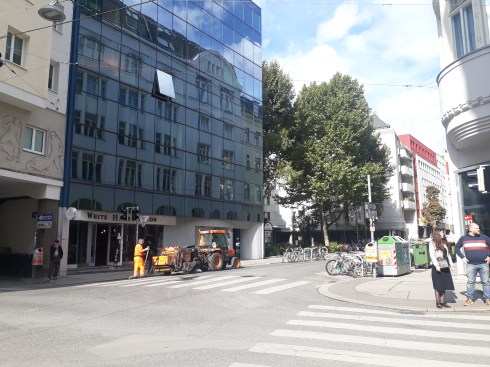
But the title of this post is “Comings and goings,” which means that there is something new to report, too. A week or two ago I noticed a miniature shop called Deli Mediterraneo with Greek products. It is an exquisite, tiny shop with two Greek gentlemen who opened it on December 1. Although they also have expensive, truly gourmet things, they have some delicious olive oil, for example, at prices only slightly higher than the generic brand in my supermarket. And they let you taste them. Bliss.

I bought some Christmas presents there and promised to go back to pick up some things for the New Year’s Eve gathering I am hosting. I have already composed their back story in my mind. You may know that life in Greece is extremely difficult at the moment and has been for a number of years. My suspicion is that these two gentlemen decided to start over in a country where the economy is still in good shape. They were lovely and friendly, doing the best they could in the German they have learned, and I wish them all the very best. If you want to try out their olive oils or take a look at their cheeses and other products, then go to Alser Straße 39 (very near Humanic at the corner of Alser Straße and Skodagasse) and enjoy!

More or less unheard of in Vienna

28 May

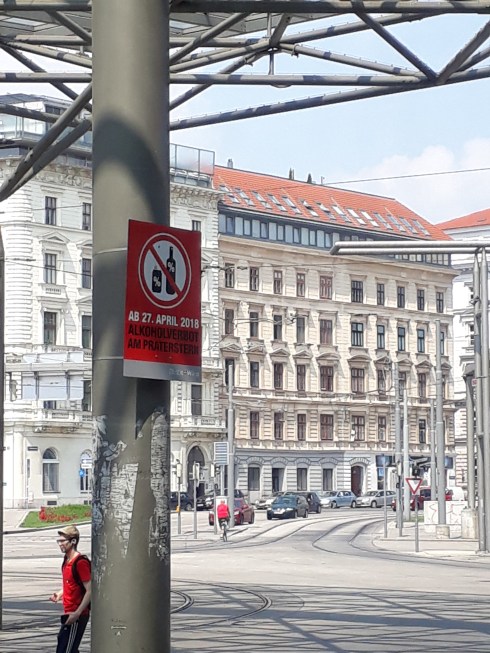
Generally speaking, you can drink alcohol where and when you like in Vienna (and you don’t need a brown paper bag). However, there has been so much violence at Praterstern recently, much of it alcohol-inflamed, that alcohol is now forbidden there. Drastic times, drastic measures.

New Mayor

26 May

I just feel I should report that after 23(?) years Vienna has a new mayor. Dr. Michael Häupl departed on Thursday and the new mayor, Dr. Michael Ludwig, has taken up the reins. Just FYI: It’s not a pre-requisite that you be called Michael to be mayor of Vienna. The one before Häupl was named Helmut … However, it does seem to help if you have a PhD.

May Day 2018

1 May

Many years on I still can’t get over it–public transportation is running today. My first year in Vienna I was invited to lunch by friends. In plenty of time, I went to the bus stop only to find that public transport wasn’t running because it was not only a public holiday, it was the First of May and therefore Labor Day, the day we celebrate by not working. In those days, the Social Democrats had an absolute majority in Vienna (“Red Vienna,” after all). They mainly represent blue-collar workers (“Arbeiter” or laborers) and tram, bus, and train drivers count as blue-collar workers. They were freed from work until 2 p.m. so that they could enjoy the parades and other festivities. On that day I walked to lunch.

How times have changed. The Social Democrats have not had the absolute majority for many years. I know there was a lot of corruption in the party. Some of the most spectacular bankruptcies of the 1990s (I’m thinking particularly of the supermarket chain Konsum) were due to the mismanagement and corruption of people closely tied to the SPÖ (the Austrian Social Democratic Party). At the same time, many of the aspects that year after year take Vienna to the top of quality of life rankings are thanks to the Social Democrats–the great public transportation, amazing cultural life, super public facilities like swimming pools and skating rinks, humane public housing, low crime rate, and perhaps that most fantastic institution, the Vienna Woods. There is little hope that the new “turquoise” and blue government (a coalition of the new branch of the Conservatives and the right-wing nationalist Freedom Party) will carry on those traditions. How times have changed, here as elsewhere.

Holiday Opening Hours 

2 Jan

I went off today with some doubt to one of the public universities where I teach. I needed to pick up exams to grade, but I wasn’t sure I’d be able to get in. I suspect many years ago, when I first arrived in Vienna, that the university would have been closed through Three Kings Day (January 6). Today I used my key card and got in with no trouble. From the lights visible in offices I could even see I was not alone. Quite a surprise for me.

New park benches

11 Jun

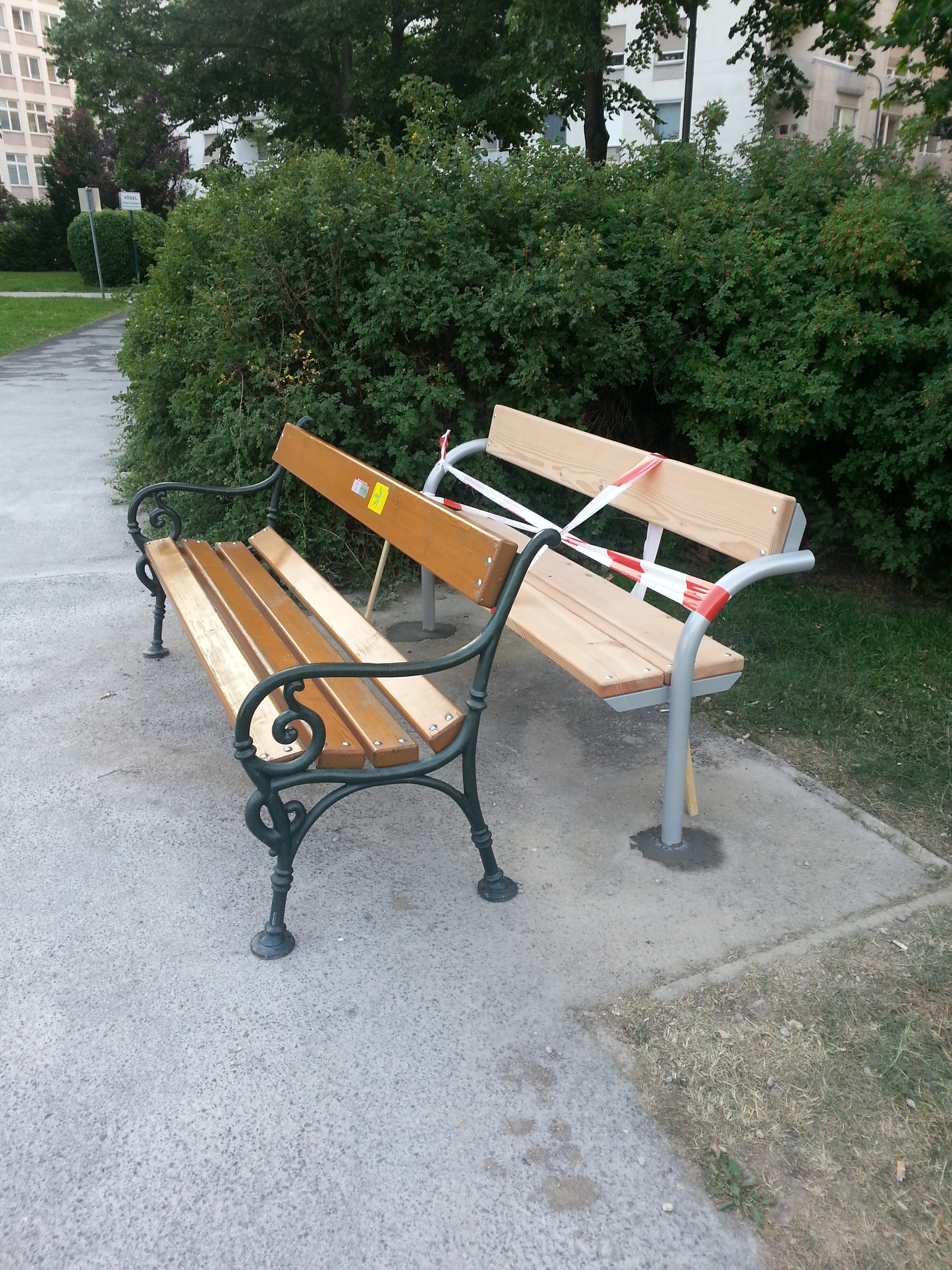
This was the sight that greeted me this morning on Maylo’s walk:

new park benches_2015-06-11

And true to form I was immediately a bit sad at the passing of the old benches and contemplative about what the change really means. Some may say that I’m reading too much into it, but I see the new style of bench as a response to two not very positive changes in Vienna over the last five years or so.

Change #1: A year or two ago I noticed that benches were disappearing from the parks. My assumption is that they were being stolen (they usually disappeared overnight) and that the new benches are a countermeasure. Understandable.

Change #2: There are more and more (homeless) people sleeping in the parks. The Austrian social system used to provide so well that you saw very few. All kinds of factors–including budget cuts and immigration–are contributing to a larger population of homeless. It may not be so visible in the photo, but the new benches are quite a bit shorter than the old benches. This, of course, makes it harder for people to sleep on them. I have very mixed feelings about that.

When changes like this come I think about the movie “You’ve Got Mail”, specifically the scene where Kathleen Kelly’s bookstore has finally succumbed to the Fox Books megastore and she is waxing philosophical about it. She says something like, “Some people would say it is an tribute to the greatness of this city, how it keeps reinventing itself, but the truth is my heart is broken. Something I loved is gone and no one can ever make it right.”

Halloween in Vienna

19 Oct

halloween_20141015This sign made me think again of a client who, about fifteen years, was lamenting the fact that the concept of Halloween was invading Austria. “After all,” she said, “we already have Fasching [Carnival].” Still, where there is buck or euro to be made …

In this case, however, there is the chance to win some euros. The only word you need to have translated above is “Gutschein”–in this case it means “voucher”–and you get the picture.

Hotel Imperial

14 Sep

Last week Franz Welser-Möst stepped down from the State Opera House. This week another farewell was reported, just as significant if somewhat more peaceable. Michael Moser, the head concierge at the Hotel Imperial, who himself occasionally uses the old-fashioned word Portier, is retiring after 31 years. Originally from the Austrian province of Carinthia, he has worked half of his life at the Imperial (link to website below), and seems to be perfect concierge material–no surprise there, given the hotel’s reputation. In his interview in the Kurier (sadly I couldn’t find it available for free online) he talks about service, discretion, relationships of many years with the many prominent guests, and the need to know Vienna and what is going on in the city inside out, especially in the days of the internet when guests can do so much research themselves.

In an earlier article he said, “‘Gibt’s nicht’, gibt es nicht”–that is, “‘Doesn’t exist’, doesn’t exist” if you’re concierge at such an establishment. He mentioned that he has a annual membership at the Albertina and the Kunsthistorisches Museum Wien (the Museum of Fine Arts in Vienna) and goes to the opera or theater about 50 times a year–“Because I like it, you understand. Not because I must.” He may go because he likes it, but it also means that when a guest asks him, for example, if the staging of an opera is modern or traditional he can answer. Not to be able to do so would be very embarrassing for him, he said. He also makes a point of finding less prominent spots and events in Vienna so that he can give guests special tips, like when the lilacs are blooming in the St. Marx cemetery (where Mozart is buried in a paupers’ grave) .

He may be retiring from life out front at the Imperial, but he will still be turning up regularly. Apparently,he’s been collecting menus, newspaper articles, funny stories from guests, and so on over the years, just tossing them into a box in his office. He is now going to take some time to sort through the 40 or so boxes he has assembled and bring some system to them. “Not for my sake and not for the sake of the Hotel, but for future generations,” he said, “so that they have something to laugh about.”

http://www.imperialvienna.com/de/concierge_service_de#mai

Sunday opening hours

14 Sep

I have left my Grätzl this morning to visit one of my “Viennese nieces” at her weekend job. She works in a bakery, and that in itself tells a story of change–and yet stability–in Austria. One sign of change: when I moved here nothing (except a few designated pharmacies) was open on a Sunday. Ran out of milk? Want fresh rolls for Sunday breakfast? Too bad.

The other sign of change: even now it is very unusual for a student at a Gymnasium (those extremely demanding high schools that are such an integral and quintessential part of Austria’s education system and whose diploma is the sole prerequisite for university entrance here) to have a job during the school year, especially if they don’t need the money. When I first arrived in Vienna it would have been unthinkable.

Then comes the stability: While my niece in the USA, almost the same age, is working every free moment to buy a car, I’m pretty sure my Viennese niece is not planning to use her earnings that way. Somehow I don’t think it would be a top priority even if she lived in the country rather than in this city of exceptionally good public transportation. Indeed, her sister in the meantime has pointed out that she doesn’t even have a driver’s license! 😉

Culture has not yet entirely converged in this globalized world, if, indeed, it ever will.

Two exhibition openings in one week

30 Mar

This past week I was at two exhibition openings, in each case at a Bezirksmusem.
Bezirk means “district” and is similar to what the Parisians mean with arrondissement. Therefore the exhibitions were at the small museums that serve each district in Vienna by maintaining and displaying things that are unique to that district. Sometimes these museums are located in the same building as the administrative offices for the district, as in the 18th district where I was on Thursday evening, and sometimes not, as in the 8th district where I was last Sunday. Usually they also house an auditorium that can be rented for different kinds of performances and occasions.
The exhibitions were completely different from each other and yet both fit perfectly the idea of what a Bezirksmuseum is for.
Last Sunday was the Day of District Museums in Vienna. Each district museum (there are 23) was open for most of the day and had its own exhibition on a common topic. In this case, the theme was—not surprisingly—“Vienna 1914: The End of an Era”. (People in other parts of the world may also be aware that this year marks the 100th commemoration of the start of the First World War.)
Each district in Vienna also has a name. For the 8th district this is “Josefstadt,” which explains why the exhibition was entitled “Josefstadt from 1900 to 1914”. If anyone doubts that there was enough going on in those 14 years to warrant an exhibition, allow me to put their minds at rest. It was a time in Viennese history when tremendous expansion was going on. When it seemed clear that the threat of the Turks overrunning Vienna was truly over (around 1858) the city walls were torn down, the famous Ringstraße with its stunning buildings was created, and the satellite towns were incorporated into the city proper. Josefstadt was such a town.
This meant that there was suddenly much demand for housing outside the first district and many of the Baroque houses—too small and too uncomfortable to accommodate the growing and ever more demanding population—were torn down to make room for much larger and, above all, taller buildings. (Sound familiar?)
New streets were created. Several existing streets, like Lange Gasse, were lengthened to open up contact to the—are you ready for this?—9th district. All of this expansion required new transportation and so new streetcar lines and then the Stadtbahn (literally “city railway”, now the U6, running along the old outer line of defense against the Turks) were constructed.
All of this meant that many open spaces, where old maps suggest gardens and orchards that provided food for the district, were built over. The improved transportation no doubt made it possible to bring in what was needed from areas farther out.
The 8th district is considered a very desirable neighborhood, and it was no different back then. The famous painter, Gustav Klimt, had his studio in the courtyard of a house on Josefstädter Straße. He, too, was a victim of the expansion. That house was torn down to make room for a bigger house with no room for artists’ studios, and Klimt had to move to the 13th district (also very desirable so my sympathy is somewhat limited). Apparently, though, he was so attached to his studio in the 8th district that he continued to use the address professionally.
Some of the obvious parallels from that era to this were highlighted by the talk given by the elected administrative head of the district. She mentioned a planned building that will cut off a historic view from the 8th to St. Stephen’s Cathedral. She didn’t mention the building of what has been referred to as the “phantom underground line U5”, but that, too, apparently is on the way. Plus ça change, plus c’est le meme chose.
On Thursday in the 18th district the exhibition was of ceramic pieces with modest price tags done by two residents of the district. The artists, married to each other, were both self-taught and had earned their livings doing something else. The guests were mainly friends, family, and neighbors, one had the sense. Music was provided by two ladies, one on the violin and the other on the cello and both well over 60 at a guess, playing Haydn(?) with an encouraging blend of skill, musicality, and love—true amateurs, then, who probably also live in the 18th. When one had sufficiently explored the artwork one could wander through the 18th district’s version of “Vienna 1914: The End of an Era,” more rural than in the 8th and as such fitting to the character of the district, which lies farther out. To round off the evening, the artists’ son and his partner danced the Tango Argentino.
So you see that, too, was simply a typical gathering at a Bezirksmuseum