That glass of water in Viennese coffeehouses has been under fire for a number of years. True, you still get one small glass of the fabulous Viennese tap water with your coffee, but you can no longer count on it being considered “perfectly normal to ask for another glass, or even several extra glasses” as my Baedeker’s Vienna assured its readers in 1988.
In fact, a year or two ago, I was breakfasting at Landtmann. Knowing that they had started charging for tap water, I pointed, to be explicit, to the small glass that had come with my coffee and said, “Noch ein Glas Wasser, bitte.” They brought a mini carafe and charged EUR 1.50 for it. A reason not to go back, if you ask me.
In the Kurier, picked up at the supermarket yesterday as the Trafik is still closed, there was a story about precisely this — but Café Landtmann came off better this time. A family had been celebrating the birthday of a great aunt at Landtmann. Once all the others were gone, one family member asked if he might stay for a bit and read the newspapers. The waiter’s answer? “We close at 11 p.m.” (Quite an open invitation these days when, even in Vienna, you are sometimes informed that you have the table for two hours only.)
The author of that piece, Wolfgang Kralicek, is himself the owner of a café and added a story from his own experience. The record for number of glasses of water to one coffee is seven(!). He then writes that the guest in question left such a large tip that he could easily have ordered a second Melange. Just goes to show it’s not always about the money.
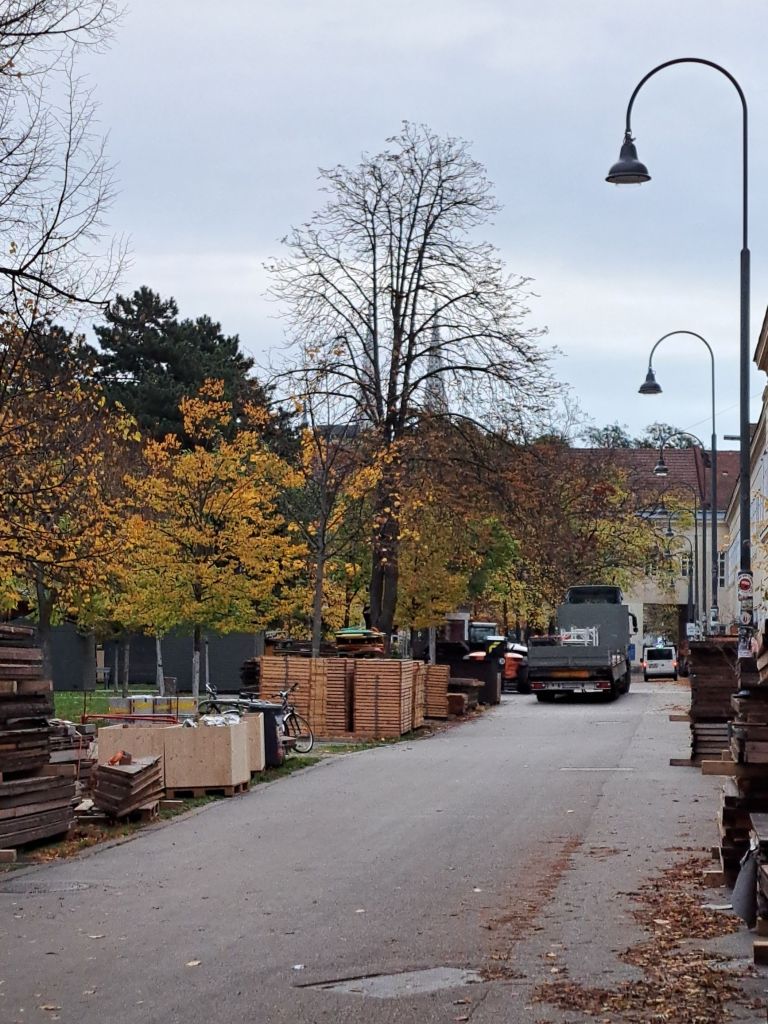
Why am I grumpy? Because that, ladies and gentlemen, is a photo of a Christmas market to be. When I arrived in Vienna, many years ago, granted, there wasn’t a Christmas market in every corner of the city and, if I remember correctly, they didn’t open until the First Sunday in Advent. At last, I thought, I’ve found a land unmoved by the consumerism of free-market capitalism.
Well, it was too good to be true. For a number of years, the Christmas markets have opened the middle of November. This year they seem almost to be striving for a pre-Halloween date.
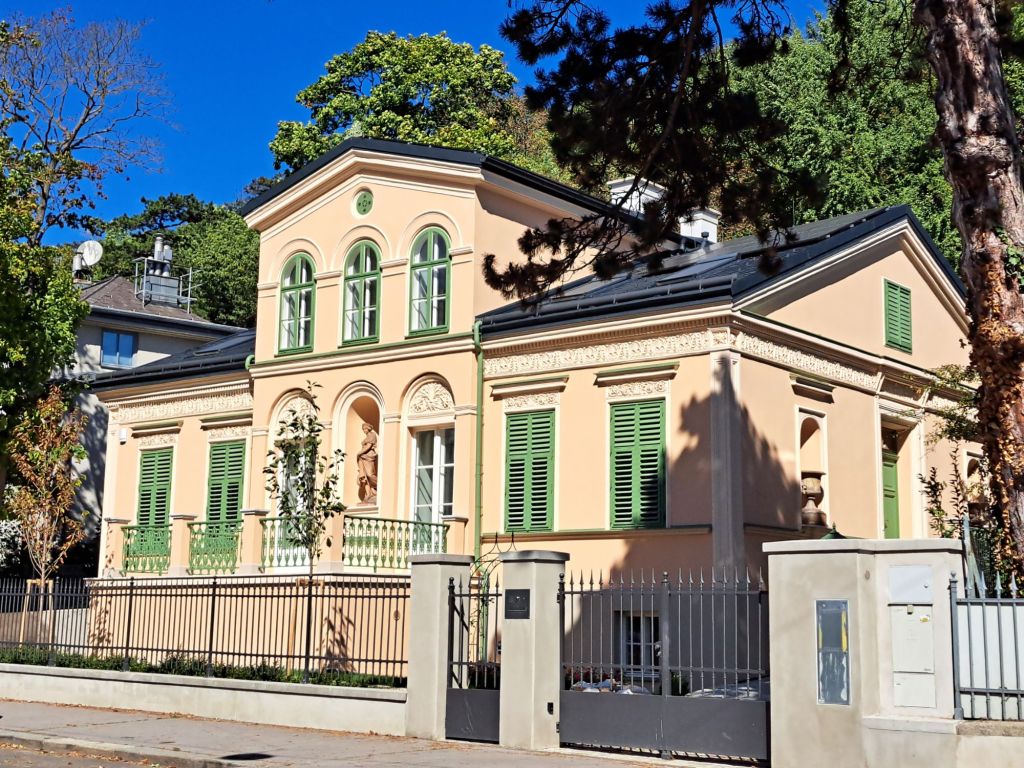
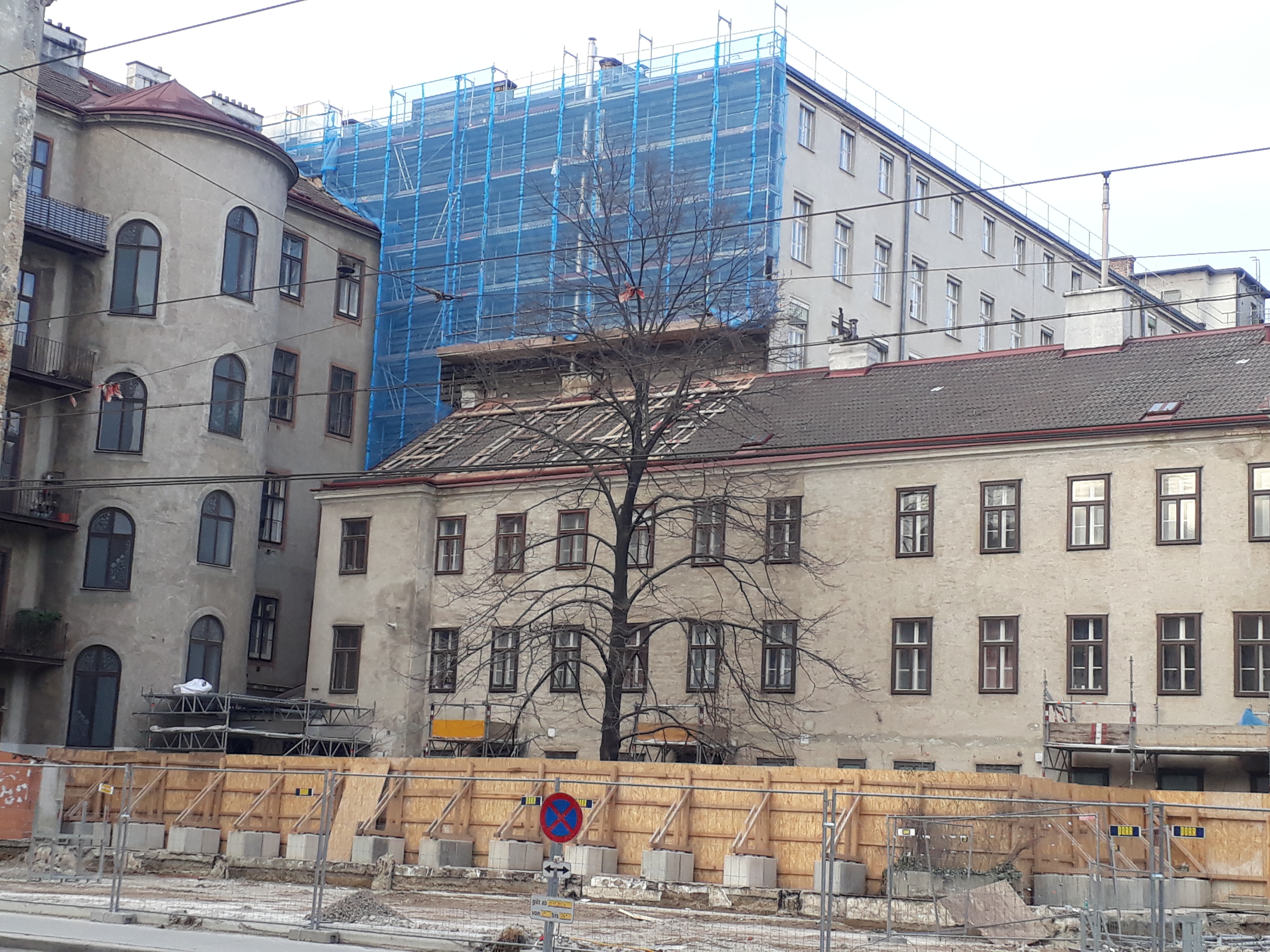
A friend and I have been keeping an eye on this villa in Neuwaldegg. We’ve seen too many treasures over the years been allowed to decay to a point when they could legally be torn down. Invariably, they were replaced with faceless, cement structures that were, possibly, quite nice to live in but brought no joy to the folks out front.
This one sat on a construction site for about two years, and for a while it wasn’t clear which way the project was going to go. Then it started to look promising. This time when I walked by I was treated to the fully renovated version.
If the person who invested the time, money, and care into restoring this property ever reads this — thank you! Not only did you save a beautiful piece of Viennese history. You restored a tiny bit of my hope in people.
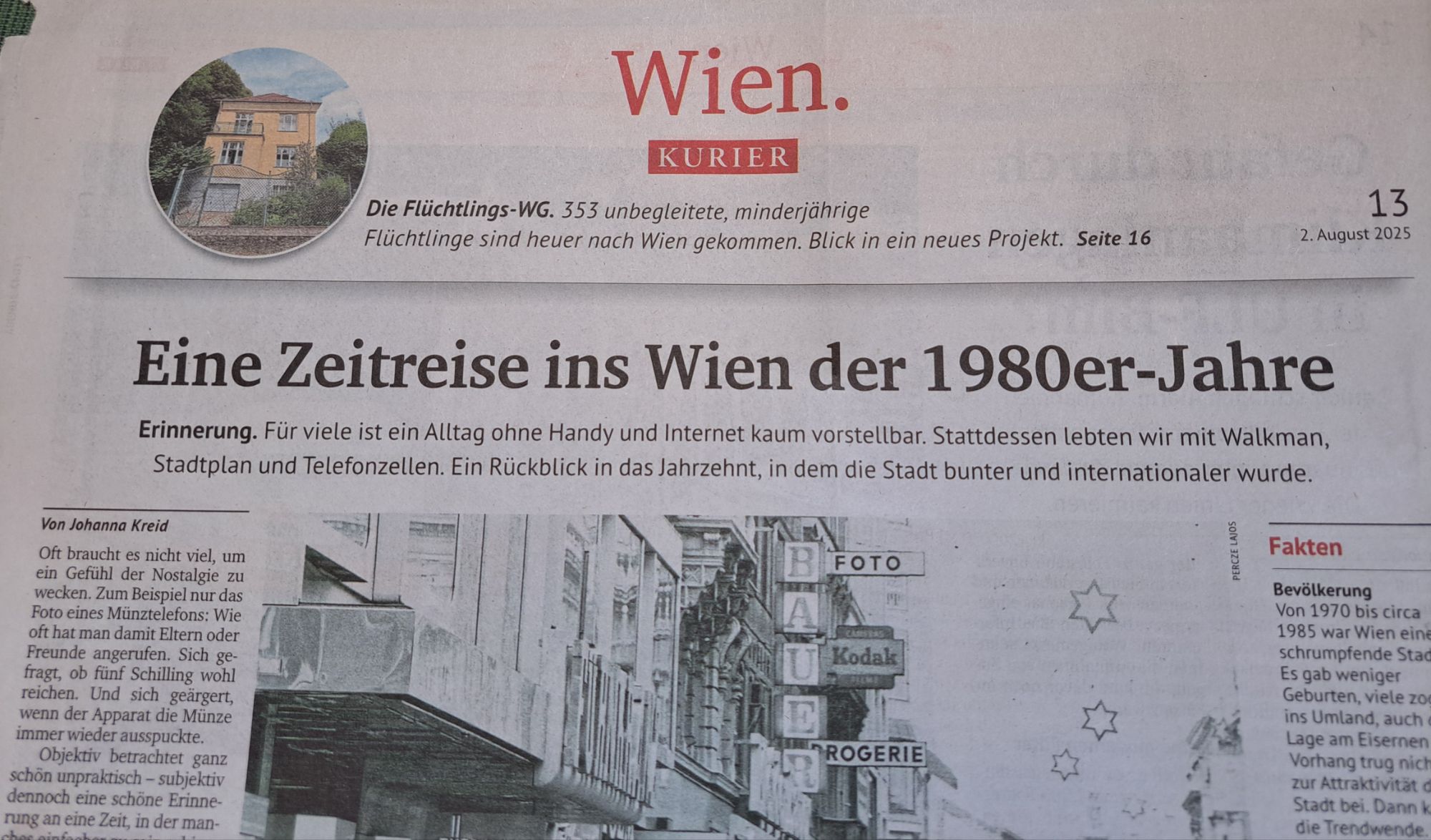
The Kurier today had an article about Vienna in the 1980s — a trip back in time. (Thanks, Kurier. That is very good way to make someone who was already an adult at that time feel rather old.) I arrived in Vienna in 1988 (had my 37th anniversary yesterday, celebrated, appropriately, at a Heuriger) and have seen significant changes, I thought it would be fun to write about some of the points mentioned.
For one thing, they write about pay phones, which reminded me of two things.
One of my first mornings in Vienna, after my German course at the Goethe Institut, I was out with my mother, who had accompanied me to help settle me in. We needed to phone the couple who became my Viennese parents to make arrangements, so we found a pay phone (they were plentiful then ;-)), put our money in, and dialed. When my Viennese father answered, he probably realized it was us calling because he couldn’t hear anything and said “Den roten Knopf drücken.” (“Press the red button.”) My mother did this, we heard the coin drop and were connected. That red button was called the “Zahlknopf” (zahlen = to pay) and released the money so that the connection could be made. Even in the late 80s, not all phones had a Zahlknopf anymore, but that one did and the Viennese had learned to give the necessary instructions.
The other phone story is much shorter. I saw a sign on a phone booth that said something about “retten”. I was familiar with the word (probably from the opening scene of “The Magic Flute” when Tamino rushes onstage pursued by the monster and sings “Save me! Save me!”) but couldn’t figure out what that had to do with a telephone. My mother translated the sign for me: This telephone can save lives. Do not destroy it. (“Dieses Telefon kann Leben retten. Zerstör es nicht.” Oddly enough, I don’t think they used the “Sie” form there.)
The article also reminded me of the men (I think it was always men) who used to sell newspapers on the street after the Trafiken had closed, which they do to this day. Vienna — thank goodness in my opinion — still has clear opening hours and very little at all is open on Sundays. You could get your news there truly hot off the press, and people often bought the next day’s paper on their way home from a ball, late opera night, or late shift. People who were looking for apartments or jobs would wait for these men and the newspapers to show up so that they could get a headstart on the search. And a tip for these men who worked long hours, in all sorts of weather, and for very little pay was obligatory.
The author also writes about Mariahilfer Straße — a very important shopping street in Vienna — and how even the part farther out, past the Gürtel, was a useful and relatively pleasant area 40 years ago. Currently, it is full of stores with really cheap goods and kebab take-out places although, apparently, there are plans to renew it. I remember, and still miss, the trams, the 52 and 58, that used to run along Mariahilfer Straße from the Ring to the Gürtel and beyond. Now we have the U3 line. Not so useful for a shopping street, I would argue. I do enjoy the kind-of pedestrian zone, though. “Kind-of” because it is what is called a “Fairness Zone,” which means you have pedestrians, bicyclists, e- and other scooter riders, and delivery trucks all in the same space without clear delineation of lanes. (What could possibly go wrong? ;-))
In addition, the author mentioned something I didn’t know. In 1988, when the Hungarians were already free enough to come to Vienna en masse, even though the Iron Curtain had not officially fallen, Mariahilfer Straße became their destination to buy things they couldn’t get at home and for a time was called “Magyarhilfer Straße” by the Viennese. My memory of this time was the truly old and stinking busses that they arrived in. We were very spoiled in Vienna with catalytic converters. These busses had no such thing and ran, I suspect, for the most part on diesel, making an ungodly noise and leaving huge black clouds behind them.
I went to the pension office this morning to clarify a few points and saw that some things have really changed in Austria and some things haven’t.
One thing that has changed: the woman in front of me in line at the reception desk was talking about her “Partnerins” (female partner’s) appointment. When there was some confusion about her name, she explained that when they had married she had taken on her partner’s family name and officially changed it on all her documents. Then I overheard that she herself isn’t self-employed but rather her partner, and she would like to be covered under her partner’s insurance.
This would have been unimaginable even five years ago (Austria enacted “Ehe für Alle” or “Marriage for All” on 1 January 2019, building on the civil union that became possible in 2010). For anyone who would like more information, here is a website (in German) giving an overview of the history of same-sex marriage as well as legal details: https://www.familienrechtsinfo.at/eherecht/ehe-fuer-alle/
Something that hasn’t yet changed? When I came out of my appointment, there was a man waiting, with his large, well-behaved, non-service dog. Wish I’d known I could have taken Maylo!
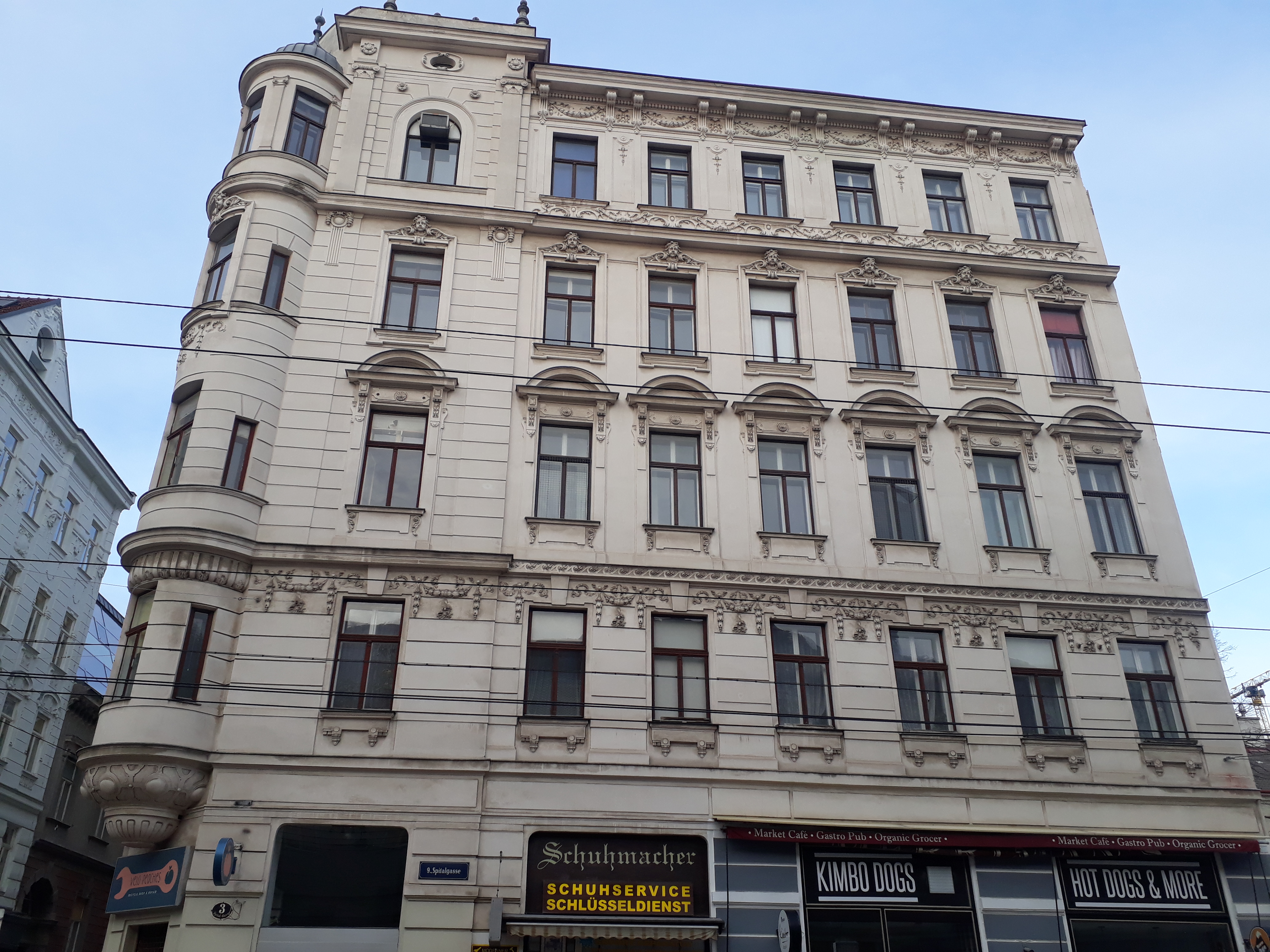
The old (1970s) WienEnergie building on Spitalgasse has been torn down to make room for a new “campus” for the medical school of the University of Vienna. This makes perfect sense–the general hospital is nearby, the old general hospital was turned into a proper campus for the University of Vienna a little over 20 years ago, and one semi-public building (the utilities provider was municipally owned at one time and then hived off) will remain in public hands. (The University of Vienna is a public university.) In addition, not even this defender of older buildings is sorry to see the olive green and orange structure go. I’ll be curious to see what comes.
In the meantime, the clearing of the site has laid the neighboring house open to scrutiny and shows some interesting things about Viennese buildings and, in fact, culture. Appearances are quite important in Vienna. (A friend of mine who has lived in Boston, London, Paris, Amsterdam, and Washington D.C. as well as in Vienna said that Vienna is the only city she has lived in where you got better service at the deli counter in the supermarket if you had put your make-up on.) For me, this focus on appearances is reflected in the relatively ornate facade of the house (the photo on the left) compared to the plainness of back of the house, with wing (the photo on the right). At the same time, it is often said that the imposing facades of the turn-of-the-century houses in Vienna hide some of the nicest aspects. These are for house residents only. This I see in what appears to be a small garden with a tree. That is probably quite a nice place to sit out–or will be again once the building project is complete!
An example of what is called a cultural artifact in the intercultural world …
Today is almost like the November days I remember from 30 years ago — gray, damp, chilly. It isn’t raining, but the pavements are damp with condensation; it isn’t that cold in temperature (about 4°C), but it is a penetrating chill. The air, as always on these days, is a bit acrid because the cloud cover holds in all the exhaust. And it may be a bit warmer than back then. Certainly it is somewhat brighter as the buildings are for the most part cleaner and this year’s spectacular foliage, in yellow and gold, is not yet completely gone.
I’m on my way to the university and heard this announcement for the first time: “Dear Passengers, Please keep your luggage with you at all times. Unattended bags will be removed.” Feels almost as if I’m finally living in London.
Over 30 years ago, I spent my first two months in Vienna in student housing (a “Hochschülerinnenheim”) on Servitengasse. Today I was in the neighborhood again to pick up some fresh pasta for New Year’s Eve dinner and saw that two floors have been added to the building and it has been turned into luxury flats. Things are changing …

 ecbinvienna