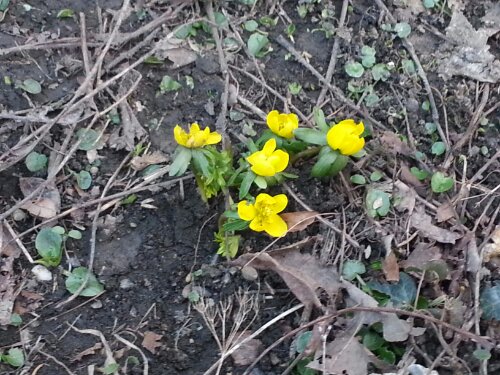
It’s still cold in Vienna, but there are definite signs of spring.
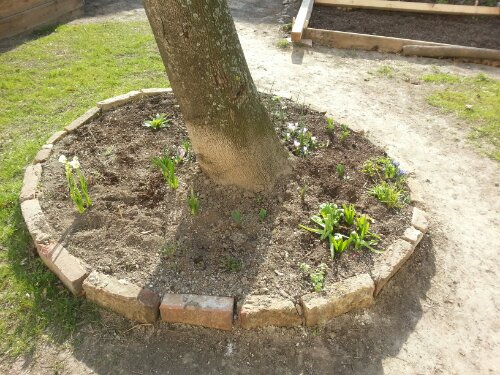
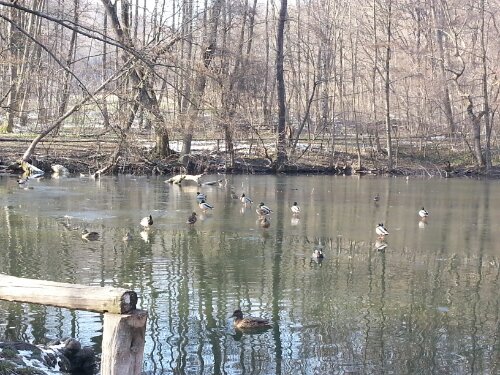
For one thing, Vienna awoke today to bright blue skies – chilly still but cheerful. I was inspired to take two bags of books to the Christ Church shop (the thrift shop of the Anglican church in the 3rd district). There I found a good-as-new copy of Frank Tallis’s “Death and the Maiden” for EUR 2. This the fourth book I have read in this series set in Vienna at the time of Freud and uniting two friends, a Catholic police inspector and a Jewish doctor and psychoanalyst, in solving crimes. After taking care of several Saturday chores and errands, Mylo and headed to – where else? – the Vienna Woods where we caught the first whiff of “Baerlauch” (wild garlic) and enjoyed watching the ducks navigating between water and ice.
The text below was written on 12 March 2008 after I attended a commemoration ceremony at Heldenplatz. It is no less timely today.
Vienna, 12 March 2008 – Islands of Light
It was a beautiful evening today at Heldenplatz—clear, cool without being cold, with graceful clouds passing through overhead. Perhaps it wasn’t all that different 70 years ago when the German troops marched in to annex Austria and to clear the way for Hitler and his historic speech to over 200,000 cheering Austrians on 15 March 1938 at Heldenplatz.
This evening, in 2008, the thousands who gathered came to light candles—one for each of the over 80,000 Austrian people who suffered imprisonment and were killed under the Nazi regime. They came to light candles against intolerance. Many came, too, to be strengthened in their resolve never to let such a violation of human rights, human dignity, and human life happen again.
Although the organizers of the commemoration called it “Die Nacht des Schweigens” (The Night of Silence) in deliberate contrast to the rowdiness the night of Hitler’s speech, there were speakers. A prominent Austrian historian, now 83, who has spent her life speaking out against race hatred; a former Austrian Chancellor who was the first high-ranking Austrian official to challenge Austria’s image as poor victim and to speak officially also of Austria’s role as perpetrator; a young woman of 19 involved in a project commemorating victims of the Holocaust called A Letter to the Stars; and a survivor of five concentration camps now 82, who had to watch her mother go to the gas chambers at Auschwitz.
I take away three messages from the speakers: that it is impossible to make reparation for crimes of this magnitude, that the fight goes on, and that it is important also to remember each person who suffered and was killed.
Reparation implies being able to repair a situation and to indemnify people, that is, to restore them to the position they were in before disaster occurred. The German equivalent Wiedergutmachung when taken apart piece by piece means to make good again. Essentially, we can never understand what it was—or still is—like for the victims and their families and no matter how much money we pay to restore property or compensate for slave labor, for example, we can never make it up to the people who suffered, were tortured and killed. We cannot make it good again.
As we stood under the stars and moon at Vienna’s Heldenplatz, peaceful and unthreatened, amid islands of light created by the 80,000 candles, the other message was that the battle goes on. Precisely because we can never truly make reparation once such crimes have been committed we all have a responsibility to make sure that our countries do not participate in such crimes again. Although we, at the moment, have democracy, peace, enough to eat and are relatively tolerant of the ethnic and other minority groups in our midst, that can change. We are in all probability facing the kinds of times where life gets tougher, where the feeling that there is not enough to go around makes it harder to be tolerant and to act justly. Those are the kinds of times when it is easier for unscrupulous or fanatical leaders to mobilize large numbers of people to oppress, imprison and finally murder their fellow citizens. We must beware.
It is hardly to be hoped that we have more resources for behaving bravely and morally than the people who came before us. For this reason, knowing what we know about the years of the Nazi regime, we need to re-commit every single day to fighting the forces that allowed such a regime to gain power. We need to combat anti-semitism and other forms of racism and intolerance wherever and whenever we encounter them, and if we fail to do so one day we have to get up the next day and try again.
In the words of Susanne Lamberg, the survivor of five concentration camps mentioned above: “When the candles that we light tonight go out we must light more tomorrow. We must decide every day to light the candles. It is tiring. But it is our only chance.”
As I was leaving Heldenplatz the Night of Silence had begun along with the commemoration of the 80,000 victims. The name of each man, woman and child was being projected on a screen—four screens, one name per screen, two seconds per name. The projection is to go on until six o’clock in the morning to get through the names of all the known victims.
I’ve had a egg carton sitting next to my computer for days to remind me to write about a new text in the cartons. I’ve long thought that the Viennese are better at putting their money where their mouths are than my compatriots, and I feel this backs me up.
One would think that egg farmers would want to sell as as many eggs as possible, never mind if food gets wasted. Well, not everywhere. There is now a heart with a stem printed inside the egg cartons in Vienna with the motto “Food is precious” [“Lebensmittel sind kostbar!”]. Next to this is the following text (translation mine): Food is precious! So don’t throw any away. Eggs, for example, can safely be used after their expiration date for baking and cooking, or enjoyed as hard-boiled eggs. It’s simply important to heat the egg thoroughly before eating.
Given the choice between selling more eggs and trying to prevent the waste of food the Austrians have clearly come down on the not wasting food side of the debate. Perhaps that is what happens when you still have people in your population who remember the cold and hunger of war?
I have just had my first ice cream cone of the season–chocolate and strawberry–at one of the best ice cream places in Vienna, Bortolotti’s at Schüttauplatz, in the 22nd district. That’s special in Vienna because most of the smaller ice cream places close from October to March. (Some of them even turn into fur coat shops for that time.) It’s the family’s only chance to recover from a relentless summer season and it fits the Viennese idea that there is (still) a season for certain things. Well, I am old-fashioned and like that. It means one appreciates those things more. 🙂
… as Joni Mitchell reminded us in “Big Yellow Taxi”. Well, it works in the reverse, too–you don’t know what you don’t got until it comes back again (that just doesn’t scan as well).
This afternoon when I went out for a round with Mylo I was stunned by the beautiful blue sky and almost blinded by the sun. It was in that moment that I realized how gray our weather has been for weeks now. It turns out that this winter we have had the least sun since 1903. Not a statistic one really wants to live through if one has a choice as Vienna typically doesn’t get much sun in winter in the best of years.
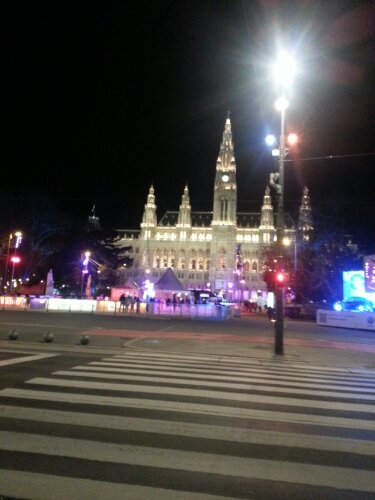
For a number of years now the City of Vienna has set up an ice-skating rink in front of City Hall. Friday evening at about 10 p.m. Maylo and I walked by and this is what we saw.
A joke just sent to me by a friend for people who know the layout of the Ringstrasse:
Franzi (a little boy) asks his father, “Papa, how can you tell the Museum of Art History from the Museum of Natural History?” (In Vienna they face each other across the statue of the great Empress Maria Teresia.)
His father answers, “That’s very easy, Franzi. The Museum of Art History is about art and culture and that is near the opera. In the Museum of Natural History you find asses and monkeys. And that is near the Parliament building!”
 ecbinvienna