Twice in one year, but they have been flirting with us. After my near rapturous post on May 26, the scent faded again. Then it would appear and disappear. Just Monday, a friend commented that it was a wonderful year for roses, and I said, rather sadly, “But not for the linden trees.”
This morning I was taking my usual walk in the park and was overwhelmed with the scent. They’re back in full force, and I am basking in the fragrance.
A little later this year than last, which I think is a good thing. I caught a faint whiff this morning and by this evening they were as noticeable as ever. Ah, May!
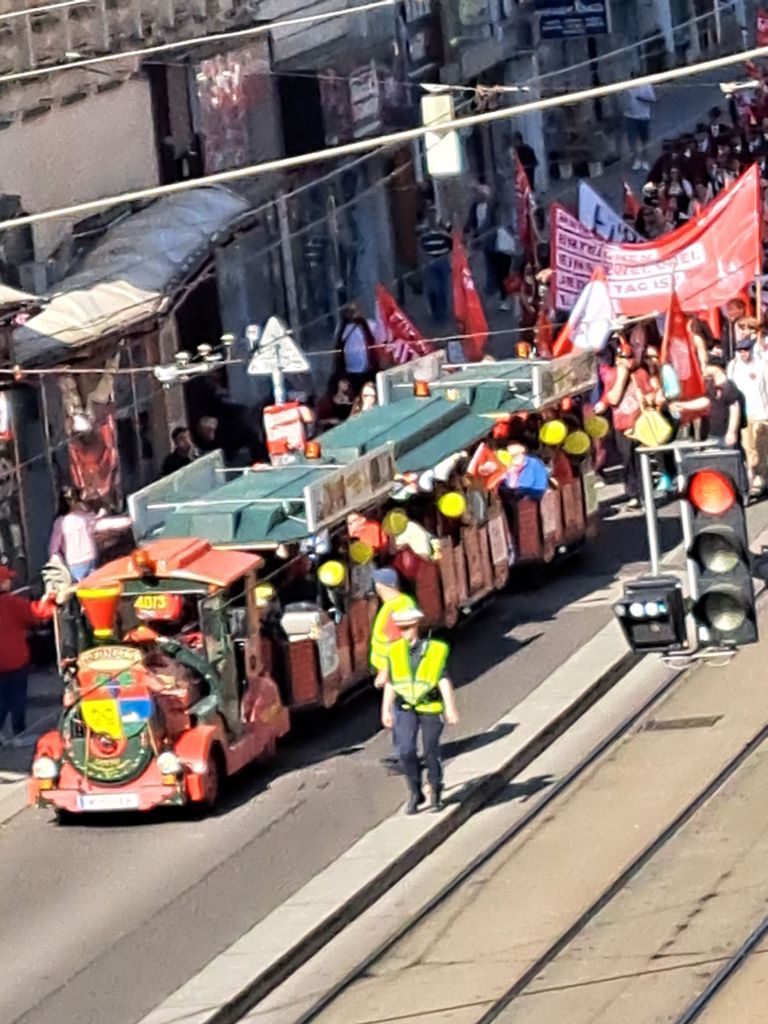
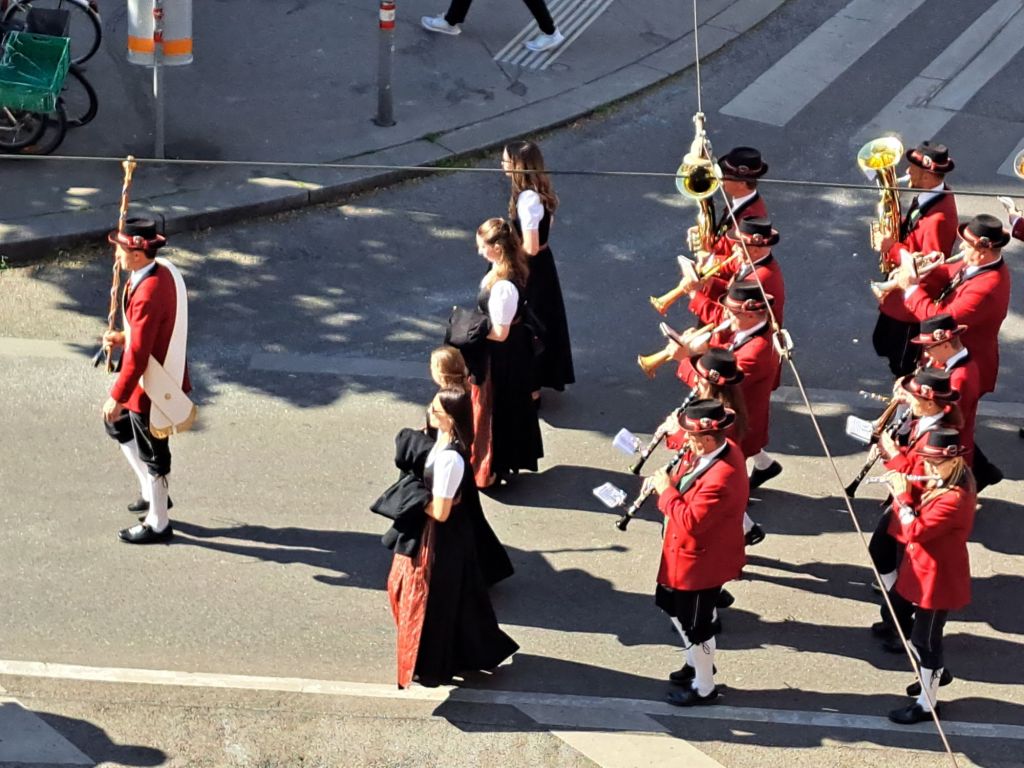
And the SPÖ (Social Democrats) are marching again. This year, the parade looks a little bigger than the past few years, perhaps because of their solid results in the elections last Sunday. Beautiful weather and a well-trained brass band are part of the tradition.
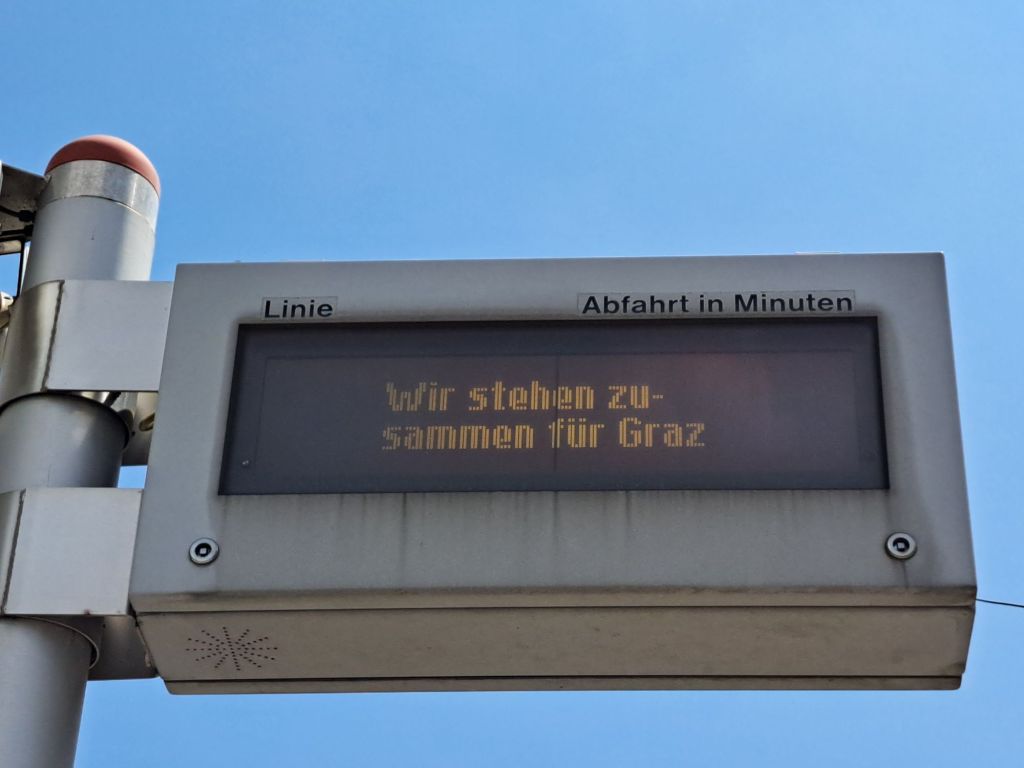
Not surprisingly, one of the banners called for solidarity. This took me back to an exercise I used to do with my U.S. American summer school students in Vienna.
To highlight one of the major differences in worldview that I see between the USA and Europe, I would ask my students for their associations with the word “solidarity.” This question was almost invariably met with confusion. What associations should they have with that word? Then I would give them examples of what my Austrian students of the same age would answer: Lech Walesa, of course, sticking together, and taking care of each other. Some Austrian students would even get into the political aspects and how solidarity is built into the systems here. I see the common use of and familiarity with the word “solidarity” as a cultural artifact for the more collectivist system here.
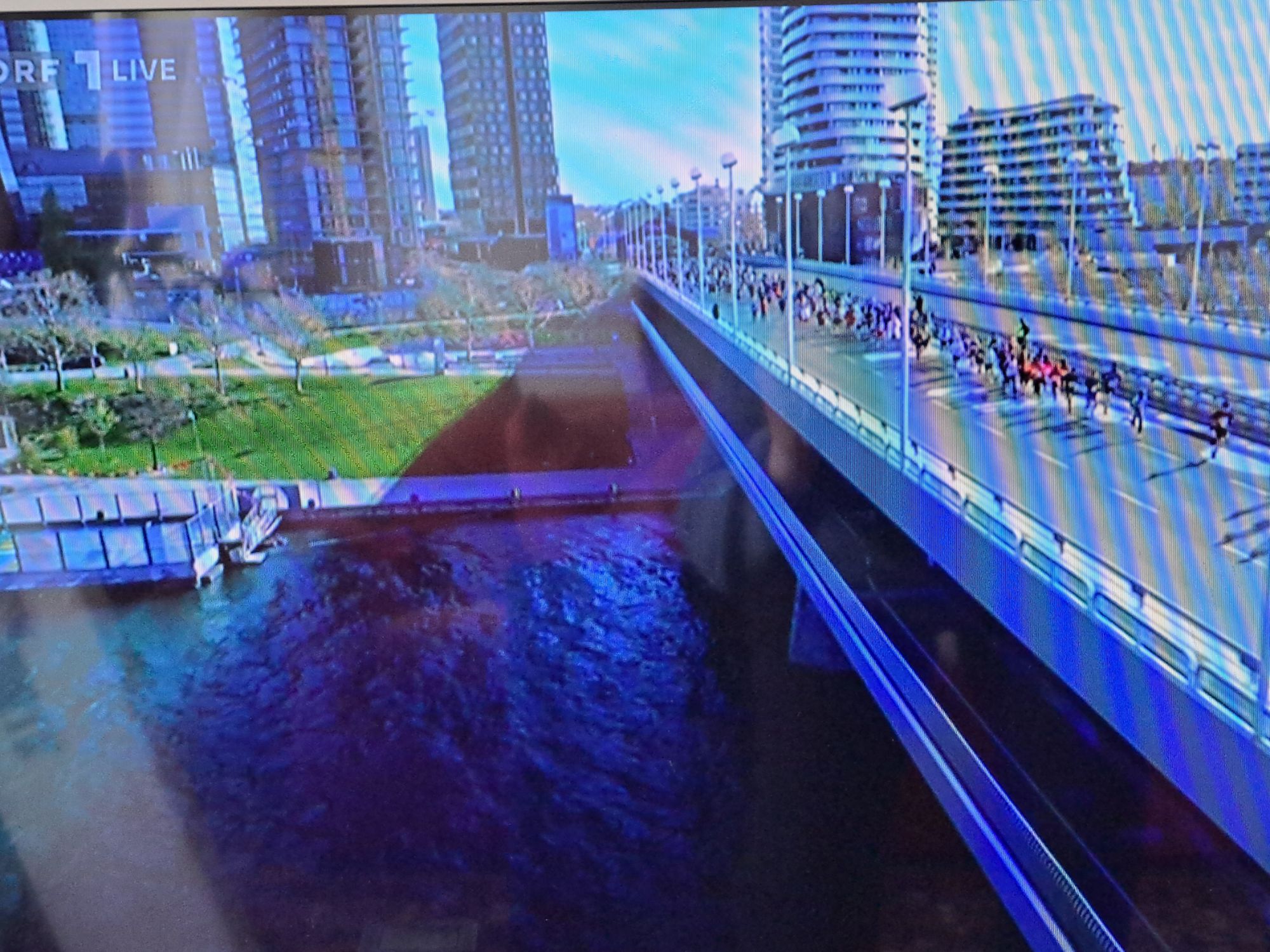
This time I actually remembered to tune into the ORF reporting 20 minutes or so before the start of the race. The main topic this year is the weather. No one’s going to get heatstroke today. It is beautifully sunny but currently 0°C with winds up to 40 kph(!). (Everyone interviewing, being interviewed, and commentating was in down jackets.) Apparently, 8 to 10 degrees are considered optimal. Maybe the organizers should have thought of that before moving the race up by about two weeks!
Some of the effects of the weather: the wind, of course, will be a major challenge. A prominent former Austrian marathoner, Michael Buchleitner, who was commenting, remarked on the water temperature. No, the runners do not need to swim the Danube – it’s a marathon not a triathlon – but they do need to drink water, and the water has been outside all night and will be very cold. He also mentioned, twice, before and after, that it is the kind of weather where the winners will not necessarily be the ones in top form (so, one kind of “fittest”) but rather the ones who adjust to the conditions most quickly and effectively, partly in terms of what kind of clothing they’re wearing. Survival of the fittest in Darwin’s original sense.
In fact, I immediately noticed the difference in clothing among the top runners in comparison to other years. I saw arm warmers, t-shirts under singlets, longer tighter shorts, some gloves, but, with one exception (and in contrast to the amateur runners) no ski hats among the men. One male runner did wear very large earmuffs, though. (He won.)
A small point, there are always ORF reporters on a motorcycle (now electric, if I remember correctly) reporting from the frontline, and they are concerned about how they will stay warm for the two plus hours they’ll be tootling about.
In spite of the temperatures and wind, there were a record number of runners this year. Over 46,000, if I understood correctly.
Watching this (from the comfort of my sofa, except for the half hour or so when I go down to cheer on the frontrunners) brought the usual joy of familiar landmarks: the Tegetthoff column at Praterstern, the Urania, Vienna River, Schönbrunn, Votiv Church, Prater again with the Lusthaus, (even the Ernst Happel stadium looked good) –and, of course, the glories of the Ringstraße (although I do always worry about the runners and the tram tracks).
The many, many campaign posters of the unpleasantly baby-faced Dominic Neff of the FPÖ lining Lassalle Straße were less enjoyable.
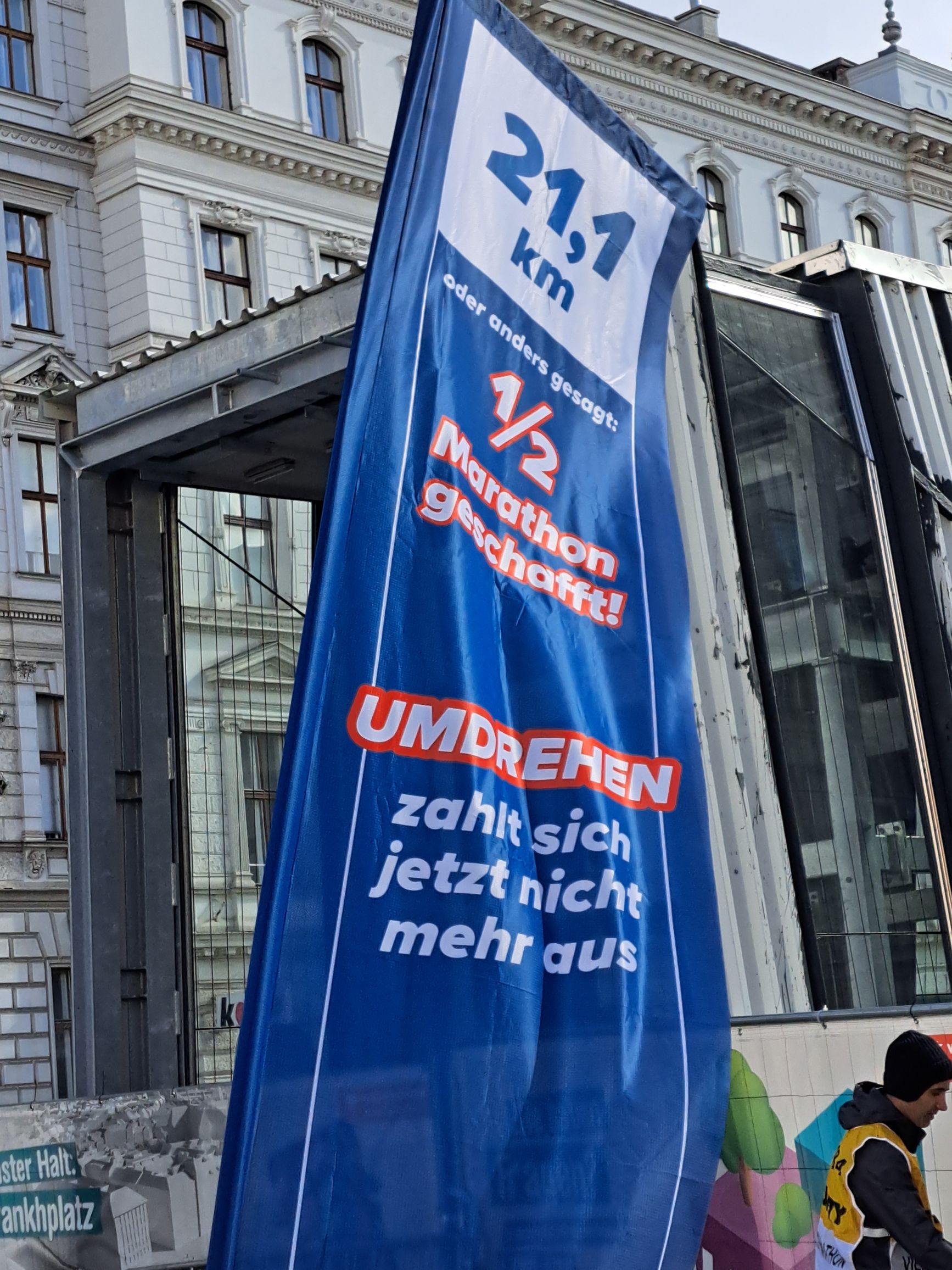
Other kinds of advertising were less disturbing, like the Erste Bank’s #glaubandich (“Believe in yourself”) in huge letters on the asphalt of the Reichs Bridge and the Hervis (sporting goods shop) banner at the halfway mark, telling the runners, who I’m sure had no time to take it in, that it made no sense to turn around now. (Like the old joke of the channel swimmer who got within 50 meters of the other shore and said, “I’m too tired. I can’t,” and turned around to swim back to where she came from.)
Valentin Pfeil, who was the first Austrian and Austrian man to cross the finish line in 2016, had been roped in as a running reporter, wired for sound and expected to comment on how the race was going while he was running it. This seemed kind of brutal to me, but he didn’t seem to mind. At the end, he even said that he experienced “runners’ high” for the first time ever in a marathon and thought that might have been because, knowing that he would be called upon to comment on the race, he wasn’t trying to run 100%. Nonetheless, I found it tactless of his ORF colleagues to ask him a couple of times along the way at which point he knew he was going to make it to the end. He finally deigned to give a clear answer, saying, “I’m passing the Staatsoper now. I think I’ll make it.” (The end is at the Burgtheater, less than a kilometer away.)
Some random points:
Vienna is really into recycling, even for the marathon. There were plastic recycling bins (those water bottles!) lining parts of the route.
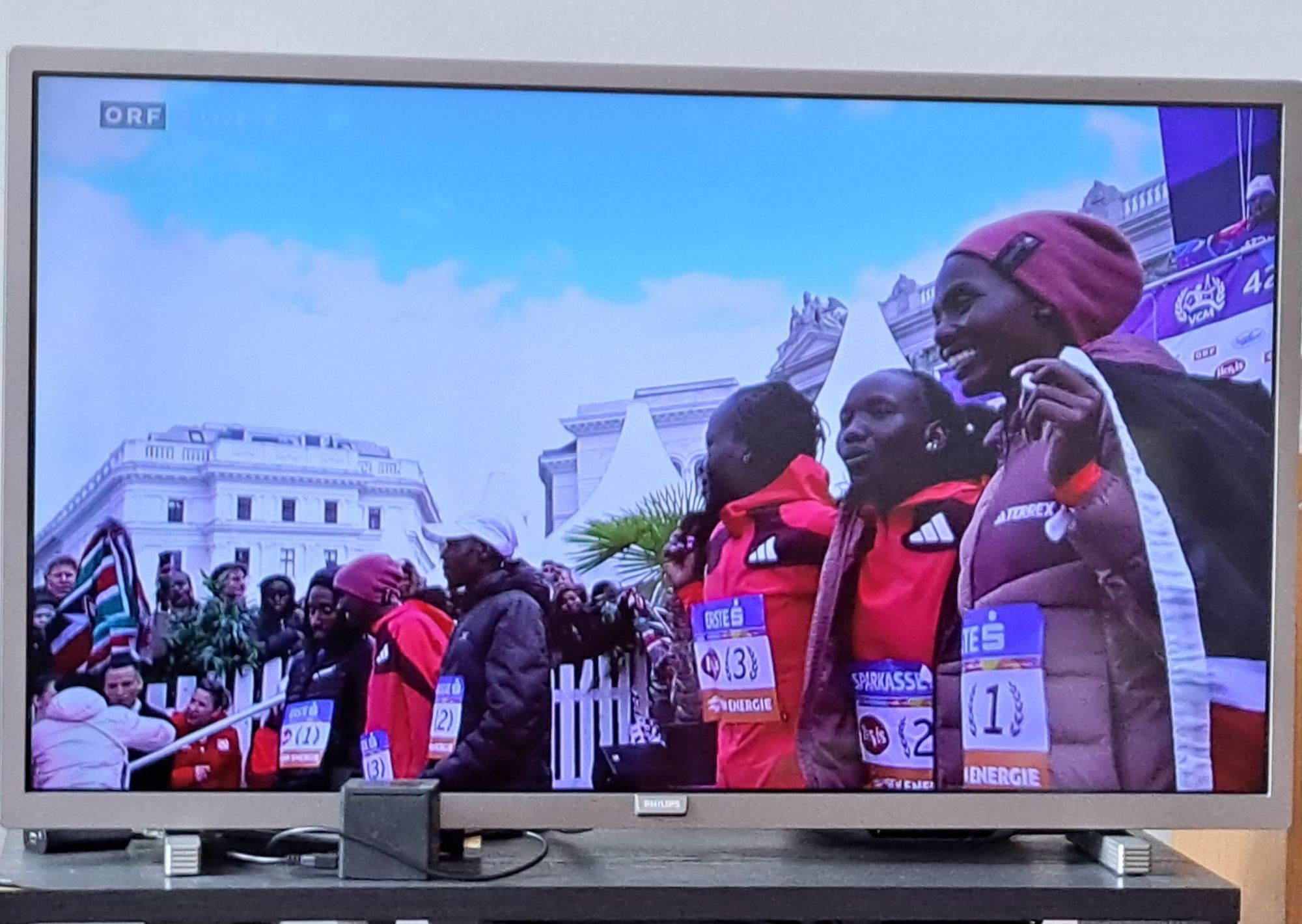
The top three women – in order of arrival at the finish line: Betty Chepkemoi, Rebbeca Tanui, and Catherine Cherotich – ran as a group for most of the race, very close together, one had the sense out of solidarity. (They are all Kenyan. Perhaps that made a difference? Or was it really, as one of the commentators suggested, a strategy to minimize the negative effects of the cold and wind?)
Two of my favorites from past years, Nancy Kiprop and Vibian Chepkirui, were nowhere to be seen, although reports leading up to the marathon had suggested they, too, would be running.
The two winners – Haftamu Abadi from Ethiopia for the men and Betty Chepkemoi (see above) – were basically upsets. I’m not sure even they expected to win. And yet both won by a considerable margin. No tense finishes today. Both crossed the finish line looking incredibly strong with no one else anywhere near them. Coincidentally, they both had the starter number 12 (M12 and F12).
Haftamu Abadi pulled a picture out of his pocket just before he crossed the finish line. On the other side of the finish line, he kissed the picture (it seemed to be of Jesus), looked at the sky, crossed himself, kissed the ground, and then took off one of his shoes and kissed that. The Austrian commentators seemed to think this was a reference to his compatriot, Derera Hurisa, who crossed the finish line first in 2021, also in something of an upset and in a blaze of glory, but was disqualified because his shoes did not meet the (brand-new) regulations.
On top of that, Haftamu Abadi, who, in spite of the conditions, achieved a personal best time of 2.08:26, is the youngest winner of the VCM in its all 42 years. He’s 21 years and 12 days old in a sport that traditionally, and oddly, favors the older contestants.
The first Austrian woman this year, Eva Wutti, is in the legal profession (that generic term “Juristin” was used so I don’t know if she is a full-fledged lawyer or a legal adviser in a company, for example) and didn’t arrive in Vienna until Friday evening because she had to work(!). (She lives in Carinthia.) She also has a daughter, and the ORF reporter predictably asked how she managed to combine family, job, and running. (Equally predictably, none of the men were asked this question.) At the same time, of the four “firsts” she was the only one who had a clear answer to the question “What’s next?” She’s hoping to run the Salzburg marathon in May. (Glutton for punishment, anyone?)
The first Austrian man, and therefore first Austrian, across the line was Andreas Vojta, who, it turns out was also the first European. He came in ninth, behind the first and third runners, who are from Ethiopia, and the six Kenyans in-between. I think this kind of result is especially amazing given that he was not able to train in December or January because of an (my dictionaries and online sources failing me I’m translating word for word here) an inflammation of the skin of the heart (Herzhautentzündung) and only started training again in February.
Valentin Pfeil, the running reporter, is coaching Johannes Pell, the second Austrian man (and 12th overall) to cross the finish line.
Have I mentioned it was really cold? (See the two winners in their down jackets!)
Curious for more? There are some website suggestions below:
I’ve always known that ice cream parlors in Vienna officially close sometime in September or October and re-open in March. I didn’t realize until now that it’s the Chamber of Commerce that chooses the dates. (I always thought the ice cream sellers simply agreed on that.)
I knew something was up when I was in the First District yesterday and saw lots of people, still in their winter coats, leaning in to large ice cream cones before lunch. And I have to say I love that about the Viennese. In the meantime, you can get “Saloneis” — as opposed to “Supermarkteis” — any time of the year, but there is still a noticeably large number of people who celebrate the First Day of Ice Cream, even if the weather is distinctly March-like, with quite a cutting wind.
The added attraction this year is that the ice cream artisans are among those contributing to the celebrations for the 200th anniversary of Johann Strauss’s birth. (The son, not the father, and therefore the composer of the “Blue Danube Waltz” and not, for example, the “Danube Songs”.) Apparently, there is already a Fledermaus flavor (I have to try that one!) and a “Night in Venice” flavor that was inspired by tiramisu.
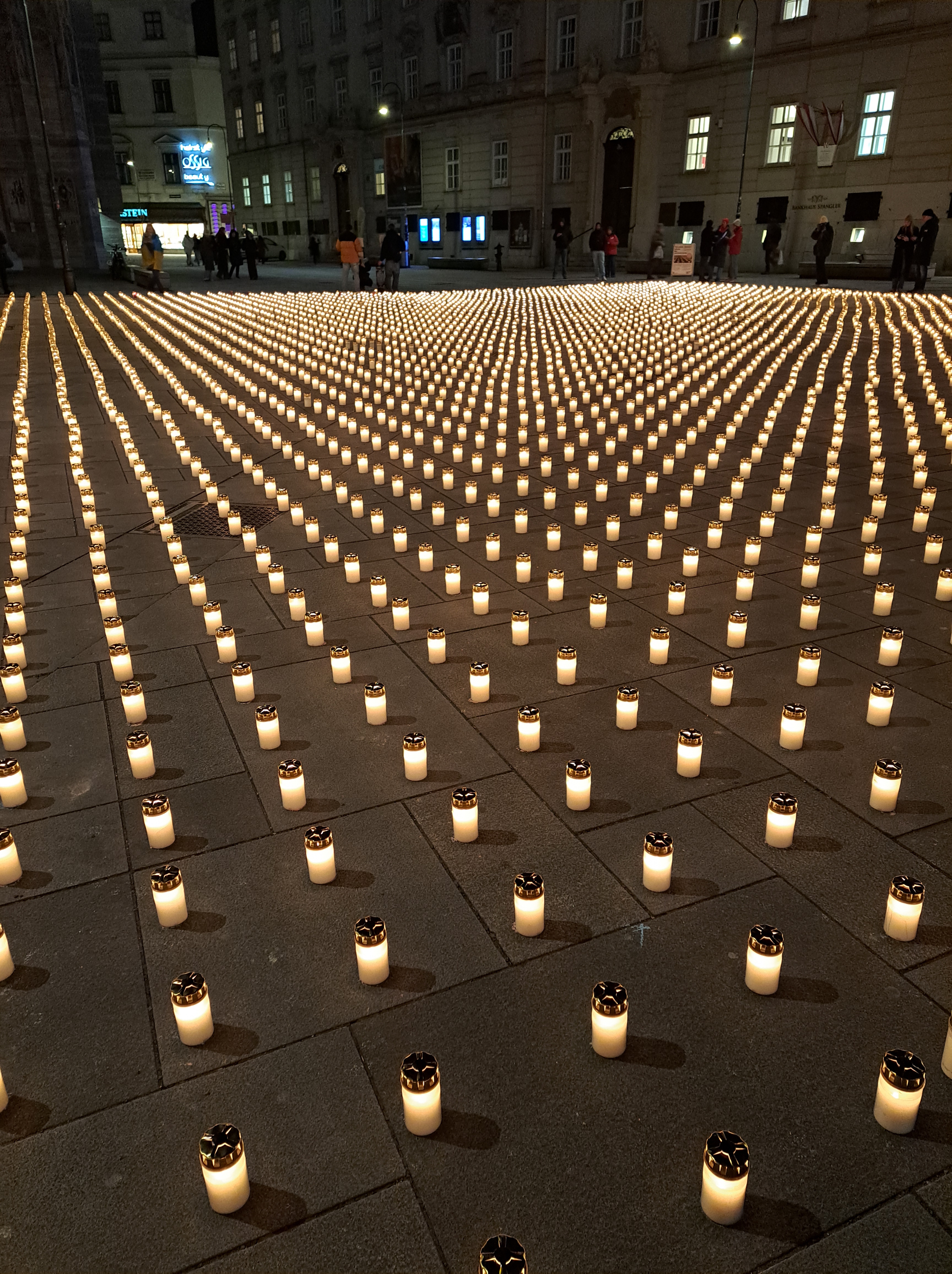
While the incumbent in the White House in Washington, DC, was blaming Ukraine for the war and calling Zelensky a dictator, Caritas in Vienna was organizing an event to express solidarity especially with the children of Ukraine. Next Monday it will, unbelievably, be three years since Russia’s invasion of Ukraine.
The Sea of Light wasn’t as big or moving as I thought it would be (fewer people, although a good number of candles carefully laid out). It started at Stephansplatz at 5 p.m. today and I worked until 5:30. Still, I thought it would at least go until 7 p.m. or so and went off with my candle to join those already there. I arrived a few minutes after 6 p.m. to find a medium-sized crowd and a Ukrainian women’s choir just finishing their last song. The organizers then thanked us for attending and started to dismantle the sound system and the small stage.
I stayed for a bit and then went home. It was somehow discouraging that all around us people were just going about their business, and I decided not to stay. But I’m glad I went and was counted.
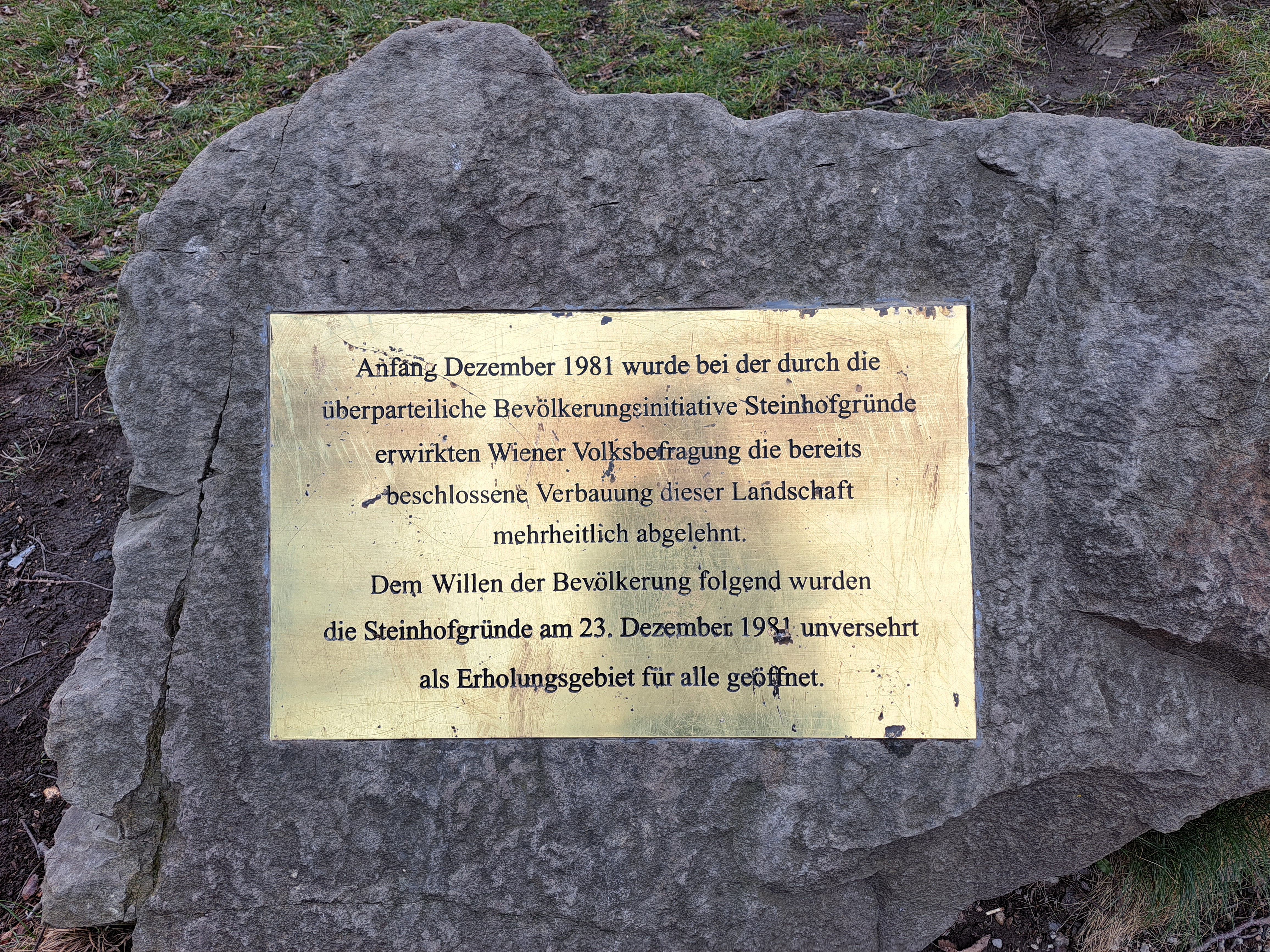
My translation of the plaque at Steinhof: At the beginning of December 1981, a Vienna-wide referendum initiated by the non-partisan citizen group Steinhofgründe rejected the construction that had already been approved for this site.
In accordance with the will of the people, the Steinhof area, in its untouched state, was opened to the public as a recreational space on December 23rd, 1981.
(Nice Christmas present! ;-))
How is it that I have now lived over 36 years in Vienna and only last Sunday discovered this part of Steinhof? I have an excuse for 11 of those years as dogs are not allowed in the area. This does however leave 25 years for which I cannot account. And how did I come to discover it now?
An answer to the first question first. All that time, whenever I heard the name Steinhof I thought of the hospital complex designed by Otto Wagner and Carlo von Boog and devoted largely to the treatment of the (wealthy!) mentally ill. (In Viennese, the area was also referred to as Baumgartner Höhe and had become a kind of shorthand for the psychiatric clinic, much the way “McLean’s” is used in Boston.) I had even taken a tour of the hospital complex once. I’m sorry to say that the only thing that sticks in my mind, other than the beauty of the Jugendstil buildings, is that the church, designed by Otto Wagner, was lined with tiles to quite a height. Taller than me, as I remember, and the reason given was that patients were more or less required to attend services but could not always control their bodily functions. The tiles made it possible to hose down the building after the services.
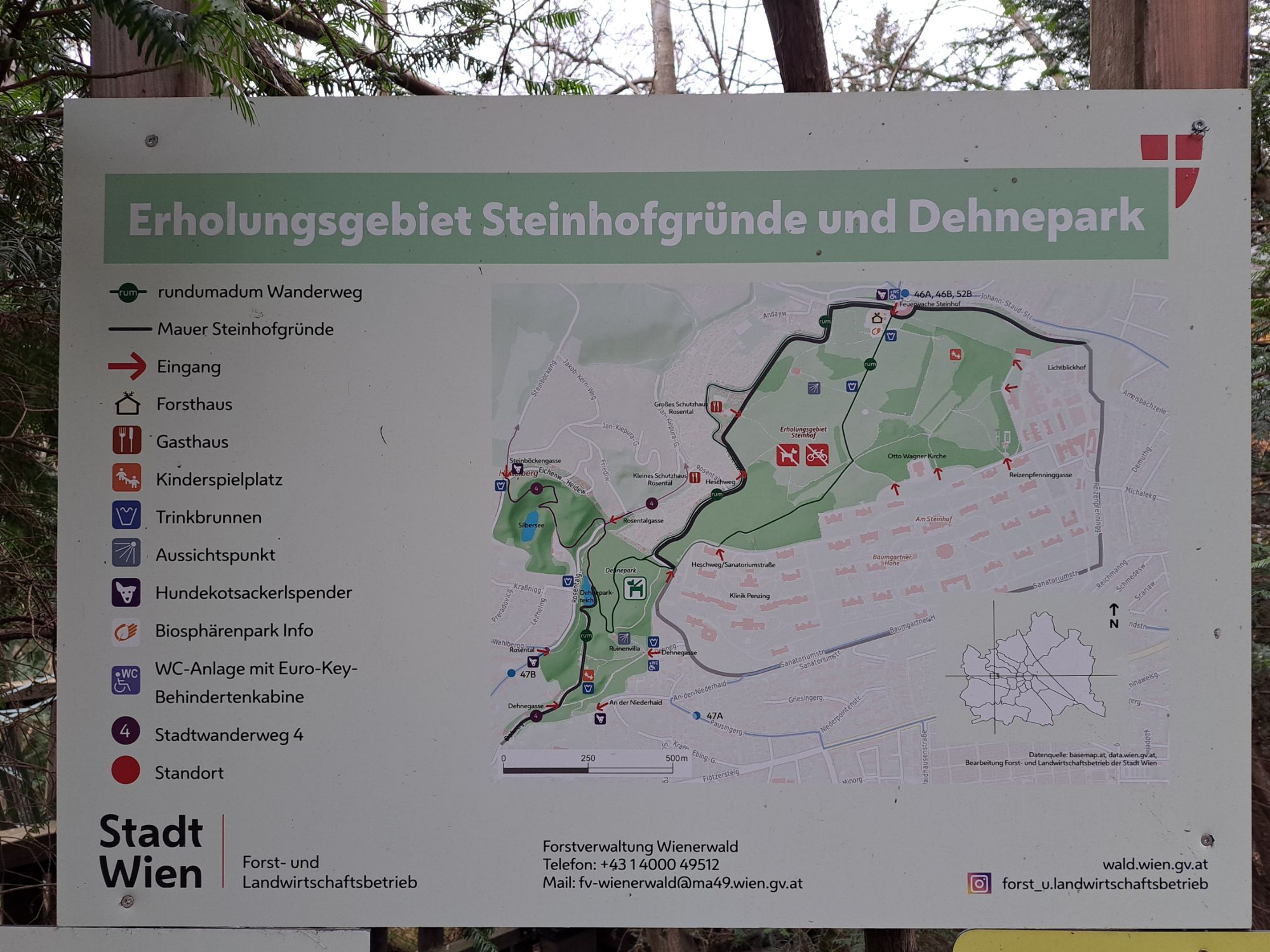
How did I come to discover it last Sunday? I wanted to go to Wilhelminenberg in the 16th district for a walk and on the bus up from the Ottakring S-Bahn station decided to get off at the Feuerwache am Steinhof stop, rather than the Savoyenstraße one, and then walk towards Dehnepark in the 14th. I was planning to walk around the outside of the grounds, as I had often done with Maylo, and enjoy the beautiful houses out that way. When I got off the bus, though, with an astonishing number of people, I realized I didn’t have to walk around the outside. I could go in. And I’m very glad I did. It is one more beautiful place to walk more or less in the Vienna Woods and will, I think, make a really nice place for picnics when the weather is warmer.
By the way, this being Vienna, I actually ran into someone I know on my walk. (“Wien ist ein Dorf” we often say. Vienna is a village.)
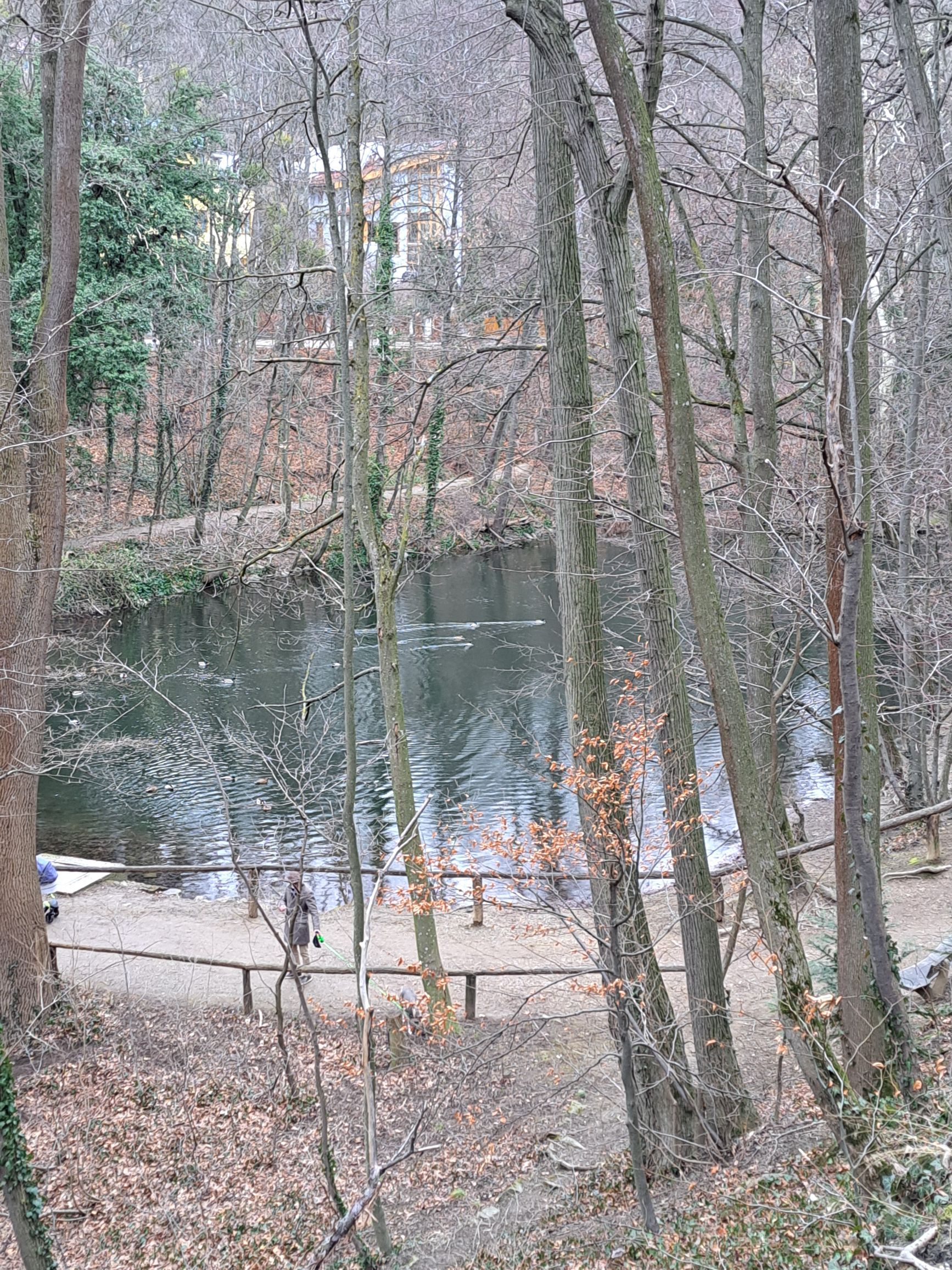
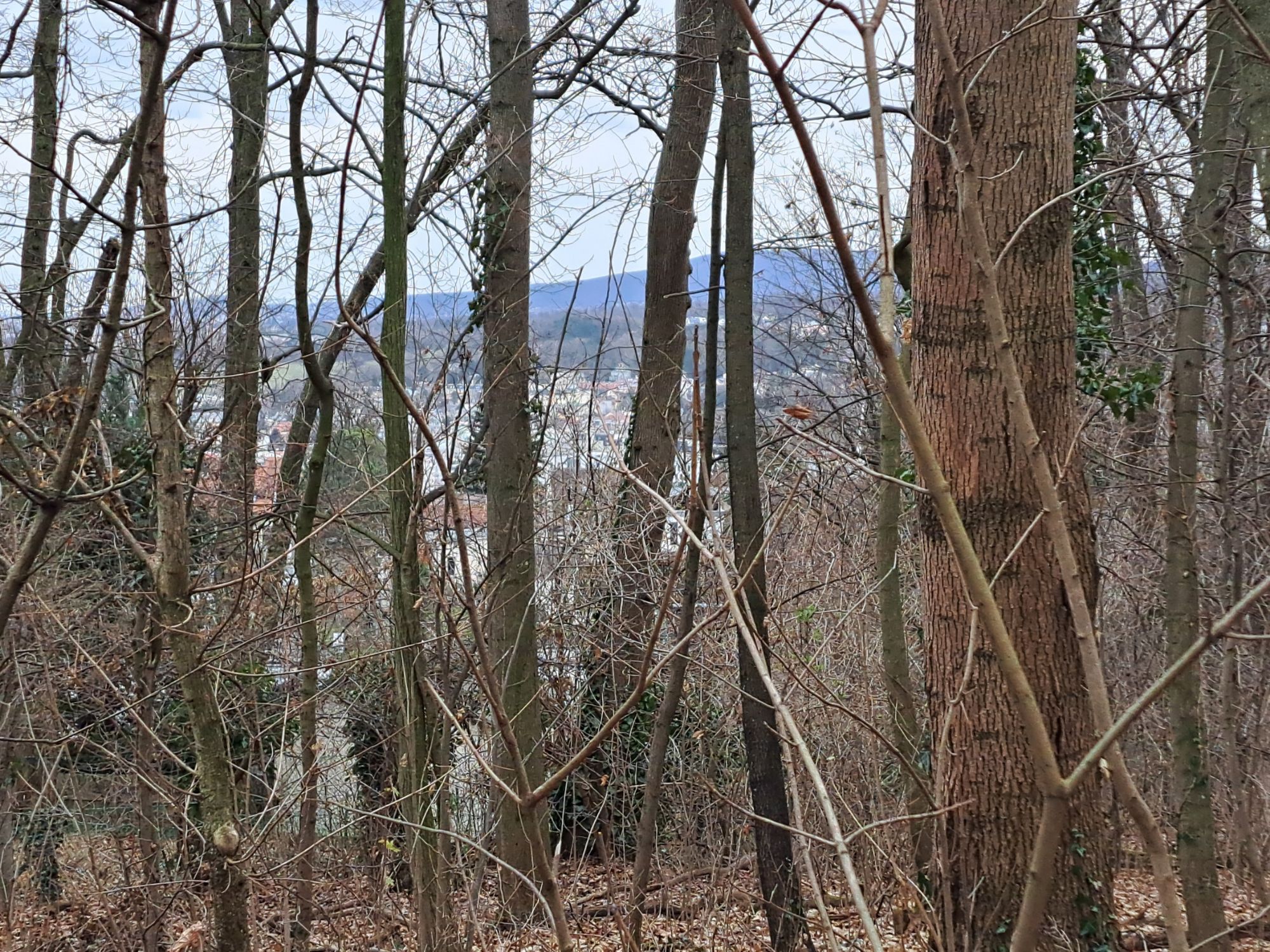
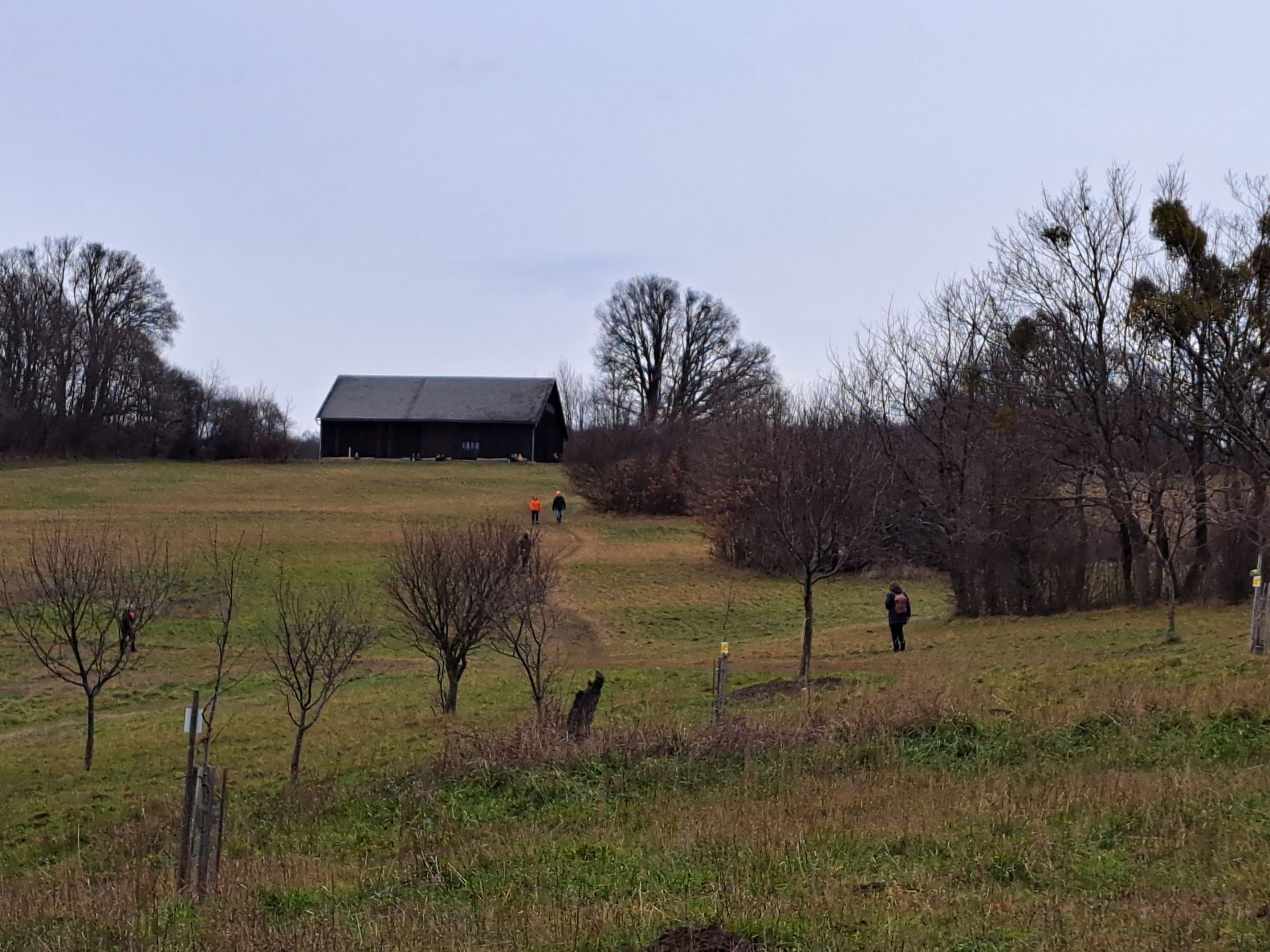
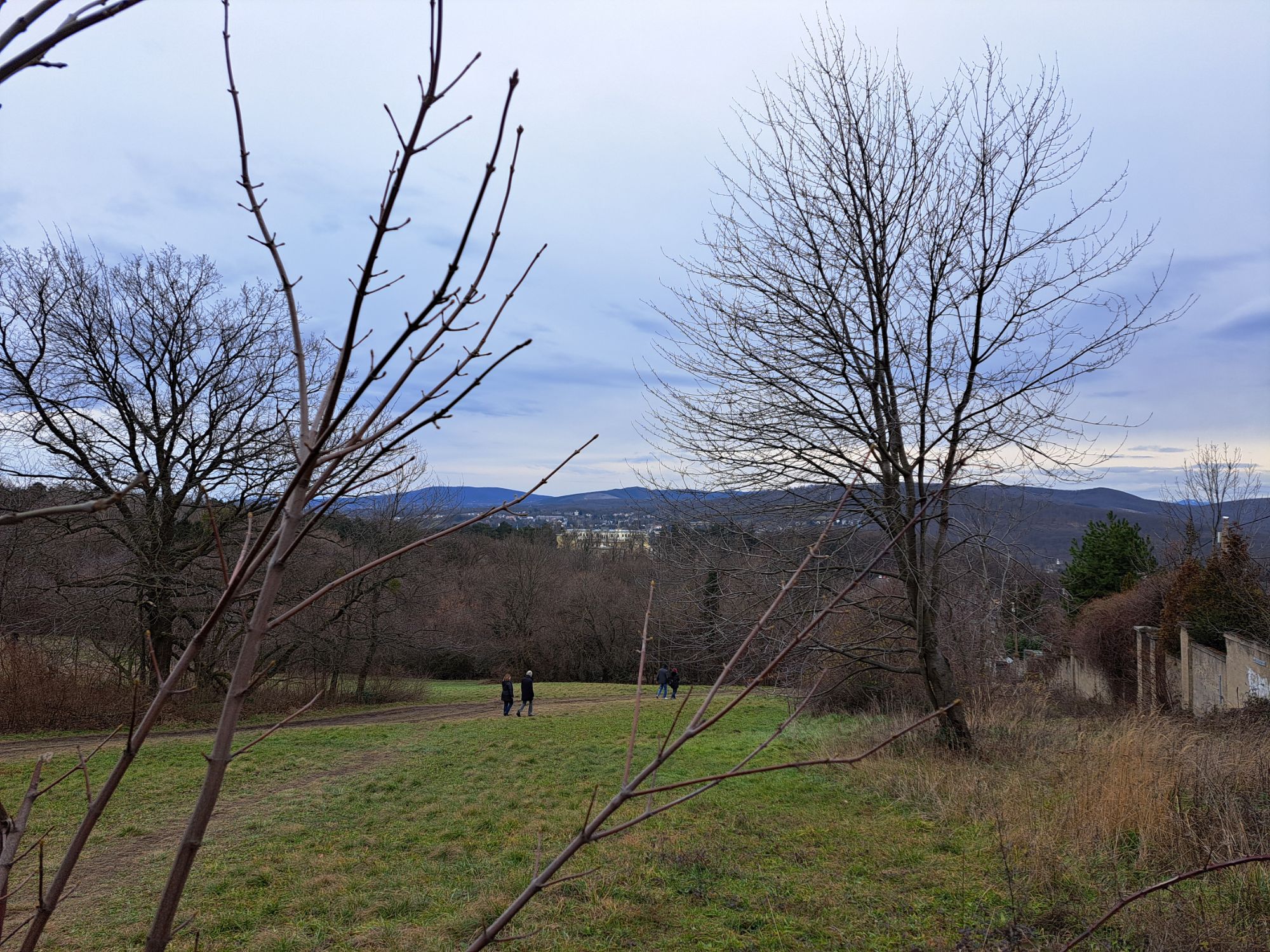
Here are a few more photos.
Walking time from Feuerwache am Steinhof to Hütteldorferstraße this time around (I got a little lost) was probably about an hour and a half. Below you can see the map.
I’m glad he made it into the NYT. He was an extraordinary artist. I had the great pleasure of experiencing him as Frosch, the prison guard, in Johann Strauss’s “Die Fledermaus” on New Year’s Eve 1988 at the Staatsoper.
 ecbinvienna