NYTimes: ‘The Hare With Amber Eyes’ Comes Home

14 Nov

‘The Hare With Amber Eyes’ Comes Home https://www.nytimes.com/2019/11/12/arts/design/hare-with-amber-eyes-vienna-edmund-de-waal.html

And I’m going to the exhibit at the Jewish Museum in Vienna on Sunday with the friend who recommended Edmund de Waal’s book. Lucky me. 🙂

07 – Lainzer Tor to Rodaun

27 Oct

Dear Reader,

Yes, we are back to the Rundumadum trail. Today we took advantage of the last warm day of autumn (the ORF tells us) to walk the seventh stretch, from the Lainzer Tor to Rodaun. And we (Maylo and I) walked with a friend (which I will use as an excuse for not noticing more about the scenery and happenings).

Because Maylo came with us we could not do the usual route through the Lainzer Tiergarten. The City of Vienna being what it is, though, had devised an alternate route for people with dogs. 🙂 The first half hour or so of this route was along roads lined with beautiful houses and gardens. We were a little distracted from the beauty around us, however, as it was all we could do to not get run over by bikes and cars and to not crash into other pedestrians. (There were many–many–people out enjoying the beautiful weather.)

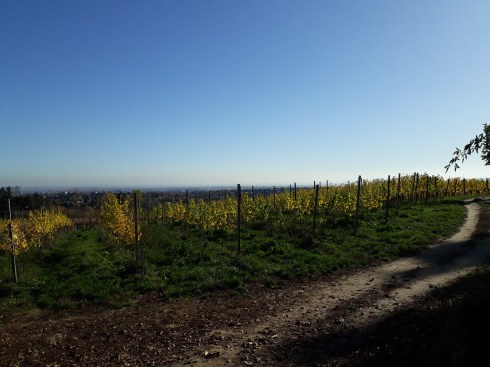
After this stretch, we made it to a “Forststraße” where cars, at least, were not allowed and could take time to photograph the view and the vineyards.

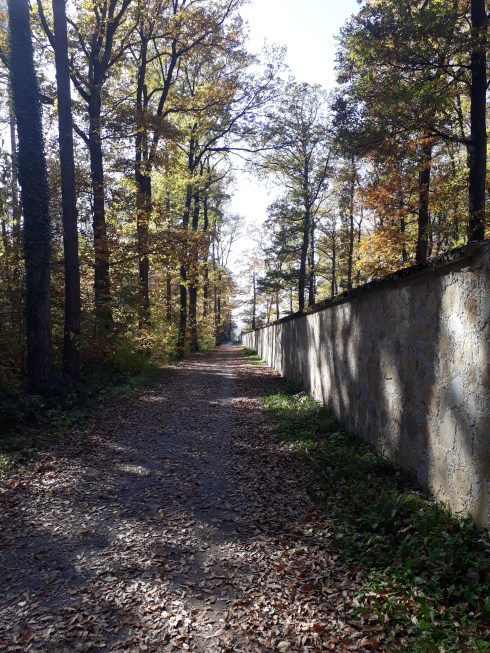
Then we followed the path along the wall of the Lainzer Tiergarten until we turned off to the left in the direction of Mauer. It was an exquisite walk through an autumn woods at its peak, with just the occasional flurry of bright leaves blown from the trees.

We briefly considered a stop at the Schießstätte–one of the many simple restaurants that fortify the walkers in the Vienna Woods–but decided we weren’t hungry enough yet. We carried on and found to our suprise and pleasure that both of us did know the area somewhat after all. We had both, separately, done the Stadtwanderweg (City Hiking Trail) #6 at some point, which in part coincides with the Rundumadum trail at this point.

Before we really expected it, we arrived in Kalksburg in the 23rd district and followed the trailmarkers to the Liesing River and then walked along the river to the Number 60 tram.

The tram routes in Vienna do get changed occasionally and not always in ways that maximize convenience. This time, however, I was pleasantly surprised to find out that the 60 tram had been extended to Westbahnhof (the westerly train station) and took that more or less home.

Next time Rodaun to Alterlaa …

Distance of alternative route: 7.5 km

Time: approx. 2 hours subtracting the break we took on a sunny bench

Marathon world record in Vienna Prater

12 Oct

Eliud Kipchoge did it! He ran the classic marathon distance in under two hours (1:59:40). And he did it in the Prater in Vienna. I’ve never seen him so happy. 😁

https://sport.orf.at/stories/3054515/

Heuriger (wine taverns or gardens)

11 Oct

How could I miss this? The Wiener Heuriger as an institution was declared “intangible cultural heritage” by UNESCO on Tuesday. Now there’s one cultural institution I’m still supporting regularly. 😁

https://m.facebook.com/oesterreichwein/photos/a.411385460232/10156501926320233/?type=3

Wien ist anders (Vienna is different)

10 Oct

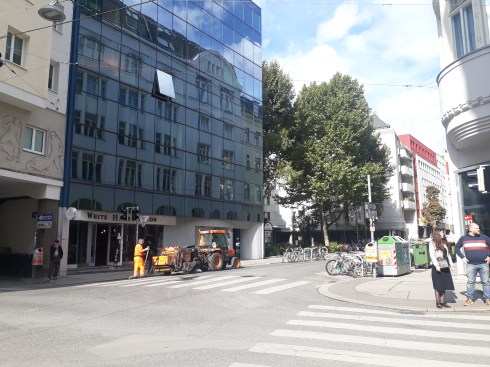
“Wien ist anders” was a slogan of the City of Vienna, highlighting the fact that Vienna was a major city but still different from the others. Today I’m using it to mean that Vienna is different from the way it was when I arrived. The photo is an illustration for me of how the city has changed–new next to old, the White Hair Salon next to Haus Neubau (the retirement home for people in the 7th district).

I spent the morning at a dynamic event launching a new endeavor (FuturAbility) to promote the UN Sustainable Development Goals. It was held at one of the now numerous co-working spaces, this one on Lindengasse in the 7th district.

I was amazed at how the area (not that far from my flat) has changed without my noticing–many new buildings, many of them very stylish apartment houses that do not exactly look Viennese (more Italian somehow).

As I was pondering the changes, I arrived at this corner and thought this about summed it up. Old (at least 20th century) Vienna is still there in the form of a humane solution for older people who no longer can or perhaps no longer want to live on their own (made possible by Red Vienna). Alongside it is a modern building in which a trendy hair salon with an English name. The old and the new.

Happy End – WIENzig

4 Oct

According to this, Emperor Josef II decreed that all plays had to have a happy ending. This meant (pretty major, if you ask me) re-writes for plays like “Romeo and Juliet” and “Hamlet”. These happy endings became known in the German speaking world as “Viennese endings”. Apparently, Apfelstrudel and other delicacies weren’t enough to keep the population happy. 😉

https://www.wienzig.at/happy-end/

“Gruß Gott!”

29 Sep

“Gruß Gott!” is still a common greeting in Austria, or at least in Vienna. Today, reading an interview in the Kurier with Thomas Schäfer-Elmayer, owner of the number one dancing school in Vienna and the Emily Post certainly of Austria if not of the entire German-speaking world, I learned something of the history and associations of the phrase.

He didn’t feel the need to explain but I do: The phrase (word-for-word translation “Greet God!”) is short for “God greet you.” (“Grüß Sie / dich Gott!”) He told a story, though, in which he was speaking at a technical / vocational high school and a student called him on using it because the student considered the greeting too closely associated with the ÖVP or Austrian People’s Party (a.k.a. the Conservatives).

To his credit, Schäfer-Elmayer looked into this claim and discovered that between the world wars it truly was a sign to others that one belonged to the People’s Party. His research showed that during this time–with what amounted to a civil war being waged in the streets of  Vienna–the hate between the Social Democrats (the Reds) and the People’s Party (the Blacks) was so great, people chose to signal their allegiance immediately in how they greeted other people. “Grüß Gott” for the Conversatives; “Guten Tag” for the Social Democrats.

The civil servants, who sought to remain neutral, as good civil servants the world over do, adopted–Schäfer-Elmayer said–the term “Mahlzeit” (usually said before a meal and then taking the place of “Guten Appetit”). This is an interesting take on the greeting, as I always assumed “Mahlzeit” had a similar function as the French “Rebonjour”. In current usage, you say “Guten Morgen” when you first run into someone in your place of work–in the morning–and “Mahlzeit” afterwards to indicate that you remember greeting them the first time. (Apparently, in French companies it is a rather large faux pas to use “Bonjour” twice in one day to the same person. I read that it is tantamount to considering the person so inconsequential that you don’t remember greeting them the first time. Source: Schneider and Barsoux, “Managing across Cultures”)

From 1938 to 1945,  apparently, “Mahlzeit” took on another use. People who wished to avoid saying “Heil Hitler” said “Mahlzeit” instead. I hear my mother–born in Berlin and raised there during the Second World War–saying, “Berliners just kept saying ‘Guten Morgen’.” Her comment is supported by Christabel Bielenberg’s incomparable memoirs, which I am currently re-reading, of living in Berlin as an Englishwoman under the Nazis. Even more of an aside here: that Berliner habit got my grandmother–my German grandmother, that is, not my English grandmother (complicated family)–into trouble when she visited her parents in their small town in Thuringia.

And so a bit of culture and history on this Sunday.

For German speakers, links to the Kurier interview and to the Wikipedia entry on some of the uses of “Mahlzeit” below:

https://kurier.at/freizeit/thomas-schaefer-elmayer-gesteht-ich-mache-auch-viel-falsch/400613615

https://de.wikipedia.org/wiki/Mahlzeit


More Helmut Deutsch

6 Sep

Ever since I read Helmut Deutsch’s memoirs I’ve been meaning to post this “review” I wrote almost 10 years ago of a concert with Barbara Bonney (who doesn’t come off terribly well in Deutsch’s memoirs), Angelika Kirchschlager (who does), and Helmut Deutsch himself.

Here goes, finally:

An Evening of Duets, 5 November 2009, Konzerthaus, Mozart-Saal

I have just come home from a mythical concert. It was the kind of concert you hear about the way you might hear about unicorns but can never be sure exist. It was a concert that made me forget that parts of Pakistan are increasingly ruled by the Taliban, that Iran is building up nuclear capability, and that bonuses are back on Wall Street with no one having learned anything from the economic crisis we are not even yet out of. It was a concert that made the world seem whole and a cheerful place to be. And it truly was miraculous—it provided a mass healing of the TB patients who usually attend concerts in the Mozart-Saal in the cold months. I think I heard only six coughs the whole evening. I’m referring to the evening of duets done by Barbara Bonney, Angelika Kirchschlager, and Helmut Deutsch at the Konzerthaus.

Kirchschlager was completely her usual extravagant self, a kind of Dorabella to Bonney’s more Fiordiligi-like gravitas. Her singing as always was simply an extension of herself. More than any singer I have had the privilege to hear live Kirchschlager embodies what one of my singing teachers referred to as singing from the inside out. She is, quite simply, a force of nature.

Deutsch was even more than usual a frame for the singers. In fact he, together with the Steinway grand piano open, unusually, on the full stick, was quite literally the perfect frame this evening, enveloping the singers in the warm curve of the piano, supporting them with his exquisite playing and remaining unobtrusive yet present in the background for the bows.

Most touching was Bonney who recently, according to reliable sources, has had several very poor years vocally. The voice this evening was not quite what it was in her early career, and I like it better. It has lost some of the ping and for that gained a kind of gentleness which at times almost suggests a fragility as well as a maturity it did not have before. It has much more power to move me than it ever did. And in the second encore, by Gounod, when she started alone and sang with such fervency it was almost unbearably moving. This rather hardened concert-goer quite suddenly found tears streaming down her face.

At the end of the evening one realized again how unusual the concert had been. Not only had the coughs been soothed, but not a single person had clapped in the French group in spite of the fact that the group incorporated the work of several composers. And when the last tones of the second encore died away, there was at first a great hush and then a roar of approval. Then came perhaps the biggest miracle of all. This Viennese audience, who usually insists on four or five encores, understood that the program was complete and needed no additional songs. After bringing the performers back for a few more rapturously received bows, the members of the audience gathered up their things and flowed in perfect harmony from the concert hall.


Ausverkauft! (Sold out!)

11 Aug

I’m having a wonderful time reading Helmut Deutsch’s memoirs (a present from a kind and generous friend).

This greatest of Lieder accompanists, born and raised in Vienna, tells a good story. This one strikes me as quintessentially Viennese: Deutsch was one of two accompanists who regularly played for the incomparable Hermann Prey. On one occasion, Deutsch needed a ticket to a Prey recital in the Konzerthaus in Vienna. The posters for days had sported a bright red “Sold out” sign. Nonetheless, Deutsch went into the ticket office to see what could be done. To his great surprise, the lady behind the counter asked, “Stalls or balcony?” Deutsch drew her attention to the “Sold out” signs at which point she smiled and said, “No, not at all. It’s just that Kammersänger Prey likes so much to see the signs.” [“Nein, nein, der Herr Kammersänger hat das nur so gern.”] 🙂

Rooseveltplatz

26 Jul

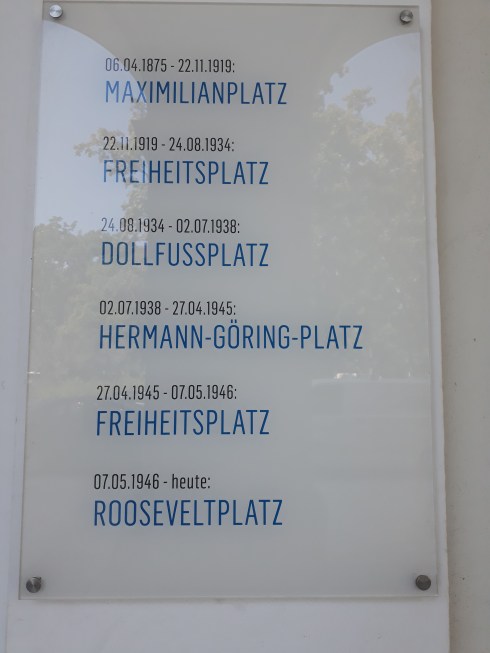
What a concise reminder of bits of Viennese and Austrian history, all in one sign at the Institute for Social Sciences of the University of Vienna. They are located at what I have always known as Rooseveltplatz. Obviously, it has had different names over the years, reflecting eras and events in Austrian history.

I can guess at most (all) of them. Maximilian was Emperor Franz Josef’s brother, who had the nearby Votiv Church built. Freiheitsplatz (Freedom Square) probably expresses the hopes of the new democracy after the First World War. Dollfuss was the Austrian chancellor assassinated by National Socialists in July 1934. Hermann-Göring-Platz is sadly self-explanatory. And then Freiheitsplatz again until it was named after the U.S. President Roosevelt.

Interesting!