Archive | Vienna, City of My Dreams RSS feed for this section

Dogs in Vienna (4)

22 Apr

We are in the middle of a “police action” against dogs and dog owners. That is, for two weeks the police in Vienna will be on the lookout for infractions of various dog-related laws, like the leash law and (one hopes) the pooper scooper law. This made headlines in the local newspapers. As one friend of mine said, “I find it very fair that they give us notice.”

I think this a really good (and, basically, very Viennese) way of approaching the topic. Let’s face it–the police have enough to do without prosecuting every person with a gentle, well-behaved dog for not having the animal on a leash. By putting a time limit on the “action” and in that time period being very strict, the police remind dogowners what their actual responsibilities are. Everybody is made to think twice. And then the police can, in good conscience, go back to chasing bank robbers, purse snatchers and dogowners who are endangering others with out-of-control pets.

It gets the message across without making the lives of the police officers, many of whom seem sympathetic to dogs and owners wanting some freedom from the leash,  harder.

Dog (3) – Scooping the poop

26 Feb

Vienna, like many big cities, has pooper scooper laws and–much as anyone who has moved or visited here recently is likely to doubt it–they have made a big difference. There is still a lot of poop on the ground, but there used to be more.

As with many things the Vienna municipal government has tried to motivate citizens to comply with the laws (a) by using humor and (b) by making it as easy as possible. In numbers: over 1,000 stands with plastic bags for the poop, which can be deposited in any of the 20,000 regular public trash bins, and 30,000 (humorous) signs to remind dog owners to scoop. (http://www.wien.gv.at/rk/msg/2007/0920/016.html)

The sign itself I find a masterpiece. (In fact is has even attracted attention in Berlin: http://www.fensterzumhof.eu/4869/berlin-wien-hundehaufen-aktion/) The perky dog has a sign in his mouth that says: Sind dir EUR 36 wurst? A very clever play on words, reminding the dog owners of the possible financial consequences of failing to scoop. “Wurst” means sausage in high German, as in the kind you eat (think “Bratwurst”). In Viennese dialogue it has two meanings. If you say, “Das ist mir wurst” it means “I don’t care” (word-for-word translation: it’s sausage to me). At the same time, I’m sorry to say, “Wurst” is also used to describe precisely what dog owners should be scooping. So the little dog is asking, “Do you really not care about EUR 36?” and referring to the poop in the same sentence.

The overriding slogan for the campaign also relies on Viennese dialect, as if to say, we are all in this together: Nimm’ ein Sackerl für mein Gackerl. This means “take a bag for my poop” but, sadly doesn’t rhyme–and isn’t very memorable or motivating–in English. The “erl” at the end of both “Sackerl” and “Gackerl” in Viennese dialect serves the function of the diminutive “chen” in high German, so we’re talking about a little bag (“Sackerl”) for a little pile of poop (“Gackerl”–a very Viennese expression).

This phrase has even inspired a song, such as it is, which can be viewed on YouTube ( http://www.youtube.com/watch?v=GdDPaAR66aQ). The verses are about the dispensers being empty and the trash bins being full so that Frau Huber has to bring her own bag and then has nowhere to dispose of it. This has not been my experience so far. Perhaps the song is a few years old?

One thing is probably no accident–that it is *Frau* Huber. My, granted not all together scientific, observations have suggested to me that it is middle-aged women who are most assiduous in cleaning up after their dogs. And I, at 50, have joined their ranks!

Dog (2) – Even strong men

23 Feb

What strikes me when I am out walking with Mylo is that even tall, strong men in power suits smile at him. Is it my dog? He is certainly worth smiling at. Or is it Vienna? I’m not sure.

Faschingsdienstag (“Mardi Gras” in Viennese)

21 Feb

There are aspects of life in Vienna that suddenly make you wonder if you, in fact, have landed in an Austrian village. Today it was the church bells ringing–briefly disorientating, as it isn’t Sunday. Then I realized that today is the Tuesday before Ash Wednesday, known as “Faschingsdienstag” in Viennese dialect. (“Fasching” is Viennese for “Carnival” and “Dienstag” is “Tuesday”.) Pancakes, anyone?

Having a dog in Vienna (1)

18 Feb

Well, I have finally done it. After several years of talking about it I have finally adopted a dog, Mylo, who was rescued from a killing station (Tötungsstation) in Hungary and has been with me for two weeks today. (This means he–and I–have already survived 10 of the coldest days in Vienna this winter.)

It’s a valid question whether it is fair to have a dog in a big city, especially when you live, as I do, in an apartment without a garden. And yet, to condemn everyone who lives in a city to a dogless condition also doesn’t seem fair. It may not be in the UN Declaration of Human Rights that people have the right to a dog, but a good dog can add tremendously to one’s quality of life–provided, of course, one likes dogs and walking (in all weathers)! And Vienna is not at all a bad city for a dog to live in.

Most newcomers notice very quickly that the Viennese very often are more open to dogs than to children. This means that even a badly behaved dog might get a smile on the street where a badly behaved child never will. It also means that it is still possible to take dogs into some shops and many restaurants. For example, Mylo and I had coffee together last week in the Roth Bar and did some errands together this morning–we went to the newsagent’s for the Saturday paper and my weekly instant lottery ticket and then on to the pet store for a few things.

There are dog parks (not unique to Vienna, I know, but I have two within 10 minutes’ walking distance). Dogs are also allowed on public transportation, although Mylo and I haven’t tried this out yet. He’s still adjusting to life in the big city. But I fully expect to be back in the Vienna Woods, from now on with my dog, taking the tram out of the city, in the next week or so.

The BBC visits two Viennese coffeehouses

26 Jan

They even mentioned one of my regular coffeehouses–Café Weimar, which has, in my opinion, the best Apfelstrudel in Vienna (which is saying a lot!).

http://www.bbc.co.uk/news/magazine-16538189

“Ihre Fahrscheine, bitte” (“Tickets, please”)

24 Jan

The public transportation system in Vienna works, one could say, on the honor system. You do not need to show your ticket when you get on but you do need to have one in case you encounter a Fahrscheinkontrolle (ticket inspection). Surely one of the less popular jobs in Vienna is that of “Kontrolleur” (ticket inspector), mainly because they are subjected to a fair amount of animosity.

Very early on I noticed how the atmosphere in a tram would change for the worse as soon as the (in those days) two middle-aged Austrian men stood up and asked to see tickets. The first time I experienced it I saw how a dog who was peacefully and happily sitting next to his master’s leg slunk under the seat and cowered there as if in fear of great evil. (Yes, dogs are allowed on public transportation in Vienna–but they, too, need to have tickets.)

It doesn’t happen often, but today I heard the dreaded phrase, “Ihre Fahrscheine, bitte”. And immediately noticed something different. The voice that spoke had a distinct foreign accent. Turkish, perhaps. And I thought, “Ah, one more unpleasant job the Viennese have outsourced to the Gastarbeiter.”

—————————————————————————————

For those of you who don’t know, Gastarbeiter was the term used to refer to migrants who came to Austria and Germany, often from Turkey or then Yugoslavia, to work and then return to their countries for their retirement. They usually took over jobs the Austrians and Germans didn’t want to do like sweeping the streets. These days the fastest growing group of Gastarbeiter in Austria–who often work as waiters, for example–is the Germans!

Cell phones ringing in the Musikverein

20 Jan

This kind of interruption seems to be in the news at the moment. Someone’s cell phone brought a New York Philharmonic concert to its knees (so to speak), earned a mention in the International Herald Tribune, and triggered an orgy of angry blogging. The person responsible (in the front row, mind you) was identified and asked not to do it again. He also agreed to an (anonymous) interview in which he detailed the circumstances that led to the incident. I’ve become so cynical I’m not sure I believe him. I was at a song recital in the Brahms-Saal in Vienna’s Musikverein a few months ago when someone’s cell phone rang just as Angelika Kirchschlager was walking onto the stage. The person made no move to tend to the phone, seemingly hoping that it would simply stop ringing, which it did after a while. And then it started again, the caller apparently not willing to give up. Kirchschlager at that point did ask the person to take care of it, and it turned out to be a lady of about 70 in the fourth row, or so.

Now, Kirchschlager belongs to that select group of singers who are up to the Brahms-Saal (which has reduced some like Anne Sophie von Otter and Sylvia McNair to sweating, hand-wringing wrecks) and she has the stage presence to bring the audience back to the present, too. But it still isn’t fair to the performers or your fellow concert-goers.

I do realize it can happen. People can for various reasons forget to turn off their cell phones, or they may think they have and for some reason not succeeded. (I also realize, such are the ways of the universe, that my cell phone will now almost certainly ring when I am at the Mozart-Saal on Thursday evening.) Still, I think the least one can do in this situation is to take responsibility, pull out the phone, and turn it off, even if a few hundred pairs of eyes are watching.

The first story that appeared in the IHT:
And the follow up, with explanation:

“We are the champions”

7 Nov

This was the title last Friday of an article in the free city newspaper Heute (Today). The subject of the article? The recent WorldSkills fair in London (http://www.worldskillslondon2011.com/), where people between the ages of 17 and 25 compete to see who is best at his or her job. Austrians won three Gold, one Silver, and two Bronze medals. One of Gold medals went to a fine pastries chef, Stefan Lubinger, so you may think that Austria simply used its natural advantages to good effect. 😉 In fact, what probably helped this small country (only 8 million inhabitants) to do so well is the ongoing belief and investment in vocational education (I’m consciously not using the word “training” because it is, in fact, an education).

The apprenticeship system–where students spend a certain part of every school week in the classroom learning the theoretical part of their trade and what they need to one day run their own small business and the rest of the time practicing in a work environment under masters–is alive and still relatively well in Austria and serves a real purpose. It makes sure that pupils who do not want to go on with academic subjects have a viable alternative in the educational system and also that the population has a pool of extremely well-qualified stone masons, plumbers, electricians, waiters, chimney sweeps, office admin staff, pastry chefs, and so on.  Truly seems like a win-win situation to me!

After the storm

28 Aug

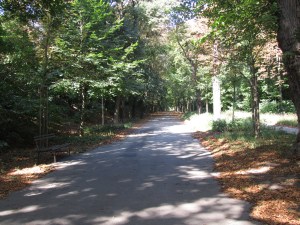
As forecast we had heavy rains last night and some impressive displays of thunder and lightning. Also as forecast, we woke up this morning to cloudless blue skies and much cooler temperatures (15°C in the shade at 8 a.m.)–perfect weather, in other words, for a long walk in the Vienna Woods. This turned out to be a bit disorienting because after the heatwave of the last week or so there were distinct signs of autumn out along Schwarzenbergallee and on Schafberg, some of which I captured with my new (at least to me) digital camera.

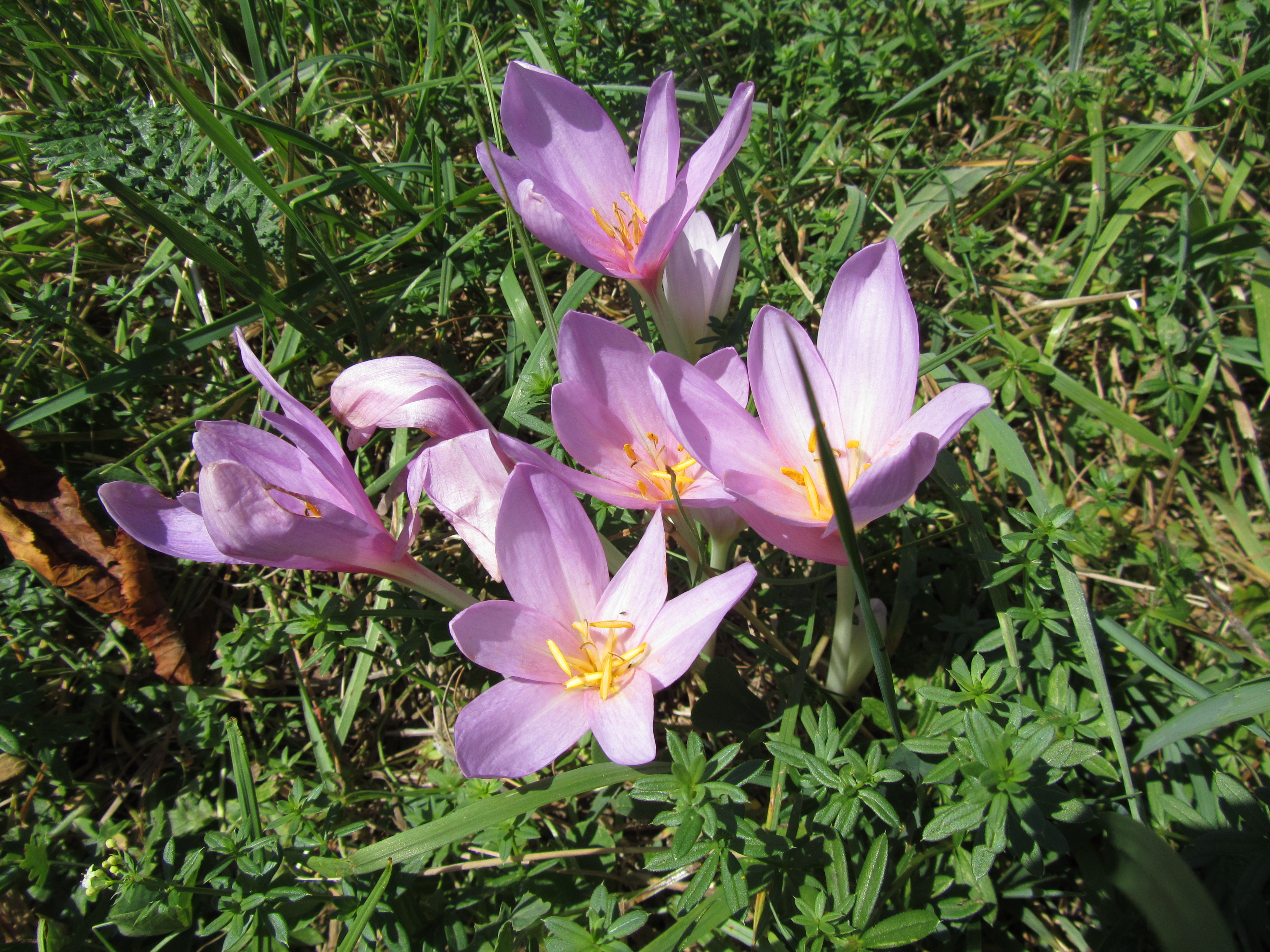
This time I finally remembered to take the manual with me and managed to figure out how to take close-ups like this one of  Herbstzeitlosen or autumn crocuses.

And it occurred to me that when I was listing the booty that people bring home from a hike in the Vienna Woods (“Another Reason I Live in Vienna,” 13 June 2011) I forgot to mention apples, as shown below. (Fully organic more because of neglect than intent, I believe.)

For some reason, though, I take comfort in the fact that they aren’t quite ripe yet!