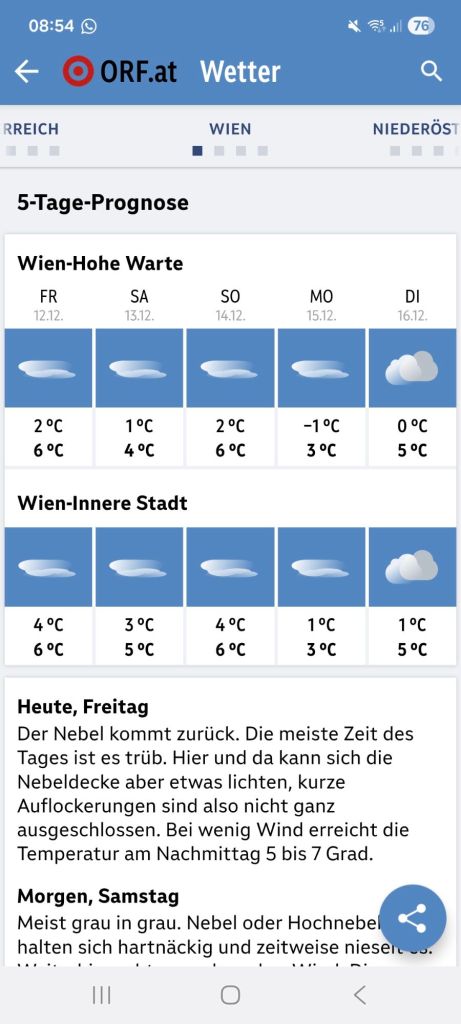
Vienna is doing what Vienna does in November and December (and sometimes in January and February). I like it. I find the mistiness soft and gentle, but, as you can see, it can go on for days at a time without a change. This explains why the Vienneselike to go to the mountains. Anyway, typical.
As women’s rights are once again endangered, it is encouraging to me to see that some long-past wrongs are being righted. (The painting that led to this re-assessment was discovered in the collection of the Kunsthistorisches Museum [museum of fine arts] in Vienna.)
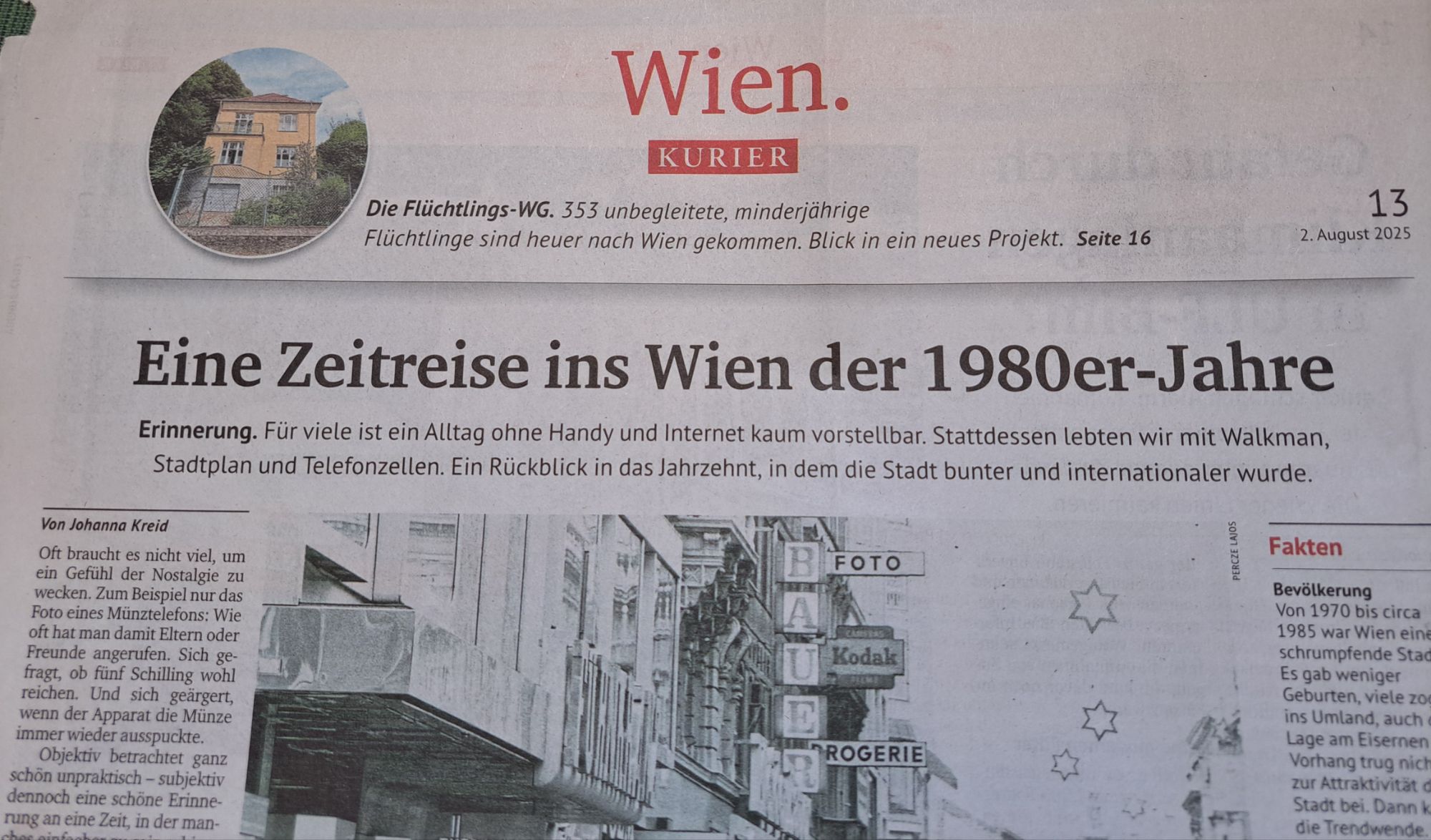
The Kurier today had an article about Vienna in the 1980s — a trip back in time. (Thanks, Kurier. That is very good way to make someone who was already an adult at that time feel rather old.) I arrived in Vienna in 1988 (had my 37th anniversary yesterday, celebrated, appropriately, at a Heuriger) and have seen significant changes, I thought it would be fun to write about some of the points mentioned.
For one thing, they write about pay phones, which reminded me of two things.
One of my first mornings in Vienna, after my German course at the Goethe Institut, I was out with my mother, who had accompanied me to help settle me in. We needed to phone the couple who became my Viennese parents to make arrangements, so we found a pay phone (they were plentiful then ;-)), put our money in, and dialed. When my Viennese father answered, he probably realized it was us calling because he couldn’t hear anything and said “Den roten Knopf drücken.” (“Press the red button.”) My mother did this, we heard the coin drop and were connected. That red button was called the “Zahlknopf” (zahlen = to pay) and released the money so that the connection could be made. Even in the late 80s, not all phones had a Zahlknopf anymore, but that one did and the Viennese had learned to give the necessary instructions.
The other phone story is much shorter. I saw a sign on a phone booth that said something about “retten”. I was familiar with the word (probably from the opening scene of “The Magic Flute” when Tamino rushes onstage pursued by the monster and sings “Save me! Save me!”) but couldn’t figure out what that had to do with a telephone. My mother translated the sign for me: This telephone can save lives. Do not destroy it. (“Dieses Telefon kann Leben retten. Zerstör es nicht.” Oddly enough, I don’t think they used the “Sie” form there.)
The article also reminded me of the men (I think it was always men) who used to sell newspapers on the street after the Trafiken had closed, which they do to this day. Vienna — thank goodness in my opinion — still has clear opening hours and very little at all is open on Sundays. You could get your news there truly hot off the press, and people often bought the next day’s paper on their way home from a ball, late opera night, or late shift. People who were looking for apartments or jobs would wait for these men and the newspapers to show up so that they could get a headstart on the search. And a tip for these men who worked long hours, in all sorts of weather, and for very little pay was obligatory.
The author also writes about Mariahilfer Straße — a very important shopping street in Vienna — and how even the part farther out, past the Gürtel, was a useful and relatively pleasant area 40 years ago. Currently, it is full of stores with really cheap goods and kebab take-out places although, apparently, there are plans to renew it. I remember, and still miss, the trams, the 52 and 58, that used to run along Mariahilfer Straße from the Ring to the Gürtel and beyond. Now we have the U3 line. Not so useful for a shopping street, I would argue. I do enjoy the kind-of pedestrian zone, though. “Kind-of” because it is what is called a “Fairness Zone,” which means you have pedestrians, bicyclists, e- and other scooter riders, and delivery trucks all in the same space without clear delineation of lanes. (What could possibly go wrong? ;-))
In addition, the author mentioned something I didn’t know. In 1988, when the Hungarians were already free enough to come to Vienna en masse, even though the Iron Curtain had not officially fallen, Mariahilfer Straße became their destination to buy things they couldn’t get at home and for a time was called “Magyarhilfer Straße” by the Viennese. My memory of this time was the truly old and stinking busses that they arrived in. We were very spoiled in Vienna with catalytic converters. These busses had no such thing and ran, I suspect, for the most part on diesel, making an ungodly noise and leaving huge black clouds behind them.
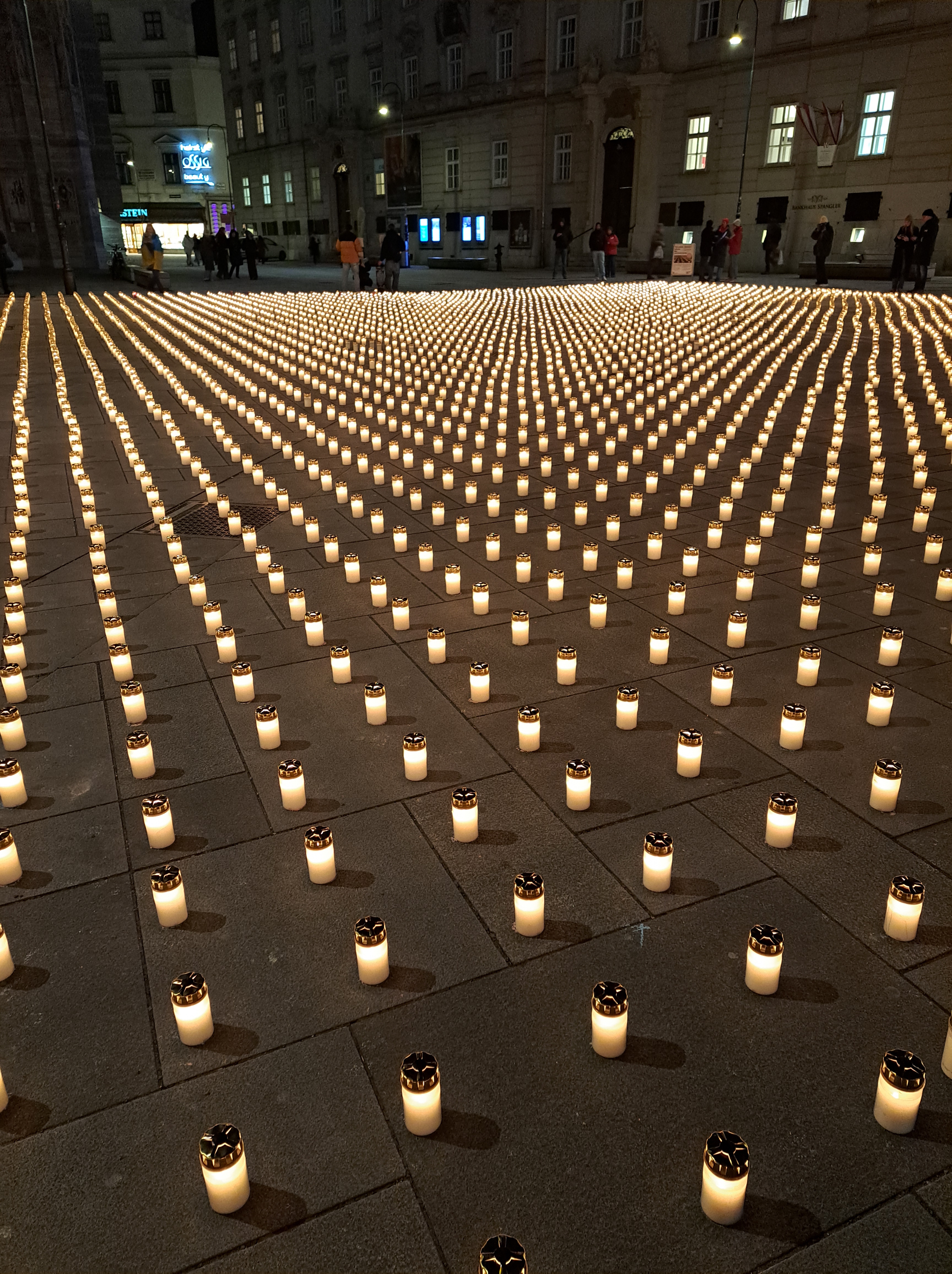
While the incumbent in the White House in Washington, DC, was blaming Ukraine for the war and calling Zelensky a dictator, Caritas in Vienna was organizing an event to express solidarity especially with the children of Ukraine. Next Monday it will, unbelievably, be three years since Russia’s invasion of Ukraine.
The Sea of Light wasn’t as big or moving as I thought it would be (fewer people, although a good number of candles carefully laid out). It started at Stephansplatz at 5 p.m. today and I worked until 5:30. Still, I thought it would at least go until 7 p.m. or so and went off with my candle to join those already there. I arrived a few minutes after 6 p.m. to find a medium-sized crowd and a Ukrainian women’s choir just finishing their last song. The organizers then thanked us for attending and started to dismantle the sound system and the small stage.
I stayed for a bit and then went home. It was somehow discouraging that all around us people were just going about their business, and I decided not to stay. But I’m glad I went and was counted.
Is this the new normal? Attacking people out for an afternoon of fun?
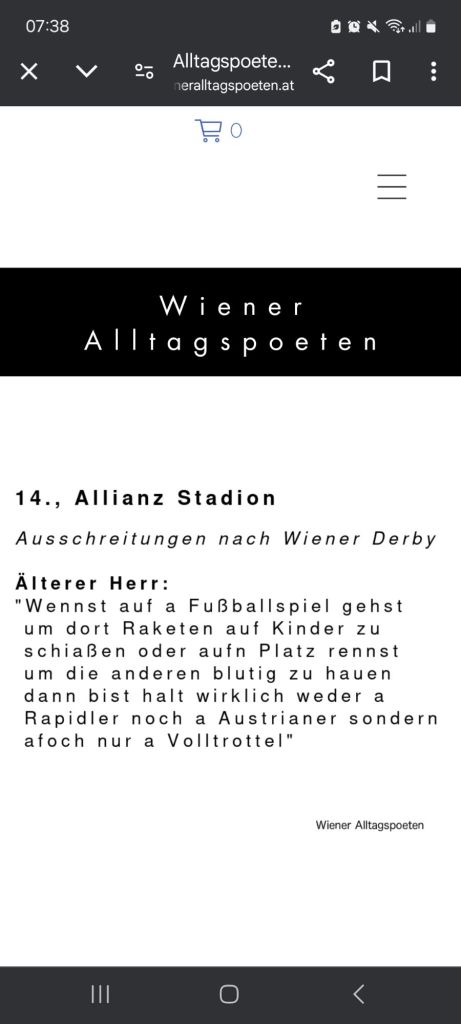
I first saw something about this on the Wiener Alltagspoeten site and then looked for the ORF report (link above). I’ll try to write more about this later, but it is a Tuesday and I do have an appointment with a client shortly.
I did want to put in what the Viennese everyday poet said (photo below), sadly in a very dull translation that doesn’t catch the Viennese tone: When you go to a football match to shoot fireworks at children and to run onto the pitch to pound other people bloody, you’re neither a Rapid fan nor an Austria fan, you’re really just a total idiot.” (Which is putting it mildly if you ask me.)
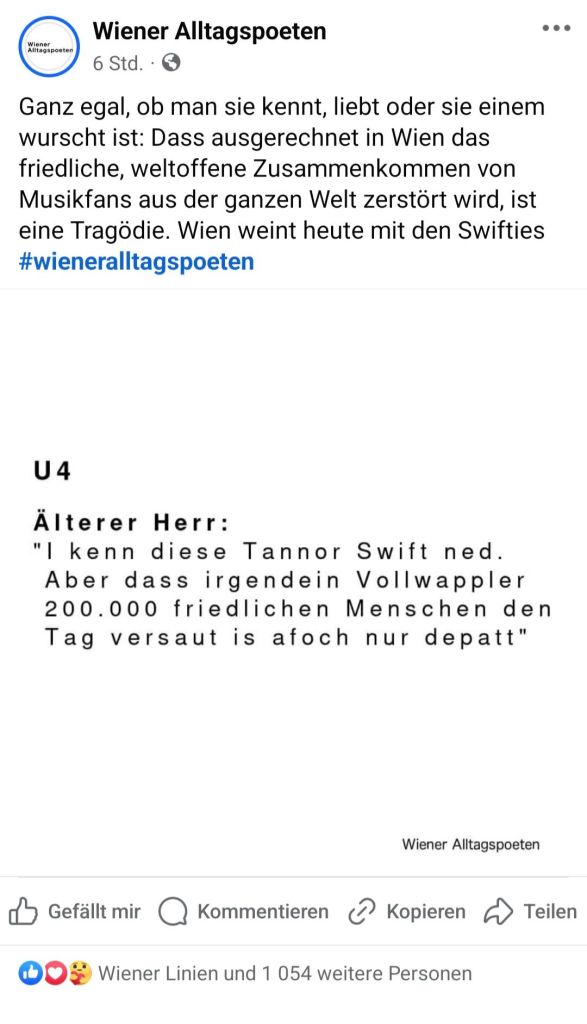
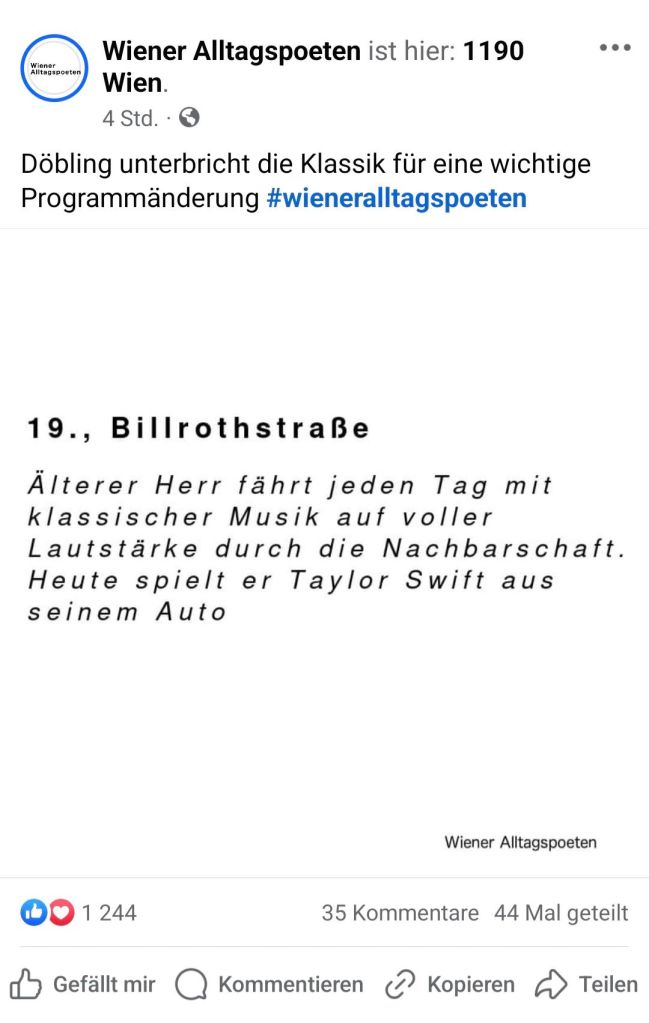
One of my kindest and most faithful readers asked if I had survived the invasion of Swifties. This made me think I should share these posts from the Wiener Alltagspoeten (Vienna’s Everyday Poets).
Wiener Alltagspoeten is a movement, one could almost say, started and run by Andreas Rainer. It comprises a website, Facebook page, and a couple of books. It’s a collection of “seen and heards” from the streets of Vienna.
The two excerpts below come from the Facebook page. In the first one, an older gentleman is saying he doesn’t know who this “Tannor Swift” is, but he finds it utterly ridiculous that some total idiot wants to ruin the day for 200,000 peaceful people. The only thing is that it’s pretty much completely in Viennese dialect (e.g. Vollwappler, versaut, and depatt), which makes it especially memorable.
The second one tells the tale of, again, an older gentleman, this one in the upmarket district, Döbling. He is usually observed driving through his neighborhood playing classical music full volume on his car stereo. After the concert was canceled, he was heard playing Taylor Swift. 😊
So, 2014 must have been the last time I watched the Eurovision song contest. I remember Conchita’s win and how fascinating it was. And now Tom Neuwirth is being written up in the NYT.
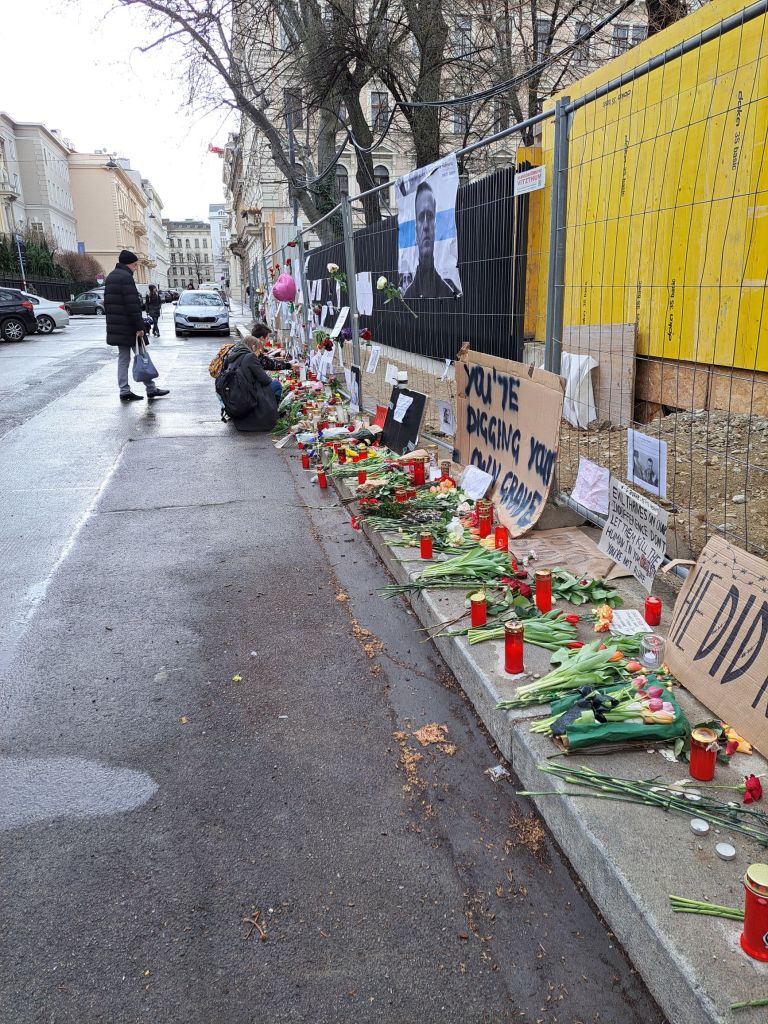
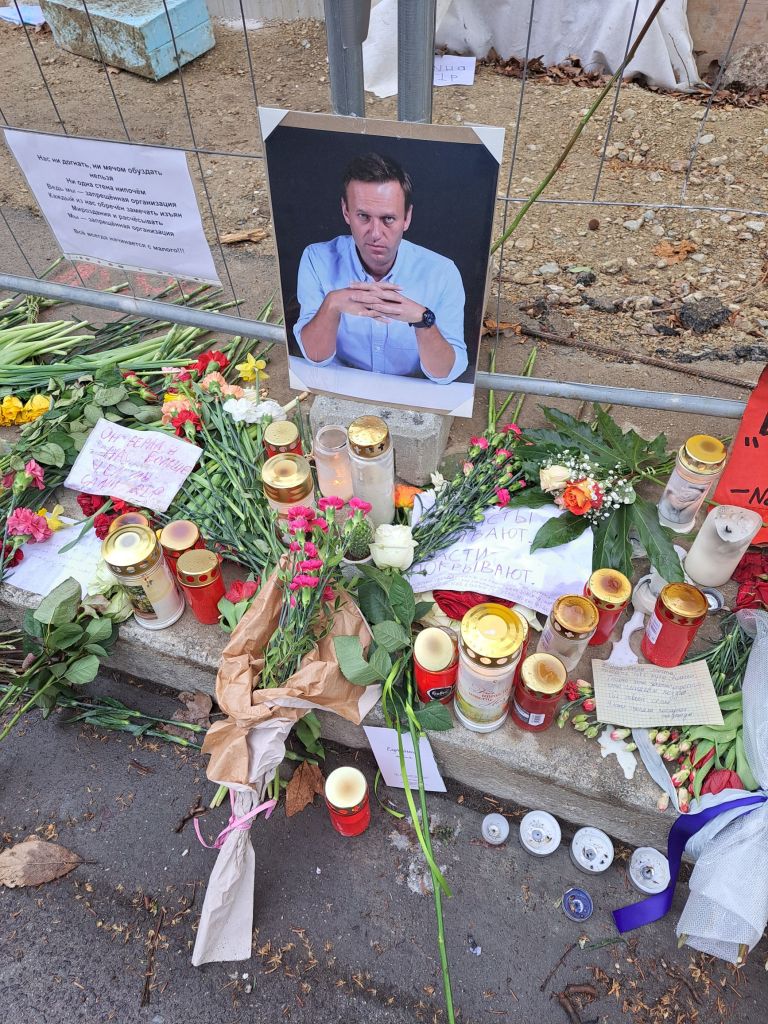
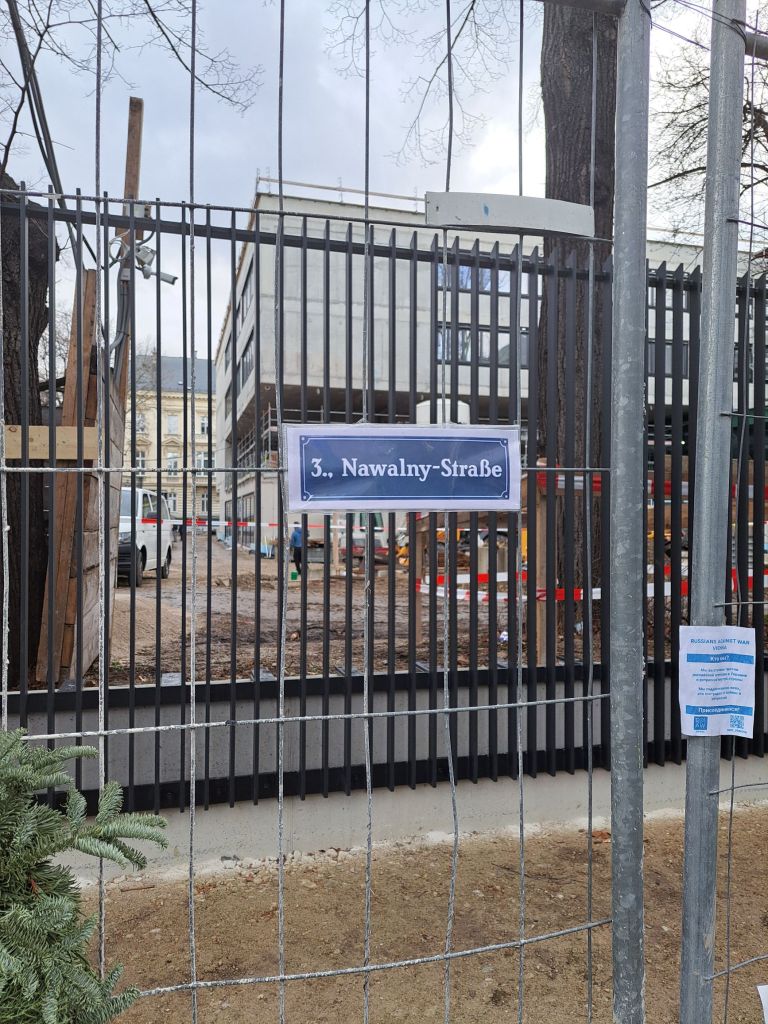
There is an impromptu memorial to Alexei Navalny right across the street from the Russian embassy.
It is good to have somewhere to go to commemorate him. He was very brave and, apparently, had a sense of humor and seemed to truly want nothing more than a better life for average Russians.
It was a bit scary to go and place a flower there. There were guards prowling about. (Mind you, I get quite unnerved by the Marines guarding the U.S. American embassy, too.) There was no interference, though. I was able to leave my flower (a white rose, for those familiar with the student resistance in Nazi Germany) and look at and read what others had written.
It was a bit scary, yes, but also moving, and I’m glad I went.
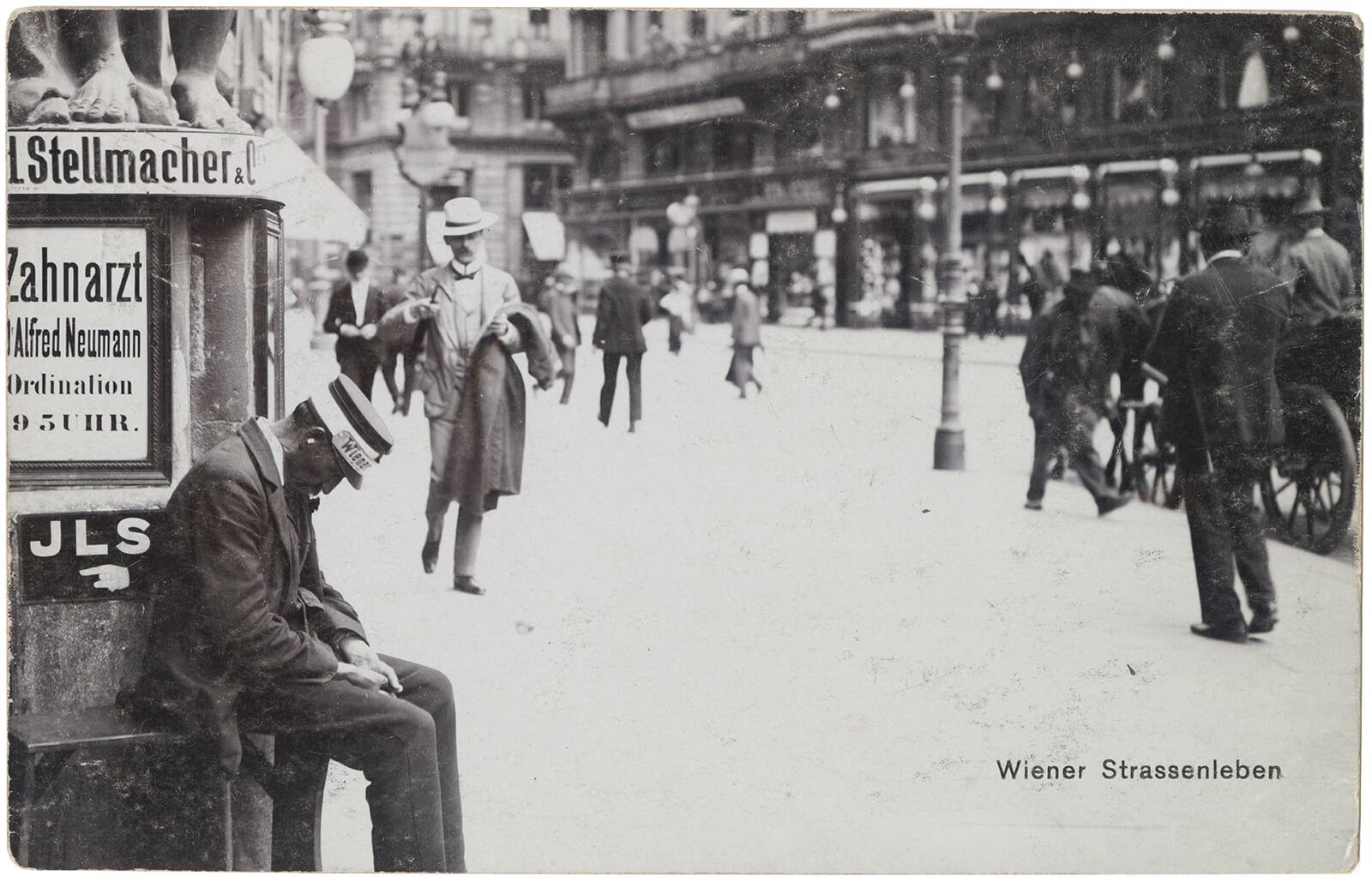
I think it was on the ORF (Austrian Broadcasting Corporation) site that I first saw a mention of a series of postcards showing everyday life on the streets of Vienna in 1905 / 1906. It is part of an exhibition at the Wien Museum (in one of their temporary quarters on Felderstraße) about postcards in general of Vienna.
What is special about this particular series? Postcards, of course, usually show us the important sights of a city — the Eiffel Tower in Paris, the Tower Bridge in London, Kiyomizu Temple in Kyoto, and Stephansdom in Vienna, to name a very few. The black-and-white postcards in the series referred to are in the form of snapshots and show people, often engaged in manual labor, going about their everday business. As the article (link below) from the Wien Museum’s magazine tells us the subjects of the photos are people who are offering their wares or services (for example as porters) on the streets and in the squares of the city, are driving vehicles or pulling carts or riding on public transportation or bikes, taking care of horses, cleaning up messes, working in public gardens, cleaning lanterns, working on building sites, maintaining tram tracks, strolling, striding, standing, cowering, sitting, sleeping, getting into mischief — and taking photographs. (my translation of part of the article) They give a real, one could say unvarnished, sense of life in Vienna at that time, which is precious to me.
I’ll want to be sure to make it to the exhibition “Grossstadt im Kleinformat” (“Big City / Small Format”), on until 24 September 2023.
 ecbinvienna