Trams around the Ring

21 Sep

A number of years ago now the City of Vienna changed the pattern of tram traffic on the Ringstraße. I’m afraid it is my belief, and not only mine, that they only did this to make money (granted, off the tourists, which may make the change more palatable to residents), uncaring of the inconvenience to anyone taking the Ring trams regularly.

That is, in the good old days, there were two lines that went in circles around the first district. You only had to know that the one on the inner ring, the Nr. 1 tram, went clockwise and the one across the Ring on the outer circuit, the Nr. 2 tram,  went counter-clockwise. In those days you could get anywhere on the Ring quickly and without changing. And if you were a tourist you could get an overview of this incredibly important thoroughfare for the price of a normal ticket.

Inconvenience Nr. 1: It took me, a regular passenger around the Ring, at least five years to get used to the new patterns. At first I kept ending up in the 4th district when I was trying–late, as usual–to get to the Konzerthaus. In fact, last week I was at Schwedenplatz and a little old lady confided in me that she has lived in Vienna for 90 years and has never adjusted to the change. She wanted to know if the tram she was boarding would take her to the Opera. It would, but just barely, being the one that now trundles off into the 4th.

Inconvenience Nr. 2: There are now a number of places I can only reach by changing twice, where before I only had to change once. (Tip to public transportation authorities: Passengers love this.)

Inconvenience Nr. 3: Where before I had two possibilities for getting to the Konzerthaus, for example, I afterwards only had one (until the 71 was extended to the old Stock Exchange). (Next tip to the public transportation authorities: Passengers love this even more.)

All of this was done, ostensibly, in the name of making life easier for passengers. Hard to believe. I am actually one of the lucky ones. At least for me one trip I take regularly (two or three times a year to visit a friend in the 2nd district) has become easier through the changes.

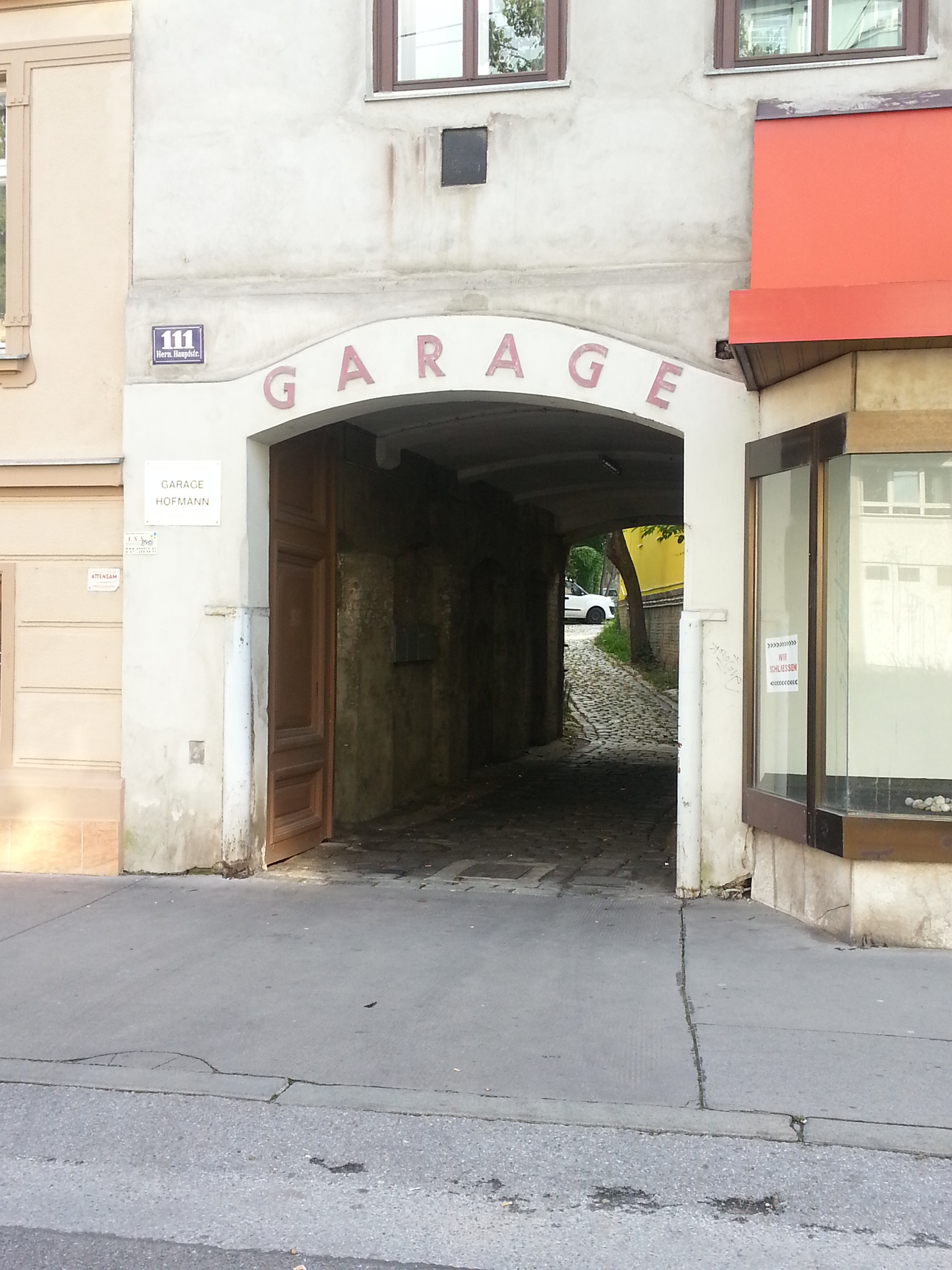
Why did I mention money at the beginning? Because below is a photo of the travesty now called the “Ring Tram”–a special tram that goes all the way around the Ring, for which you need to buy a special ticket that costs about three times as much as a normal ticket. 😦 Not a good move.
image

Last Sunday

16 Sep

I was walking through the park in front of the Nationalbank on Sunday on my way to afternoon tea at a friend’s house and took this picture. Yes, those are lilacs and, yes, it is September. That is not normal for Vienna!

image

A garage in Hernals

15 Sep

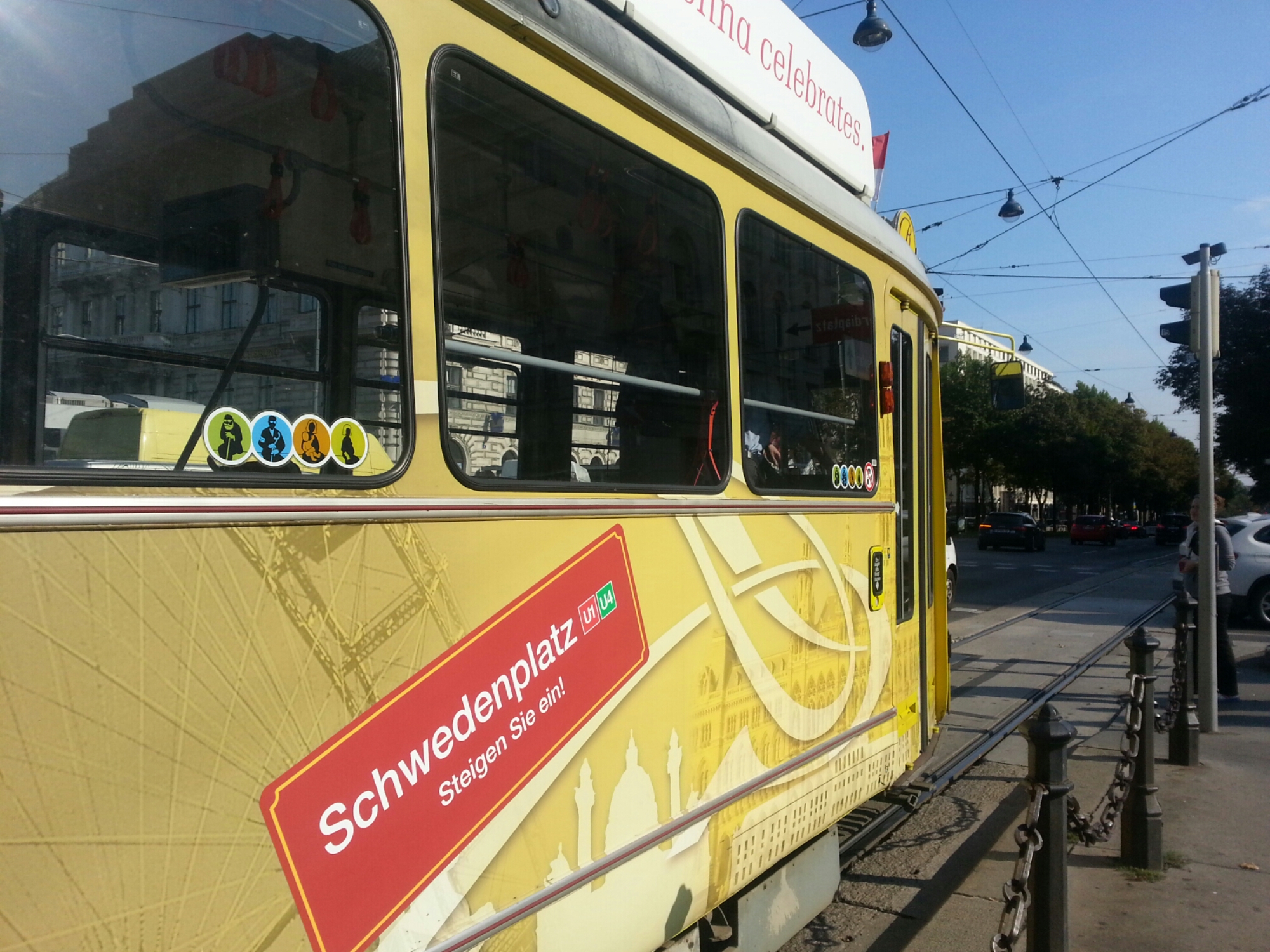
I’ve been meaning to take a photo of this for years. It is precisely the kind of building that is a perfect example of an earlier time and most likely to be torn down or converted into something else. In this case, although the building is much older, the fact that it is called a garage makes me think of the 1950s, when very few Viennese had cars and quite often they parked them in neighborhood garages, which were more like workshops than more modern parking garages. Mary Stewart describes just such a place in Marseilles in her wonderful romantic thriller Madam, Will You Talk?

garage on hernalser hauptstrasse_01

garage on hernalser hauptstrasse_03

And news from another prominent Viennese hotel

14 Sep

Just a quick note: the Hotel Bristol will be hosting Afternoon Tea with Opera Stars (and, yes, that they’re calling “Afternoon Tea” not “Nachmittagstee”). To celebrate various premieres they are offering a traditional (English, I suppose) afternoon tea with Sekt (or sparkling wine) and a chance to meet (see?) the singers, conductors, and stage directors of the current premiere at the State Opera just across the street.

It costs EUR 49 per person and can be booked by calling +43-1-515 16 555 or by writing to groupsevents.bristol[at]luxurycollection.com. The one of the first opera stars at this Salon Operá is Michael Schade, appearing on 26 September 2014.

Hotel Imperial

14 Sep

Last week Franz Welser-Möst stepped down from the State Opera House. This week another farewell was reported, just as significant if somewhat more peaceable. Michael Moser, the head concierge at the Hotel Imperial, who himself occasionally uses the old-fashioned word Portier, is retiring after 31 years. Originally from the Austrian province of Carinthia, he has worked half of his life at the Imperial (link to website below), and seems to be perfect concierge material–no surprise there, given the hotel’s reputation. In his interview in the Kurier (sadly I couldn’t find it available for free online) he talks about service, discretion, relationships of many years with the many prominent guests, and the need to know Vienna and what is going on in the city inside out, especially in the days of the internet when guests can do so much research themselves.

In an earlier article he said, “‘Gibt’s nicht’, gibt es nicht”–that is, “‘Doesn’t exist’, doesn’t exist” if you’re concierge at such an establishment. He mentioned that he has a annual membership at the Albertina and the Kunsthistorisches Museum Wien (the Museum of Fine Arts in Vienna) and goes to the opera or theater about 50 times a year–“Because I like it, you understand. Not because I must.” He may go because he likes it, but it also means that when a guest asks him, for example, if the staging of an opera is modern or traditional he can answer. Not to be able to do so would be very embarrassing for him, he said. He also makes a point of finding less prominent spots and events in Vienna so that he can give guests special tips, like when the lilacs are blooming in the St. Marx cemetery (where Mozart is buried in a paupers’ grave) .

He may be retiring from life out front at the Imperial, but he will still be turning up regularly. Apparently,he’s been collecting menus, newspaper articles, funny stories from guests, and so on over the years, just tossing them into a box in his office. He is now going to take some time to sort through the 40 or so boxes he has assembled and bring some system to them. “Not for my sake and not for the sake of the Hotel, but for future generations,” he said, “so that they have something to laugh about.”

http://www.imperialvienna.com/de/concierge_service_de#mai

Sunday opening hours

14 Sep

I have left my Grätzl this morning to visit one of my “Viennese nieces” at her weekend job. She works in a bakery, and that in itself tells a story of change–and yet stability–in Austria. One sign of change: when I moved here nothing (except a few designated pharmacies) was open on a Sunday. Ran out of milk? Want fresh rolls for Sunday breakfast? Too bad.

The other sign of change: even now it is very unusual for a student at a Gymnasium (those extremely demanding high schools that are such an integral and quintessential part of Austria’s education system and whose diploma is the sole prerequisite for university entrance here) to have a job during the school year, especially if they don’t need the money. When I first arrived in Vienna it would have been unthinkable.

Then comes the stability: While my niece in the USA, almost the same age, is working every free moment to buy a car, I’m pretty sure my Viennese niece is not planning to use her earnings that way. Somehow I don’t think it would be a top priority even if she lived in the country rather than in this city of exceptionally good public transportation. Indeed, her sister in the meantime has pointed out that she doesn’t even have a driver’s license! 😉

Culture has not yet entirely converged in this globalized world, if, indeed, it ever will.

How could I have missed this?

6 Sep

In taking out my Fodor’s to check the information about the bomb damage in the State Opera, I re-discovered an excellent article at the back on Austria’s wines, written by an Englishman named Nicholas Allen, whose day job it is / was to tour Austria with an English-language theater group.

No doubt the entry will need some updating, as 1987 was pretty soon after the international “Weinskandal” (yes, that means exactly what you think it means), but the 1987 article still gives a very good overview of the various regions and varieties, including a mini-glossary of wine terms.
– – – – –
The Austrian wine scandal: When it was discovered that some (although only very few) Austrian winemakers were adding anti-freeze (as I heard it) to their wines to, I’m sorry to say, improve the flavor.

Austrian wines have come a very long way since then!

News from the State Opera in Vienna

6 Sep

There are over two pages in today’s Kurier about the decision of the Music Director of the State Opera, Franz Welser-Möst, to step down, with comments from the current General Director, the former General Director, the head of the holding company for the national theaters, and the Ministry of Culture. There is even a message of solidarity to the General Director from the chairman of the Vienna Philharmonic, saying that the orchestra, from whose members the Vienna State Opera Orchestra is assembled, will do whatever it can to make sure that performances go ahead as planned. Not excessive, I think, in a city where, I have read, the Viennese, even those who had never set foot inside, stood in the streets in tears watching the Opera burn after it was hit by a bomb on 12 March 1945, so ironically close to the end of the war.  According to my 1987 Fodor’s guide, “… the Viennese made it one of their first priorities … to rebuild their beloved Opera.” Vienna, Fodor’s goes on to point out, “… is a city where opera is taken very, very seriously. “

Freud’s Vienna

31 Aug

I’m not a compulsive seeker of Freud’s Vienna, but I do find articles and books interesting that address Freud’s complicated relationship with this city, so imagine my surprise to find the following lengthy article in the weekend edition of the International New York Times:

http://www.nytimes.com/2014/08/31/travel/freuds-city-from-couch-to-cafes.html

Without doing any extensive fact-checking I can correct a few points:

– The university campus with the outdoor cafés Stephen Heyman writes about was, until about 15 years ago, the General Hospital. Freud would not have known it as a campus. The university as Freud knew it was centered around the building on the Ringstrasse, formerly on Dr-Karl-Lueger-Ring now on Universitätsring, a change of name rich in Viennese history.

– The “Narrenturm” on what is now the campus was revolutionary in its day (late 18th century) for its humane treatment of psychiatric patients. As I overheard one guide telling a group, many people who were treated in that facility would, before the “Narrenturm” existed, for example, have been burned at the stake as witches. Granted, psychiatric patients did have it somewhat easier after Freud and his pupils brought in their revolutionary theories, but it is all relative.

My favorite source for a quick fix of Freud’s Vienna is Frank Tallis. He is a practicing psychologist in the UK who has created a fascinating detective team of a Catholic detective inspector in the Viennese police and a Jewish pupil of Freud’s. Together they solve mysteries around opera singers and freemasons in turn-of-the-century Vienna, and when they are not solving crimes they are making music together. In the tradition of the day, the psychoanalyst is an accomplished amateur pianist and the police inspector has a lovely baritone voice.

See: http://www.franktallis.com/

“The Third Man”

30 Aug

Do you immediately hear the zither music when you read that title? If so, you can look forward to some interesting trivia (as well as one person’s reminiscences of a long relationship with the film).

If you don’t know what I’m talking about, you can discover a quintessential film about life in Vienna right after the war (WWII, as one must specify in this city which has so much history).

Ah, “The Third Man”. Black and white. Based on the book (do we really believe it was a novel?) by Graham Greene. Directed by Carol Reed. Produced by David O. Selznick. Starring (a still young and relatively slender) Orson Welles as the elusive Harry Lime. Starring still more the city of Vienna c. 1947–“bombed about a bit,” as the English narrator tells us in the beginning. World premier: 65 years ago, on 31 August 1949.

My mother showed it to me when it was clear that I was moving here. Above all, she wanted me to experience the landlady played by Hedwig Bleibtreu because “you might end up with just such a landlady”. (In broadest Viennese dialect she said things like, “Das ist ein anständiges Haus. Hier hat sogar früher ein Metternich verkehrt” Translation: “This is a respectable house. In the olden days, even a Metternich [member of an old aristocratic family] came to visit.”)

My mother had forgotten, though, a treasured line (one of my favorites) from another great Austrian actor, Paul Hörbinger. He played the concierge in the house where Harry Lime lived.  When tired of and scared by questions about Harry Lime’s death, he says he won’t answer any more and adds very gruffly indeed, “Und jetzt gehen Sie. Sonst verliere ich meinen Wiener Charme.” (“And now leave–otherwise I’ll forget my Viennese charm.”) Even writing it down like this makes me laugh.

There are far too many such moments too relate here, and I don’t want to ruin any surprises for those who haven’t experienced it yet. If you are interested in Vienna, I simply encourage you to see it. If you’re in Vienna, you can catch it in the late show on weekends at the Burg Kino. For the time being, I’ll simply pass on some facts that were printed in today’s Kurier.

Part of what people remember best are the music (by great good fortune done by a zither player, Anton Karas, at the last minute when the budget was more or less exhausted) and the chase scenes through the sewer system of Vienna. To this day, you can take “Third Man” walking tours of Vienna including, indeed, a look underneath the commendably clean streets of the city.

First bit of trivia, over 100,000 people have already taken that tour. I’m assuming the tour does not cover all 2,400 kilometers of that system, especially since only 25 meters were used for filming. This year Tom Cruise, who just finished filming in Vienna, took it.

“The Third Man” won the Academy Award(R) for “Best black-and-white picture” and was nominated for two others. Apparently in 2012, film critics named it the “Best British Film of All Time”.

That may have made worthwhile to Reed and Selznick that they apparently only slept two hours per night for the seven weeks they were filming on location. The Kurier reports that they kept themselves awake by taking a drug called dexedrine, better known as speed(!).

The unfortunate Anna Schmidt (Harry Lime’s paramour) was played by Alida Valli, an actress ironically descended from  an old Austro-Italian aristocratic family, possibly as important as the Metternichs ;-). She died in Rome in 2006 at the age of 84.

Five years ago was the first talk of a re-make, which supposedly would star Leonardo DiCaprio as Harry Lime and Tobey Maguire as Lime’s faithful friend Holly Martins. I’m not a fan of re-makes, but I think those two would be well cast, at least. Don’t know what they’ll do about the City of Vienna, though. Most of the bombed out bits have been re-built in the last 65 years.

The famous music was #1 on the U.S. charts for weeks in 1950. The next Austrian artist to achieve this feat was Falco in 1986 with “Rock Me Amadeus”.

To give you a bit of a taste, here is the opening scene, with fantastic running commentary from Major Calloway, the devastatingly attractive if unattainable British narrator, played by Trevor Howard:

http://www.youtube.com/watch?v=Fja9kwTl_jU

For people who have already seen the film, here is the unforgettable cuckoo clock speech:

http://www.youtube.com/watch?v=WS-JcaPFzp4

With thanks to Bernhard Praschl of the Kurier, who wrote the article from which most of these tidbits were drawn.