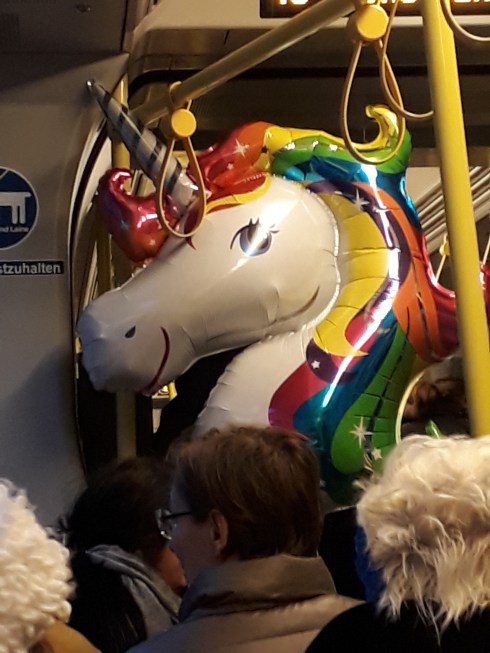
The Wiener Linien (“Vienna Lines”) are the public transportation authority in Vienna. Here, we even have unicorns taking the tram. 😉
The Wiener Linien (“Vienna Lines”) are the public transportation authority in Vienna. Here, we even have unicorns taking the tram. 😉
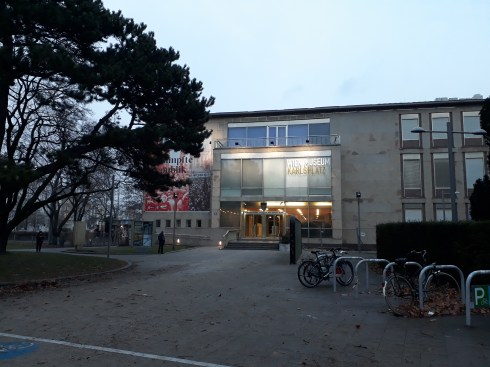
I went to the Wien Museum (formerly Museum der Stadt Wien) at Karlsplatz this afternoon. For some reason, I feel the need to justify this on a Thursday. My justification is this: at about noon I finished the preparation for my big meeting tomorrow, the preparation that shortened my Christmas vacation by three to five days, depending on how you count it. Now I’m making up part of one of those missing vacation days.
The incentives were also strong. The Museum will be closing for extensive renovation and expansion on 3 February 2019, and an exhibition I’ve been wanting to see ends this Sunday already. (I can’t go tomorrow–big meeting–and I hate going on weekends because there are so many people).
In fact there were two exhibitions I really wanted to see so I was there for the better part of two hours, until they closed. One is called “Fluchtspuren” (or “What Remains: Traces of Refugees”). The other is called “Die Erkämpfte Republik” (or “The Hard-Won Republic”) and shows photos and newsreels from the first year of the First Republic of Austria (one hundred years ago).
“Traces of Refugees” is small. It displays 15 telling, everyday objects–shorts lovingly sewn by a mother for her son out of sailcloth and with buttons scrounged from a soldier or the keys that are all that remain of a house that was destroyed when a whole village was burned to the ground in the Balkan Wars. All the objects are connected to refugees to Austria, mainly to Vienna, and mainly at the end of the First World War as the Austro-Hungarian Empire was disintegrating, during the Second World War, and during the Balkan Wars (which I remember as I was already living here then).
This exhibition was in conjunction with a small but wonderful exhibition about Lisa Jalowetz Aronson, who was a costume and scenery designer (as well as being a Jewish refugee in the Second World War). Among other things, she worked with her husband on Broadway, where she landed after being born in Prague, raised in Cologne, and educated in Vienna. The exhibition included a video interview with her done, I think, by her grandchildren. Quite something! She struck me as the epitome of resilience, laughing easily as she recounted hair-raising stories like how angry she was at her parents that they wouldn’t let her finish her art studies in Vienna (in 1938). “They probably saved my life but I was still furious,” she tells us.
“The Hard-Won Republic” was an important and effective reminder that this city, which is now so beautiful and rich, was cold and starving at the end of the First World War. Trees were being cut down in the Vienna Woods (my Vienna Woods!) to make sure people had something to heat with, and the Viennese traveled out of the city to glean the fields once the farmers had harvested what they wanted. People were literally starving to death and, of course, were terribly vulnerable to disease, particularly tuberculosis.
Beyond that, things that stuck out for me were the fact that Kaiser Karl, Franz Josef’s successor and emperor for only two years, didn’t understand why people wanted him to abdicate(!). (Seeing a photo of him getting off a plane at the airfield in Aspern with his wife and children reminded me that this is all recent enough–and I have been here long enough–to have seen Zita Hapsburg’s funeral in Vienna. Something to tell my grandchildren, if I had any.)
Other things: Within days after the end of the war, there were three security forces in Vienna, each allied with a different political platform. Anti-Semitism was as strong and, in some ways as subtle, as ever. Women were getting the vote. People were taking to the streets–a different group practically every day it seemed. And in 1924 there was a massive anti-war protest (“Nie wieder Krieg!” or “Never again war!”) in front of the City Hall.
If I’d had time, I could have gone to the “Gemma, Gemma” exhibition (“Gemma” is Viennese for “Let’s go” or “Let’s get going”) about the coming renovations and expansion. As it is, I took a brief moment on my way out to watch a video about it. It looks very promising. (And this from someone who hates change.)
An afternoon very well spent, if you ask me.
Austria has the reputation of being “gemütlich”–one of those words that is well-nigh impossible to translate. If you look in the dictionary, the primary suggestion is “comfortable” but “gemütlich” means much more than that. It implies, among other things, an appreciation for a slower pace of life and a preference for quality of life (if a choice must be made) over standard of living as well as for relaxation over precision.
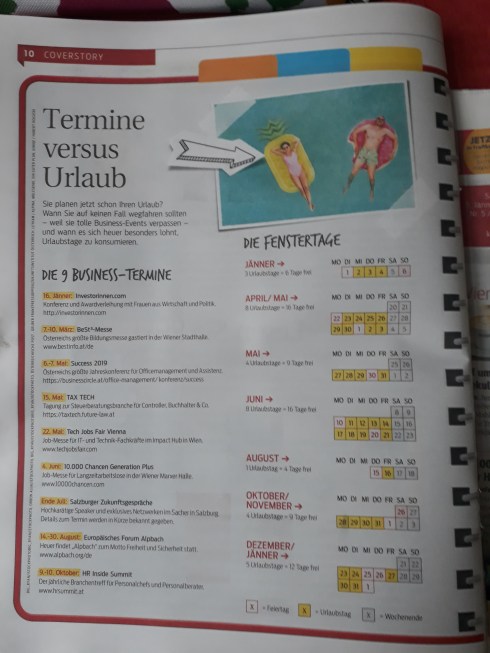
At the same time, it’s not uncommon for Austrians to be very pragmatic in their pursuit of “Gemütlichkeit”. The image above, from today’s Kurier, informs readers of the best times to take vacation, where “best” is defined as getting the most days off while still using the fewest vacation days (and this in a country where five weeks of vacation per year is the legal minimum).
How does this work? Because Austria, unlike the U.S.A., celebrates its holidays on the day they happen, we have something called “window days” (“Fenstertage”). These are the days that fall between a holiday and a weekend. The graphic above shows where the window days fall in 2019, making it easier for people to get the most out of their vacation days.
Only in Austria?
My thermometer is pointing to 3°C above zero, but I have just gotten back from a dogwalk that felt a lot colder. There is a special combination of wind and damp in Vienna (“hands and feet weather” I call it) that makes even this vegetarian look longingly at the fur coats going by.
Add to that the fact that there has been thick, dark gray cloud cover all day and you have a fairly typical January day in Vienna.
Anyone want to come visit? 😉
Except that I have just read on the infoscreen of the Wiener Linien that it actually comes from a less-known meaning of the word “rutschen,” namely to travel. Bon Voyage into 2019!
Actually, they’re already here. I went to two supermarkets this morning to get everything for dinner this evening and, in both, Italians were trying to communicate with the natives.
In the first one, a customer was trying to buy “brodo” (broth). She seemed, rightly so, rather skeptical when she was shown the bouillon cubes.
In the second one, the conversation at the cash register went like this:
Italian customer: Panettone?
Cashier: Nein.
Italian customer (in Italian): “No” you don’t understand or “no” you don’t have any?
Cashier (in German): I don’t understand you but no we don’t have any.
Italian customer: ?
Twenty years of voice lessons including Italian opera and a few trips to Italy allowed me to clarify: Non c’è la. [And benvenuta a Vienna. ;-)]
According to U.S. American standards, the Viennese can be a bit grumpy, but there are signs that they can get into the Christmas spirit, too.
There is a beggar who stands outside my door most days. Over the years, we have built up something of a relationship. It’s sometimes a bit fraught (for example when no matter how much I’ve given he wants more) but we have worked out a way of getting along and even built a bit of a relationship. He’ll be off to Romania to see his family for Christmas tomorrow so today is his last day at work this year.
His Christmas present to me this morning, as I went off to the supermarket for a few last-minute items, was to simply wish me “Frohe Weihnachten” without asking for any money, acknowledging that the banknote I gave him on Saturday was my final contribution. My little extra present was to pick up some sweets for his children along with my shopping. Walking up to my door, I saw one of my neighbors slip him a can of beer. As I handed over the sweets, I smiled and something “Something for the father, something for the children.” He smiled back.
In the words of Scrooge’s nephew: “… I am sure I have always thought of Christmas time, when it has come around, as a good time; a kind, forgiving, charitable, pleasant time; the only time I know of in the long calendar of the year, when men and women seem by one consent to open their shut-up hearts freely, and to think of people below them is if they really were fellow-passengers to the grave, and not another race of creatures bound on other journeys.” (Dickens, “A Christmas Carol”, Peter Pauper Press version)
Merry Christmas to all my readers who celebrate Christmas!
Even though Austria’s empire is long gone (ended 100 years ago this year), there are still reminders that Vienna was the glittering multicultural, multilingual heart of that empire. A few days ago, I saw two men nipping across a wide and busy street, dodging between cars. One of the drivers stopped to let them go in front of him, and one of the pedestrians waved and said “Danke!” Then he saw the Bratislava license plates and added “Ďakujem!”
Of course, this includes the Vienna Woods.
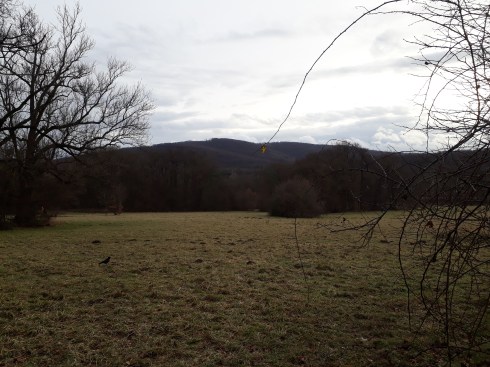
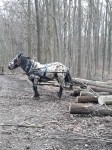
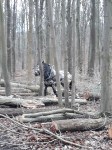
What was perhaps rather unusual was to find this horse with his handler very competently dragging the recently lumbered logs to the path, where they will, presumably, be picked up later.
 ecbinvienna