Good weather for the marathon today, dry but not too hot.
Archive | The many faces of Vienna RSS feed for this section
Violence in the city
3 FebSomething terrible is happening in this city I love. We are not used to violent crime, or really much violence (or crime for that matter), in Vienna, but in the last few weeks there have been reports of a tram driver being knifed in the back, violent demonstrations against a ball organized and attended by the extreme right wing, a dog (a Pekingese so it was clearly not self-defense) being kicked and throttled on the platform of an underground station, my neighbors were broken into and robbed when they were away for four hours only, and this evening coming home from work I saw two men attacking another man at a major underground station.
At first I thought it was just shouting. Then I saw they were pushing, kicking, and hitting him. It looked as if no one was going to intervene when suddenly four women emerged from the crowd and started to run interference to protect the victim, who was not only one against two but was also so drunk he was completely unable to defend himself. These women kept this up long enough and effectively enough, one on the phone to the police, that the attackers gave up and disappeared, at which point someone from the underground oversight appeared and took on responsibility for the drunken, battered man.
The women went their own ways, obviously previously unknown to each other, having simply stepped in spontaneously together in the interest of protecting the weak.
There is a campaign on in Vienna encouraging people to show more “Zivilcourage” (“moral courage” according to leo.org). These women, and not really anyone else in the crowded concourse, seem to have taken that message to heart.
If things go on as they are, we are all going to need a lot more “Zivilcourage”.
January 7th in Vienna
7 JanToday the city came alive again. The 12 Days of Christmas are over, and everyone is going back to work. I, for one, am glad. I spent the holidays home by myself nursing a badly injured little dog and feeling very alone. Vet’s office closed for days in a row as I worried about whether the latest development warranted calling the emergency number and getting the vet away from her celebrations and, on top of that, many friends out of town. Now life is getting back to normal. And the sun is coming up noticeably earlier. It was already bathing the park in a rosy pink at shortly after seven this morning.
Spitting
5 OctI have to confess I had a bit of a headache this morning after tasting at least 10 wines yesterday evening. I know you’re supposed to spit instead of swallow, but when I get a really good wine in my mouth I want to hang onto it. It’s like Oda Mae Brown in “Ghost” after Sam tells her she has to give the check to the nun–and I had no Patrick Swayze to get me to let go.
The Ice Saints (Die Eisheiligen)
14 MayThe weather is cooler at the moment, even though the sky is bright blue, and that is fully in keeping with the date. We are experiencing the Eisheiligen or ice saints, and it is almost always cooler for the five days they are among us. First comes Mamertus on May 11, then Pankratius, Servatius, Bonifatius and to round it off on May 15th comes Sophie (“die kalte Sophie” or “cold Sophie”).
The German version of Wikipedia gives all kinds of information about the meteorology of the ice saints, and seems to be rather skeptical, drawing, for example, on the implementation of the Gregorian calendar at different times in different regions and saying that we actually should see the ice saints eleven to twelve days later than currently expected (at which point they, of course, would no longer be called Mamertus, Pankratius, Servatius, Bonifatius, and Sophie).
I can only say that this year it truly is cooler than it has been and the forecast is indeed for warmer weather in a day or two. I can also tell a story. I was visiting friends this weekend, and we were all listening to the quiz show that is broadcast every Sunday afternoon by Austrian radio. One contestant had the chance to win a few extra points if he could name one of the ice saints. He paused for a moment and then said, in unison with my friend who was in the kitchen cooking, “Pankratius”. I’m not sure why he would stick out so much. I can be relied on to supply cold Sophie but not any of the others. No matter, the ice saints at least do seem to be alive and well in people’s minds!
The Anschluss – 75 years on
13 MarThe text below was written on 12 March 2008 after I attended a commemoration ceremony at Heldenplatz. It is no less timely today.
Vienna, 12 March 2008 – Islands of Light
It was a beautiful evening today at Heldenplatz—clear, cool without being cold, with graceful clouds passing through overhead. Perhaps it wasn’t all that different 70 years ago when the German troops marched in to annex Austria and to clear the way for Hitler and his historic speech to over 200,000 cheering Austrians on 15 March 1938 at Heldenplatz.
This evening, in 2008, the thousands who gathered came to light candles—one for each of the over 80,000 Austrian people who suffered imprisonment and were killed under the Nazi regime. They came to light candles against intolerance. Many came, too, to be strengthened in their resolve never to let such a violation of human rights, human dignity, and human life happen again.
Although the organizers of the commemoration called it “Die Nacht des Schweigens” (The Night of Silence) in deliberate contrast to the rowdiness the night of Hitler’s speech, there were speakers. A prominent Austrian historian, now 83, who has spent her life speaking out against race hatred; a former Austrian Chancellor who was the first high-ranking Austrian official to challenge Austria’s image as poor victim and to speak officially also of Austria’s role as perpetrator; a young woman of 19 involved in a project commemorating victims of the Holocaust called A Letter to the Stars; and a survivor of five concentration camps now 82, who had to watch her mother go to the gas chambers at Auschwitz.
I take away three messages from the speakers: that it is impossible to make reparation for crimes of this magnitude, that the fight goes on, and that it is important also to remember each person who suffered and was killed.
Reparation implies being able to repair a situation and to indemnify people, that is, to restore them to the position they were in before disaster occurred. The German equivalent Wiedergutmachung when taken apart piece by piece means to make good again. Essentially, we can never understand what it was—or still is—like for the victims and their families and no matter how much money we pay to restore property or compensate for slave labor, for example, we can never make it up to the people who suffered, were tortured and killed. We cannot make it good again.
As we stood under the stars and moon at Vienna’s Heldenplatz, peaceful and unthreatened, amid islands of light created by the 80,000 candles, the other message was that the battle goes on. Precisely because we can never truly make reparation once such crimes have been committed we all have a responsibility to make sure that our countries do not participate in such crimes again. Although we, at the moment, have democracy, peace, enough to eat and are relatively tolerant of the ethnic and other minority groups in our midst, that can change. We are in all probability facing the kinds of times where life gets tougher, where the feeling that there is not enough to go around makes it harder to be tolerant and to act justly. Those are the kinds of times when it is easier for unscrupulous or fanatical leaders to mobilize large numbers of people to oppress, imprison and finally murder their fellow citizens. We must beware.
It is hardly to be hoped that we have more resources for behaving bravely and morally than the people who came before us. For this reason, knowing what we know about the years of the Nazi regime, we need to re-commit every single day to fighting the forces that allowed such a regime to gain power. We need to combat anti-semitism and other forms of racism and intolerance wherever and whenever we encounter them, and if we fail to do so one day we have to get up the next day and try again.
In the words of Susanne Lamberg, the survivor of five concentration camps mentioned above: “When the candles that we light tonight go out we must light more tomorrow. We must decide every day to light the candles. It is tiring. But it is our only chance.”
As I was leaving Heldenplatz the Night of Silence had begun along with the commemoration of the 80,000 victims. The name of each man, woman and child was being projected on a screen—four screens, one name per screen, two seconds per name. The projection is to go on until six o’clock in the morning to get through the names of all the known victims.
Image
The Votivkirche
9 Jan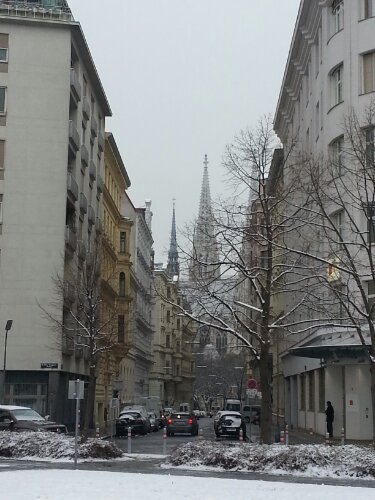
The snow is already gone, but I felt it made a nice picture yesterday with the Votivkirche, that neo-Gothic church erected by Emperor Franz Josef’s brother in thanks that the Emperor escaped an assassination attempt, visible here at the end of Frankgasse in the 9th district.
Perhaps I was also drawn to the picture because of the drama that is unfolding in and around the Votivkirche. The end of November, if I remember correctly, tents appeared in Freud-Park, named indeed for Sigmund Freud, and located between the Votivkirche and the Ringstrasse. At some point I walked down to find out what it was about and it turned out to be a protest for overfilled refugee and asylum-seeker camps. Over the weeks that followed the camp didn’t grow, but it didn’t shrink either. At the end of December the police stepped in to clear the camp, which was in violation of several ordnances. A number of inhabitants of the camp fled across the street into the Votivkirche, where the priest decided to let them stay, at least for now.
At the moment there is something of a stalemate. The refugees, asylum-seekers, and organizers of the protest are, of course, reluctant to give up since they have, presumably as intended, received a lot of media attention through their action and gotten the government to discuss their plight. The City of Vienna, and indeed the government of Austria, is reluctant to give in to what has become essentially a form of blackmail and might encourage other groups to follow suit. So, your basic lose-lose situation. In an attempt to up the ante a number of the protestors have now gone on hunger strike. So far it hasn’t made a difference.
What I have further garnered from the free daily newspaper, Heute, and the website of the Austrian Broadcasting Corporation (ORF), is that the FPÖ (the Freedom Party of Austria, far right) has responded by saying that the hunger strikers should be forcibly removed and force fed (always makes me think of the scenes about the suffragette movement as shown in “Upstairs, Downstairs”), the Grünen (the Green Party of Austria) has come under attack in Parliament for their relative support of the protestors, the ÖVP (the Austrian People’s Party, right centrist) is against the occupation of the Votivkirche and would probably like more regulation of immigration, and the SPÖ (the Socialist-Democrats in Austria and by far the strongest party in Vienna–not for nothing known as “Red Vienna”) are lamenting that the one federal state in Austria that is actually fulfilling its commitments to refugees is the one with the large-scale protest. Dr. Michael Häupl, mayor of Vienna, has also, legitimately, I think, expressed concern that the refugees and asylum-seekers are being used to political ends. The City of Vienna offered, apparently even before the occupation of Freud-Park, alternative accommodation that was rejected. Add to the mix that the organizers are reportedly from Bavaria (a federal state in Germany) and you have a sense of the complexity of the situation, and the low, low chances of a favorable outcome for anyone.
 ecbinvienna