Eliud Kipchoge did it! He ran the classic marathon distance in under two hours (1:59:40). And he did it in the Prater in Vienna. I’ve never seen him so happy. 😁
Heuriger (wine taverns or gardens)
11 OctHow could I miss this? The Wiener Heuriger as an institution was declared “intangible cultural heritage” by UNESCO on Tuesday. Now there’s one cultural institution I’m still supporting regularly. 😁
https://m.facebook.com/oesterreichwein/photos/a.411385460232/10156501926320233/?type=3
Happy End – WIENzig
4 OctAccording to this, Emperor Josef II decreed that all plays had to have a happy ending. This meant (pretty major, if you ask me) re-writes for plays like “Romeo and Juliet” and “Hamlet”. These happy endings became known in the German speaking world as “Viennese endings”. Apparently, Apfelstrudel and other delicacies weren’t enough to keep the population happy. 😉
More Helmut Deutsch
6 SepEver since I read Helmut Deutsch’s memoirs I’ve been meaning to post this “review” I wrote almost 10 years ago of a concert with Barbara Bonney (who doesn’t come off terribly well in Deutsch’s memoirs), Angelika Kirchschlager (who does), and Helmut Deutsch himself.
Here goes, finally:
An Evening of Duets, 5 November 2009, Konzerthaus, Mozart-Saal
I have just come home from a mythical concert. It was the kind of concert you hear about the way you might hear about unicorns but can never be sure exist. It was a concert that made me forget that parts of Pakistan are increasingly ruled by the Taliban, that Iran is building up nuclear capability, and that bonuses are back on Wall Street with no one having learned anything from the economic crisis we are not even yet out of. It was a concert that made the world seem whole and a cheerful place to be. And it truly was miraculous—it provided a mass healing of the TB patients who usually attend concerts in the Mozart-Saal in the cold months. I think I heard only six coughs the whole evening. I’m referring to the evening of duets done by Barbara Bonney, Angelika Kirchschlager, and Helmut Deutsch at the Konzerthaus.
Kirchschlager was completely her usual extravagant self, a kind of Dorabella to Bonney’s more Fiordiligi-like gravitas. Her singing as always was simply an extension of herself. More than any singer I have had the privilege to hear live Kirchschlager embodies what one of my singing teachers referred to as singing from the inside out. She is, quite simply, a force of nature.
Deutsch was even more than usual a frame for the singers. In fact he, together with the Steinway grand piano open, unusually, on the full stick, was quite literally the perfect frame this evening, enveloping the singers in the warm curve of the piano, supporting them with his exquisite playing and remaining unobtrusive yet present in the background for the bows.
Most touching was Bonney who recently, according to reliable sources, has had several very poor years vocally. The voice this evening was not quite what it was in her early career, and I like it better. It has lost some of the ping and for that gained a kind of gentleness which at times almost suggests a fragility as well as a maturity it did not have before. It has much more power to move me than it ever did. And in the second encore, by Gounod, when she started alone and sang with such fervency it was almost unbearably moving. This rather hardened concert-goer quite suddenly found tears streaming down her face.
At the end of the evening one realized again how unusual the concert had been. Not only had the coughs been soothed, but not a single person had clapped in the French group in spite of the fact that the group incorporated the work of several composers. And when the last tones of the second encore died away, there was at first a great hush and then a roar of approval. Then came perhaps the biggest miracle of all. This Viennese audience, who usually insists on four or five encores, understood that the program was complete and needed no additional songs. After bringing the performers back for a few more rapturously received bows, the members of the audience gathered up their things and flowed in perfect harmony from the concert hall.
150 years of the Vienna State Opera
26 MayI’m watching the gala celebrating the 150th anniversary of the Wiener Staatsoper and remembering the moment I first saw it.
I was in a car driven by a school friend of my mother’s. It was about 10 o’clock at night. She had picked us up at the airport (thank goodness because in those days the airport bus didn’t run that late(!)) and was driving us to the student residence where we were staying.
We rounded the Ring at Hotel Bristol and suddenly there it was all lit up and glorious. In those days, I believed I was destined to sing on that stage and found the sight electrifying and deeply moving.
Over 30 years later, I must confess to a certain familiarity. I sometimes ride past on the tram without really looking at it, but tonight is giving me back some of that excitement.
To 150 more years at least!
MA 42 a.k.a. das Gartenamt
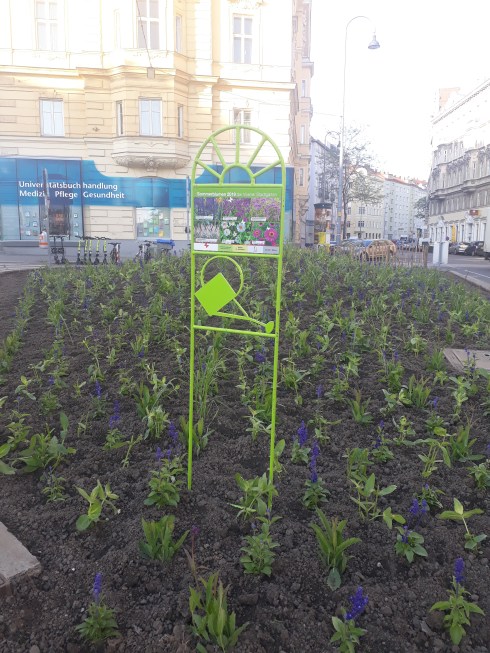
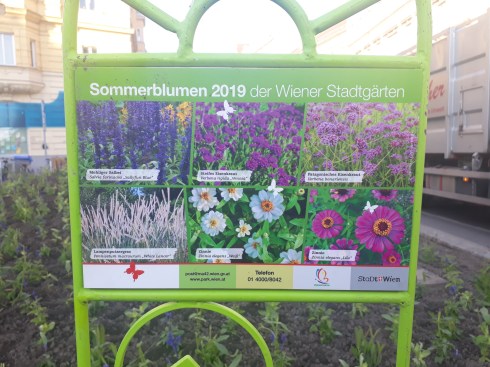
8 MayThe Parks and Gardens Department in Vienna have pretty much declared summer. They have put out their summer flowers along with a welcome addition of the last few years–a sign telling you what is growing in the bed. One thing I greatly enjoy is watching the flowers grow and fill out until they reach their peak in the fall. 🙂


06 – Bahnhof Hütteldorf to Lainzer Tor (again)
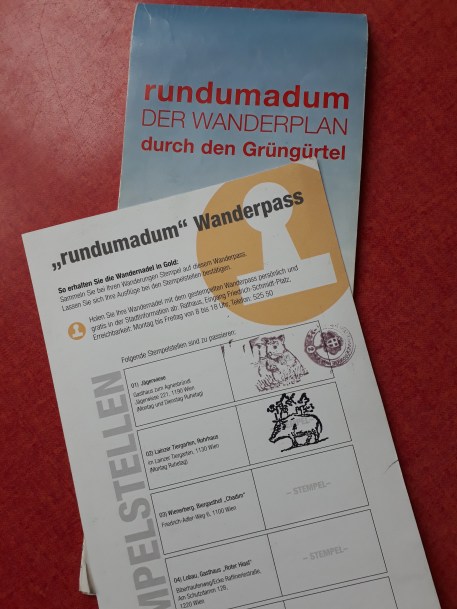
30 AprYes, you read that right. I did the Rundumadum stretch from Hütteldorf to the Lainzer Tor again. This time I was able to walk through the Tiergarten (the Lainz Game Reserve) and get the stamp I need for the “Wandernadel” (the pin you can earn by hiking enough designated paths in the Vienna Woods).
It was a pleasure–and something of a homecoming–to walk through this park I used to go to regularly but hadn’t been through in over seven years. (Dogs aren’t allowed which means that as long as I have had Maylo I have walked elsewhere.) Much was the same–the paths, the picnic tables, and many of the signs–but a lot of lumbering has gone on, as in other parts of the Vienna Woods, and so there were a number of rather forlorn patches I didn’t remember.
I entered through the Nikolaitor (St. Nicholas Gate), remembering my first time when I opened the gate to go in, saw a wild boar standing just meters away, and tried to close the gate again. I couldn’t get it shut because there were people on the other side trying to get out. I let them out, closed the gate, and wondered what to do. Since I knew that people walked in the Tiergarten, I decided to take another look and noticed that there were lots of people, including small children, standing around admiring the boar. Ah, a more or less tame one (photo below). I went in.
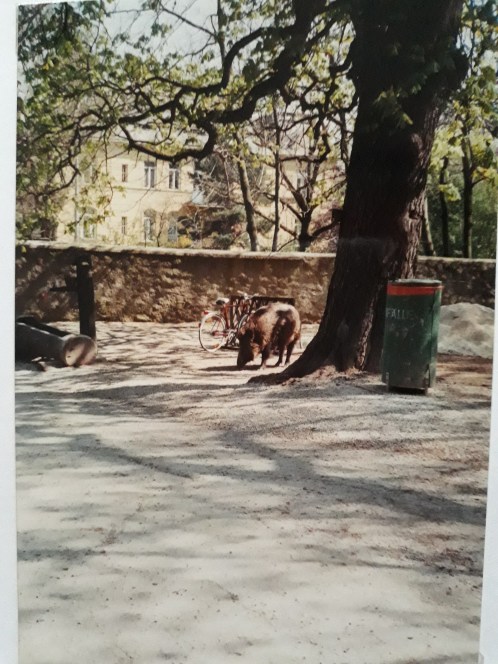
Wild boar, 1989
No boar at the Nikolai Gate on Sunday. Probably the one I saw has long since gone to his heavenly reward. I was unimpeded. I turned right and went along the route I used to know so well. I greeted the first few fellow hikers going by with a friendly “Grüß Gott” only to then remind myself: We’re still in the city. People don’t greet each other here as they do in the mountains. After that, I smiled but said nothing. It was wonderful–much as I love him–to be walking for once without my dog, to go at my own pace (not needing to stop to allow him an intense sniff at something) and to think my own thoughts. I usually try to walk mindfully, but this time I let myself just walk and not try to do or be anything in particular. It was deeply enjoyable.
Because spring came so early and fast this year there wasn’t much to see in the way of blossoms, unlike my first walk in the Lainzer Tiergarten. That was 30 years ago probably pretty much to the day when I took the photo below and showed it to friends at home, amazed and proud of the fact that this was within the city limits.
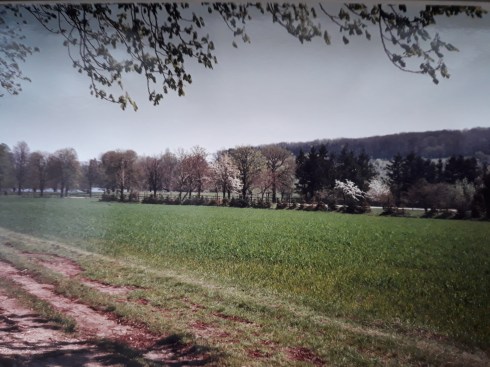
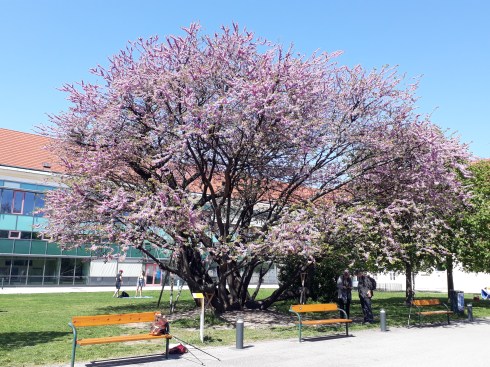
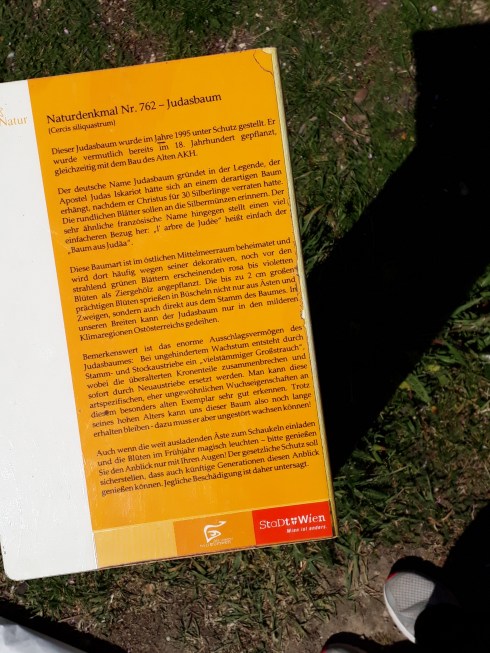
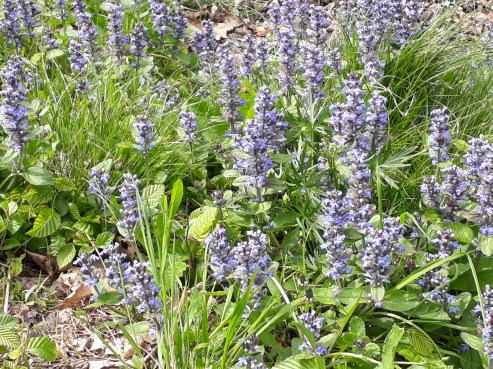
Nonetheless, this time I did see a fox skirting around the people excitedly watching it (never seen a fox in the Tiergarten before) and these beautiful purple flowers.
Before I knew it, I was at the Rohrhaus–the rustic eatery where you can get your card stamped. I briefly considered having coffee and a Milchrahmstrudel (a piece of Topfenstrudel served warm in a sea of warm vanilla sauce), but they were–not surprisingly given the weather–full, and I suspected there would be quite a long wait. Instead I just asked for the stamp and carried on, thinking I might have better luck at Empress Elisabeth’s retreat, the Hermes Villa.
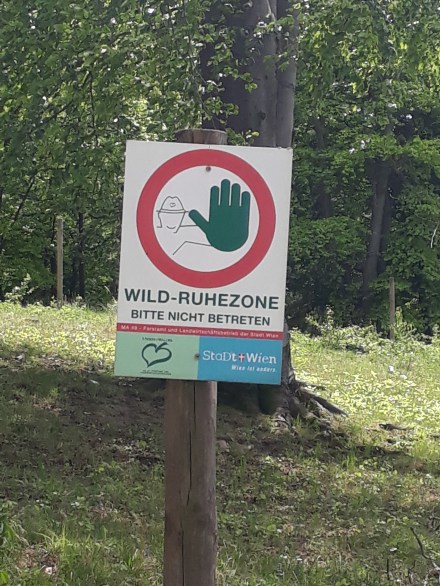
Even on the way to the Hermes Villa I didn’t see any wild boar, not even a squirrel. But I did see this sign (below), which makes me think perhaps all the animals were resting (“ruhen”) peacefully away from us humans. (The sign makes more sense if you know that in this context “Wild” in German means game, as in, boar, deer, pheasant, and so on.)
More quickly than I remembered I arrived at the Hermes Villa and saw that outside on the terrace there was a self-service café so I got a delicious cheesecake (actually, more precisely, a “Topfentorte”), and then I carried on to the Lainzer Tor remembering outings with friends and their children to pick “Bärlauch” (wild garlic) and dandelion greens and to read all the informative signs about the trees and bushes along the path.
I arrived at the Lainzer Tor a few minutes before the bus was due to leave to take me back to the bus that would take me to the underground (do you get the sense that this is truly on the edge of the city?) and took the opportunity to check where we go from there. It looks as if Maylo will be allowed on the next stretch and, much as I enjoyed walking without him for once, I’ll be happy to have my hiking companion with me for the next bit.
Distance: 7.6 km
Time: about two hours, even with the coffee break
P.S. My initial reaction to the boar was apparently not out of place. The British Ambassador had an encounter with a boar in the Lainzer Tiergarten in which he hurt his hand (story here).
Ducks!
12 Apr
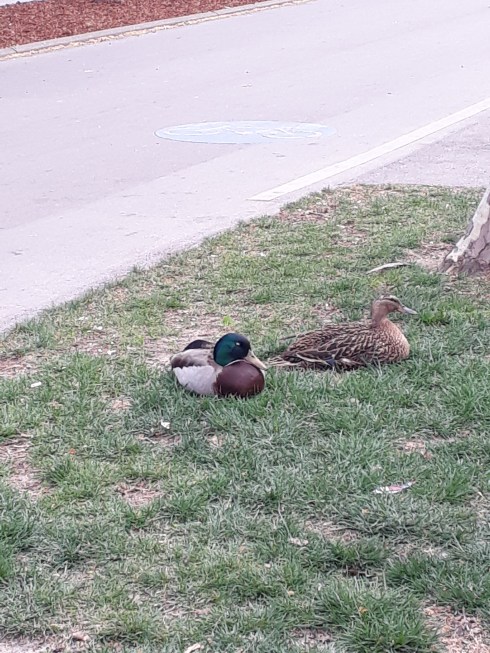
Two ducks just hanging out next to the bike path on the Ring. I love Vienna a.k.a #keenonwien
The seasons in Vienna
23 Feb
Nothing from the Kurier this Saturday morning, but here is something a friend sent me from the ORF (Austrian Broadcasting Corporation) Vienna. The Viennese have a well-recognized tendency to complain, even though their complaining is for the most part at “hohem Niveau” (at a “high level”, that is, about small things from a position of considerable comfort). This graphic shows this beautifully, I think. “Deppat” means “stupid” so the photos, which take us through spring, summer, fall, and winter are captioned: stupid pollen, stupid heat, stupid leaves, and stupid cold. 😆