This one in Tokyo (the World Championships). Julia Mayer, who was the first Austrian woman to cross the finish line in the Vienna City Marathon in 2023 and 2024, came in 33rd. Might not sound like much to a Kenyan or Ethiopian, but Mayer said afterwards that she was absolutely satisfied and could not have done any better. It sounds like quite a dramatic race for her on a hot and muggy day. At the 20-kilometer mark, she was 46th (already better than her results in the World Championships in Budapest two years ago) and worked her way up slot by slot.
I’ll be very curious how she does in the VCM 2026, if she runs it.
I’m sitting at the airport in Vienna waiting for a flight and am actually enjoying the commercial for Austrian Airlines that keeps flashing across the screen.
It’s informing us that Austrian is the official airline of the Austrian national football / soccer team and shows members of the men’s national team kicking a soccer ball around a hangar and a pilot joining in. Then a red shoe, a pump, stops the ball. The camera pans up to show the owner of the shoe — a middle-aged(!) female flight attendant — who winks at the men and then kicks the ball through the open door of a plane. Tor! High fives all around.
For me, this is typical of state-owned (or, more accurately, formerly state-owned) companies in Austria. Diversity, yes, but with a light touch. Which is a good way to get past people’s defenses.
In any case, as a middle-aged woman who played soccer competitively for her school for six years, it was really enjoyable.
This time I actually remembered to tune into the ORF reporting 20 minutes or so before the start of the race. The main topic this year is the weather. No one’s going to get heatstroke today. It is beautifully sunny but currently 0°C with winds up to 40 kph(!). (Everyone interviewing, being interviewed, and commentating was in down jackets.) Apparently, 8 to 10 degrees are considered optimal. Maybe the organizers should have thought of that before moving the race up by about two weeks!
Some of the effects of the weather: the wind, of course, will be a major challenge. A prominent former Austrian marathoner, Michael Buchleitner, who was commenting, remarked on the water temperature. No, the runners do not need to swim the Danube – it’s a marathon not a triathlon – but they do need to drink water, and the water has been outside all night and will be very cold. He also mentioned, twice, before and after, that it is the kind of weather where the winners will not necessarily be the ones in top form (so, one kind of “fittest”) but rather the ones who adjust to the conditions most quickly and effectively, partly in terms of what kind of clothing they’re wearing. Survival of the fittest in Darwin’s original sense.
In fact, I immediately noticed the difference in clothing among the top runners in comparison to other years. I saw arm warmers, t-shirts under singlets, longer tighter shorts, some gloves, but, with one exception (and in contrast to the amateur runners) no ski hats among the men. One male runner did wear very large earmuffs, though. (He won.)
A small point, there are always ORF reporters on a motorcycle (now electric, if I remember correctly) reporting from the frontline, and they are concerned about how they will stay warm for the two plus hours they’ll be tootling about.
In spite of the temperatures and wind, there were a record number of runners this year. Over 46,000, if I understood correctly.
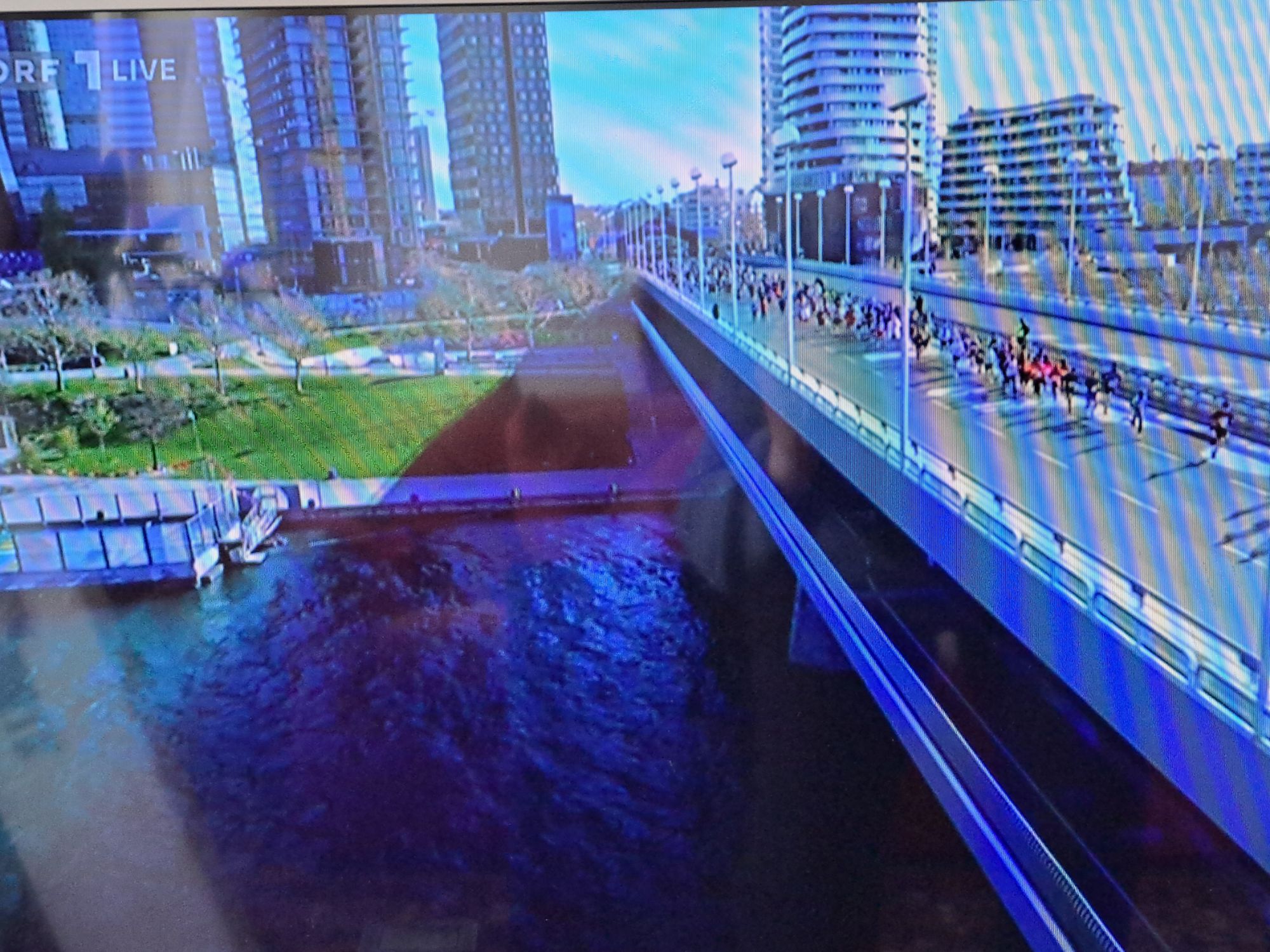
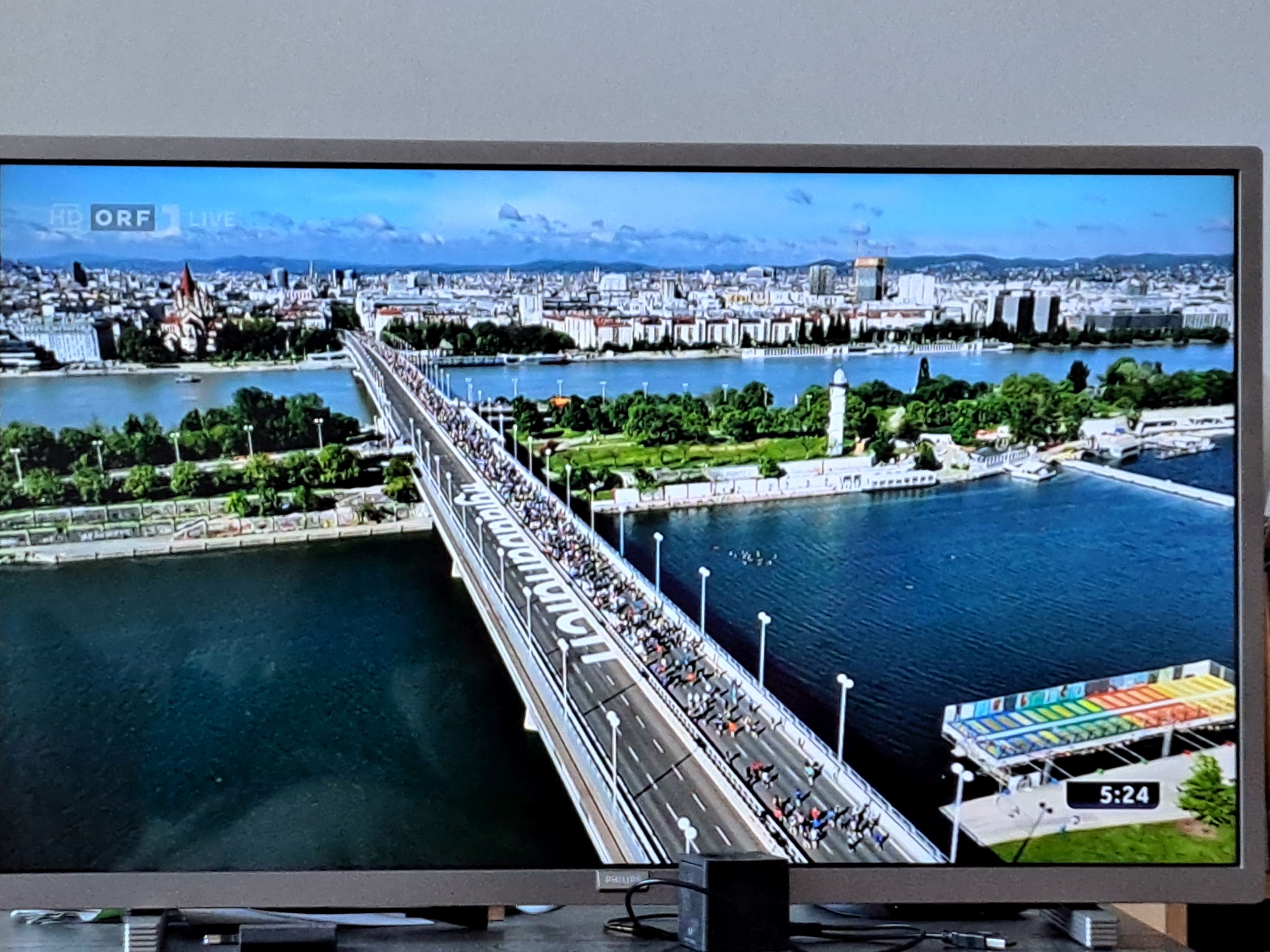
Watching this (from the comfort of my sofa, except for the half hour or so when I go down to cheer on the frontrunners) brought the usual joy of familiar landmarks: the Tegetthoff column at Praterstern, the Urania, Vienna River, Schönbrunn, Votiv Church, Prater again with the Lusthaus, (even the Ernst Happel stadium looked good) –and, of course, the glories of the Ringstraße (although I do always worry about the runners and the tram tracks).
The many, many campaign posters of the unpleasantly baby-faced Dominic Neff of the FPÖ lining Lassalle Straße were less enjoyable.
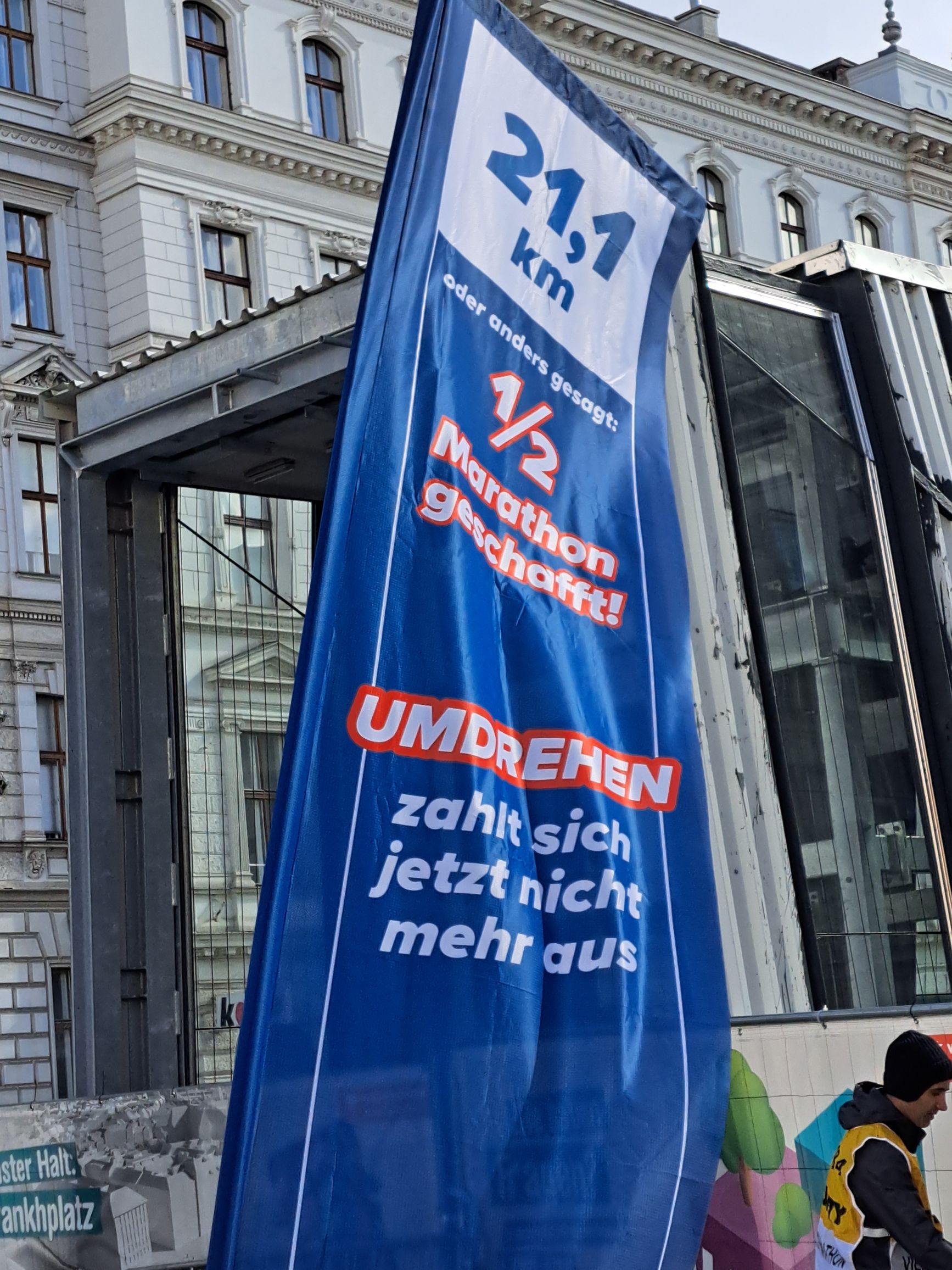
Other kinds of advertising were less disturbing, like the Erste Bank’s #glaubandich (“Believe in yourself”) in huge letters on the asphalt of the Reichs Bridge and the Hervis (sporting goods shop) banner at the halfway mark, telling the runners, who I’m sure had no time to take it in, that it made no sense to turn around now. (Like the old joke of the channel swimmer who got within 50 meters of the other shore and said, “I’m too tired. I can’t,” and turned around to swim back to where she came from.)
Valentin Pfeil, who was the first Austrian and Austrian man to cross the finish line in 2016, had been roped in as a running reporter, wired for sound and expected to comment on how the race was going while he was running it. This seemed kind of brutal to me, but he didn’t seem to mind. At the end, he even said that he experienced “runners’ high” for the first time ever in a marathon and thought that might have been because, knowing that he would be called upon to comment on the race, he wasn’t trying to run 100%. Nonetheless, I found it tactless of his ORF colleagues to ask him a couple of times along the way at which point he knew he was going to make it to the end. He finally deigned to give a clear answer, saying, “I’m passing the Staatsoper now. I think I’ll make it.” (The end is at the Burgtheater, less than a kilometer away.)
Some random points:
Vienna is really into recycling, even for the marathon. There were plastic recycling bins (those water bottles!) lining parts of the route.
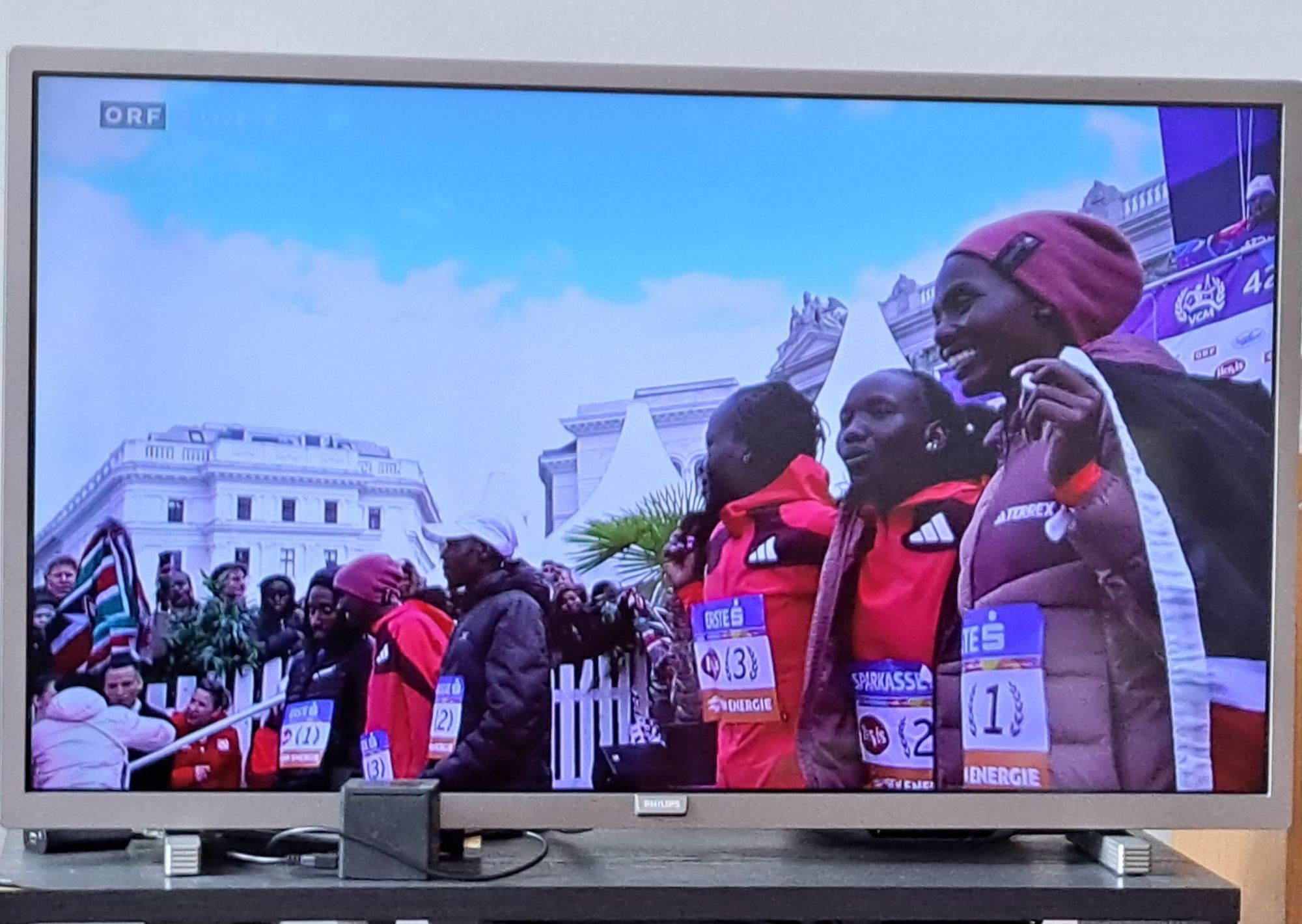
The top three women – in order of arrival at the finish line: Betty Chepkemoi, Rebbeca Tanui, and Catherine Cherotich – ran as a group for most of the race, very close together, one had the sense out of solidarity. (They are all Kenyan. Perhaps that made a difference? Or was it really, as one of the commentators suggested, a strategy to minimize the negative effects of the cold and wind?)
Two of my favorites from past years, Nancy Kiprop and Vibian Chepkirui, were nowhere to be seen, although reports leading up to the marathon had suggested they, too, would be running.
The two winners – Haftamu Abadi from Ethiopia for the men and Betty Chepkemoi (see above) – were basically upsets. I’m not sure even they expected to win. And yet both won by a considerable margin. No tense finishes today. Both crossed the finish line looking incredibly strong with no one else anywhere near them. Coincidentally, they both had the starter number 12 (M12 and F12).
Haftamu Abadi pulled a picture out of his pocket just before he crossed the finish line. On the other side of the finish line, he kissed the picture (it seemed to be of Jesus), looked at the sky, crossed himself, kissed the ground, and then took off one of his shoes and kissed that. The Austrian commentators seemed to think this was a reference to his compatriot, Derera Hurisa, who crossed the finish line first in 2021, also in something of an upset and in a blaze of glory, but was disqualified because his shoes did not meet the (brand-new) regulations.
On top of that, Haftamu Abadi, who, in spite of the conditions, achieved a personal best time of 2.08:26, is the youngest winner of the VCM in its all 42 years. He’s 21 years and 12 days old in a sport that traditionally, and oddly, favors the older contestants.
The first Austrian woman this year, Eva Wutti, is in the legal profession (that generic term “Juristin” was used so I don’t know if she is a full-fledged lawyer or a legal adviser in a company, for example) and didn’t arrive in Vienna until Friday evening because she had to work(!). (She lives in Carinthia.) She also has a daughter, and the ORF reporter predictably asked how she managed to combine family, job, and running. (Equally predictably, none of the men were asked this question.) At the same time, of the four “firsts” she was the only one who had a clear answer to the question “What’s next?” She’s hoping to run the Salzburg marathon in May. (Glutton for punishment, anyone?)
The first Austrian man, and therefore first Austrian, across the line was Andreas Vojta, who, it turns out was also the first European. He came in ninth, behind the first and third runners, who are from Ethiopia, and the six Kenyans in-between. I think this kind of result is especially amazing given that he was not able to train in December or January because of an (my dictionaries and online sources failing me I’m translating word for word here) an inflammation of the skin of the heart (Herzhautentzündung) and only started training again in February.
Valentin Pfeil, the running reporter, is coaching Johannes Pell, the second Austrian man (and 12th overall) to cross the finish line.
Have I mentioned it was really cold? (See the two winners in their down jackets!)
Curious for more? There are some website suggestions below:
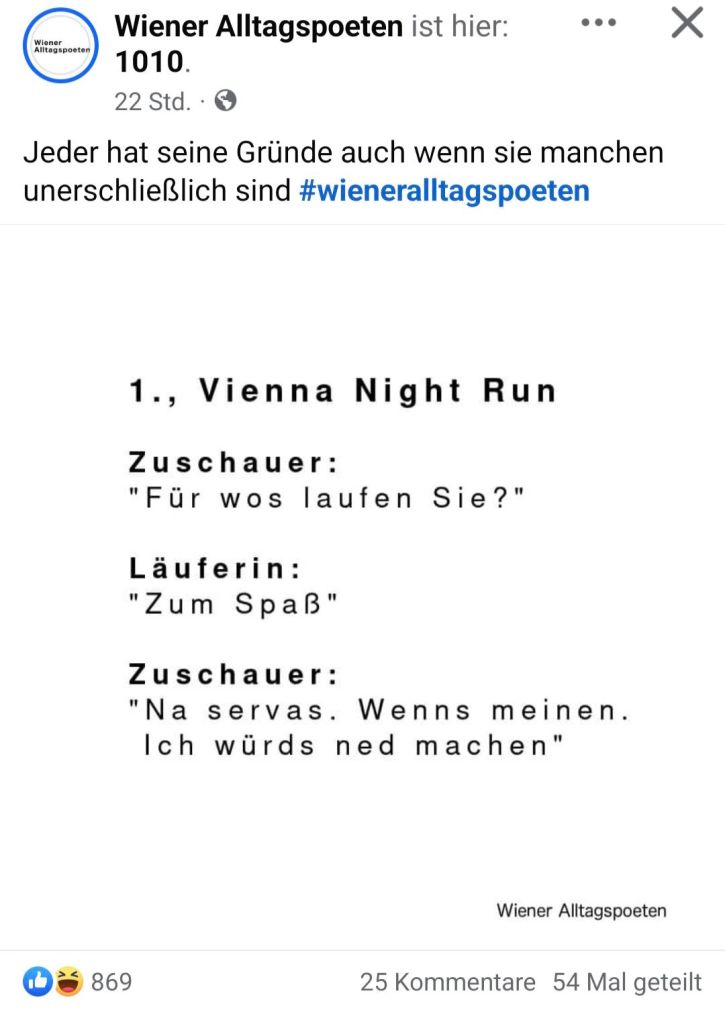
… but there still are a number of people who feel the way this spectator did: “Why are you running [in this race]?” “For fun.” “Huh. Well, if you think so. I wouldn’t do it.”
Is this the new normal? Attacking people out for an afternoon of fun?
I first saw something about this on the Wiener Alltagspoeten site and then looked for the ORF report (link above). I’ll try to write more about this later, but it is a Tuesday and I do have an appointment with a client shortly.
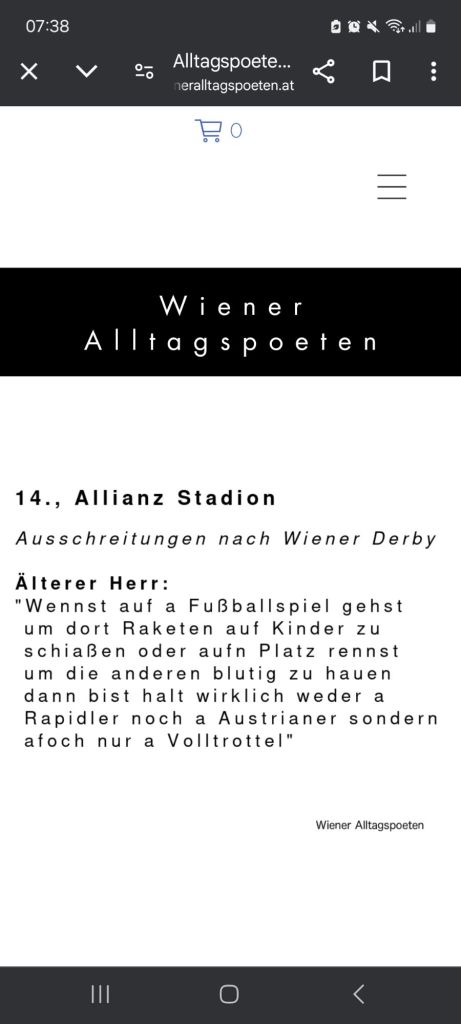
I did want to put in what the Viennese everyday poet said (photo below), sadly in a very dull translation that doesn’t catch the Viennese tone: When you go to a football match to shoot fireworks at children and to run onto the pitch to pound other people bloody, you’re neither a Rapid fan nor an Austria fan, you’re really just a total idiot.” (Which is putting it mildly if you ask me.)
The Vienna City Marathon (VCM) 2024 has come and gone this sunny and cool day, good for running although perhaps a tad too windy. It seemed a bit uneventful this year.
No course records were broken as two were in 2023, when Samwel Mailu of Kenya very clearly broke the men’s course record and Julia Mayer, in a stunning display of tenacity and speed in the homestretch, broke the Austrian women’s course record by one second.
No pacemakers finished the race without their racers as Timon Theuer’s did in 2022, when Theuer fell at the 32-km mark and bowed out of the race. This year, Theuer was entered for the half marathon.
There were no neck-and-neck finishes, as there were in 2022 when Joyce Chepkirui, defending her title from the year before, just managed to maintain her lead and cross the finish line before Ruth Chebitok.
No one collapsed near the finish line and therefore none of the other runners had to dodge an ambulance on their way to the end of the race as Chepkirui had to when she won on 2021.
None of the winners was disqualified for wearing the wrong shoes, as happened to Derera Hurisa of Ethiopia, heartbreakingly, also in 2021.
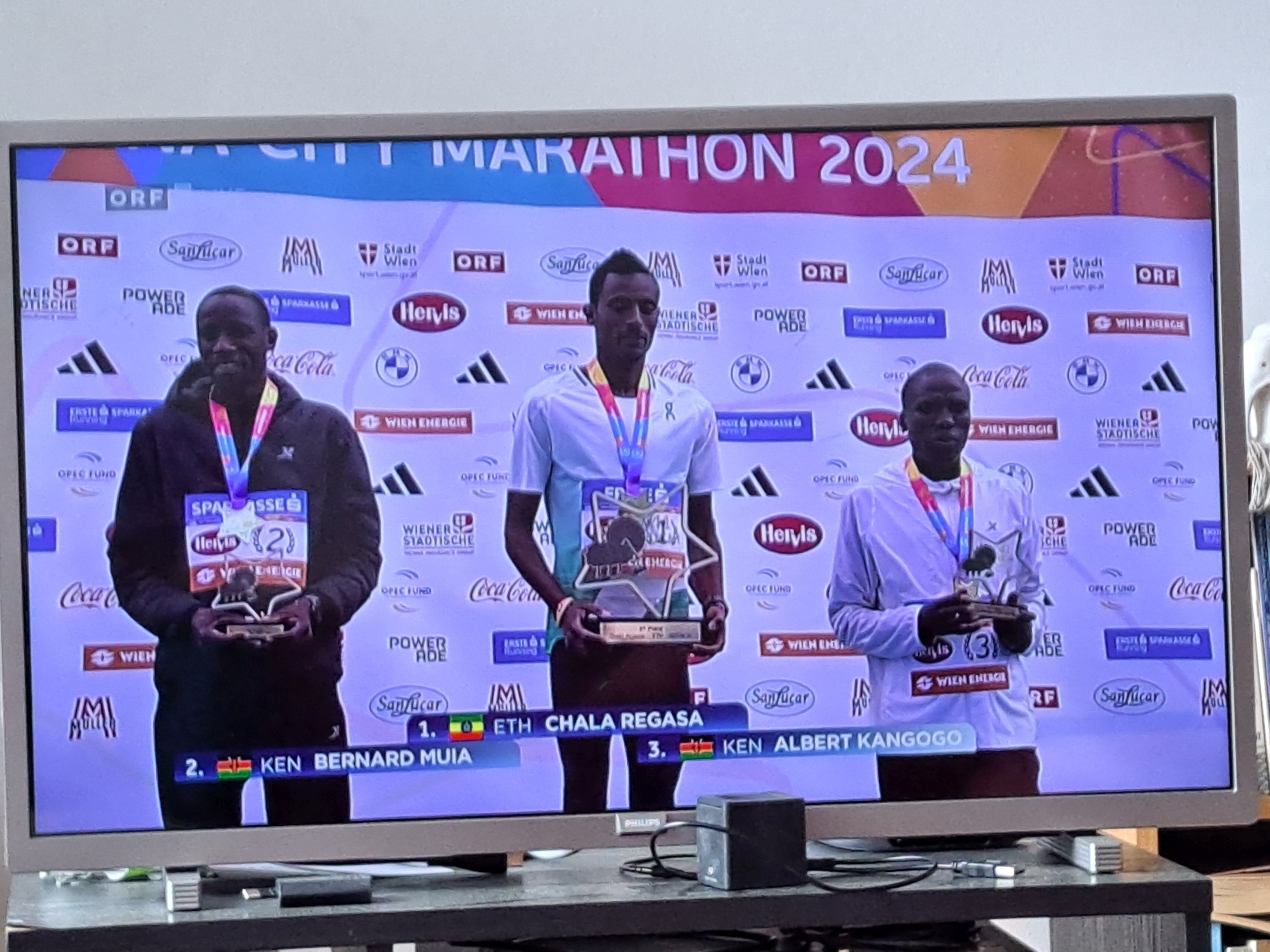
So, beautiful weather and clear wins by the leaders: Chala Regasa (ETH), Bernard Muia (KEN), Albert Kangogo (KEN), Mario Bauernfeind (AUT), Nazret Weldu (ERI), Faith Chepkoech (KEN), Rebbeca Tanui (KEN), and Julia Mayer (AUT).
In fact, coming into the homestretch Chala Regusa was so far ahead of the other men the VCM Twitter feed (I refuse to call it “X” and, in fact, only look at it to stay on top of what is happening in the marathon) had a post: Umdrehen muss er sich nicht, der erste Verfolger ist mehr als zwei Minuten hinter ihm. (He doesn’t have look over his shoulder – the nearest competitor is over two minutes behind him.)
In terms of diversity, just two interesting points from the interviews after the race. When Mario Bauernfeind, first Austrian man and on the police force in Vienna, was asked where he would go from here, he said he would have to go home, talk to the people close to him, and figure it out, that his children were getting older and needed more of his time. And Julia Mayer, first Austrian woman, mentioned that she had her period and so was really proud of her body for doing such a good job. To his credit, the ORF interviewer didn’t blink and later said something about how good that she felt free to mention that openly.
Once again, the Kenyan fans were out in force and showed great joy even though the first places were occupied by an Ethiopian (first time for the men since 2015) and an Eritrean (first time for the women ever, if I understood correctly).
After a few days in Baden with a friend, I got back to Vienna Friday evening. A good bit of Saturday was taken up with the usual household tasks, but yesterday evening I went to hear a bluegrass group I’ve known (about) for a long time at a wine bar in Grinzing. Yes, you read that correctly — bluegrass in Grinzing. A friend of mine from West Virginia and I go whenever we can and always leave feeling restored. The band itself has four regular members: one Austrian, one Slovak, one Czech, and, now, one Dutch. Constructive globalization in action. 🙂
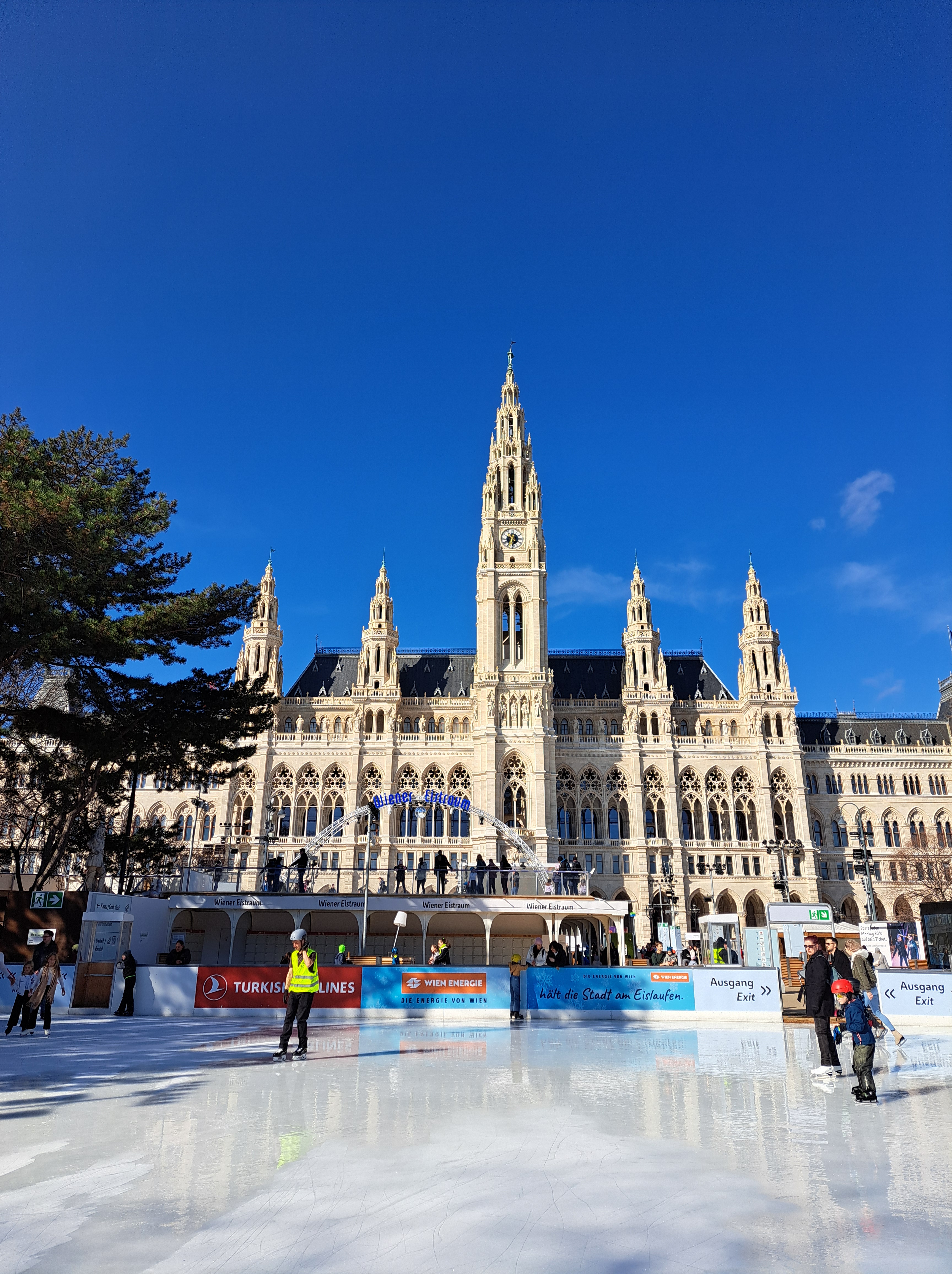
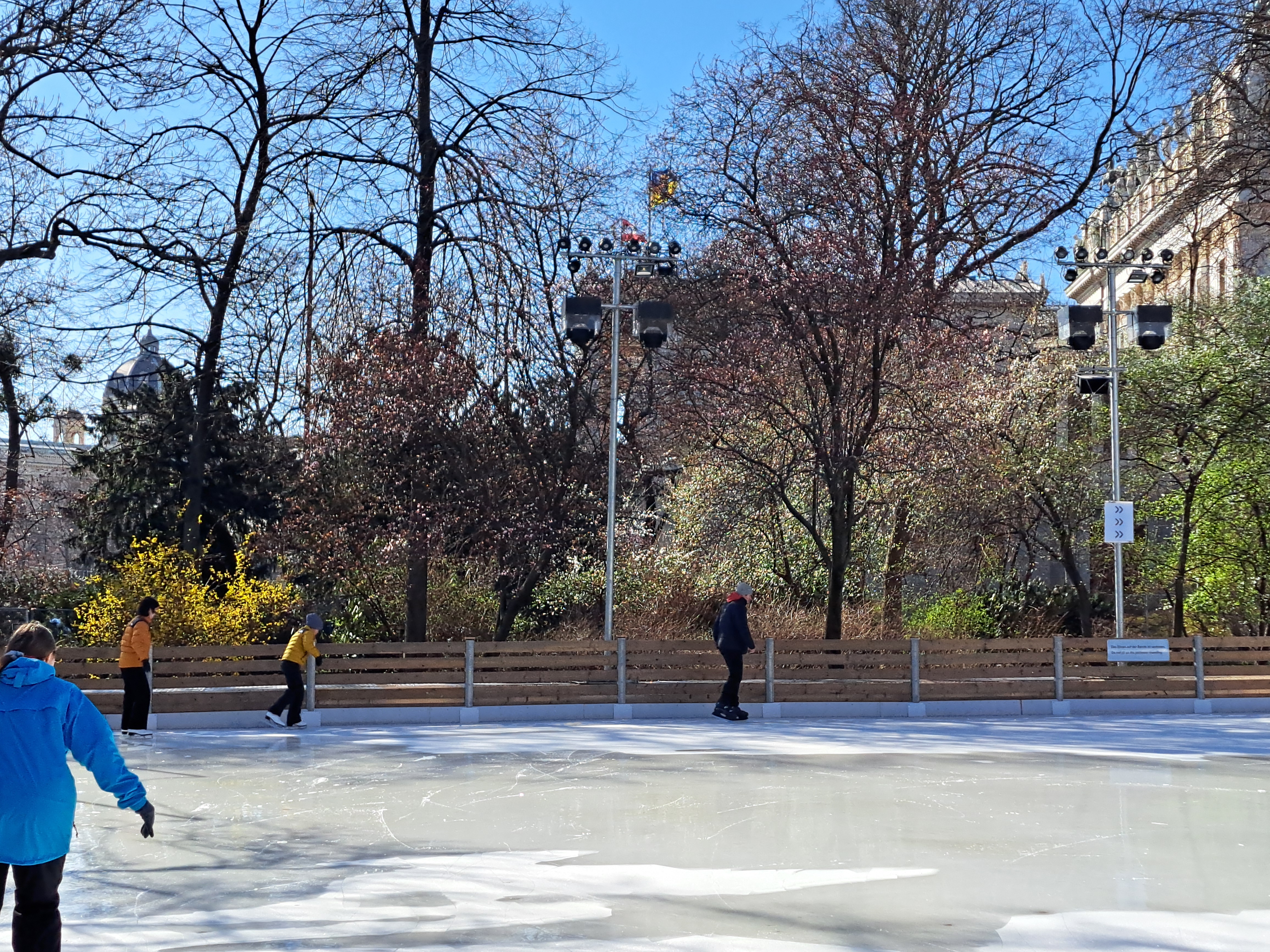
As for today, this is the last day the ice-skating rink in front of the Rathaus is open. (Actually it offers two levels — so probably one of the few places you can skate uphill and then down again — and paths through the park so “rinks,” plural, seems more appropriate.) Given that not only the forsythia is out but also the flowering trees, it is probably a good thing that today is that last day.
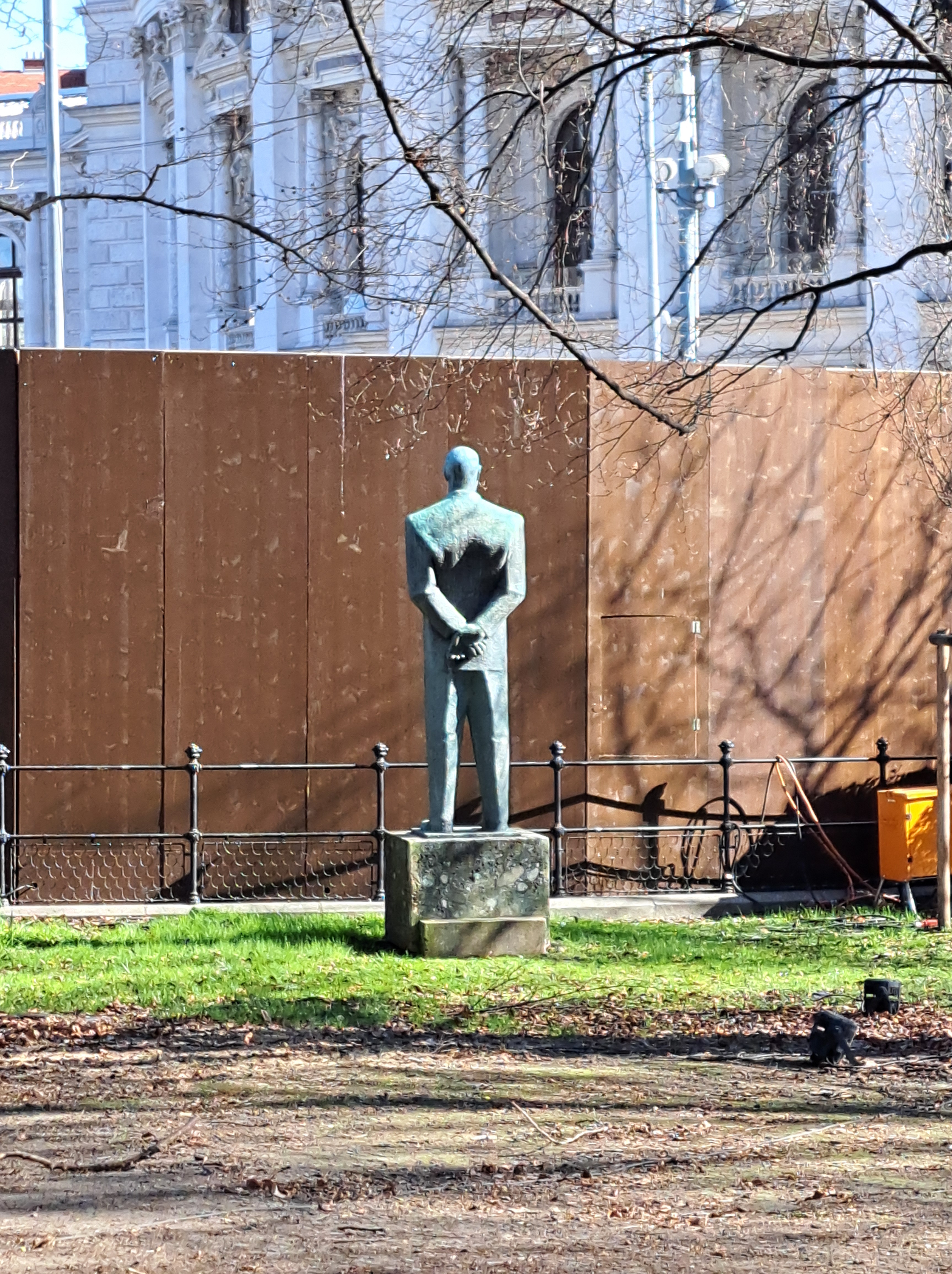
I hadn’t been yet this season so I went down at 10 a.m. just as they were opening and stayed for about an hour. After that, it got so full(!) it wasn’t as much fun anymore. The photos I took show the general flowering of everything as well as the statues that have been accommodated. Now I feel I need to go down once the rinks have been removed and see who those gentlemen are.
Now I slowly have to get back into a work state of mind. Luckily, I have most of the afternoon to do that. And I’ve had a lovely time so — as the old tenant says in the Gwyneth Paltrow “Emma” — mustn’t grumble.
One more great lost this year. Of course, his soccer playing was incomparable, but I will miss most his smile, his humanity, and his humanitarian efforts. I’ll never forget that the day David Beckham arrived in Los Angeles with great fanfare, Pele was playing in a match to benefit UNICEF. The article in the NYT reminded me of the beauty of Rob Hughes’s (essentially philosophical) writing about soccer and introduced me to that side of Pelé’s greatness.
The Vienna City Marathon (VCM) 2020 has, of course, been canceled. It would have been held today, and the weather would have been good for it–not too hot or sunny and not much wind.
A few years ago I started writing the VCM date in my calendar so that I could set aside time to watch it undisturbed. This was after a number of years of having it on the TV in the background but not planning to really watch it. At some point I had to accept that it was oddly absorbing and enjoyable to watch people run for hours and that there was no point in trying to get anything else done while the VCM was on.
I still watch on TV but there is a point at which the runners pass about 10 minutes from my flat so I have taken to walking down there and cheering on the front runners: first man, first Austrian man, first woman, first Austrian woman. (I have never gotten the sense that they took in that we were there cheering, but I like to cheer them on nonetheless.)
There is a hole in my calendar this year where the VCM would have been. I’ll especially miss seeing Valentin Pfeil, a gifted and personable Austrian marathoner, and Nancy Kiprop, the Kenyan teacher who runs to earn funds for her school and has been the winner among the women three years in a row. I’ll miss the shots of this beautiful city I live in, the streets cleared of cars but lined with fans. I’ll miss the people who run it with a sense of fun, dressed up in silly costumes and not looking at the clock. I’ll miss the ORF commentary. And I’ll miss the stories of the runners and how they came to be in the VCM.
This, too, is a part of Vienna in the times of coronavirus.
Not me! I’m just a dog-walking observer. And as an observer I can’t help noticing how many more runners there are than there were just two weeks ago.
The other thing I’m noticing is how fast some of them are running. I still remember walking through Central Park in New York with my then Austrian partner, about 15 years ago, who couldn’t get over how fast all the runners were moving. Vienna was in the throes of the “slow running” fad, and until now I hadn’t really thought about it, but Vienna was still in the throes until the coronavirus lockdown started!
Clearly, there’s currently a lot of energy out there that is not getting used up in other ways.



 ecbinvienna