According to this, Emperor Josef II decreed that all plays had to have a happy ending. This meant (pretty major, if you ask me) re-writes for plays like “Romeo and Juliet” and “Hamlet”. These happy endings became known in the German speaking world as “Viennese endings”. Apparently, Apfelstrudel and other delicacies weren’t enough to keep the population happy. 😉
Tag Archives: history
“Gruß Gott!”
29 Sep“Gruß Gott!” is still a common greeting in Austria, or at least in Vienna. Today, reading an interview in the Kurier with Thomas Schäfer-Elmayer, owner of the number one dancing school in Vienna and the Emily Post certainly of Austria if not of the entire German-speaking world, I learned something of the history and associations of the phrase.
He didn’t feel the need to explain but I do: The phrase (word-for-word translation “Greet God!”) is short for “God greet you.” (“Grüß Sie / dich Gott!”) He told a story, though, in which he was speaking at a technical / vocational high school and a student called him on using it because the student considered the greeting too closely associated with the ÖVP or Austrian People’s Party (a.k.a. the Conservatives).
To his credit, Schäfer-Elmayer looked into this claim and discovered that between the world wars it truly was a sign to others that one belonged to the People’s Party. His research showed that during this time–with what amounted to a civil war being waged in the streets of Vienna–the hate between the Social Democrats (the Reds) and the People’s Party (the Blacks) was so great, people chose to signal their allegiance immediately in how they greeted other people. “Grüß Gott” for the Conversatives; “Guten Tag” for the Social Democrats.
The civil servants, who sought to remain neutral, as good civil servants the world over do, adopted–Schäfer-Elmayer said–the term “Mahlzeit” (usually said before a meal and then taking the place of “Guten Appetit”). This is an interesting take on the greeting, as I always assumed “Mahlzeit” had a similar function as the French “Rebonjour”. In current usage, you say “Guten Morgen” when you first run into someone in your place of work–in the morning–and “Mahlzeit” afterwards to indicate that you remember greeting them the first time. (Apparently, in French companies it is a rather large faux pas to use “Bonjour” twice in one day to the same person. I read that it is tantamount to considering the person so inconsequential that you don’t remember greeting them the first time. Source: Schneider and Barsoux, “Managing across Cultures”)
From 1938 to 1945, apparently, “Mahlzeit” took on another use. People who wished to avoid saying “Heil Hitler” said “Mahlzeit” instead. I hear my mother–born in Berlin and raised there during the Second World War–saying, “Berliners just kept saying ‘Guten Morgen’.” Her comment is supported by Christabel Bielenberg’s incomparable memoirs, which I am currently re-reading, of living in Berlin as an Englishwoman under the Nazis. Even more of an aside here: that Berliner habit got my grandmother–my German grandmother, that is, not my English grandmother (complicated family)–into trouble when she visited her parents in their small town in Thuringia.
And so a bit of culture and history on this Sunday.
For German speakers, links to the Kurier interview and to the Wikipedia entry on some of the uses of “Mahlzeit” below:
https://kurier.at/freizeit/thomas-schaefer-elmayer-gesteht-ich-mache-auch-viel-falsch/400613615
https://de.wikipedia.org/wiki/Mahlzeit
Rooseveltplatz
26 Jul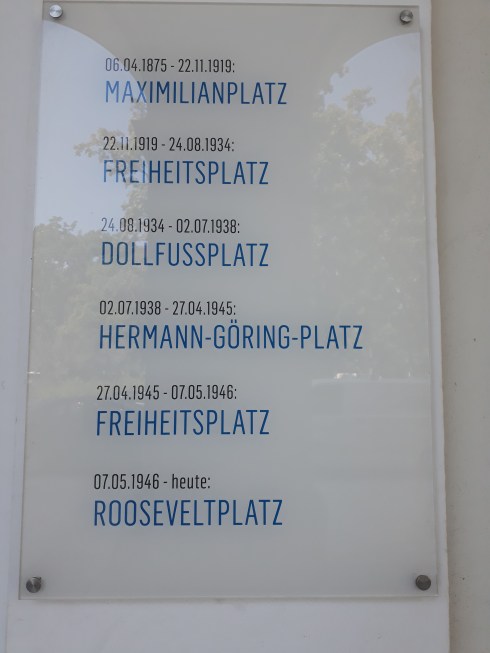
What a concise reminder of bits of Viennese and Austrian history, all in one sign at the Institute for Social Sciences of the University of Vienna. They are located at what I have always known as Rooseveltplatz. Obviously, it has had different names over the years, reflecting eras and events in Austrian history.
I can guess at most (all) of them. Maximilian was Emperor Franz Josef’s brother, who had the nearby Votiv Church built. Freiheitsplatz (Freedom Square) probably expresses the hopes of the new democracy after the First World War. Dollfuss was the Austrian chancellor assassinated by National Socialists in July 1934. Hermann-Göring-Platz is sadly self-explanatory. And then Freiheitsplatz again until it was named after the U.S. President Roosevelt.
Interesting!
150 years of the Vienna State Opera
26 MayI’m watching the gala celebrating the 150th anniversary of the Wiener Staatsoper and remembering the moment I first saw it.
I was in a car driven by a school friend of my mother’s. It was about 10 o’clock at night. She had picked us up at the airport (thank goodness because in those days the airport bus didn’t run that late(!)) and was driving us to the student residence where we were staying.
We rounded the Ring at Hotel Bristol and suddenly there it was all lit up and glorious. In those days, I believed I was destined to sing on that stage and found the sight electrifying and deeply moving.
Over 30 years later, I must confess to a certain familiarity. I sometimes ride past on the tram without really looking at it, but tonight is giving me back some of that excitement.
To 150 more years at least!
Wien Museum (Vienna Museum)
10 Jan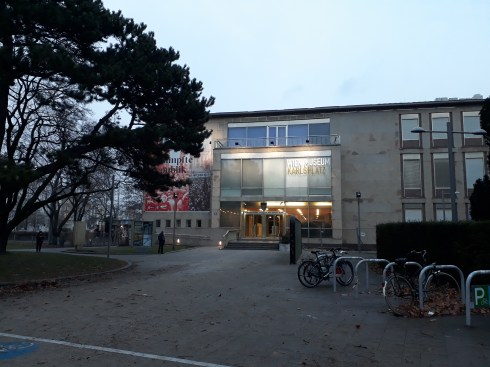
I went to the Wien Museum (formerly Museum der Stadt Wien) at Karlsplatz this afternoon. For some reason, I feel the need to justify this on a Thursday. My justification is this: at about noon I finished the preparation for my big meeting tomorrow, the preparation that shortened my Christmas vacation by three to five days, depending on how you count it. Now I’m making up part of one of those missing vacation days.
The incentives were also strong. The Museum will be closing for extensive renovation and expansion on 3 February 2019, and an exhibition I’ve been wanting to see ends this Sunday already. (I can’t go tomorrow–big meeting–and I hate going on weekends because there are so many people).
In fact there were two exhibitions I really wanted to see so I was there for the better part of two hours, until they closed. One is called “Fluchtspuren” (or “What Remains: Traces of Refugees”). The other is called “Die Erkämpfte Republik” (or “The Hard-Won Republic”) and shows photos and newsreels from the first year of the First Republic of Austria (one hundred years ago).
“Traces of Refugees” is small. It displays 15 telling, everyday objects–shorts lovingly sewn by a mother for her son out of sailcloth and with buttons scrounged from a soldier or the keys that are all that remain of a house that was destroyed when a whole village was burned to the ground in the Balkan Wars. All the objects are connected to refugees to Austria, mainly to Vienna, and mainly at the end of the First World War as the Austro-Hungarian Empire was disintegrating, during the Second World War, and during the Balkan Wars (which I remember as I was already living here then).
This exhibition was in conjunction with a small but wonderful exhibition about Lisa Jalowetz Aronson, who was a costume and scenery designer (as well as being a Jewish refugee in the Second World War). Among other things, she worked with her husband on Broadway, where she landed after being born in Prague, raised in Cologne, and educated in Vienna. The exhibition included a video interview with her done, I think, by her grandchildren. Quite something! She struck me as the epitome of resilience, laughing easily as she recounted hair-raising stories like how angry she was at her parents that they wouldn’t let her finish her art studies in Vienna (in 1938). “They probably saved my life but I was still furious,” she tells us.
“The Hard-Won Republic” was an important and effective reminder that this city, which is now so beautiful and rich, was cold and starving at the end of the First World War. Trees were being cut down in the Vienna Woods (my Vienna Woods!) to make sure people had something to heat with, and the Viennese traveled out of the city to glean the fields once the farmers had harvested what they wanted. People were literally starving to death and, of course, were terribly vulnerable to disease, particularly tuberculosis.
Beyond that, things that stuck out for me were the fact that Kaiser Karl, Franz Josef’s successor and emperor for only two years, didn’t understand why people wanted him to abdicate(!). (Seeing a photo of him getting off a plane at the airfield in Aspern with his wife and children reminded me that this is all recent enough–and I have been here long enough–to have seen Zita Hapsburg’s funeral in Vienna. Something to tell my grandchildren, if I had any.)
Other things: Within days after the end of the war, there were three security forces in Vienna, each allied with a different political platform. Anti-Semitism was as strong and, in some ways as subtle, as ever. Women were getting the vote. People were taking to the streets–a different group practically every day it seemed. And in 1924 there was a massive anti-war protest (“Nie wieder Krieg!” or “Never again war!”) in front of the City Hall.
If I’d had time, I could have gone to the “Gemma, Gemma” exhibition (“Gemma” is Viennese for “Let’s go” or “Let’s get going”) about the coming renovations and expansion. As it is, I took a brief moment on my way out to watch a video about it. It looks very promising. (And this from someone who hates change.)
An afternoon very well spent, if you ask me.
The Heart of Central Europe
23 DecEven though Austria’s empire is long gone (ended 100 years ago this year), there are still reminders that Vienna was the glittering multicultural, multilingual heart of that empire. A few days ago, I saw two men nipping across a wide and busy street, dodging between cars. One of the drivers stopped to let them go in front of him, and one of the pedestrians waved and said “Danke!” Then he saw the Bratislava license plates and added “Ďakujem!”
Ice skating in Vienna
1 DecThis interested me very much. I used to live near the Engelmann ice-skating rink, which is on top of a building. Apparently, it opened in 1909 and was the first open-air rink. Cool! 😉
Kristallnacht, 80 years on
9 NovAs I went out with Maylo for our last trip around the block, I saw this:
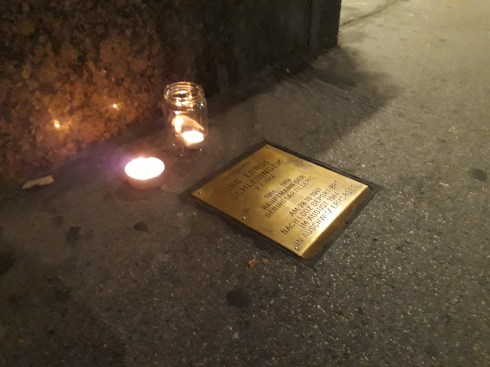
I knew it was the anniversary of Kristallnacht because it, like Hiroshima day, is part of my personal calendar. When I saw the candles next to the commemorative plaque, I suddenly realized that Kristallnacht was 80 years ago tonight. May God help us all.
The Anschluss – 80 years on | ecbinvienna
12 Mar10 years ago I wrote the text linked below. Reading it again, I am struck by how quickly we have moved to just such a situation historians and survivors warned about then. Let us remain active and keep lighting those candles, every day.
https://ecbinvienna.com/2013/03/13/the-anschluss-75-years-on/
 ecbinvienna