This morning I awoke to beautiful sunshine in Vienna and about 3°C — a perfect late winter day. As always, I went out with Maylo without checking my phone. We enjoyed our walk.
Then at breakfast I checked the headlines. The NYT: Russia attacks Ukraine. ORF: Russland greift Ukraine an. Both sites with videos of the shelling. And I realize that Europe is once again at war. I think of a workshop participant on Tuesday who was joining us from Moscow and felt it necessary to emphasize that many Russians do not want war. I think of a neighbor, a student at the University of Vienna, who comes from Ukraine and whose family who is still there. I think of the wonderful members of a Ukrainian choir who passed through Vienna on their way to a church choir festival in Switzerland in the heady, hopeful days of the early 1990s. I think of a U.S. American friend’s sister who has lived in Kyiv for many years working for an organization that takes care of orphans, who has chosen to stay and continue her work. I think of them all and can hardly type this for the tears running down my face.
When I can, I will wipe my tears and will carry on — as my parents did growing up in Germany and England respectively in the Second World War and my grandparents before them in the First World War, and as so many generations have and so many people around the world throughout time. No doubt I will cry again, and wipe my tears again, and carry on again. And in the meantime I will leave sunflowers for my neighbor to let her know that someone in our house has noticed and cares, and I will donate to Caritas for humanitarian aid to the Ukraine, and I will sit and try to maintain my own peace so that I do not contribute to the violence of this world.
I have loved and tried to be guided by this quotation below from Etty Hillesum for years. Now more than ever.
“Ultimately, we have just one moral duty: to reclaim large areas of peace in ourselves, more and more peace, and to reflect it towards others. And the more peace there is in us, the more peace there will also be in our troubled world.”
If she could write that from the despair of a concentration camp, surely I can begin, at least begin, to do it surrounded by the beauty of a perfect late winter day in Vienna.
And in Stephansdom no less, where you don’t need an appointment.
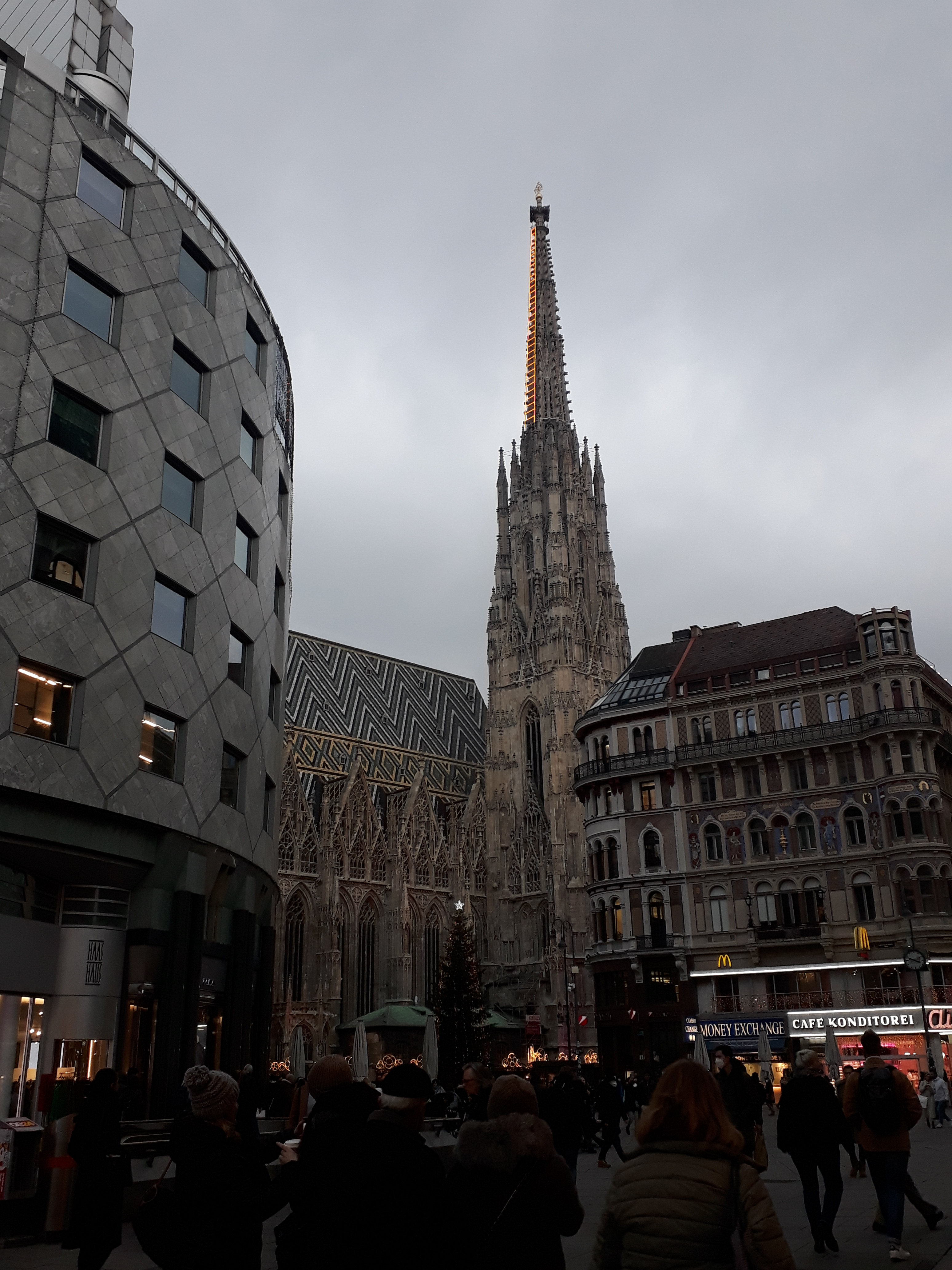
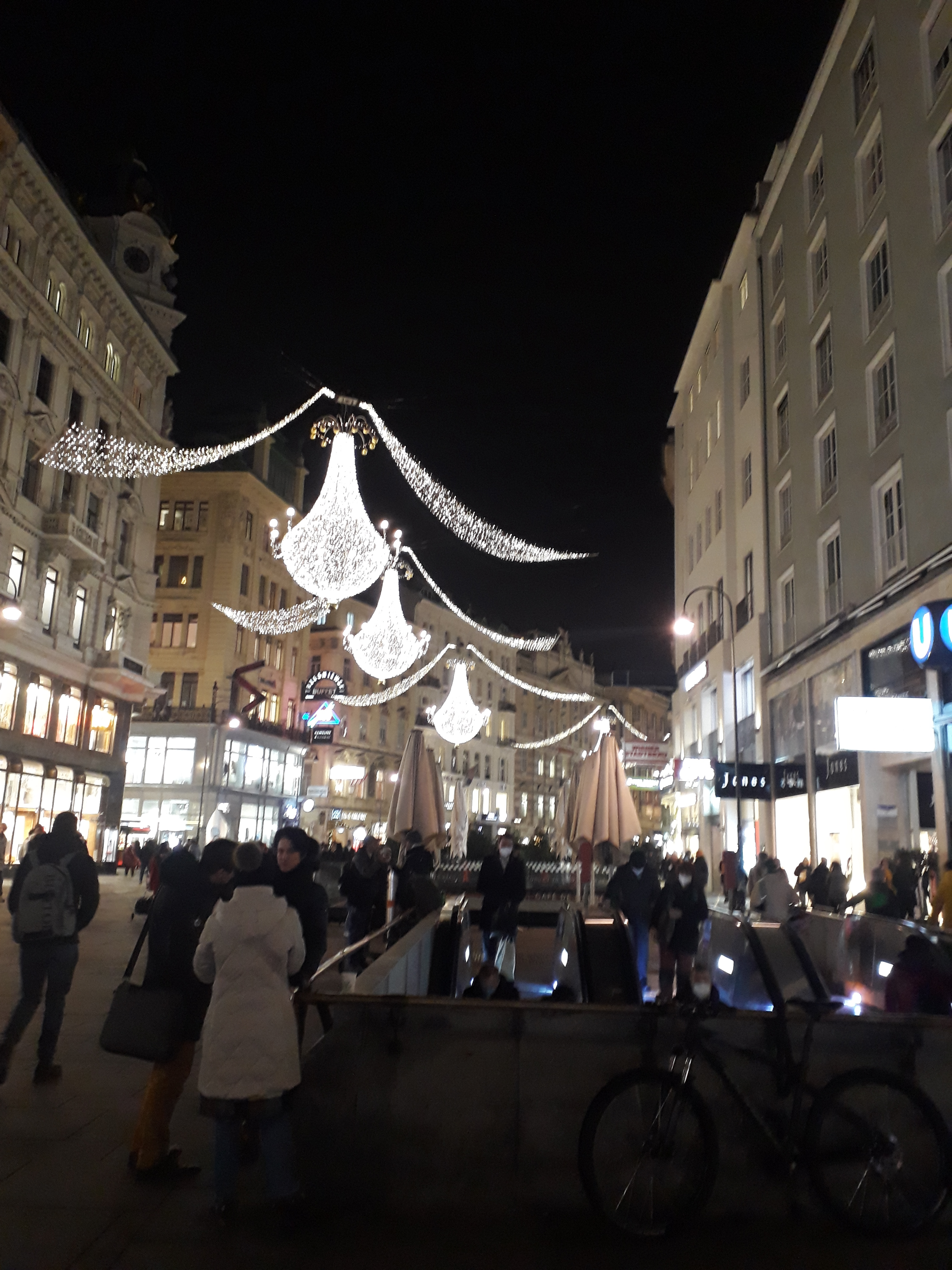
The path to Stephansdom via the Graben and the line of 21st century people waiting in front of the Wiener-Neustadt Altar
Beyond the fact that I didn’t need an appointment, why did I choose to go to Stephansdom for my vaccination? For romantic reasons. I have never forgotten the tour I took of the catacombs very early on in my Vienna days. There are bones of Bubonic plague victims in those catacombs and I am slowly coming to accept that COVID-19 is our plague.
As a bonus to that historical connection and a beautiful setting in which to wait, an Advent meditation was starting just as I was leaving. Simple and meaningful, with a small choir and short bursts of organ music and a homily on finding room at the inn.
Stephansdom has survived plagues (and wars and reformations) and we shall, too.
One thing that strikes me is how many reminders of the World Wars there still are in this part of Europe. Beyond the memorials, there are daily reminders that 80 years ago or so (or just over a hundred years ago) mines were being laid and bombs were being dropped.
There’s an article in today’s Kurier about the bomb squad, whose responsibilities include defusing bombs left over from the wars. Apparently, the squad gets three to four calls a day(!) to take care of old explosive devices.
It reminded me of the time, only three years ago or so, I almost missed the last Vienna-bound flight out of the Cologne airport because the highway was closed and traffic was being rerouted to give a wide berth to the site where an enormous bomb from the Second World War was being defused.
That reminded me of the story a German client told me. His company was in an area of Germany where a lot of bombs got dropped randomly as the RAF planes were on their way home. (This, apparently, was a common practice on both sides. I’m sure there’s a counterpart in the U.K. that defuses old Luftwaffe bombs on a daily basis.)
When my client company was breaking ground for a new plant, they came across one of the bigger bombs and called in the bomb squad. This, of course, delayed progress. When the (U.K.-based) parent company wanted to know why the project was no longer on track, my German client, with some relish (there were some of the usual tensions between parent company and subsidiary), relayed the information that they had been delayed by a British bomb. The head office was attuned to the irony of this and took some of the pressure off.
How easy it is in this peaceful Europe to forget that the E.U. grew out of a desire to never fight neighbors again. And how helpful to have these reminders.
Seems a particularly Austrian solution to me. It is against the law for descendants of aristocratic families to use their titles and has been since 1918. The maximum penalty? 14 cents. 🙂
A nice change from the dire news coming in from around the world – someone has found what is believed to be the oldest recording of a Lehar piece, a march recorded by the Imperial Infantry in 1901. We won’t be able to hear it, though, until the end of the month.
As we struggle with the coronavirus, let us not forget that 75 years ago the Second World War was ending. In Austria alone, as the Kurier reported this morning, the timeline looked like this:
29 March 1945 – Soviet troops entered Austria in Burgenland; members of the SS rolled boulders off the rim of the quarry in St. Margarethen onto the forced laborers who had been driven together in the quarry below, causing a blood bath; massacres of forced laborers took place in Deutsch-Schuetzen and Bad Deutsch-Altenburg; a death march from the southeast towards the concentration camp Mauthausen near Linz (approximately 300 km away) were started
6 April 1945 – There is a massacre, called the “Krems Rabbit Hunt” (Kremser Hasenjagd), as the concentration camp Krems-Stein is being evacuated. In this massacre, prisoners who tried to escape, including the freedom figher Alois Westermeier, were caught and executed.
8 April 1945 – The freedom fighters Major Karl Biedermann, Captain Alfred Huth, and First Lieutenant Rudolf Raschke were executed at the Florisdorfer Spitz in Vienna for trying to negotiate with the Red Army a peaceful transfer of Vienna.
13 April 1945 – The battle for Vienna ends. St. Stephen’s Cathedral stands in flames.
17 April 1945 – Theodor Koerner is appointed interim mayor of Vienna.
27 April 1945 – Declaration of independence and founding of the Second Republic.
28 April 1945 – U.S. American troops approach Tirol and Upper Austria. The last of three death march groups reach the camp in Gunskirchen, Upper Austria. Thousands of those people do not survive the next few days.
29 April 1945 – Last murder by gassing of prisoners in the concentration camp, Mauthausen. French troops enter Austrian soil in Vorarlberg.
30 April 1945 – In Vienna, at the orders of Interim Mayor Theodor Koerner, street signs with National Socialist names are taped over. Hitler commits suicide in his bunker in Berlin.
6 May 1945 – British troops cross the Carinthian border into Austria. The concentration camp [actually Aussenlager”] Ebensee is liberated by U.S. American troops.
8 May 1945 – Eight days after Hitler’s suicide, the Third Reich capitulates unconditionally and the war in Europe is over.
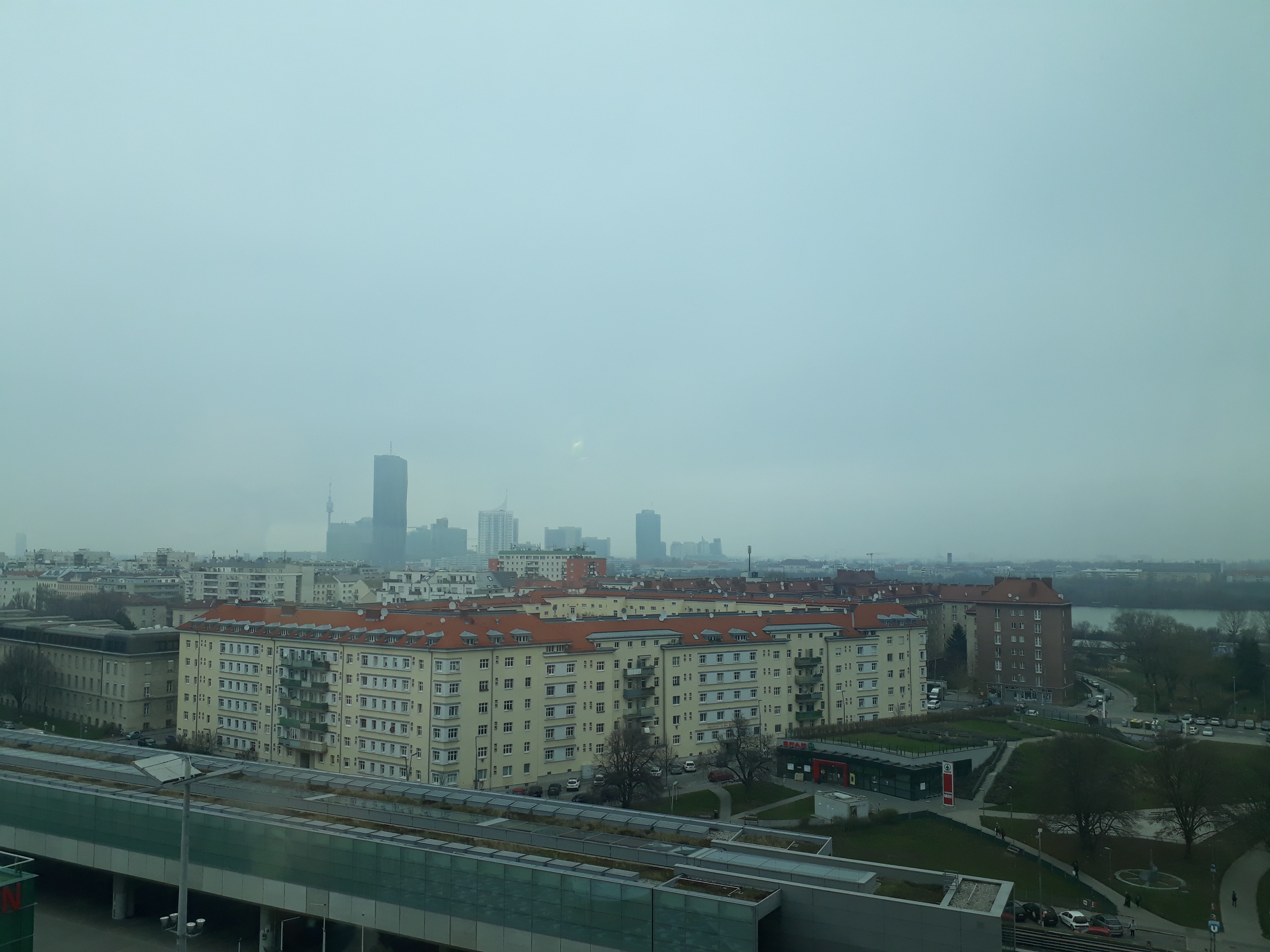
The photo didn’t quite turn out the way I wanted, but I found the view an interesting representation of some of the major changes in Vienna over the last 100 years or so with one of the original Gemeindebauten on the other side of the U2 tracks and the UN and everything that has grown up around it in the background. On the right you can catch a glimpse of the Danube.
Eliud Kipchoge did it! He ran the classic marathon distance in under two hours (1:59:40). And he did it in the Prater in Vienna. I’ve never seen him so happy. 😁


 ecbinvienna