Tag Archives: history

64,440 Names

13 Nov

I have finally gotten around to creating a blog article I have been meaning to post for over a year. It is in the form of the first, and possibly only, video I have filmed for my blog. Because of the size of the file I am putting a link here for those who wish to take a look. Warning: It is on an emotional topic.

Some links to additional information:
The official website
The ORF report from 9 November 2022
Every name stands for a world that was killed

Schwedenplatz 2020

3 Nov

Yesterday marked the second anniversary of the attacks at Schwedenplatz on that balmy evening that tempted so many people to be out and about on the eve of our third (or was it already our fourth?) lockdown.

So much has happened since then and life feels so different that it seems impossible that it has only been two years.

Austria’s fattest “photo album”

26 Oct

Today, October 26, is a holiday in Austria, commemorating the vote in Parliament that established Austria’s permanent neutrality. (My understanding is that it was the first business enacted by the Parliament after all occupying powers had left Austrian territory after the Second World War. More about the treaty here.)

It is probably no accident, then, that the ORF (Austrian Broadcasting Corporation) chose today to draw attention to the special photo and image archive of the Austrian National Library. Here is a taste from the ORF site of the millions of photos stored.

The ORF article is lengthy and only in German, unfortunately. Some of the main points they make: the Imperial Collection created a foundation for the current collection (yes, there is a photo of the enigmatic Empress Elisabeth); the rise of press photography bearing contemporary witness to life vs. studio portraits; the suppression of free media and therefore, of course, photojournalism as well as the banning of Jewish photographers during the Nazi regime and the resurrection of those professions after the Second World War; the role photography played in documenting the Cold War and the images of its major players (one of the most chilling photos for me on the ORF site was of Russian soldiers goose-stepping in Moscow in 1988); and the challenges of maintaining a usable archive in the world of digital photography where photos can be snapped one a second. (In fact, the teaser for the article mentions sinking into Austria’s fattest “photo album”.)

A heads-up: The Austrian National Library is planning for 2023 a retrospective of photos by Yoichi Okamoto who was head of the United States Information Service during the Occupation in Austria and later presidential photographer for Lyndon B. Johnson.

Those who would like to see more photos, I have chosen the link to the digital archive with images of Vienna to share with you here.

Praterwal wird ins Wien Museum gehoben

20 Jul

https://wien.orf.at/stories/3165341/

Here is a nice, light story in a world full of heavy news. A 10-meter whale sculpture that stood in front of a Gasthaus (kind of restaurant), zum Walfisch, in the Prater is being moved to the Wien Museum now that the restaurant it represented is no longer there. It is so big that it is being moved in now while the renovations are still ongoing. Eventually it will be hung from the ceiling.

More about this later, I hope, but now I have to go to work. The curse of the drinking classes, as my father loved to quip, possibly quoting George Bernard Shaw. Curse of the writing classes is more like it! 😉

If you’re interested in the renovation of the Wien Museum, I mentioned it in this post: https://ecbinvienna.com/2019/01/10/wien-museum-vienna-museum/

Lillehammer 1994

2 Apr

Today’s Kurier has an interview with Oksana Baiul, the 1994 Ukrainian gold medalist in women’s figure-skating. (She beat Nancy Kerrigan in the final seconds of her routine, as I remember it, by adding a rotation to a jump.)

Just seeing her name and the photo of her with her pink costume and frizzy 1980s hairstyle reminded me of how, in those days, no one except Ukrainians knew the Ukrainian anthem. The way I remember it, the award ceremony was delayed because they were searching backstage for the music so the anthem could be played. In the interview, Baiul says it was because the organizers couldn’t find a Ukrainian flag.

We are now all familiar with the anthem and the flag. I wish it for different reasons.

April 1st – a significant date for both the last emperor and the last empress of Austria

1 Apr

I always check the ORF headlines on my phone at breakfast. This morning I saw that today is the 100th anniversary of the death of Karl I of Austria — the Habsburg who had the thankless task of assuming the throne after the almost 68-year reign of Franz Josef I. He was ill-prepared, not really having expected to ascend to the throne (Crown Prince Rudolf shot himself, Franz Ferdinand made a morganatic marriage and was, of course, later assassinated in Sarajevo, and Karl’s father died young) and took on the role in the middle of a war he had mixed feelings about. One could say that at least he only had to do the job for two years, from 1916 to 1918 when Austria became a republic, but I suspect he didn’t see it that way.

Reading this reminded me that I was a part of the crowd at Stephansplatz that gathered to see Empress Zita’s funeral procession. What I had forgotten was that this was on 1 April 1989. What I still remember is that I got a very good place to stand because there was an incredible downpour just as I was walking to Stephansplatz, which, I suspect, sent the people who were already gathered there scurrying for cover. I sheltered in the doorway of a shop until the worst was over and then made my way to the square and took up a spot near the doors to St. Stephen’s Cathedral in the front row.

What particularly overwhelmed me as the procession went by was the weight of history summed up in this last imperial funeral in Austria. The funeral coach had already become a museum piece and I had seen it in the Wagenburg (Imperial Carriage Museum) at Schönbrunn. The enormous black horses with their stiff black plumes were like something out of Victorian England, as were the uniforms worn by the staff members of the City of Vienna undertakers. The crowd stretched away from Stephansplatz up Kärntner Straße and off along the Graben, where people hoped to catch a glimpse of the procession as Zita was conveyed from the Cathedral to the Kapuzinergruft, where the Habsburgs are interred in their family vault. The Habsburgs are laid out chronologically and so it happens that Zita’s coffin stands on a pedestal next to that of Franz Josef I. Because of history and human frailty, her husband’s grave is still (and probably now will remain) at Funchal in Madeira, although in the manner of the Habsburgs his heart lies elsewhere (in Switzerland).

What a privilege it was to be able to see that bit of history. Something I will never forget.

If you would like more information, here are two pages from the ORF website, with videos.

About Karl I: https://orf.at/stories/3256669/

On Zita’s funeral: https://tvthek.orf.at/history/Persoenlichkeiten/9501729/Begraebnis-von-Kaiserin-Zita/9573009

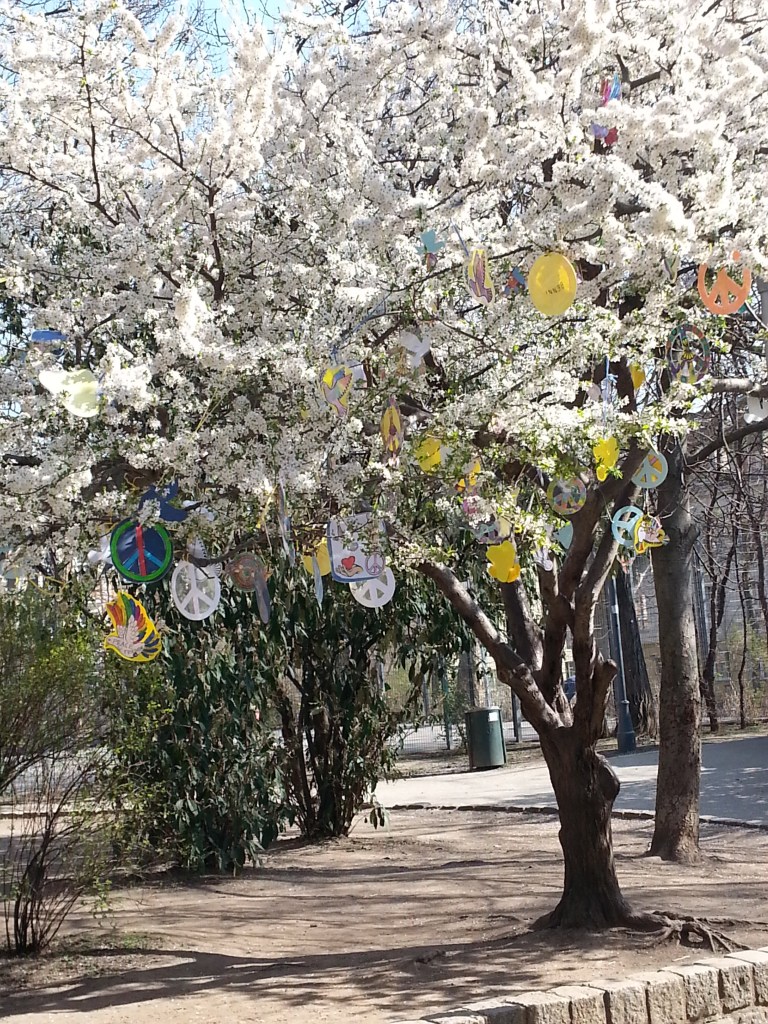
A peace tree

27 Mar
In front of a school in the 18th district

As spring comes in full force to Vienna we continue to keep our Ukrainian neighbors in our hearts as the war rages on. Schoolchildren in the 18th district were inspired to express their desire for peace and their solidarity with Ukraine in this way.

With many thanks to my friend Petra for the photo.

Heading into the 4th week

17 Mar

A number of years ago, I started a gratitude practice I call my gratitude session. I sit at my breakfast table and, before I take a bite or sip, I get into a slightly meditative state and ask myself: What am I especially grateful for right now?

Often the answer is simple and quick — the sunshine, the flowers in the park, my central heating, or the food on my table. Sometimes it takes longer and says more, like in 2015 when I had been helping distribute food to largely Syrian refugees at Westbahnhof. Then it was that I have some control over my life.

The last few days the answer has been the same: that I am still here in this city I love, that I can still practice my profession and earn a living, and, today, that I can still meet friends for a drink in the evening.

Update

10 Mar

A few days ago, I heard that the friend’s sister mentioned in my post from February 24 (link below) and her charges, co-workers, two cats and a dog had made it safely to Poland and will be relocated to Germany.

I haven’t seen my Ukrainian neighbor in the last week.

I have once again been amazed at how wonderful the “children” in my life are. When I, at my wits’ end, asked the older of my Viennese nieces what she wanted for her (29th — you see why “children” is in quotation marks) birthday, she asked me to donate to Neighbor in Need, a very reputable Austrian charitable organization that did wonders in the Balkan war.

And so we stumble into the third week of war in the Ukraine.

Ukraine

Thursday

3 Mar

Every morning I send an e-mail to my mother in the U.S.A. to check in. Sometimes I literally just write “Checking in.” Below is today’s mail.

Boy, it’s been a long week. Still, in terms of acquiring business it hasn’t been bad. Whether things will actually take place given that Austria is already seeing the impact of the war is another question. (The BMW plant — in Steyr, I think — has cut production because they can’t get parts from Ukraine and one Russian bank with offices in Vienna has already gone bankrupt.) C. has also advised stocking up on sunflower products, like oil, because they come almost entirely from Ukraine. 

I saw my Ukrainian neighbor on Alser Straße yesterday. She was on her way to the university. How much she will be able to concentrate is anyone’s guess. She did say her parents had left Kyiv and moved west. With the news this morning that may turn out not to have helped.

For me, the war is pretty much all present. I’m getting on with what needs to be done, but it is always there. You know what this feels like, I know.

Sending very much love