Tag Archives: events

They’re running through the streets (and parks) of Vienna again – VCM (Marathon) 2025

6 Apr

This time I actually remembered to tune into the ORF reporting 20 minutes or so before the start of the race. The main topic this year is the weather. No one’s going to get heatstroke today. It is beautifully sunny but currently 0°C with winds up to 40 kph(!). (Everyone interviewing, being interviewed, and commentating was in down jackets.) Apparently, 8 to 10 degrees are considered optimal. Maybe the organizers should have thought of that before moving the race up by about two weeks!

Some of the effects of the weather: the wind, of course, will be a major challenge. A prominent former Austrian marathoner, Michael Buchleitner, who was commenting, remarked on the water temperature. No, the runners do not need to swim the Danube – it’s a marathon not a triathlon – but they do need to drink water, and the water has been outside all night and will be very cold. He also mentioned, twice, before and after, that it is the kind of weather where the winners will not necessarily be the ones in top form (so, one kind of “fittest”) but rather the ones who adjust to the conditions most quickly and effectively, partly in terms of what kind of clothing they’re wearing. Survival of the fittest in Darwin’s original sense.

In fact, I immediately noticed the difference in clothing among the top runners in comparison to other years. I saw arm warmers, t-shirts under singlets, longer tighter shorts, some gloves, but, with one exception (and in contrast to the amateur runners) no ski hats among the men. One male runner did wear very large earmuffs, though. (He won.)

A small point, there are always ORF reporters on a motorcycle (now electric, if I remember correctly) reporting from the frontline, and they are concerned about how they will stay warm for the two plus hours they’ll be tootling about.

In spite of the temperatures and wind, there were a record number of runners this year. Over 46,000, if I understood correctly.

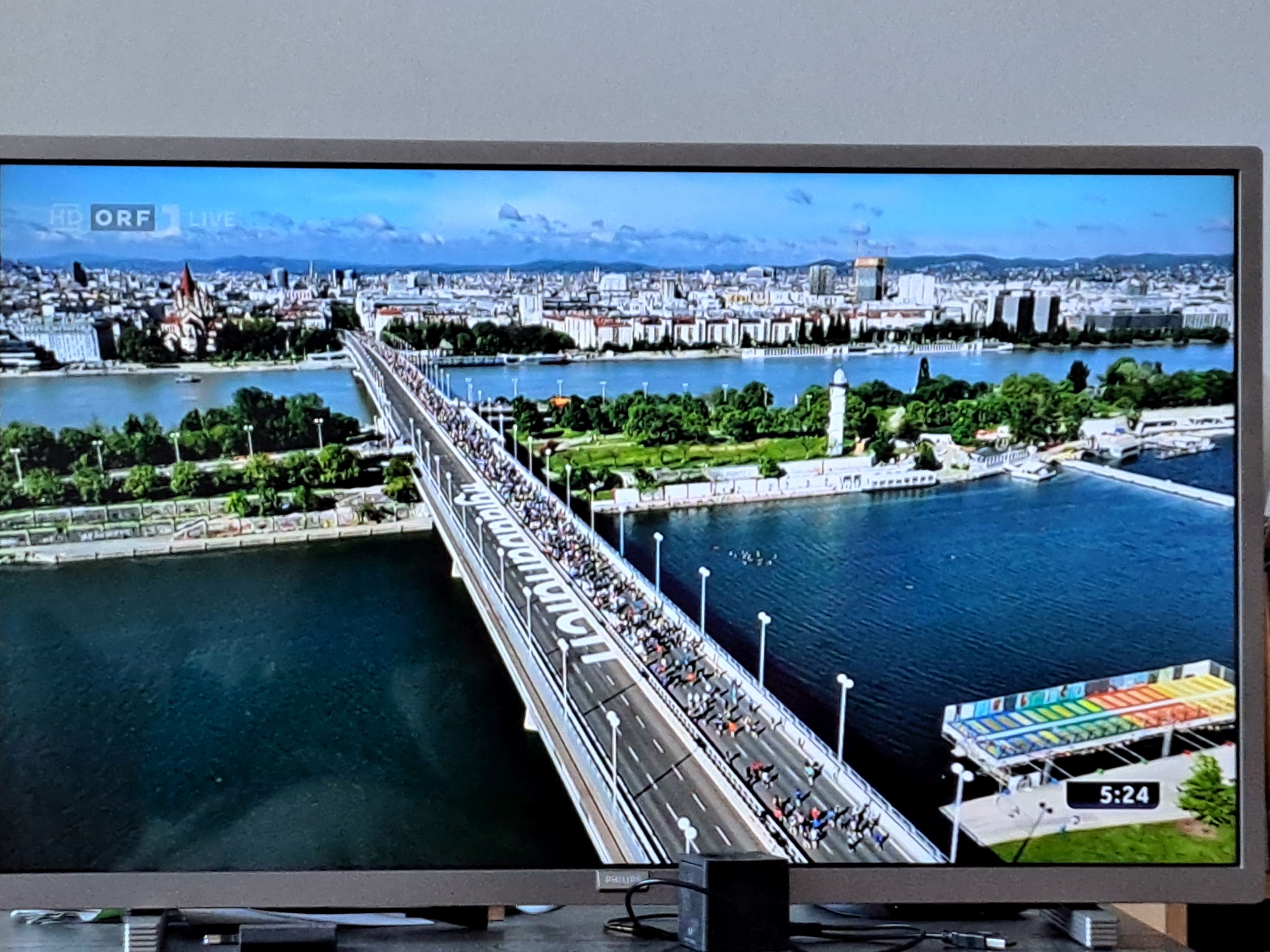
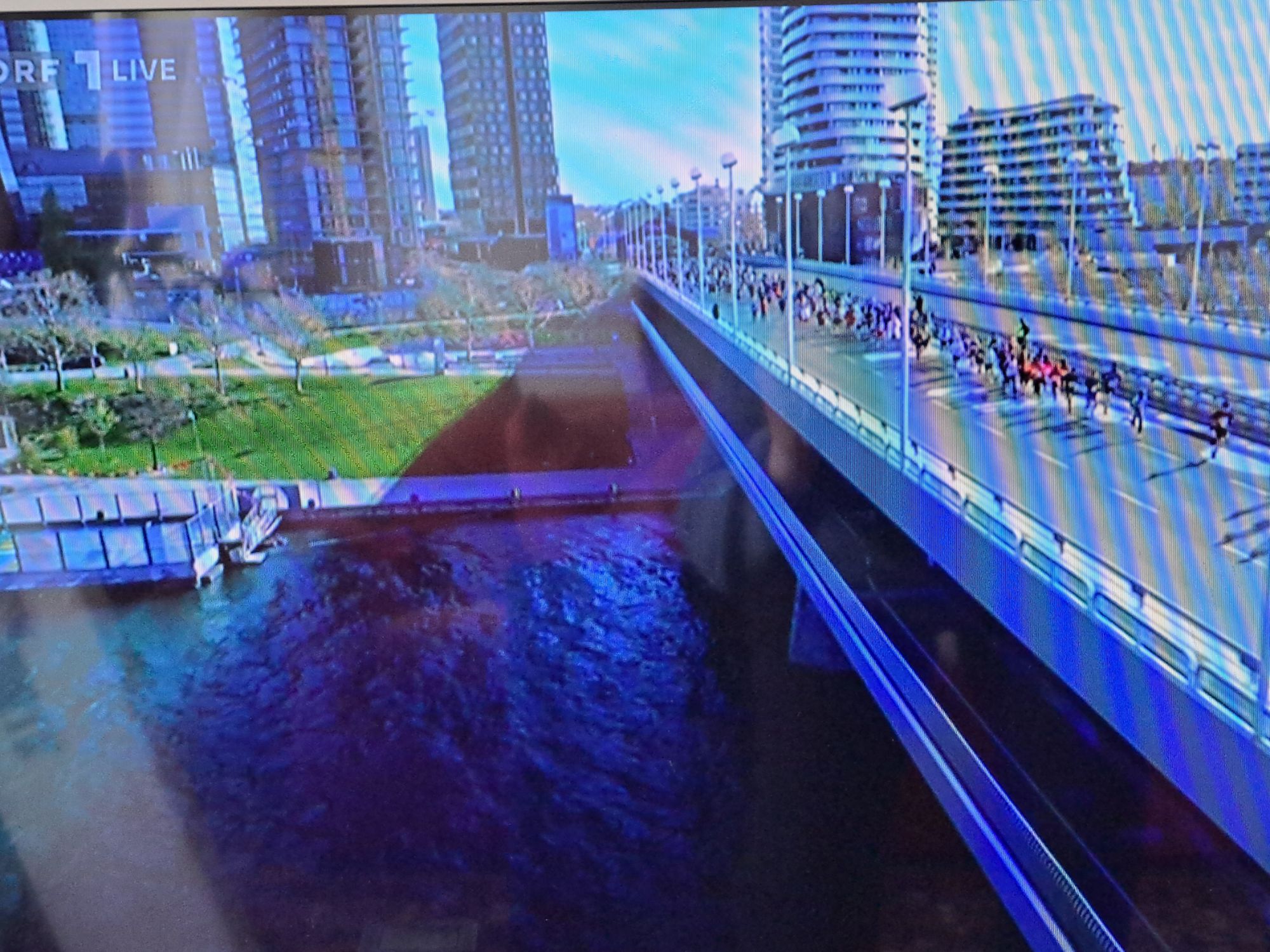
Watching this (from the comfort of my sofa, except for the half hour or so when I go down to cheer on the frontrunners) brought the usual joy of familiar landmarks: the Tegetthoff column at Praterstern, the Urania, Vienna River, Schönbrunn, Votiv Church, Prater again with the Lusthaus, (even the Ernst Happel stadium looked good)  –and, of course, the glories of the Ringstraße (although I do always worry about the runners and the tram tracks).

The many, many campaign posters of the unpleasantly baby-faced Dominic Neff of the FPÖ lining Lassalle Straße were less enjoyable.

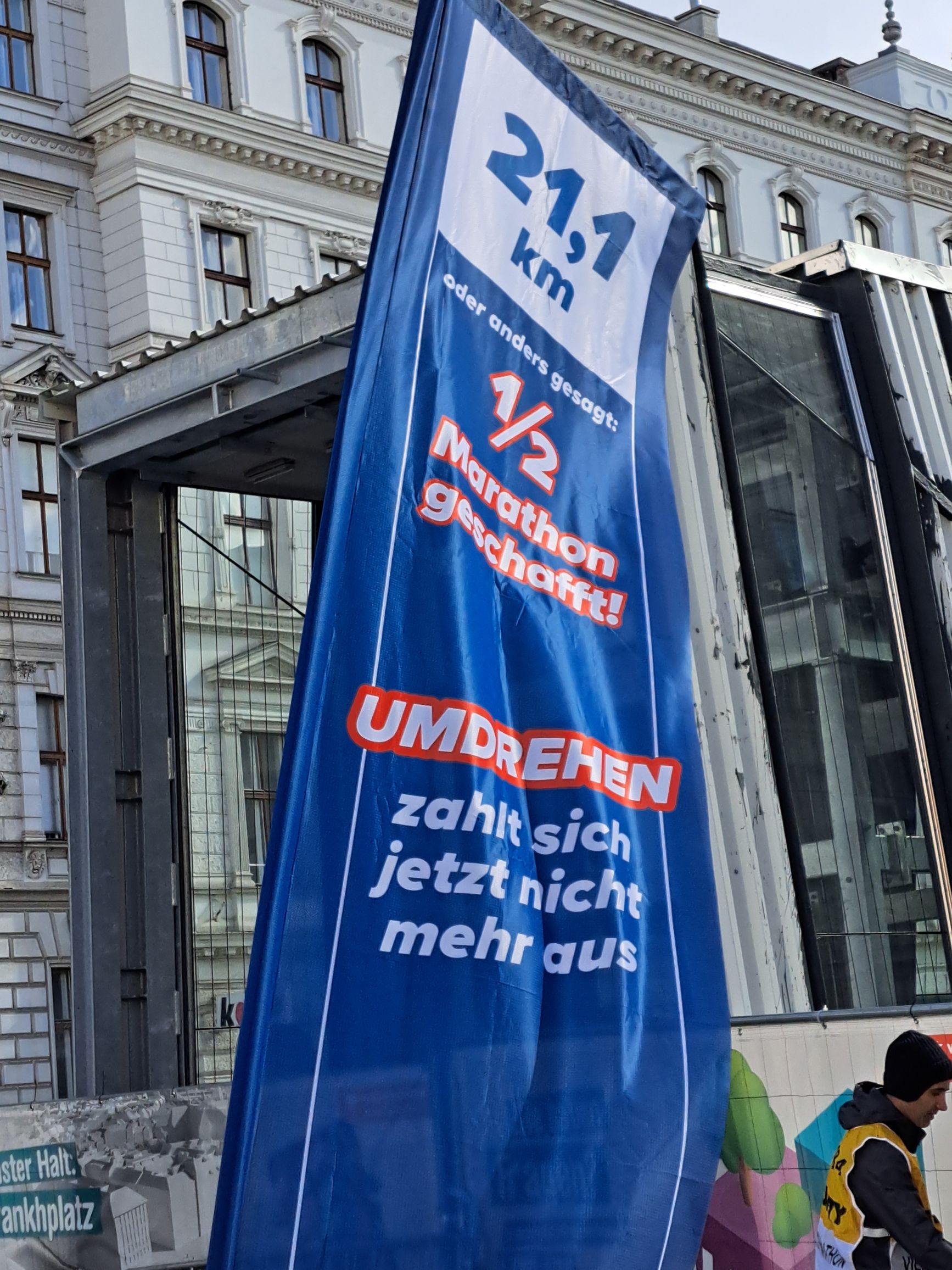
Other kinds of advertising were less disturbing, like the Erste Bank’s #glaubandich (“Believe in yourself”) in huge letters on the asphalt of the Reichs Bridge and the Hervis (sporting goods shop) banner at the halfway mark, telling the runners, who I’m sure had no time to take it in, that it made no sense to turn around now. (Like the old joke of the channel swimmer who got within 50 meters of the other shore and said, “I’m too tired. I can’t,” and turned around to swim back to where she came from.)
Valentin Pfeil, who was the first Austrian and Austrian man to cross the finish line in 2016, had been roped in as a running reporter, wired for sound and expected to comment on how the race was going while he was running it. This seemed kind of brutal to me, but he didn’t seem to mind. At the end, he even said that he experienced “runners’ high” for the first time ever in a marathon and thought that might have been because, knowing that he would be called upon to comment on the race, he wasn’t trying to run 100%. Nonetheless, I found it tactless of his ORF colleagues to ask him a couple of times along the way at which point he knew he was going to make it to the end. He finally deigned to give a clear answer, saying, “I’m passing the Staatsoper now. I think I’ll make it.” (The end is at the Burgtheater, less than a kilometer away.)

Some random points:

  • Vienna is really into recycling, even for the marathon. There were plastic recycling bins (those water bottles!) lining parts of the route.
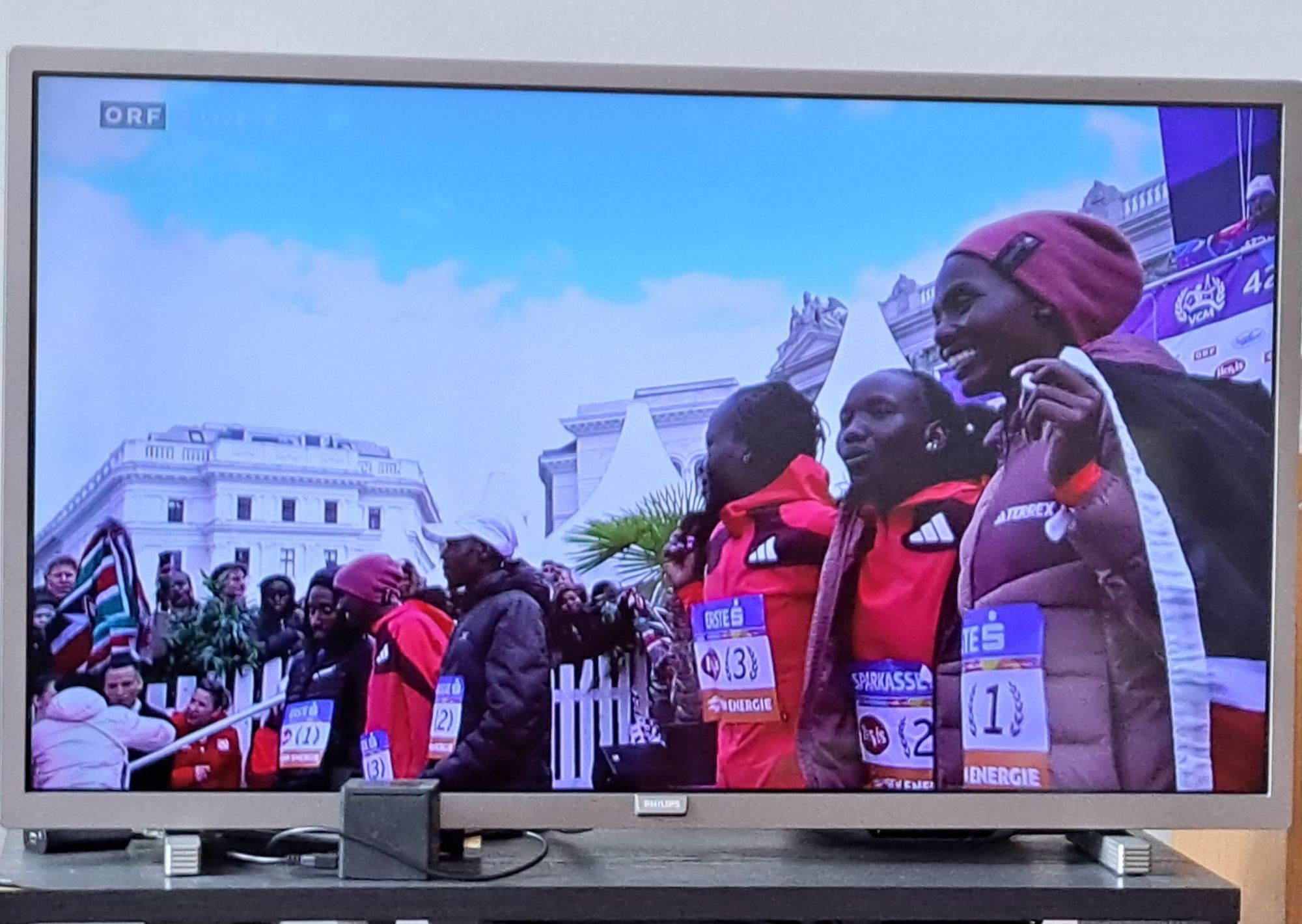
  • The top three women – in order of arrival at the finish line: Betty Chepkemoi, Rebbeca Tanui, and Catherine Cherotich – ran as a group for most of the race, very close together, one had the sense out of solidarity. (They are all Kenyan. Perhaps that made a difference? Or was it really, as one of the commentators suggested, a strategy to minimize the negative effects of the cold and wind?)
  • Two of my favorites from past years, Nancy Kiprop and Vibian Chepkirui, were nowhere to be seen, although reports leading up to the marathon had suggested they, too, would be running.
  • The two winners – Haftamu Abadi from Ethiopia for the men and Betty Chepkemoi (see above) – were basically upsets. I’m not sure even they expected to win. And yet both won by a considerable margin. No tense finishes today. Both crossed the finish line looking incredibly strong with no one else anywhere near them. Coincidentally, they both had the starter number 12 (M12 and F12).
  • Haftamu Abadi pulled a picture out of his pocket just before he crossed the finish line. On the other side of the finish line, he kissed the picture (it seemed to be of Jesus), looked at the sky, crossed himself, kissed the ground, and then took off one of his shoes and kissed that. The Austrian commentators seemed to think this was a reference to his compatriot, Derera Hurisa, who crossed the finish line first in 2021, also in something of an upset and in a blaze of glory, but was disqualified because his shoes did not meet the (brand-new) regulations.
  • On top of that, Haftamu Abadi, who, in spite of the conditions, achieved a personal best time of 2.08:26, is the youngest winner of the VCM in its all 42 years. He’s 21 years and 12 days old in a sport that traditionally, and oddly, favors the older contestants.
  • The first Austrian woman this year, Eva Wutti, is in the legal profession (that generic term “Juristin” was used so I don’t know if she is a full-fledged lawyer or a legal adviser in a company, for example) and didn’t arrive in Vienna until Friday evening because she had to work(!). (She lives in Carinthia.) She also has a daughter, and the ORF reporter predictably asked how she managed to combine family, job, and running. (Equally predictably, none of the men were asked this question.) At the same time, of the four “firsts” she was the only one who had a clear answer to the question “What’s next?” She’s hoping to run the Salzburg marathon in May. (Glutton for punishment, anyone?)
  • The first Austrian man, and therefore first Austrian, across the line was Andreas Vojta, who, it turns out was also the first European. He came in ninth, behind the first and third runners, who are from Ethiopia, and the six Kenyans in-between. I think this kind of result is especially amazing given that he was not able to train in December or January because of an (my dictionaries and online sources failing me I’m translating word for word here) an inflammation of the skin of the heart (Herzhautentzündung) and only started training again in February.
  • Valentin Pfeil, the running reporter, is coaching Johannes Pell, the second Austrian man (and 12th overall) to cross the finish line.

Have I mentioned it was really cold? (See the two winners in their down jackets!)
Curious for more? There are some website suggestions below:

The official Vienna City Marathon site: https://www.vienna-marathon.com/?go=welcome

The ORF (Austrian Broadcasting, in German): https://sport.orf.at/stories/3139958
Wiener Alltagspoeten and the Taylor Swift concert (that didn’t take place)

23 Aug

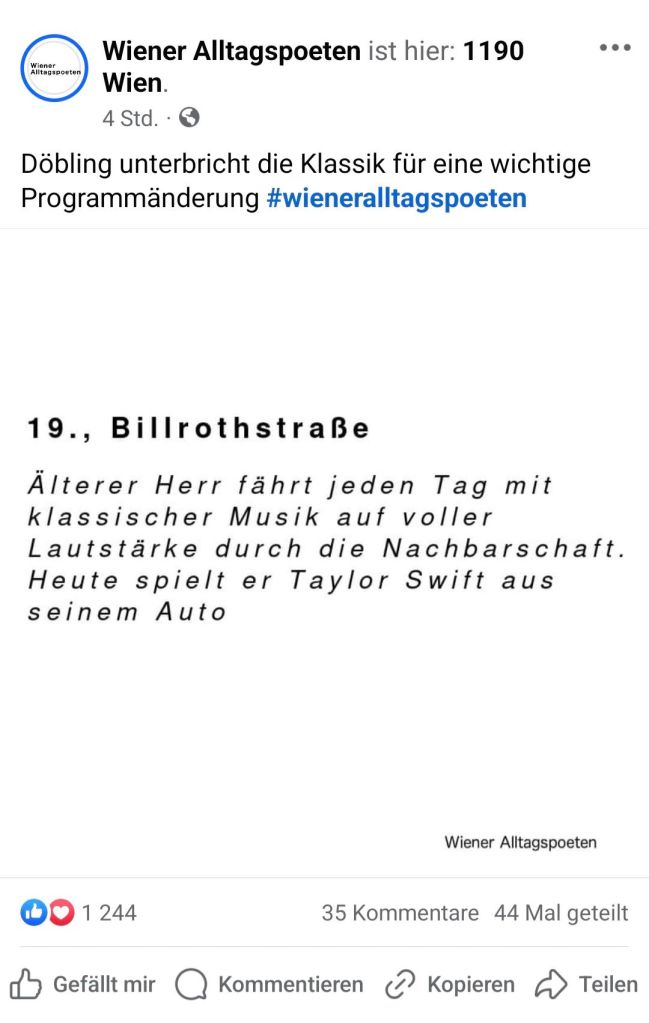
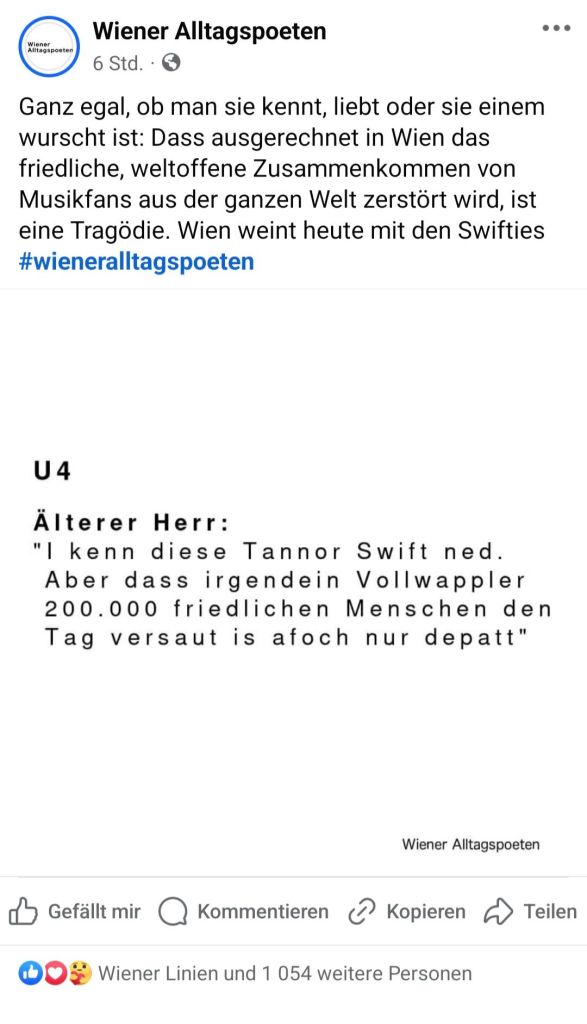
One of my kindest and most faithful readers asked if I had survived the invasion of Swifties. This made me think I should share these posts from the Wiener Alltagspoeten (Vienna’s Everyday Poets).

Wiener Alltagspoeten is a movement, one could almost say, started and run by Andreas Rainer. It comprises a website, Facebook page, and a couple of books. It’s a collection of “seen and heards” from the streets of Vienna.

The two excerpts below come from the Facebook page. In the first one, an older gentleman is saying he doesn’t know who this “Tannor Swift” is, but he finds it utterly ridiculous that some total idiot wants to ruin the day for 200,000 peaceful people. The only thing is that it’s pretty much completely in Viennese dialect (e.g. Vollwappler, versaut, and depatt), which makes it especially memorable.

The second one tells the tale of, again, an older gentleman, this one in the upmarket district, Döbling. He is usually observed driving through his neighborhood playing classical music full volume on his car stereo. After the concert was canceled, he was heard playing Taylor Swift. 😊

VCM 2024 (Vienna City Marathon)

21 Apr

The Vienna City Marathon (VCM) 2024 has come and gone this sunny and cool day, good for running although perhaps a tad too windy. It seemed a bit uneventful this year.

No course records were broken as two were in 2023, when Samwel Mailu of Kenya very clearly broke the men’s course record and Julia Mayer, in a stunning display of tenacity and speed in the homestretch, broke the Austrian women’s course record by one second.

No pacemakers finished the race without their racers as Timon Theuer’s did in 2022, when Theuer fell at the 32-km mark and bowed out of the race. This year, Theuer was entered for the half marathon.

There were no neck-and-neck finishes, as there were in 2022 when Joyce Chepkirui, defending her title from the year before, just managed to maintain her lead and cross the finish line before Ruth Chebitok.

No one collapsed near the finish line and therefore none of the other runners had to dodge an ambulance on their way to the end of the race as Chepkirui had to when she won on 2021.

None of the winners was disqualified for wearing the wrong shoes, as happened to Derera Hurisa of Ethiopia, heartbreakingly, also in 2021.

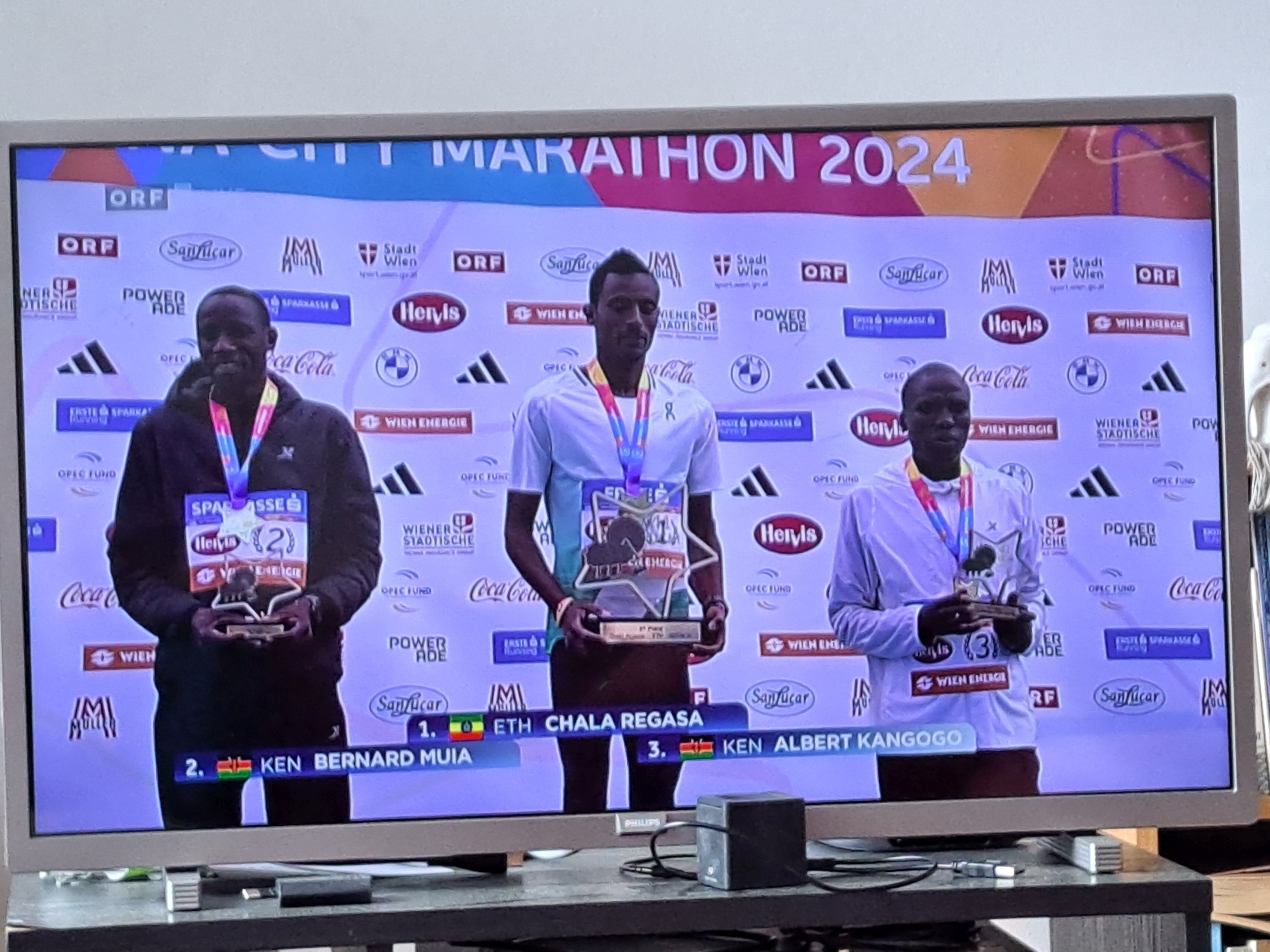
So, beautiful weather and clear wins by the leaders: Chala Regasa (ETH), Bernard Muia (KEN), Albert Kangogo (KEN), Mario Bauernfeind (AUT), Nazret Weldu (ERI), Faith Chepkoech (KEN), Rebbeca Tanui (KEN), and Julia Mayer (AUT).

In fact, coming into the homestretch Chala Regusa was so far ahead of the other men the VCM Twitter feed (I refuse to call it “X” and, in fact, only look at it to stay on top of what is happening in the marathon) had a post: Umdrehen muss er sich nicht, der erste Verfolger ist mehr als zwei Minuten hinter ihm. (He doesn’t have look over his shoulder – the nearest competitor is over two minutes behind him.)

In terms of diversity, just two interesting points from the interviews after the race. When Mario Bauernfeind, first Austrian man and on the police force in Vienna, was asked where he would go from here, he said he would have to go home, talk to the people close to him, and figure it out, that his children were getting older and needed more of his time. And Julia Mayer, first Austrian woman, mentioned that she had her period and so was really proud of her body for doing such a good job. To his credit, the ORF interviewer didn’t blink and later said something about how good that she felt free to mention that openly.

Once again, the Kenyan fans were out in force and showed great joy even though the first places were occupied by an Ethiopian (first time for the men since 2015) and an Eritrean (first time for the women ever, if I understood correctly).

Street Life in Vienna (a series of postcards)

8 Aug

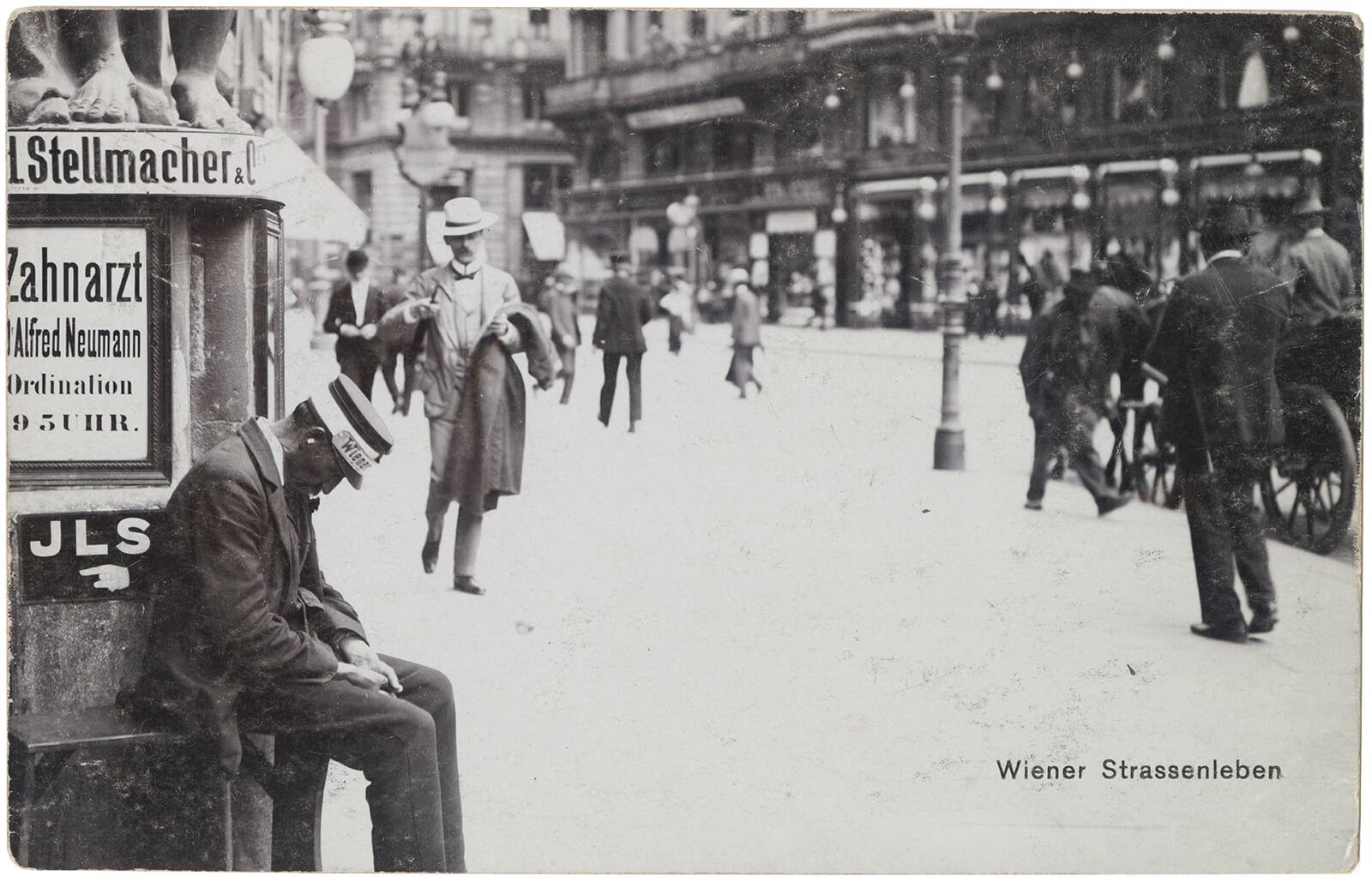
I think it was on the ORF (Austrian Broadcasting Corporation) site that I first saw a mention of a series of postcards showing everyday life on the streets of Vienna in 1905 / 1906. It is part of an exhibition at the Wien Museum (in one of their temporary quarters on Felderstraße) about postcards in general of Vienna.

What is special about this particular series? Postcards, of course, usually show us the important sights of a city — the Eiffel Tower in Paris, the Tower Bridge in London, Kiyomizu Temple in Kyoto, and Stephansdom in Vienna, to name a very few. The black-and-white postcards in the series referred to are in the form of snapshots and show people, often engaged in manual labor, going about their everday business. As the article (link below) from the Wien Museum’s magazine tells us the subjects of the photos are people who are offering their wares or services (for example as porters) on the streets and in the squares of the city, are driving vehicles or pulling carts or riding on public transportation or bikes, taking care of horses, cleaning up messes, working in public gardens, cleaning lanterns, working on building sites, maintaining tram tracks, strolling, striding, standing, cowering, sitting, sleeping, getting into mischief — and taking photographs. (my translation of part of the article) They give a real, one could say unvarnished, sense of life in Vienna at that time, which is precious to me.

I’ll want to be sure to make it to the exhibition “Grossstadt im Kleinformat” (“Big City / Small Format”), on until 24 September 2023.

The article from the Wien Museum specifically on this series (in German and showing some of the images): https://magazin.wienmuseum.at/fotopostkarten-wiener-strassenleben

VCM 2020

19 Apr

The Vienna City Marathon (VCM) 2020 has, of course, been canceled. It would have been held today, and the weather would have been good for it–not too hot or sunny and not much wind.

A few years ago I started writing the VCM date in my calendar so that I could set aside time to watch it undisturbed. This was after a number of years of having it on the TV in the background but not planning to really watch it. At some point I had to accept that it was oddly absorbing and enjoyable to watch people run for hours and that there was no point in trying to get anything else done while the VCM was on.

I still watch on TV but there is a point at which the runners pass about 10 minutes from my flat so I have taken to walking down there and cheering on the front runners: first man, first Austrian man, first woman, first Austrian woman. (I have never gotten the sense that they took in that we were there cheering, but I like to cheer them on nonetheless.)

There is a hole in my calendar this year where the VCM would have been. I’ll especially miss seeing Valentin Pfeil, a gifted and personable Austrian marathoner, and Nancy Kiprop, the Kenyan teacher who runs to earn funds for her school and has been the winner among the women three years in a row. I’ll miss the shots of this beautiful city I live in, the streets cleared of cars but lined with fans. I’ll miss the people who run it with a sense of fun, dressed up in silly costumes and not looking at the clock. I’ll miss the ORF commentary. And I’ll miss the stories of the runners and how they came to be in the VCM.

This, too, is a part of Vienna in the times of coronavirus.

NYTimes: Gowns, Wurst and Protesters: It’s Ball Season in Vienna

9 Feb

We made the New York Times! (Doesn’t happen all that often.)

Gowns, Wurst and Protesters: It’s Ball Season in Vienna https://nyti.ms/2GL8Fkl

In Düsseldorf

19 Jan

Am waiting to board the last plane to Vienna this evening and am interested in the information about Vienna they are showing on a screen–that there are more people buried in the main cemetery (2.5 m) than live in the city (1.8 m) and that there are over 300 balls a year. Fun to have another perspective!

And news from another prominent Viennese hotel

14 Sep

Just a quick note: the Hotel Bristol will be hosting Afternoon Tea with Opera Stars (and, yes, that they’re calling “Afternoon Tea” not “Nachmittagstee”). To celebrate various premieres they are offering a traditional (English, I suppose) afternoon tea with Sekt (or sparkling wine) and a chance to meet (see?) the singers, conductors, and stage directors of the current premiere at the State Opera just across the street.

It costs EUR 49 per person and can be booked by calling +43-1-515 16 555 or by writing to groupsevents.bristol[at]luxurycollection.com. The one of the first opera stars at this Salon Operá is Michael Schade, appearing on 26 September 2014.

Eurovision song contest 2014

10 May

From today’s International New York Times (the new incarnation of the International Herald Tribune): “Over the years, Eurovision has reflected Europe’s social and political changes, and this one is no exception. Along with the requisite scantily clad women and hunky men, an Austrian transgender singer, Conchita Wurst, advanced to this year’s finals, to the consternation of Eastern European social conservatives who have called Eurovision the epitome of the morally corrupt West.” There was a photo of Conchita on the front page of the print edition of the International New York Times . Fame indeed! The Austrian media I have seen seem to be simply pleased that Conchita made it to the finals, is representing Austria, and has a chance of winning, so don’t seem to share the opinion of the stated “Eastern European social conservatives”.

One point to clarify, though, I’m not sure that Conchita Wurst is transgender, as reported in the article. My source for that statement is German Wikipedia, so I don’t know how reliable or up-to-date the entry is, but there it is stated that Conchita Wurst is the stage name of Thomas Neuwirth, a cross dresser. Apparently as a homosexual from a small town in the province of Styria, he suffered a lot of discrimination and created the figure of Conchita Wurst to make a statement against discrimination of what is different. The first name was given to him as a nickname by a Cuban friend of his. The last name “Wurst” comes from the expression in German “Das ist wurst”–in other words “that doesn’t matter”. He wanted to express with it that it doesn’t matter where one comes from or what one looks like.

The whole INYT article can be found at: http://www.nytimes.com/2014/05/10/arts/television/eurovision-splashes-into-2014-finals-to-rapt-audiences.html?hp&_r=0

Marathon

13 Apr

Good weather for the marathon today, dry but not too hot.