Archive | Austria and the Austrians RSS feed for this section

Fasching (or Carnival)

11 Nov

I was talking over the weekend with a friend who was visiting from London and mentioned that Carnival (Fasching) starts on November 11th. I’ve so internalized this, still remember having a member of the seminar hotel waitstaff bring a bottle of bubbly into the seminar room in the middle of a session, that I was surprised that he was surprised that this should be the case. I decided to explore.

After a quick search and skimming articles, I see that often Carnival really doesn’t start until Shrovetide starts, although there is a bit of disagreement as to when that is. (Some sites say Shrove Saturday, or the Saturday before Ash Wednesday, and some say Shrove Sunday — three days before Ash Wednesday.)

Fasching, however, is a different story. According to the website feiertage-osterreich (or Austrian holidays), Fasching does really start on November 11th at 11:11 a.m. Legend has it that on November 11th, the fools are woken up. The partying isn’t supposed to start until January 7th — the day after Three Kings — but time is needed for the preparations. It’s interesting to know that on November 11th the Head Fool (Obernarr) traditionally was given the key to the city and took over the government. (Some would argue that the Head Fool rarely leaves!)

Apparently this tradition comes from the Rhineland and didn’t make it to Austria until the middle of the 20th century. It certainly has become embedded (see hotel story above) since then, possibly because it aligns with St. Martin’s Day, which has long been a part of Austrian culture!

For German speakers, there are a few more details here: https://www.feiertage-oesterreich.at/festtage/faschingsbeginn/

Good job, Austrian Airlines!

15 Jun

I’m sitting at the airport in Vienna waiting for a flight and am actually enjoying the commercial for Austrian Airlines that keeps flashing across the screen.

It’s informing us that Austrian is the official airline of the Austrian national football / soccer team and shows members of the men’s national team kicking a soccer ball around a hangar and a pilot joining in. Then a red shoe, a pump, stops the ball. The camera pans up to show the owner of the shoe — a middle-aged(!) female flight attendant — who winks at the men and then kicks the ball through the open door of a plane. Tor! High fives all around.

For me, this is typical of state-owned (or, more accurately, formerly state-owned) companies in Austria. Diversity, yes, but with a light touch. Which is a good way to get past people’s defenses.

In any case, as a middle-aged woman who played soccer competitively for her school for six years, it was really enjoyable.

May Day 2025

1 May

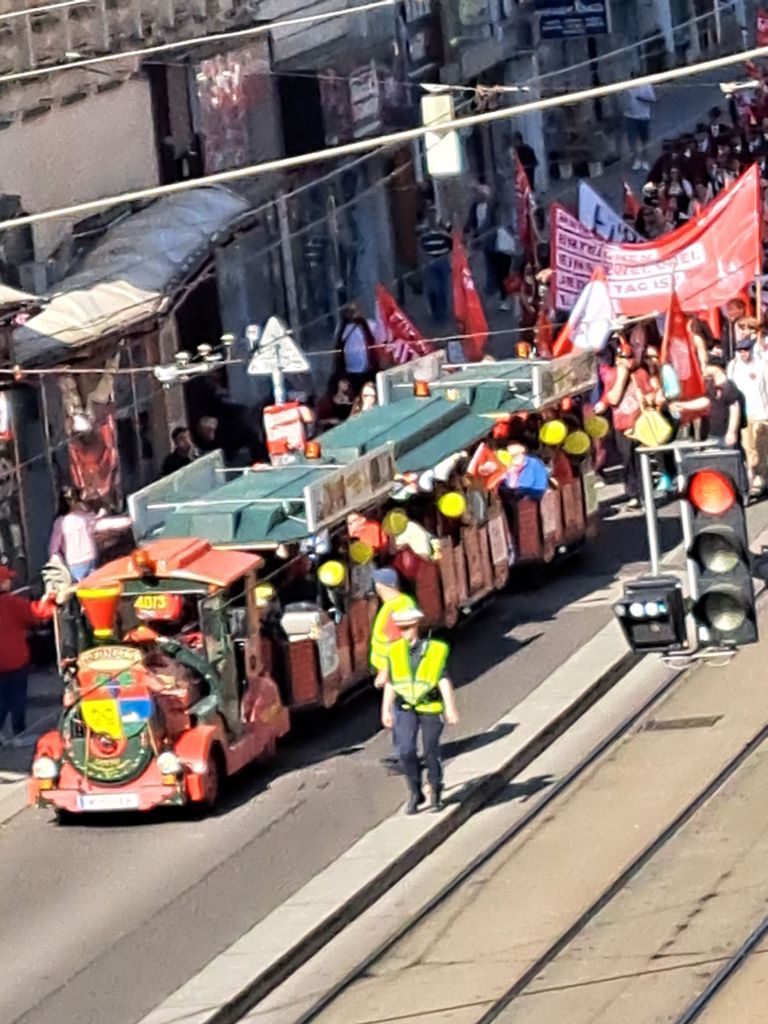
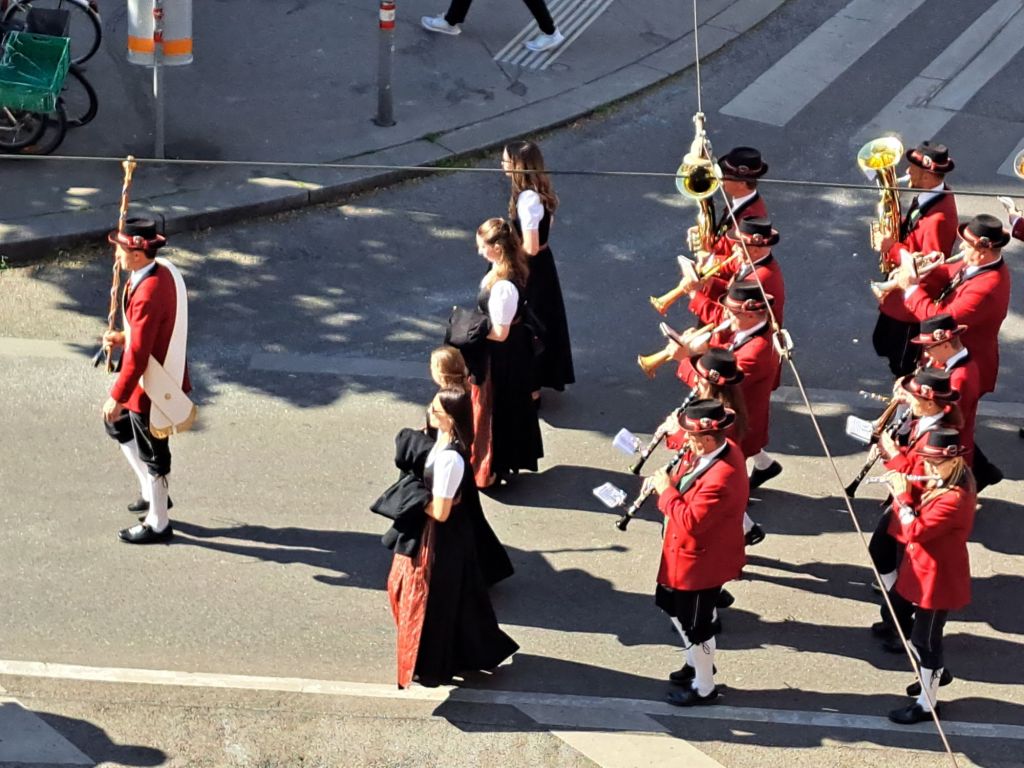
And the SPÖ (Social Democrats) are marching again. This year, the parade looks a little bigger than the past few years, perhaps because of their solid results in the elections last Sunday. Beautiful weather and a well-trained brass band are part of the tradition.

Not surprisingly, one of the banners called for solidarity. This took me back to an exercise I used to do with my U.S. American summer school students in Vienna.

To highlight one of the major differences in worldview that I see between the USA and Europe, I would ask my students for their associations with the word “solidarity.” This question was almost invariably met with confusion. What associations should they have with that word? Then I would give them examples of what my Austrian students of the same age would answer: Lech Walesa, of course, sticking together, and taking care of each other. Some Austrian students would even get into the political aspects and how solidarity is built into the systems here. I see the common use of and familiarity with the word “solidarity” as a cultural artifact for the more collectivist system here.

My little intercultural comment for today. 😉

WorldSkills 2024 – Suddenly World Champion

21 Sep

Mastery. Part of flourishing, according to the  positive psychology field. (PERMA for Positive Emotions, Engagement, Positive Relationships, Meaning, and Achievement or mastery)

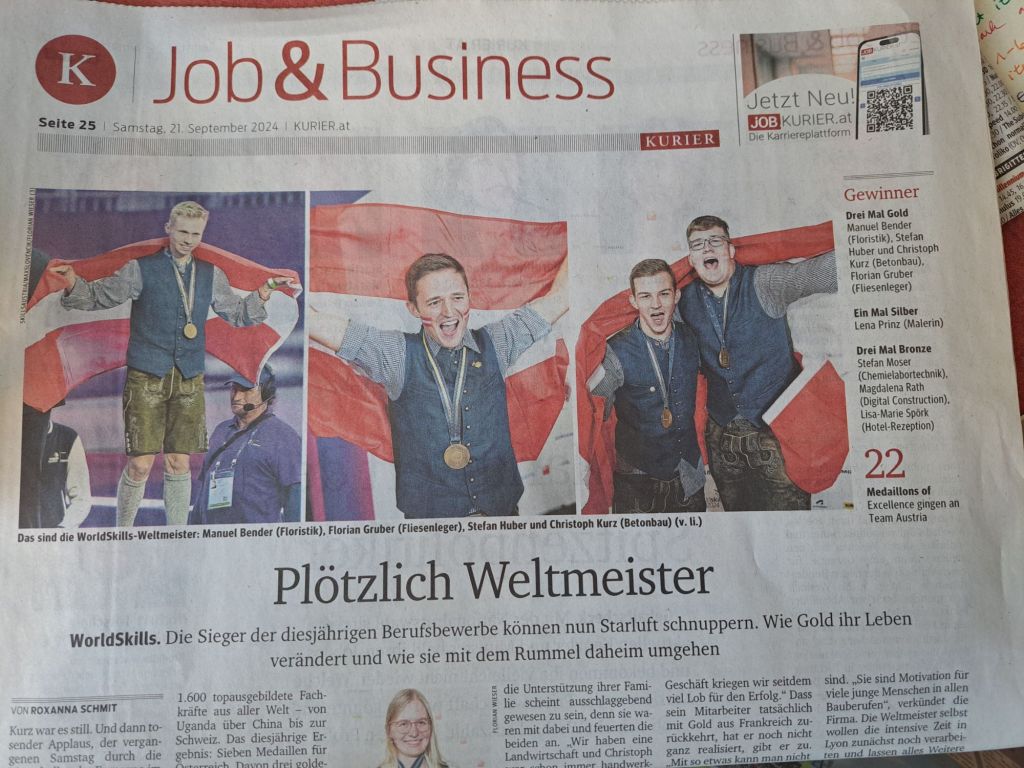
I love the fact that there is a worldwide competition for the trades. Austria’s gold medalists this year won for flower arranging, tile laying, and work with concrete. The silver medal for painting (e.g., doors) went to a young Austrian woman.

Why am I drawn to writing about this every year? Because I think athletes get too big a share of the glory. Being uniquely good at flower arranging – or building with concrete – is also a wonderful thing and needs to be celebrated more. (I love the Scripps National Spelling Bee, too, for providing celebration of another non-athletic achievement, not to mention often offering an alternative route to a better life for children from disadvantaged backgrounds.)

Additionally, I love seeing young people getting satisfaction out of working with their hands. I may teach at a university (and love academic work myself), but I think far too many students are pushed into it for the prestige. I feel we would all be better off if everyone were encouraged to find what they’re really interested in and were then supported in achieving mastery of it.

Anyway, congratulations to all the competitors at the WorldSkills competition! As the mother of one them said, “In our eyes, they have all already won. To make it to the world championships is such an unbelievable success.”

A typically Austrian story

16 May

I just heard from a colleague who is currently in Vienna with a group of U.S. American students that two of his group were walking around yesterday and ended up chatting with the Austrian president, Alexander van der Bellen.  They even got a selfie with him! (With or without his shelter dog I don’t know. )

The ORF on normality

21 Jul

Below is a link to a very interesting (and rather worrying) ORF article about the word “normal”. Recently, the governor of Lower Austria, Johanna Mikl-Leitner, used the phrase “people who think normally” (“normal denkende Menschen”) repeatedly in an interview in the newspaper the “Standard”. She is a member of the conservative People’s Party (ÖVP) and, the ORF tells us, was only following the party line, which has also been embraced, as you might expect, by the right-wing, nationalistic Freedom Party (FPÖ).

The Vice-Chancellor, Werner Kogler, of the Green Party (“die Grünen”), as might be expected, sharply criticized that use of the word and called the “normal” rhetoric “prefascist” (“präfaschistoid”) in an interview in the news magazine “Profil”.

In my opinion, Kogler has some justification for doing so. The problem is, of course, who gets to decide what “normal” is — and then what happens to those who are considered “not normal”. In a country that has a not-so-distant history of labeling anyone who criticized the government “asocial” (“asozial”) and sending them, often, to concentration camps sometimes to be murdered, it does feel as if we are on a slippery slope. (link to recent ORF article on this below)

I accept that there is bound to be (always has been?) backlash and that as diversity, inclusion, and belonging initiatives make headway (I’m not so sure “equity” plays a big role in the discussion in Austria at the moment) there will be pushback against people who want inclusive language (one of Mickl-Leitner’s hobby horses) or reject schnitzel or cars as central to their lives (Chancellor Nehammer’s [ÖVP] examples). I also think we need to tread very carefully and always remember where this kind of language has led in the past and could still lead in the present and future.

What is, after all, normal?

https://orf.at/stories/3324510/ (in German, on “normal denkende Menschen”)

https://topos.orf.at/Vergessene-NS-Opfer100 (in German, on “asoziale”)

The Pandemic in Austria

26 Mar

I’ve been recording the numbers more or less daily for three(!) years and have decided to stop. For that, I did want to do a quick review.

On 26 March 2020, 35,995 tests had been done. (A lot, I think, given that the pandemic made it into our consciousness only about two weeks before that.) As of yesterday, 207,503,628 had been carried out, an unimaginably big number. At the height of the testing campaign, there were a few days when over 500,000 tests were done per day. The daily rate is currently around 25,000. (Out of gratitude for them, I try not to think too clearly about what the testing and vaccination campaigns have done to the environment.)

The early statistics included only four numbers: tests, confirmed cases, deaths, and recoveries. We now get eight numbers: the seven-day average (as of yesterday: 246.9 compared to over 1,100 at its peak), tests (see above), positive tests (a cumulative number: 6,021,769), active cases (currently 37,912), people hospitalized (1,044), people in intensive care (in addition to those hospitalized: 55), fatalities (22,082), and recoveries (5,961,775).

For a while, I was also keeping track every few days of the vaccination rates, but these have hardly changed in the last few months so it hasn’t been very interesting. (In fact, it started to get a bit discouraging.) My last recorded figures tell me that 71.8% of the population have gotten two doses; 56.2% have gotten three; and only 18.7% percent have been “aufgefrischt”, which is defined as having gotten 4 or more.

Not only have the numbers changed. The terminology has, too. “Bestätigte Fälle” (confirmed cases) became at some point “In Labor bestätigte Fälle” presumably to distinguish those results from the ones we get from self tests, of which we still get five per month for free on our health insurance. “Todesfälle” has become “Verstorbene,” which sounds a bit more tender. And “Auskuriert” has become “Genesene” (recovered). I’d love to know the reasons for the changes, but I don’t.

Coronavirus is still with us, but we are getting back to life without masks and such frequent testing. Spring seems the perfect season to live a bit more again, a bit like coming out of hibernation.

Should you be interested in where I got the numbers: https://orf.at/corona/daten/oesterreich

Wishing all a beautiful Sunday and great health!

NYTimes: Robert Clary, Who Took a Tragic Journey to ‘Hogan’s Heroes,’ Dies at 96

20 Nov

Robert Clary, Who Took a Tragic Journey to ‘Hogan’s Heroes,’ Dies at 96 https://nyti.ms/3GwlErL

My brother and I used to sneak “Hogan’s Heroes” because (a) we were limited in how much TV we were allowed to watch and (b) my mother, having grown up in Nazi Germany, objected to making light in any way of what happened. Would she feel differently if she knew that one actor was a concentration camp survivor and three were refugees? Perhaps. Or perhaps the reminders of those years would all still be too painful.

Three refugees, you ask? Robert Clary’s obituary only mentions Wilhelm Klemperer and John Banner. They left out Leon Askin, who played General Burkhalter. He was born Leon Aschkenasy in Vienna and lost both his parents in Treblinka. Ever since I learned that, years ago, I’ve thought how therapeutic it must have been to play the bad-tempered and quite repulsive General.

A particularly Austrian solution

20 Dec

Seems a particularly Austrian solution to me. It is against the law for descendants of aristocratic families to use their titles and has been since 1918. The maximum penalty? 14 cents. 🙂

Georg Kapsch: The departing head of the Federation of Austrian Industries

13 Jun

This is something that really struck me when I moved to Austria – how the relationship between management and labor was more collaborative than in the U.S.A. There was a sense that Austria as a whole could only do well if everyone was doing all right, that economic success could not happen on the backs of one group.

In this interview, it becomes clear that Georg Kapsch is of the old school. A departing president of the body representing (big) business talking about how to close the gap between rich and poor and how to make sure everyone gets the education they need to be a contributing member of society? Seems pretty radical these days. I hope his successor is on the same page!

A link to the interview is below. Unfortunately, you do have to subscribe to the digital edition to read the whole thing.

https://kurier.at/wirtschaft/georg-kapsch-diese-sommerschule-ist-zu-wenig/400938857