The info screen on the tram is telling me that the Wiener Staatsoper reopened on this day in 1955. It was bombed in the final days of World War II. The auditorium and backstage area were completely destroyed. The Viennese are said to have wept openly in the streets as they watched it burn.
The opera chosen for the opening of the rebuilt house was “Fidelio” by Ludwig van Beerhoven, a story about unlawful imprisonment, courage, and justice.
I’ve always known that ice cream parlors in Vienna officially close sometime in September or October and re-open in March. I didn’t realize until now that it’s the Chamber of Commerce that chooses the dates. (I always thought the ice cream sellers simply agreed on that.)
I knew something was up when I was in the First District yesterday and saw lots of people, still in their winter coats, leaning in to large ice cream cones before lunch. And I have to say I love that about the Viennese. In the meantime, you can get “Saloneis” — as opposed to “Supermarkteis” — any time of the year, but there is still a noticeably large number of people who celebrate the First Day of Ice Cream, even if the weather is distinctly March-like, with quite a cutting wind.
The added attraction this year is that the ice cream artisans are among those contributing to the celebrations for the 200th anniversary of Johann Strauss’s birth. (The son, not the father, and therefore the composer of the “Blue Danube Waltz” and not, for example, the “Danube Songs”.) Apparently, there is already a Fledermaus flavor (I have to try that one!) and a “Night in Venice” flavor that was inspired by tiramisu.
I’m glad he made it into the NYT. He was an extraordinary artist. I had the great pleasure of experiencing him as Frosch, the prison guard, in Johann Strauss’s “Die Fledermaus” on New Year’s Eve 1988 at the Staatsoper.
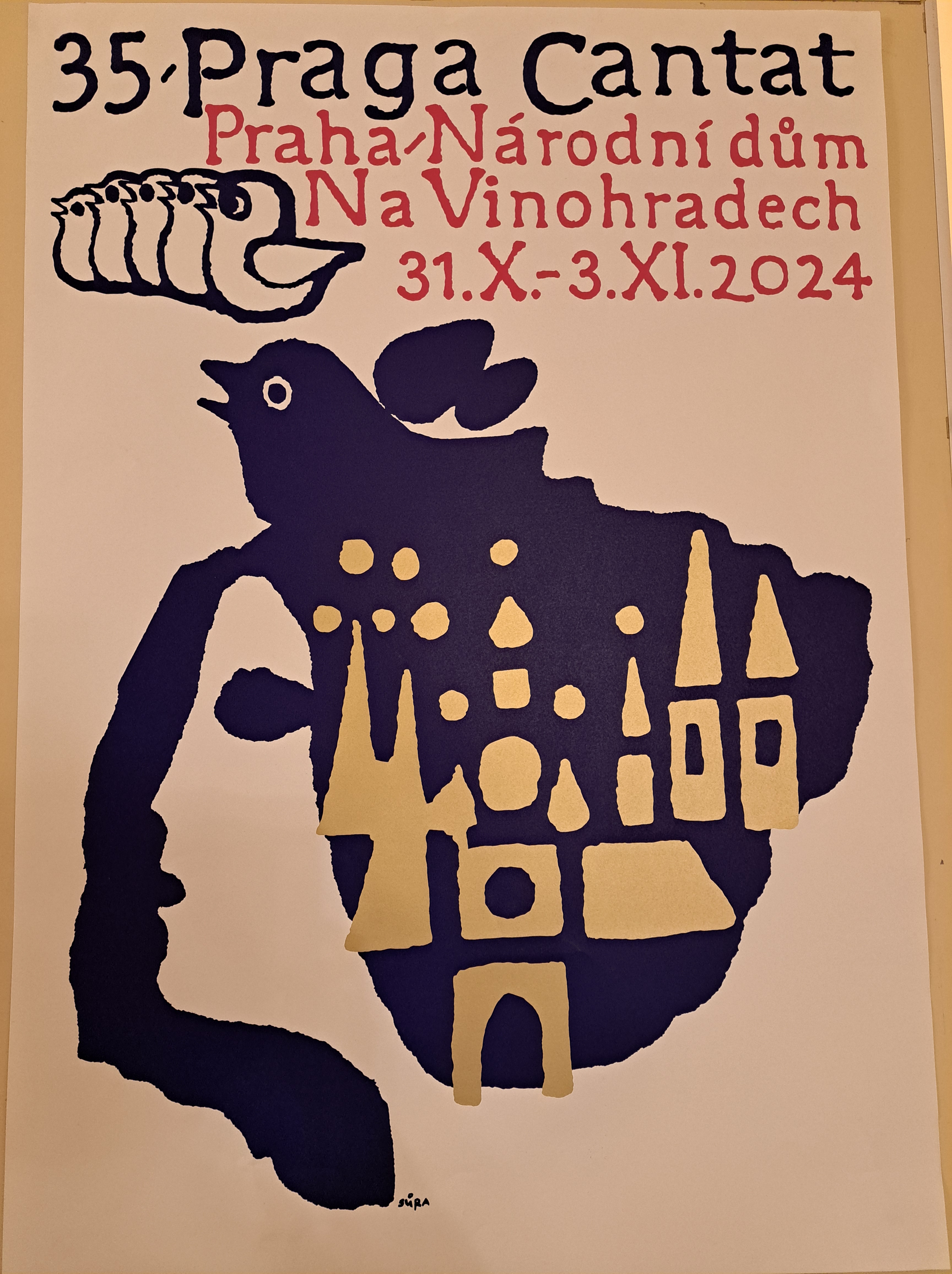
I went to Prague this weekend to see a friend I hadn’t seen in over 20 years (often the price of this international life I lead). His choral group was participating in the 35th Praga Cantat choir competition and festival, and the four hours by train to Prague seemed much more manageable than the however many hours it would take me to visit him in Cancún, where he has lived since he left Vienna.
Perhaps I should mention that I hadn’t been to Prague in over 15 years and wouldn’t have minded never going again. My memory was of grim, unhelpful people and taxi drivers who rip you off ruthlessly. (This was not just my impression. The reputation of the Prague taxi drivers got so bad that the mayor disguised himself as an Italian tourist and found himself paying over five times as much as usual. See the New York Times piece on the story: https://archive.nytimes.com/intransit.blogs.nytimes.com/2009/09/08/hailing-taxi-tips-in-prague/ ) This complaint makes me sound like a spoiled brat who takes taxis all the time. The truth is that I rarely take taxis unless I am very late or have a lot of luggage or have another pressing reason. For some reason, my then partner and I took taxis three times in a several-day visit to Prague and got ripped off a different way each time. (Points, at least, for ingenuity.)
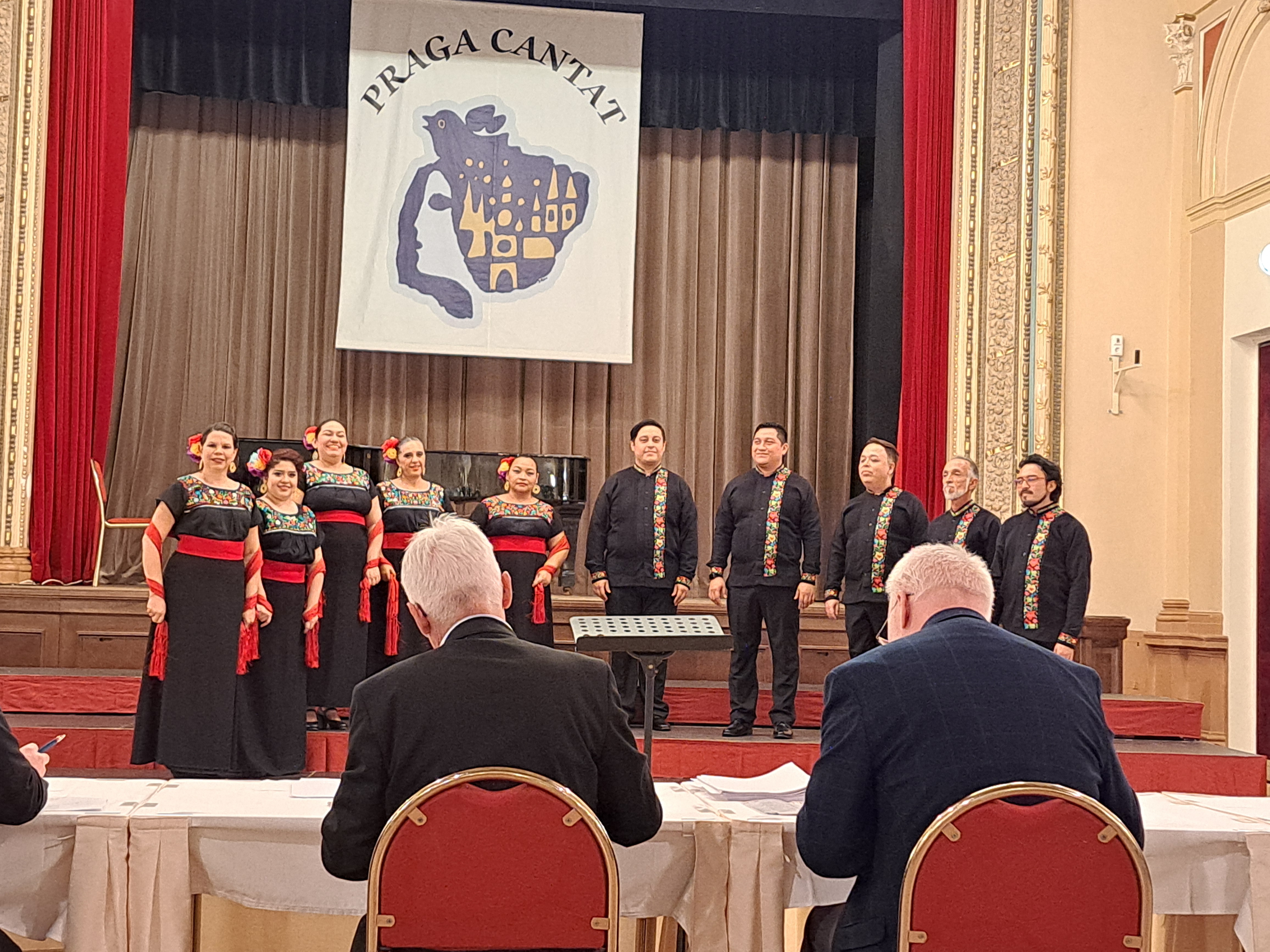
In any case, I went to Prague to see my friend Chris and cheer on his small, a cappella singing group from Cancún (Coro Municipal de Cancún). And now I need to re-write my experiences of the Czech capital. Perhaps it helped that the weather was good, but then I don’t remember it being so bad when I was there before. Perhaps it was limiting my stay to the pretty and quiet residential Vinohrady district or trailing about with a group of singers from Mexico who were loving their time in Europe and glowing from the fact that they had, a mere 14 months after their forming, just won two gold medals in their first ever choir competition in Madrid. Or perhaps it really was that it was a completely different experience with the people.
Taking no chances, I asked the hotel to book a transfer from the train station for me so that I would arrive in time to hear the preliminary rounds of the competition. The driver was prompt, friendly, and asked only the agreed upon price. The receptionist at the hotel, Martina, was exceptionally friendly, not only helpful but taking real pleasure in having a singing group in the hotel. (She even called Saturday morning, her day off, to find out how they had done in the preliminary rounds.) And the competition / festival staff were warmly welcoming and very helpful.
It was my first choir competition so I have nothing to compare it to, but I have to say it seemed more of a festival than a competition. Not that the singing wasn’t good – it was, partly extremely good. It was the atmosphere. There were no tickets to buy. You were let in for free and could enjoy as much of the competition as you wanted. The very competitors themselves didn’t seem very cutthroat but mainly seemed to be focused on enjoying themselves and doing as good a job as they could. The applause for the groups that made it to the next round was loud and hearty. An encouraging experience.
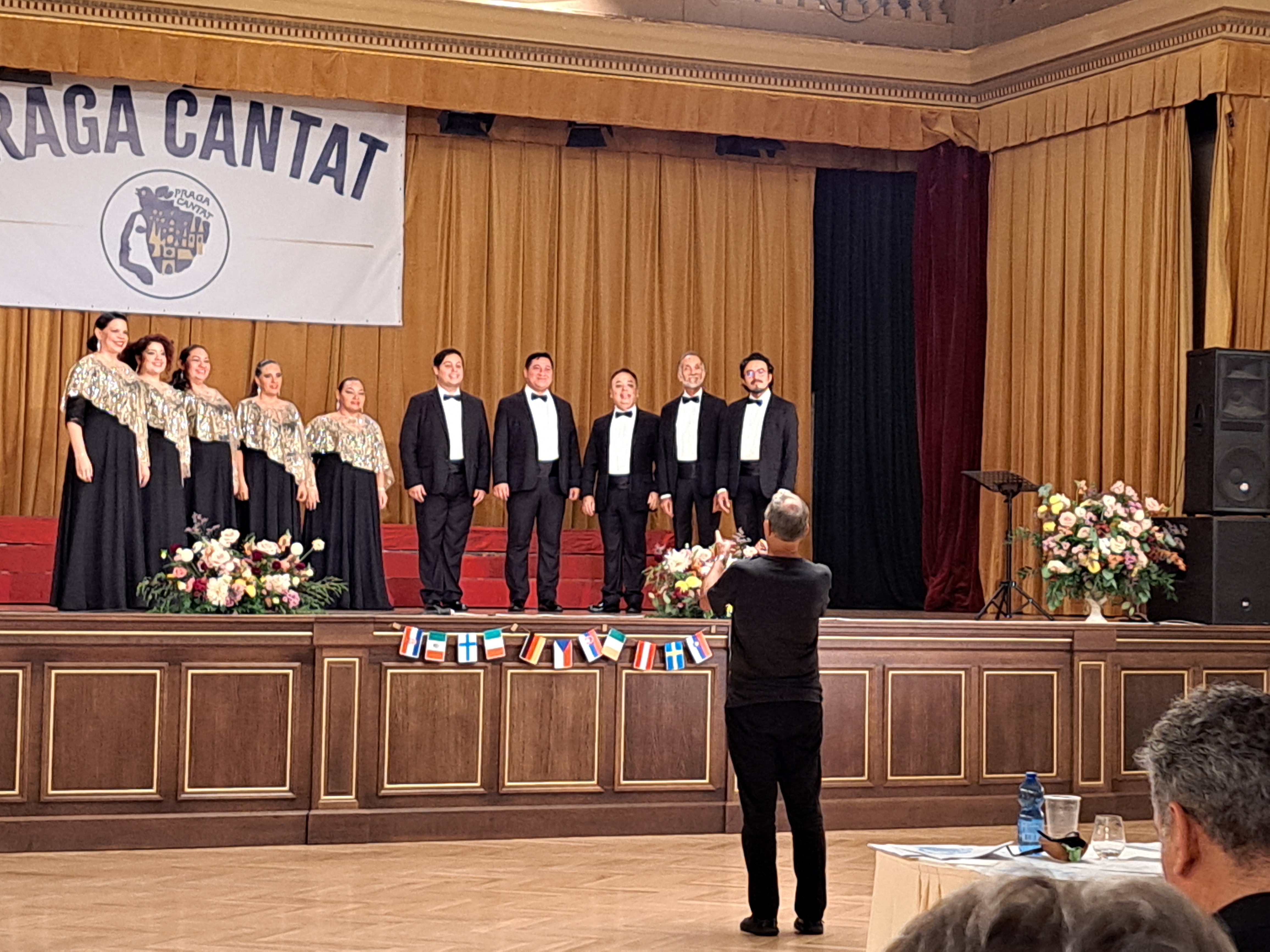
I’m not entirely clear on the structure, if I’m honest. I do know that Chris’s group was entered in two categories: folkloric and mixed choir (i.e., men and women). At the end of the first day, Friday, the best groups, regardless of category, were chosen to go through to the finals, which were held at 2 p.m. the following day. The Coro was one of six groups that advanced to the finals. 😊
The folkloric categoryThe mixed choir category (the man with his back to us was the tireless and tirelessly good-humored festival photographer)
This point was announced after 9 p.m. on Friday evening, and by the time we got underway in search of some supper we couldn’t find a place that would feed us. (We were a group of 17 people showing up as the kitchens were closing.) We made one last effort and asked at Vinohradský Parlament. Their kitchen was just closing, but they took pity on us and just asked that we be ready to order in 10 minutes, which, okay, with no one in the group who spoke Czech and not many who spoke English well enough to understand the menu, was more rushed that you might think but worked out. The food was a big hit as was – we’re talking Czech Republic here – the beer, and we all made it back to the hotel sated and happy.
The following morning, I had to grade some papers and the choir had to practice so we all met up again shortly before two o’clock and went over to the venue. What a crowd there was! I was happy for the organizers of the event because they really did such a good job and made the whole thing so welcoming. Each of the six groups that had made it into the finals sang two pieces. As I listened, I had that torn feeling many of my readers will recognize – there were two Austrian choirs I wanted to support and, of course, the Coro. The others were no slouches either – the youth choir from Sweden was especially impressive and, in fact, in the end, (spoiler alert) won the Grand Prix – so we left the sing-off with no clear idea of who might be the winners.
Then the closing ceremony with the awarding of the prizes. As far as I could tell, every participating group got something. For each category, bronze, silver, and gold medals were awarded, sometimes with more than one group getting a medal – you can see what I meant about it being more a festival than a competition – and then a winner of that category was chosen. On top of that, special prizes were awarded, one, for example, for the best overall conductor. (This went to an Austrian.)
The other thing that made it more of a festival than a competition was a ritual I found moving. There were three categories where the choirs were given a mandatory piece to learn. When the prizes had been awarded in those categories, all choirs in the category were asked to come up and sing the required piece together – conducted, I think, by the conductor whose group had won. For the Coro, this meant that their conductor, a native Spanish speaker originally from Venezuela, ended up conducting the Dvorak piece – in Czech in the capital of the Czech Republic – that was the required piece for the mixed choruses. (He was already completely overwhelmed because of the two special prizes that went to the Coro one was for the interpretation of that Dvorak piece!)
All in all, the newly formed group from Cancún won gold medals in each of their two categories, two special prizes (the other for vocal culture), and one trophy for the mixed choir category. You can imagine they were over the moon. Perhaps still are.
The awarding of the prizes was followed, as was to be expected, by a (rowdy) party. I didn’t stay to the end, which was officially announced for 11 p.m. I heard at breakfast this morning that, after the hired band finished playing, the choirs started singing again, standing in an enormous circle in the beautiful concert hall and taking turns singing favorites.
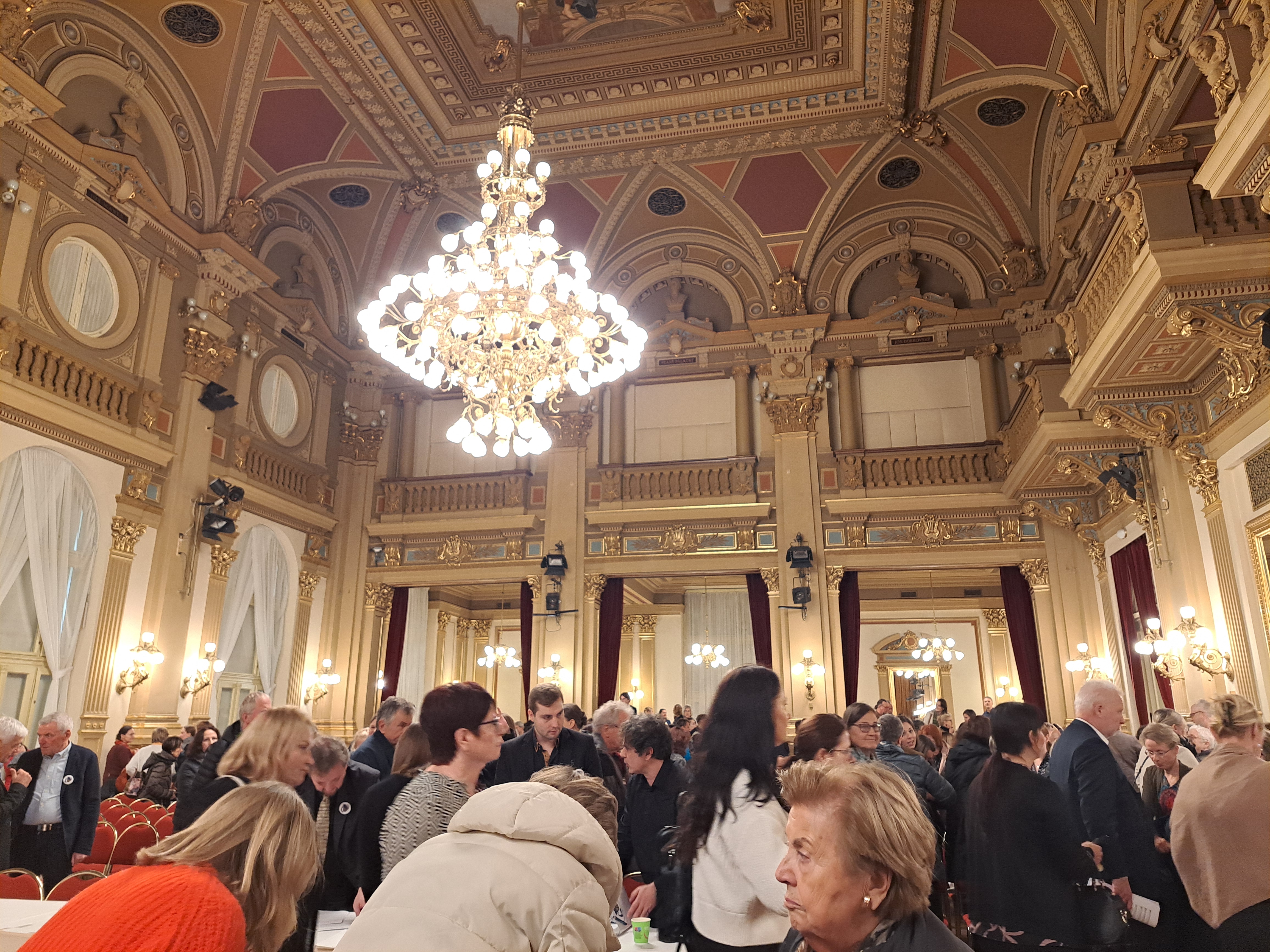
The beautiful main concert hall of the Vinohrady National House
I had such a good time I might need to go back to Prague sometime.
A couple of my personal (additional) highlights:
Of course, the stunning fire and precision of the Coro Municipal de Cancún
An Irish men’s choir who, surrounded by the prevailing Central European and Latin music, sang a couple of Irish folksongs, complete with penny whistle and drum, that brought tears to my eyes (that kind of music is in my bones)
The youth choirs, especially one from Sweden and one from Austria
The elderly gentleman from Germany who mentioned that he had started singing in his choir when his wife died. They had always sung together and he didn’t want to stop singing.
Hotel Anna (part of a chain of “small, charming hotels” and living up to its name): www.hotelanna.cz
Vinohradský Parlament (the restaurant that fed us when several had already turned us away, even though the kitchen had technically just closed): www.vinohradskyparlament.cz
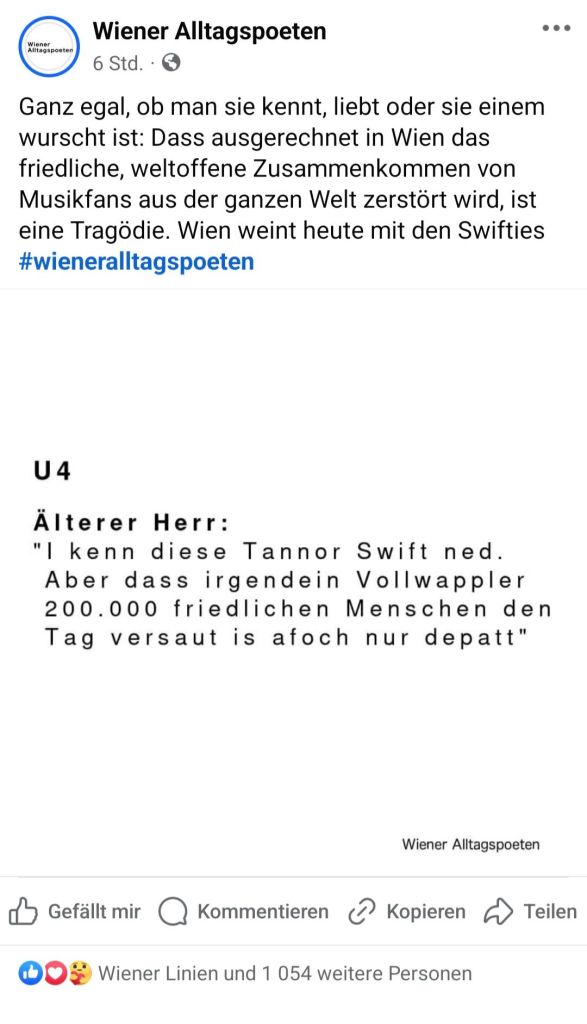
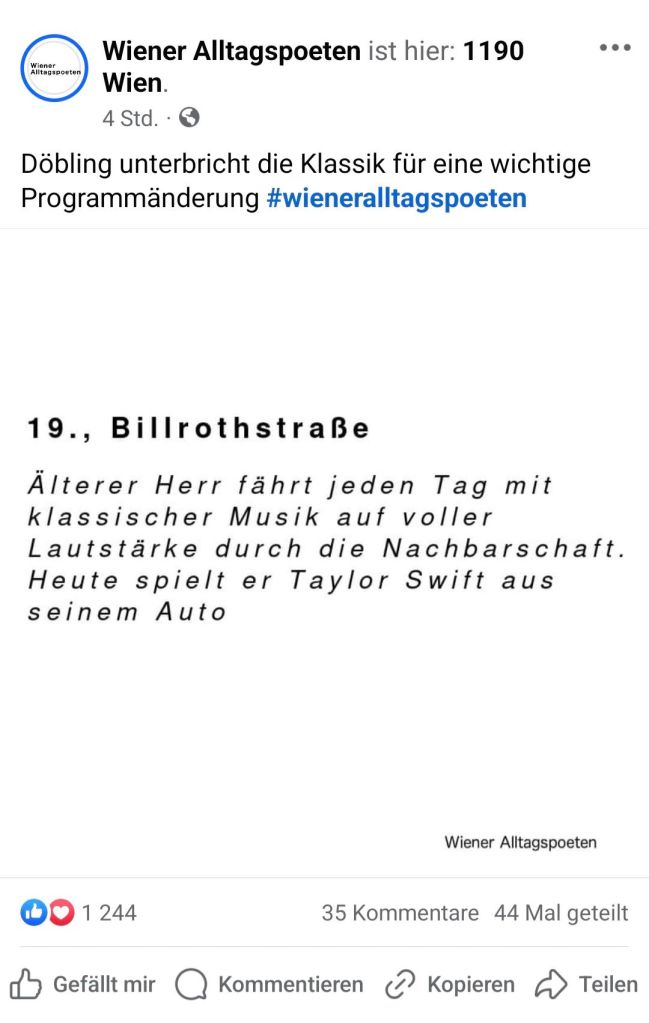
One of my kindest and most faithful readers asked if I had survived the invasion of Swifties. This made me think I should share these posts from the Wiener Alltagspoeten (Vienna’s Everyday Poets).
Wiener Alltagspoeten is a movement, one could almost say, started and run by Andreas Rainer. It comprises a website, Facebook page, and a couple of books. It’s a collection of “seen and heards” from the streets of Vienna.
The two excerpts below come from the Facebook page. In the first one, an older gentleman is saying he doesn’t know who this “Tannor Swift” is, but he finds it utterly ridiculous that some total idiot wants to ruin the day for 200,000 peaceful people. The only thing is that it’s pretty much completely in Viennese dialect (e.g. Vollwappler, versaut, and depatt), which makes it especially memorable.
The second one tells the tale of, again, an older gentleman, this one in the upmarket district, Döbling. He is usually observed driving through his neighborhood playing classical music full volume on his car stereo. After the concert was canceled, he was heard playing Taylor Swift. 😊
So, 2014 must have been the last time I watched the Eurovision song contest. I remember Conchita’s win and how fascinating it was. And now Tom Neuwirth is being written up in the NYT.
A nice change from the dire news coming in from around the world – someone has found what is believed to be the oldest recording of a Lehar piece, a march recorded by the Imperial Infantry in 1901. We won’t be able to hear it, though, until the end of the month.
It’s that time of year again. The linden (or lime) trees are in blossom and seducing all with their powerful and sweet fragrance. In their honor, here is Schubert’s song “Der Lindenbaum” sung by my favorite Lieder singer, Olaf Bär, accompanied by the inimitable Geoffrey Parsons. Ah.
Ever since I read Helmut Deutsch’s memoirs I’ve been meaning to post this “review” I wrote almost 10 years ago of a concert with Barbara Bonney (who doesn’t come off terribly well in Deutsch’s memoirs), Angelika Kirchschlager (who does), and Helmut Deutsch himself.
Here goes, finally:
An Evening of Duets, 5 November 2009, Konzerthaus, Mozart-Saal
I have just come home from a mythical concert. It was the kind of concert you hear about the way you might hear about unicorns but can never be sure exist. It was a concert that made me forget that parts of Pakistan are increasingly ruled by the Taliban, that Iran is building up nuclear capability, and that bonuses are back on Wall Street with no one having learned anything from the economic crisis we are not even yet out of. It was a concert that made the world seem whole and a cheerful place to be. And it truly was miraculous—it provided a mass healing of the TB patients who usually attend concerts in the Mozart-Saal in the cold months. I think I heard only six coughs the whole evening. I’m referring to the evening of duets done by Barbara Bonney, Angelika Kirchschlager, and Helmut Deutsch at the Konzerthaus.
Kirchschlager was completely her usual extravagant self, a kind of Dorabella to Bonney’s more Fiordiligi-like gravitas. Her singing as always was simply an extension of herself. More than any singer I have had the privilege to hear live Kirchschlager embodies what one of my singing teachers referred to as singing from the inside out. She is, quite simply, a force of nature.
Deutsch was even more than usual a frame for the singers. In fact he, together with the Steinway grand piano open, unusually, on the full stick, was quite literally the perfect frame this evening, enveloping the singers in the warm curve of the piano, supporting them with his exquisite playing and remaining unobtrusive yet present in the background for the bows.
Most touching was Bonney who recently, according to reliable sources, has had several very poor years vocally. The voice this evening was not quite what it was in her early career, and I like it better. It has lost some of the ping and for that gained a kind of gentleness which at times almost suggests a fragility as well as a maturity it did not have before. It has much more power to move me than it ever did. And in the second encore, by Gounod, when she started alone and sang with such fervency it was almost unbearably moving. This rather hardened concert-goer quite suddenly found tears streaming down her face.
At the end of the evening one realized again how unusual the concert had been. Not only had the coughs been soothed, but not a single person had clapped in the French group in spite of the fact that the group incorporated the work of several composers. And when the last tones of the second encore died away, there was at first a great hush and then a roar of approval. Then came perhaps the biggest miracle of all. This Viennese audience, who usually insists on four or five encores, understood that the program was complete and needed no additional songs. After bringing the performers back for a few more rapturously received bows, the members of the audience gathered up their things and flowed in perfect harmony from the concert hall.
I’m having a wonderful time reading Helmut Deutsch’s memoirs (a present from a kind and generous friend).
This greatest of Lieder accompanists, born and raised in Vienna, tells a good story. This one strikes me as quintessentially Viennese: Deutsch was one of two accompanists who regularly played for the incomparable Hermann Prey. On one occasion, Deutsch needed a ticket to a Prey recital in the Konzerthaus in Vienna. The posters for days had sported a bright red “Sold out” sign. Nonetheless, Deutsch went into the ticket office to see what could be done. To his great surprise, the lady behind the counter asked, “Stalls or balcony?” Deutsch drew her attention to the “Sold out” signs at which point she smiled and said, “No, not at all. It’s just that Kammersänger Prey likes so much to see the signs.” [“Nein, nein, der Herr Kammersänger hat das nur so gern.”] 🙂
 ecbinvienna