The magazine Condé Nast Traveller has released the results of their survey on the friendliest city in Europe. (We beat out Lisbon!?!) I hardly know what to say. Friendliness is fine, but the famous “Grant” (grumpiness) in Vienna also had something.
Makes me think of the Boston Globe (New York Times?) headline when the Red Sox finally won the World Series after well over 70 years of not winning it: Now just a team like any other?
I’m glad he made it into the NYT. He was an extraordinary artist. I had the great pleasure of experiencing him as Frosch, the prison guard, in Johann Strauss’s “Die Fledermaus” on New Year’s Eve 1988 at the Staatsoper.
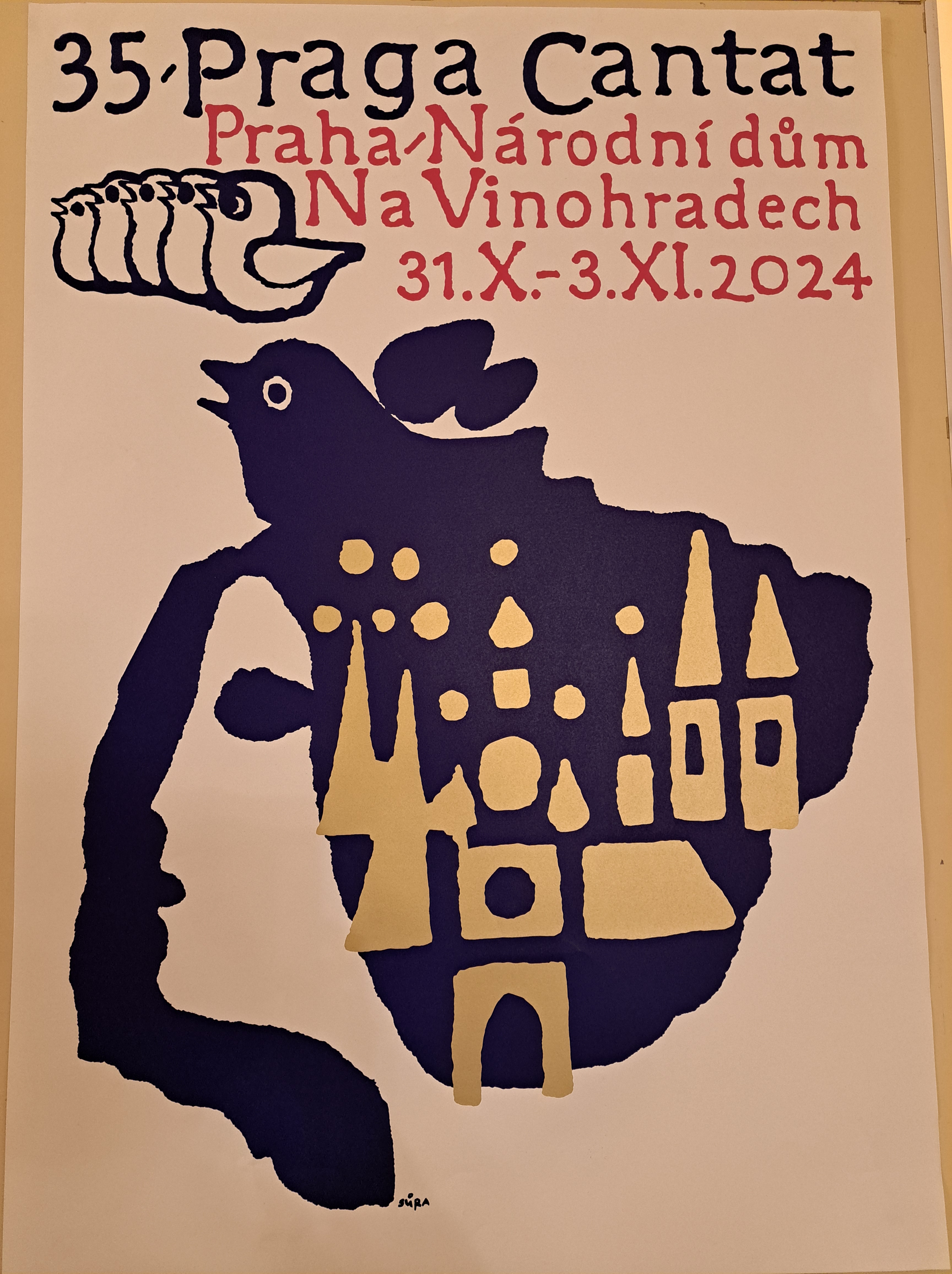
I went to Prague this weekend to see a friend I hadn’t seen in over 20 years (often the price of this international life I lead). His choral group was participating in the 35th Praga Cantat choir competition and festival, and the four hours by train to Prague seemed much more manageable than the however many hours it would take me to visit him in Cancún, where he has lived since he left Vienna.
Perhaps I should mention that I hadn’t been to Prague in over 15 years and wouldn’t have minded never going again. My memory was of grim, unhelpful people and taxi drivers who rip you off ruthlessly. (This was not just my impression. The reputation of the Prague taxi drivers got so bad that the mayor disguised himself as an Italian tourist and found himself paying over five times as much as usual. See the New York Times piece on the story: https://archive.nytimes.com/intransit.blogs.nytimes.com/2009/09/08/hailing-taxi-tips-in-prague/ ) This complaint makes me sound like a spoiled brat who takes taxis all the time. The truth is that I rarely take taxis unless I am very late or have a lot of luggage or have another pressing reason. For some reason, my then partner and I took taxis three times in a several-day visit to Prague and got ripped off a different way each time. (Points, at least, for ingenuity.)
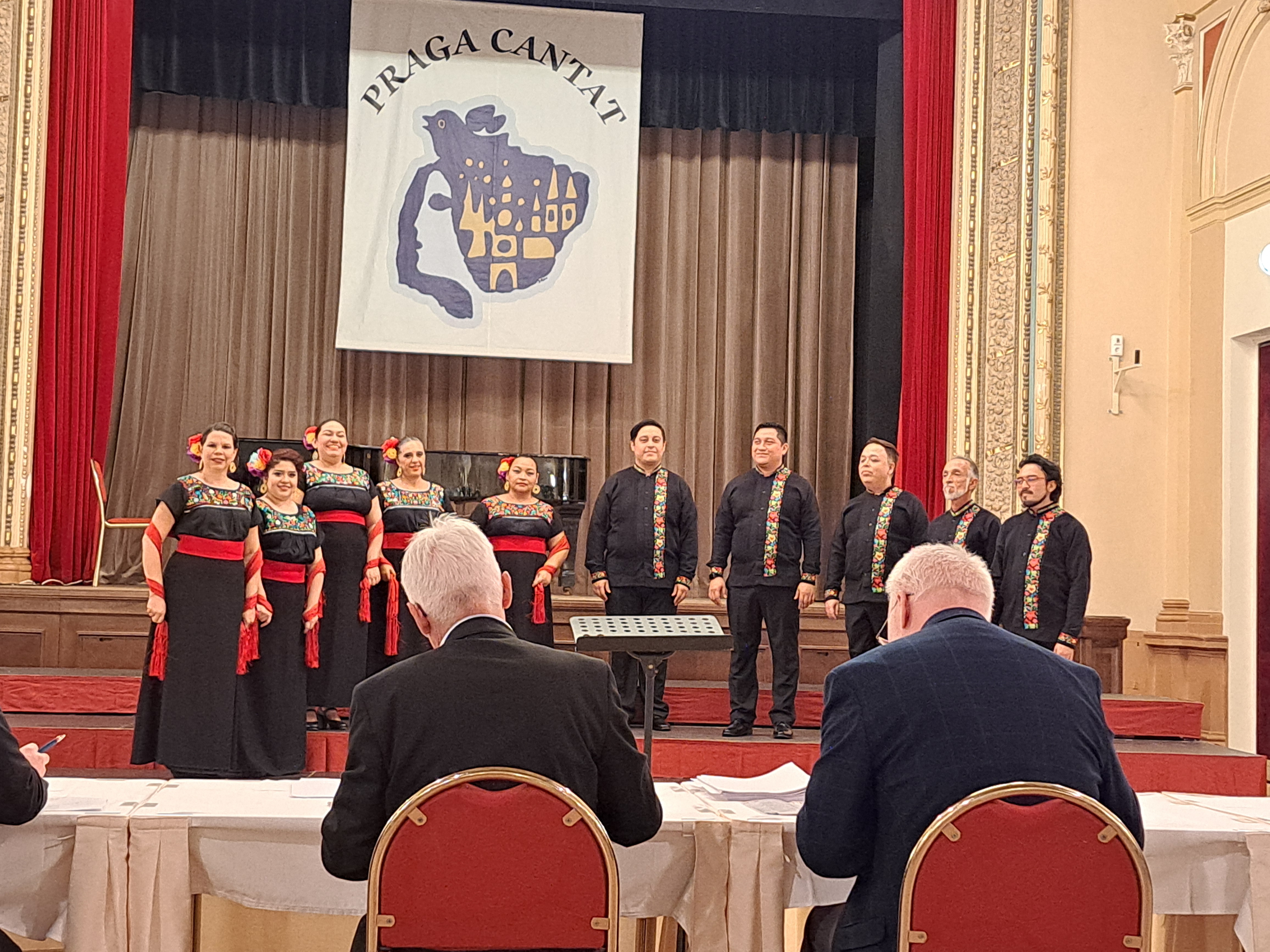
In any case, I went to Prague to see my friend Chris and cheer on his small, a cappella singing group from Cancún (Coro Municipal de Cancún). And now I need to re-write my experiences of the Czech capital. Perhaps it helped that the weather was good, but then I don’t remember it being so bad when I was there before. Perhaps it was limiting my stay to the pretty and quiet residential Vinohrady district or trailing about with a group of singers from Mexico who were loving their time in Europe and glowing from the fact that they had, a mere 14 months after their forming, just won two gold medals in their first ever choir competition in Madrid. Or perhaps it really was that it was a completely different experience with the people.
Taking no chances, I asked the hotel to book a transfer from the train station for me so that I would arrive in time to hear the preliminary rounds of the competition. The driver was prompt, friendly, and asked only the agreed upon price. The receptionist at the hotel, Martina, was exceptionally friendly, not only helpful but taking real pleasure in having a singing group in the hotel. (She even called Saturday morning, her day off, to find out how they had done in the preliminary rounds.) And the competition / festival staff were warmly welcoming and very helpful.
It was my first choir competition so I have nothing to compare it to, but I have to say it seemed more of a festival than a competition. Not that the singing wasn’t good – it was, partly extremely good. It was the atmosphere. There were no tickets to buy. You were let in for free and could enjoy as much of the competition as you wanted. The very competitors themselves didn’t seem very cutthroat but mainly seemed to be focused on enjoying themselves and doing as good a job as they could. The applause for the groups that made it to the next round was loud and hearty. An encouraging experience.
I’m not entirely clear on the structure, if I’m honest. I do know that Chris’s group was entered in two categories: folkloric and mixed choir (i.e., men and women). At the end of the first day, Friday, the best groups, regardless of category, were chosen to go through to the finals, which were held at 2 p.m. the following day. The Coro was one of six groups that advanced to the finals. 😊
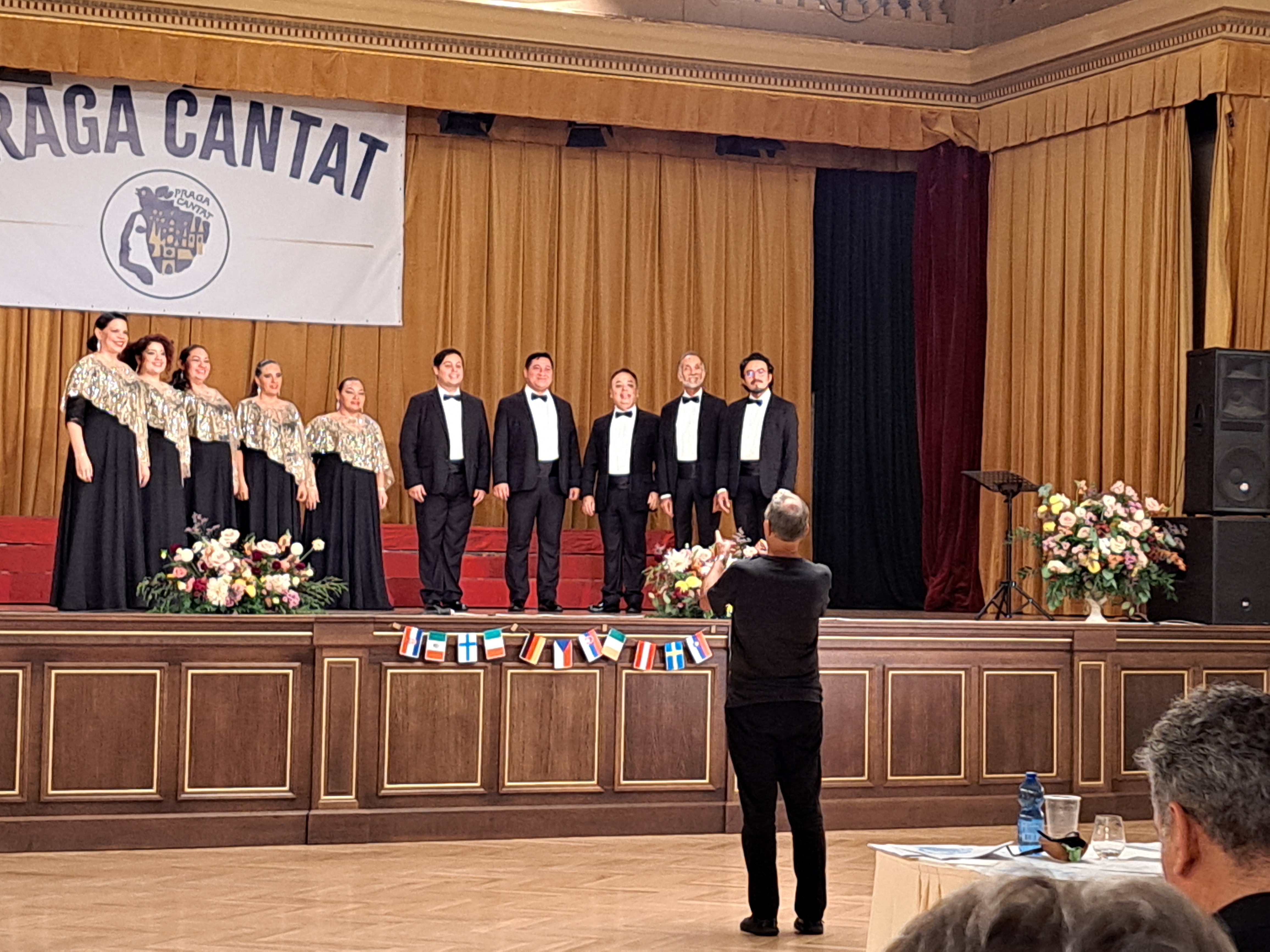
The folkloric categoryThe mixed choir category (the man with his back to us was the tireless and tirelessly good-humored festival photographer)
This point was announced after 9 p.m. on Friday evening, and by the time we got underway in search of some supper we couldn’t find a place that would feed us. (We were a group of 17 people showing up as the kitchens were closing.) We made one last effort and asked at Vinohradský Parlament. Their kitchen was just closing, but they took pity on us and just asked that we be ready to order in 10 minutes, which, okay, with no one in the group who spoke Czech and not many who spoke English well enough to understand the menu, was more rushed that you might think but worked out. The food was a big hit as was – we’re talking Czech Republic here – the beer, and we all made it back to the hotel sated and happy.
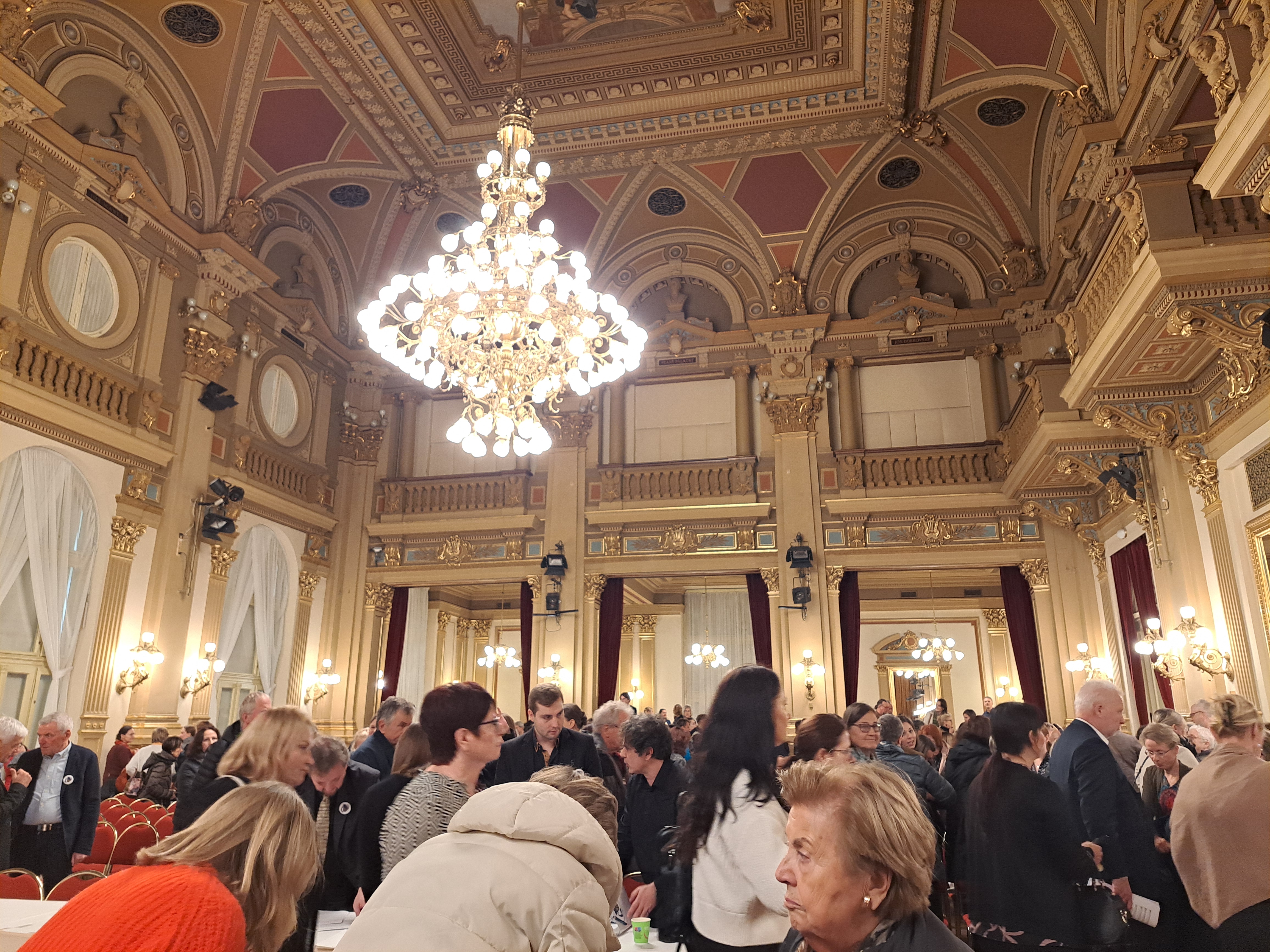
The following morning, I had to grade some papers and the choir had to practice so we all met up again shortly before two o’clock and went over to the venue. What a crowd there was! I was happy for the organizers of the event because they really did such a good job and made the whole thing so welcoming. Each of the six groups that had made it into the finals sang two pieces. As I listened, I had that torn feeling many of my readers will recognize – there were two Austrian choirs I wanted to support and, of course, the Coro. The others were no slouches either – the youth choir from Sweden was especially impressive and, in fact, in the end, (spoiler alert) won the Grand Prix – so we left the sing-off with no clear idea of who might be the winners.
Then the closing ceremony with the awarding of the prizes. As far as I could tell, every participating group got something. For each category, bronze, silver, and gold medals were awarded, sometimes with more than one group getting a medal – you can see what I meant about it being more a festival than a competition – and then a winner of that category was chosen. On top of that, special prizes were awarded, one, for example, for the best overall conductor. (This went to an Austrian.)
The other thing that made it more of a festival than a competition was a ritual I found moving. There were three categories where the choirs were given a mandatory piece to learn. When the prizes had been awarded in those categories, all choirs in the category were asked to come up and sing the required piece together – conducted, I think, by the conductor whose group had won. For the Coro, this meant that their conductor, a native Spanish speaker originally from Venezuela, ended up conducting the Dvorak piece – in Czech in the capital of the Czech Republic – that was the required piece for the mixed choruses. (He was already completely overwhelmed because of the two special prizes that went to the Coro one was for the interpretation of that Dvorak piece!)
All in all, the newly formed group from Cancún won gold medals in each of their two categories, two special prizes (the other for vocal culture), and one trophy for the mixed choir category. You can imagine they were over the moon. Perhaps still are.
The awarding of the prizes was followed, as was to be expected, by a (rowdy) party. I didn’t stay to the end, which was officially announced for 11 p.m. I heard at breakfast this morning that, after the hired band finished playing, the choirs started singing again, standing in an enormous circle in the beautiful concert hall and taking turns singing favorites.
The beautiful main concert hall of the Vinohrady National House
I had such a good time I might need to go back to Prague sometime.
A couple of my personal (additional) highlights:
Of course, the stunning fire and precision of the Coro Municipal de Cancún
An Irish men’s choir who, surrounded by the prevailing Central European and Latin music, sang a couple of Irish folksongs, complete with penny whistle and drum, that brought tears to my eyes (that kind of music is in my bones)
The youth choirs, especially one from Sweden and one from Austria
The elderly gentleman from Germany who mentioned that he had started singing in his choir when his wife died. They had always sung together and he didn’t want to stop singing.
Hotel Anna (part of a chain of “small, charming hotels” and living up to its name): www.hotelanna.cz
Vinohradský Parlament (the restaurant that fed us when several had already turned us away, even though the kitchen had technically just closed): www.vinohradskyparlament.cz
So, 2014 must have been the last time I watched the Eurovision song contest. I remember Conchita’s win and how fascinating it was. And now Tom Neuwirth is being written up in the NYT.
Today’s Kurier is reminding me that the only TV series I ever planned my life around, “Kommissar Rex”, is celebrating this year the 30th anniversary of its debut.
It seemed such a natural hit (Rex, Tobias Moretti, and Vienna) that I was surprised to read that the writer, Peter Hajek, tried for ages to get someone interested. Even when he found a director, Oliver Hirschbiegel, who had just won a prestigious prize for another crime show, it didn’t get much easier. Finally, a private network, SAT1, took it on. To think we might never have had it at all!
It was a show that not only appealed to the Viennese. It was shown in 120 countries around the world and inspired a Canadian version, “Hudson & Rex”.
And it gave work to some young actors who went on to international fame, notably Karl Markovics, who played the main role in “The Counterfeiters”, which won the Oscar for Best Foreign Language Film in 2008, and Christoph Waltz, who, with two Oscars for Best Supporting Actor, is practically a fixture in Hollywood at this point. He got a good start playing very sinister characters on Kommissar Rex when he played a doll maker who liked to dress women up as dolls, photograph them, and then murder them.
The episode that has stayed with me the longest was one in which someone was killing off little old Viennese ladies to get their hands on the apartments, leased until death at very low rents. (I would say “rent-controlled” but I think the system in New York, for example, is a little different from here.) That seemed quite realistic to me, and perhaps a bit worrying as I am now getting older, living in just such a flat (although without quite so low a rent).
Today, October 26, is a holiday in Austria, commemorating the vote in Parliament that established Austria’s permanent neutrality. (My understanding is that it was the first business enacted by the Parliament after all occupying powers had left Austrian territory after the Second World War. More about the treaty here.)
It is probably no accident, then, that the ORF (Austrian Broadcasting Corporation) chose today to draw attention to the special photo and image archive of the Austrian National Library. Here is a taste from the ORF site of the millions of photos stored.
The ORF article is lengthy and only in German, unfortunately. Some of the main points they make: the Imperial Collection created a foundation for the current collection (yes, there is a photo of the enigmatic Empress Elisabeth); the rise of press photography bearing contemporary witness to life vs. studio portraits; the suppression of free media and therefore, of course, photojournalism as well as the banning of Jewish photographers during the Nazi regime and the resurrection of those professions after the Second World War; the role photography played in documenting the Cold War and the images of its major players (one of the most chilling photos for me on the ORF site was of Russian soldiers goose-stepping in Moscow in 1988); and the challenges of maintaining a usable archive in the world of digital photography where photos can be snapped one a second. (In fact, the teaser for the article mentions sinking into Austria’s fattest “photo album”.)
A heads-up: The Austrian National Library is planning for 2023 a retrospective of photos by Yoichi Okamoto who was head of the United States Information Service during the Occupation in Austria and later presidential photographer for Lyndon B. Johnson.
Those who would like to see more photos, I have chosen the link to the digital archive with images of Vienna to share with you here.
Here is a nice, light story in a world full of heavy news. A 10-meter whale sculpture that stood in front of a Gasthaus (kind of restaurant), zum Walfisch, in the Prater is being moved to the Wien Museum now that the restaurant it represented is no longer there. It is so big that it is being moved in now while the renovations are still ongoing. Eventually it will be hung from the ceiling.
More about this later, I hope, but now I have to go to work. The curse of the drinking classes, as my father loved to quip, possibly quoting George Bernard Shaw. Curse of the writing classes is more like it! 😉

 ecbinvienna